-
-
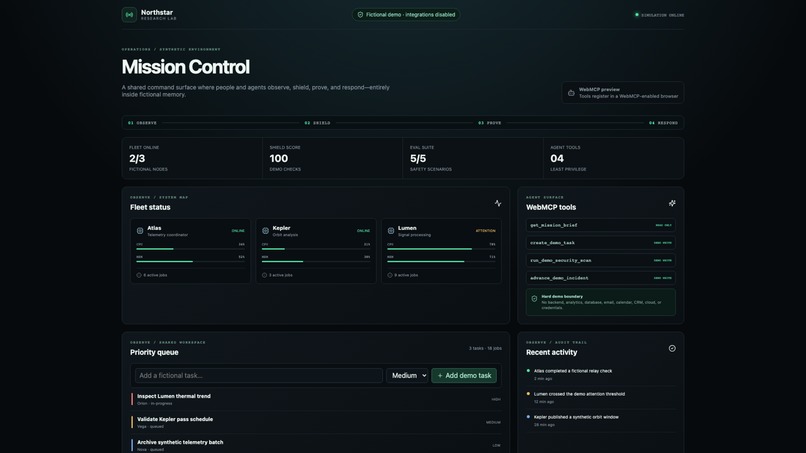
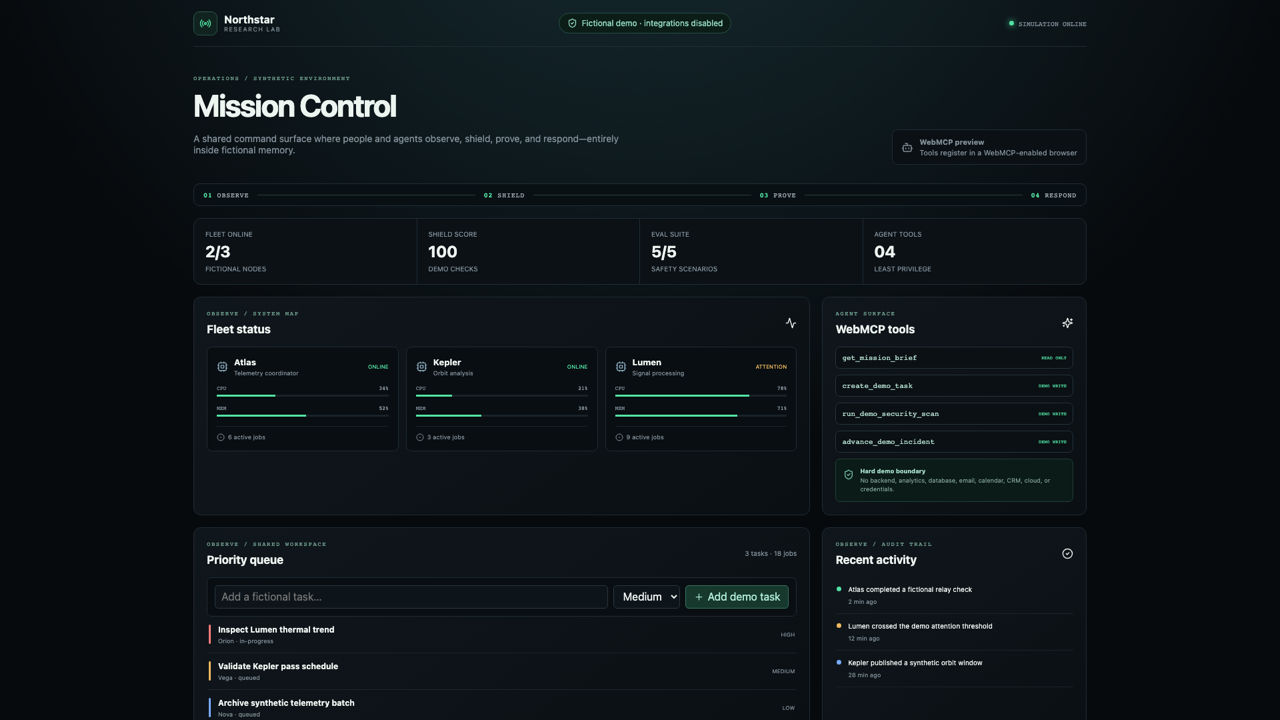
Mission Control: Shield Wall — fictional WebMCP operations console
Inspiration
Mission Control is a shared operations surface for teams and their AI agents. The challenge was to make agent access useful without turning a real operations system into an open door.
What we built
Mission Control: Shield Wall is a public-safe, fictional dashboard where a person and WebMCP agents can observe a synthetic fleet, create an ephemeral task, run six local security checks, preview a simulated scheduled report, prove tool behavior with a five-scenario harness, and walk through a reversible incident drill.
Why WebMCP matters
A person can see the same state an agent is using, while the agent receives explicit schemas instead of guessing through buttons. The tools are bounded to fictional memory: one read, one validated task write, one local scan, and one reversible incident action. Invalid inputs and external-workflow attempts are rejected by the evaluation harness.
Privacy and implementation
The demo has no backend, database, analytics, credentials, cookies, external calls, or production integrations. It uses Next.js, React, TypeScript, Zod, and the experimental document.modelContext.registerTool pattern. Every visible organization, operator, task, check, and incident is fictional.
What we learned
Designing the human and agent surfaces together made least privilege visible as a product feature. Shield Wall and the repeatable harness turn safety claims into something a judge can inspect and run.
Built With
- next.js
- playwright
- react
- typescript
- vercel
- webmcp


Log in or sign up for Devpost to join the conversation.