-
-
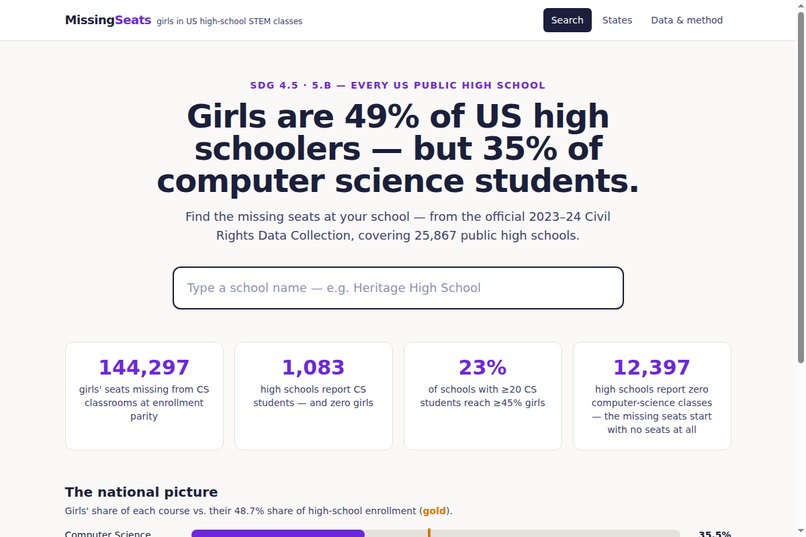
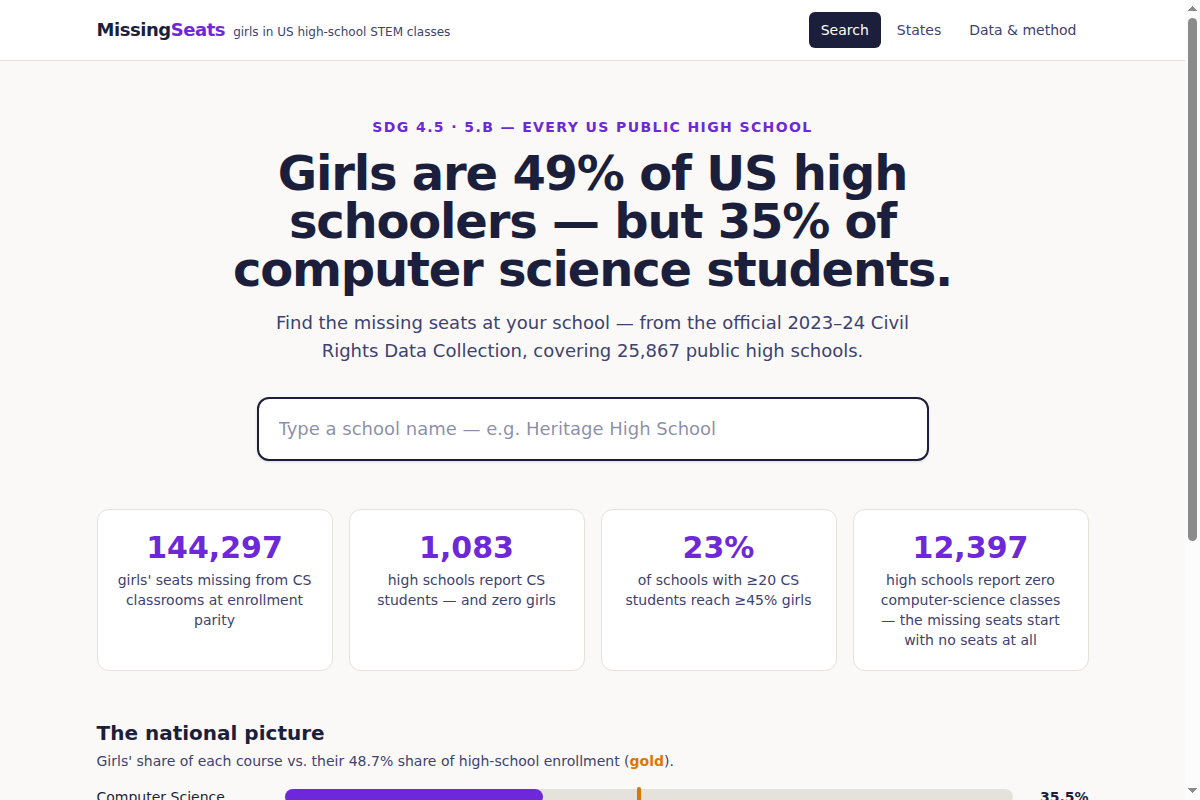
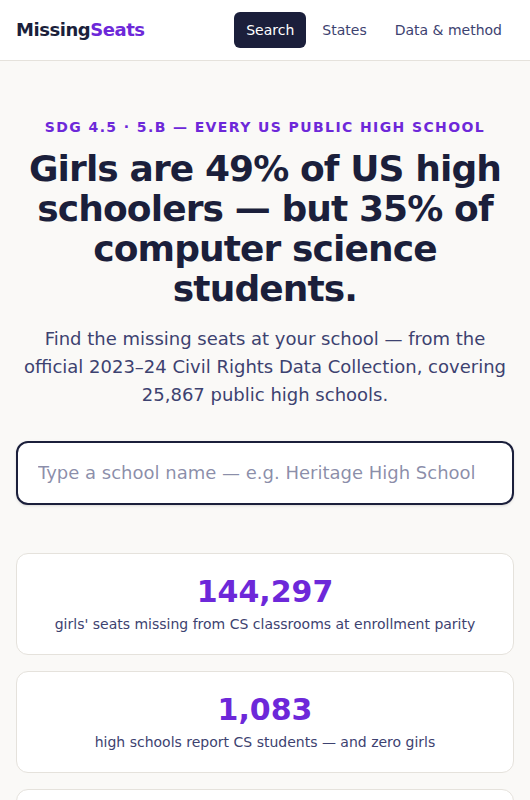
Search any US public high school — instant typeahead over ~26k schools.
-
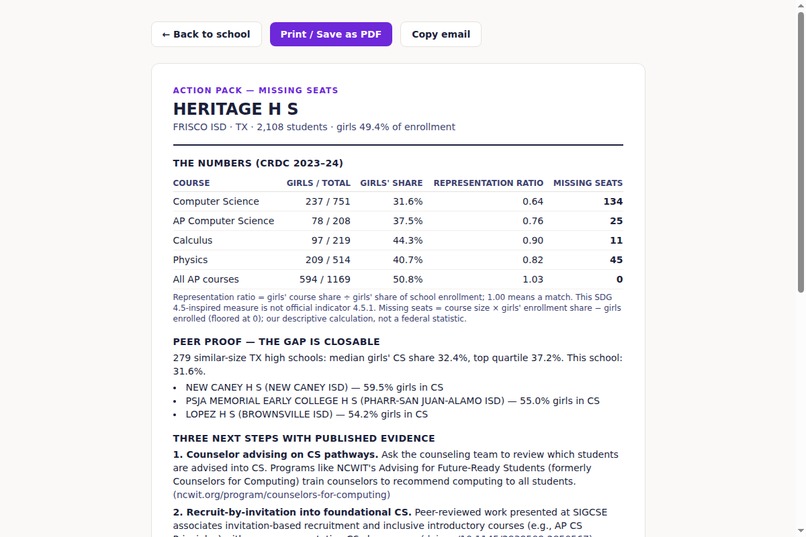
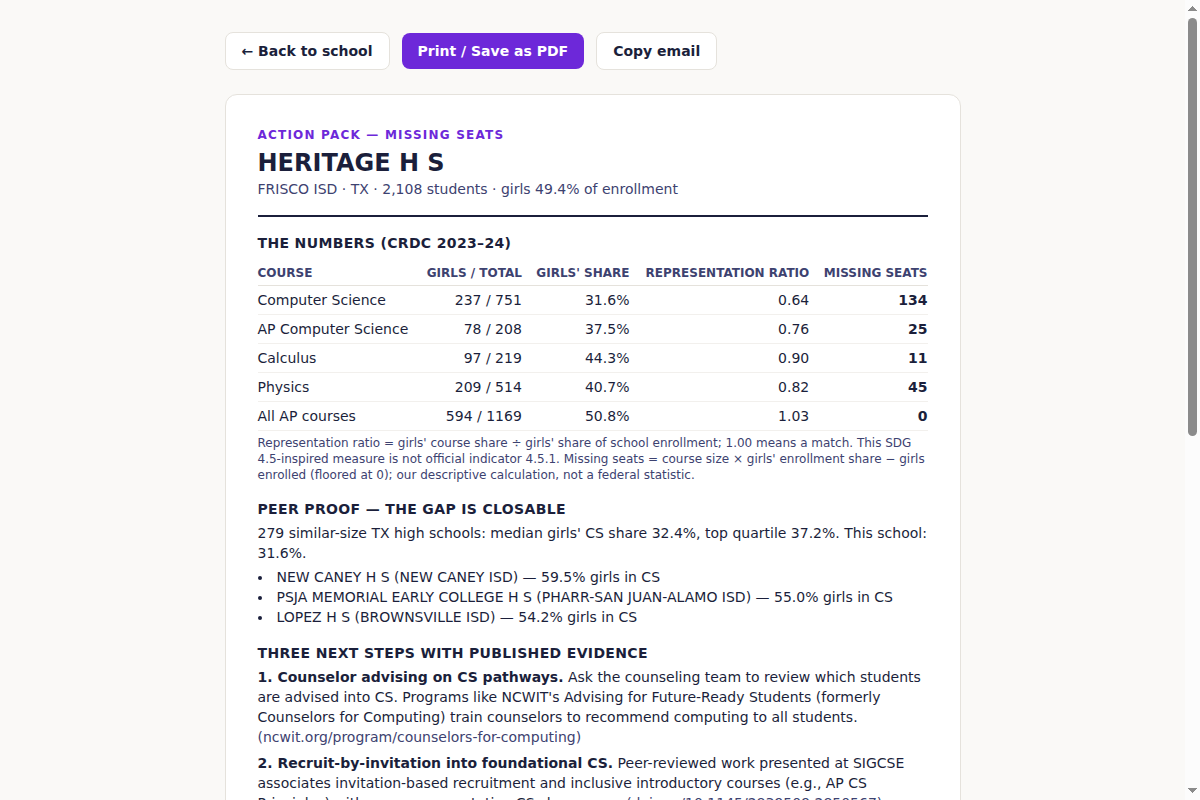
Printable one-page Action Pack for a counselor or principal.
-
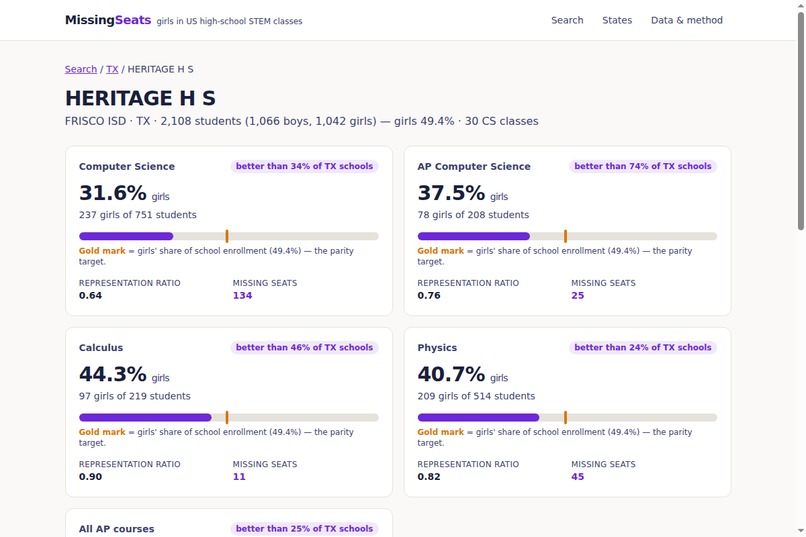
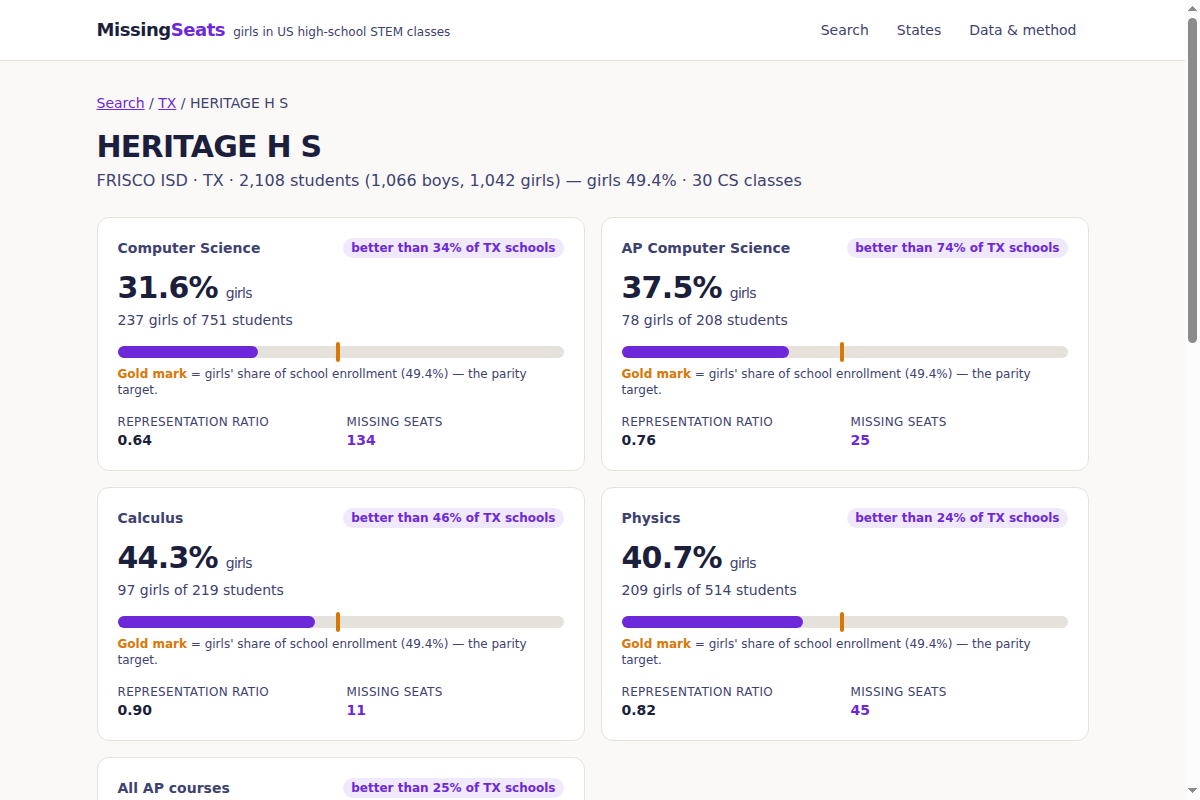
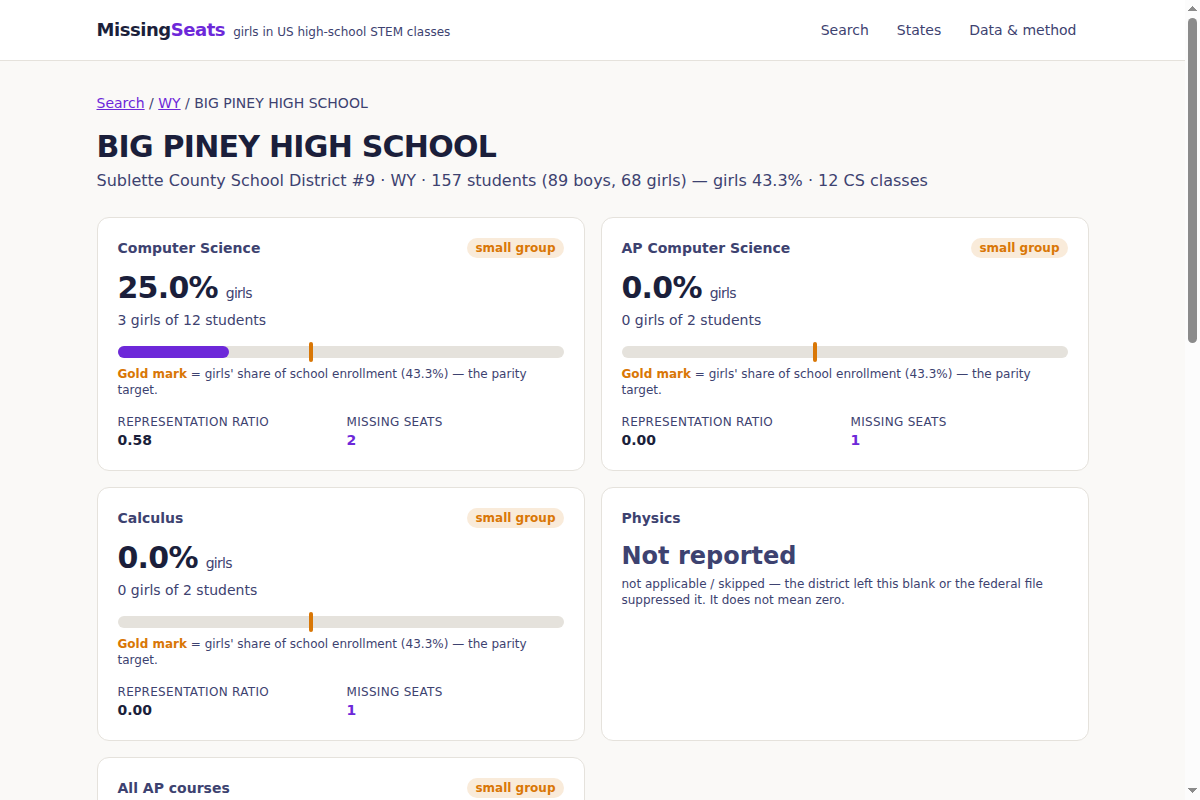
Gap Card: girls' share, parity ratio, and missing seats per course, incl. all AP.
-
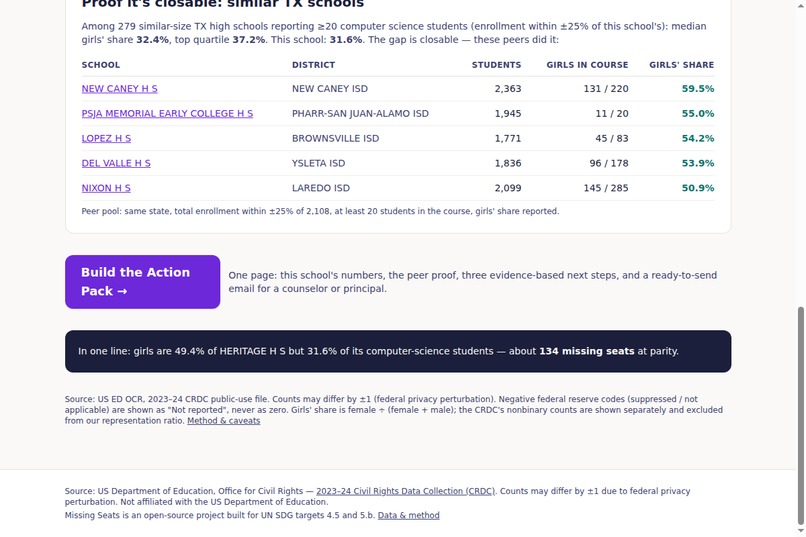
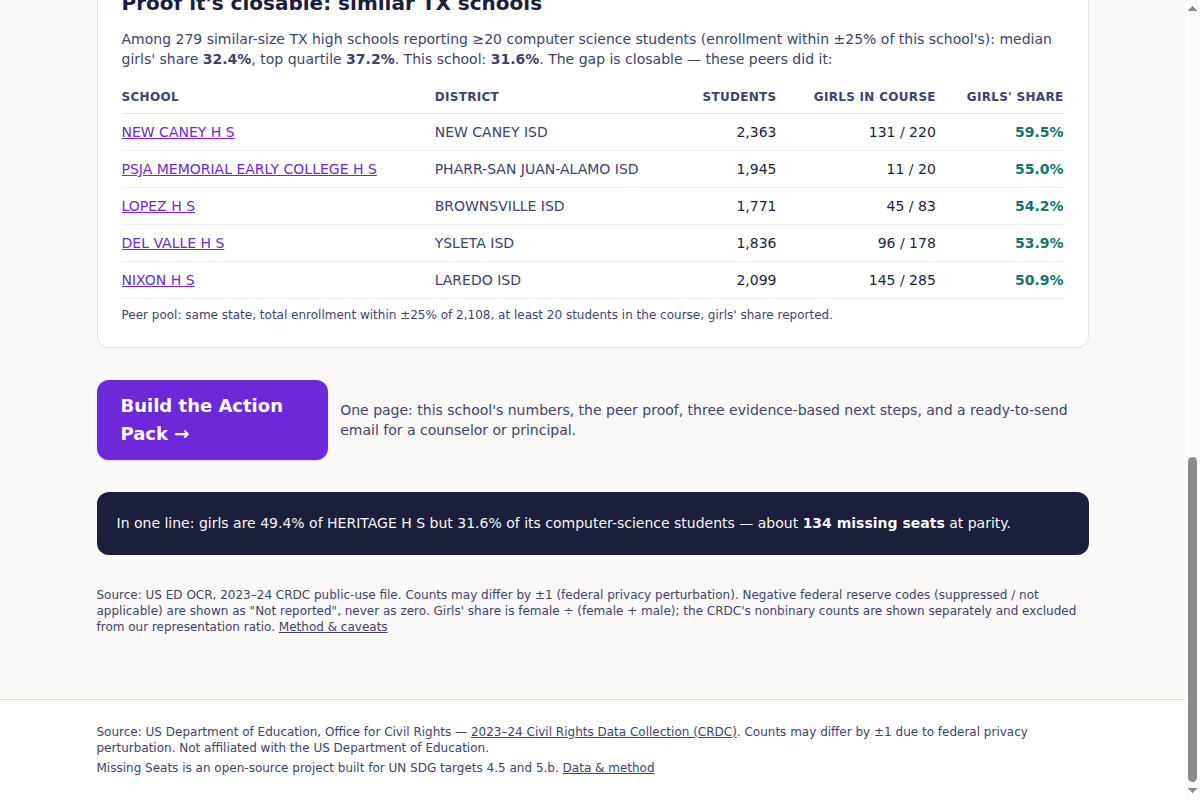
Peer proof: same-state schools that actually closed the gap.
-
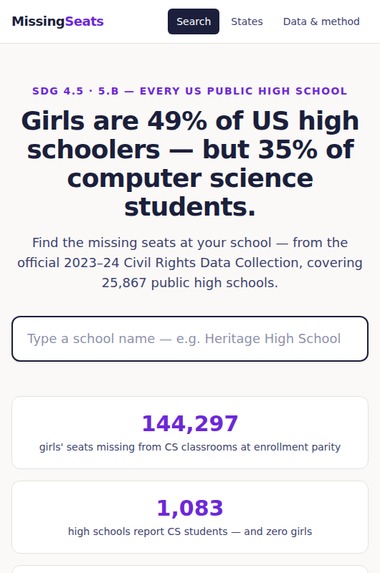
Fully responsive — works at mobile width too.
-
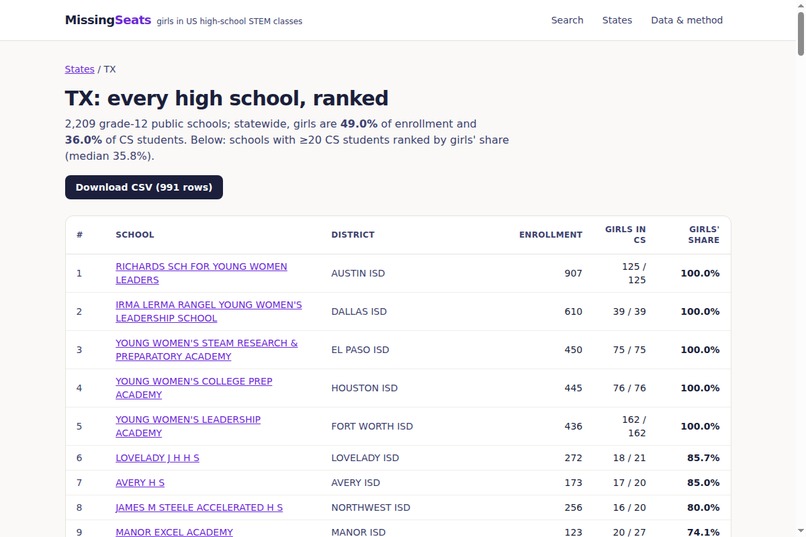
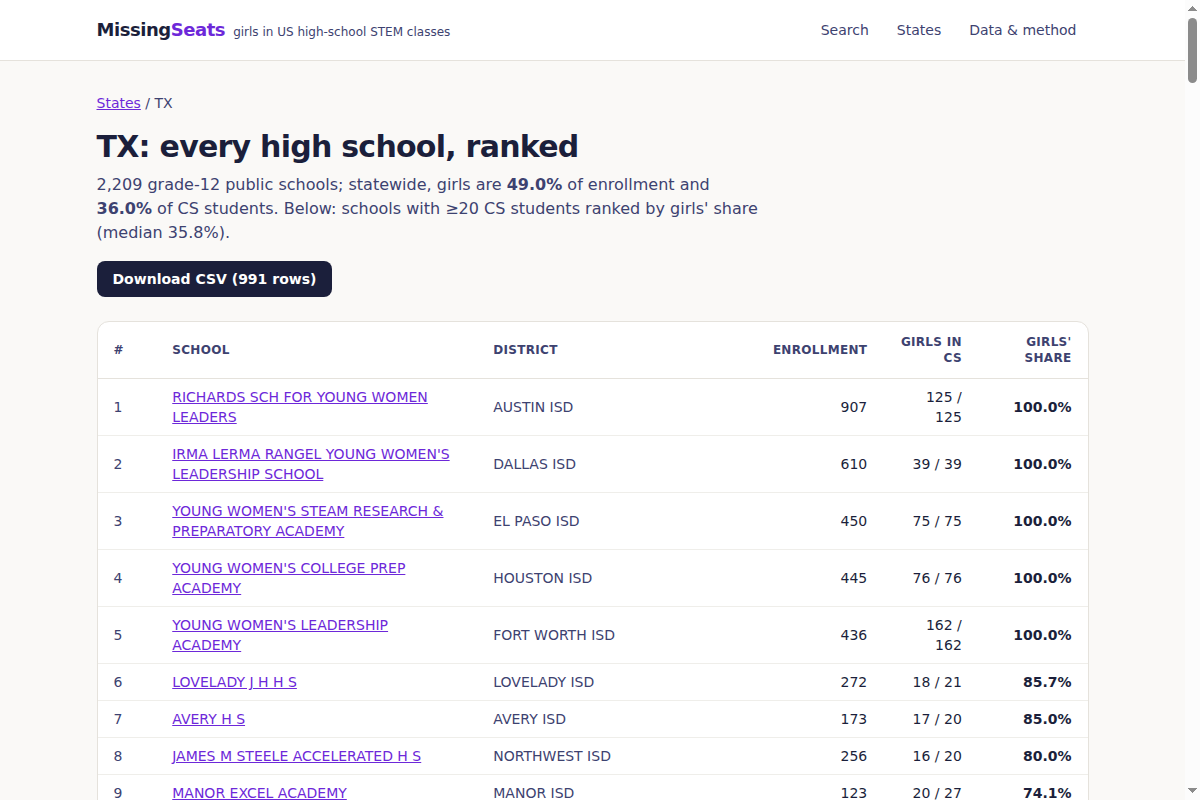
State pages rank every school and export an outreach CSV.
-
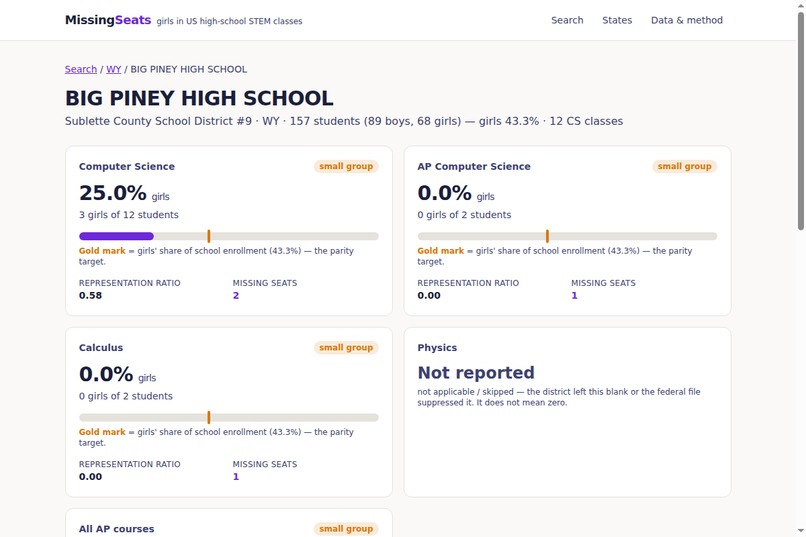
Small schools flagged — federal reserve codes shown as Not reported.
Inspiration
About 144,000 girls are missing from America's computer science classrooms. Not "less interested" — missing. The evidence has been sitting in a public federal file for months; it's just 1.1 GB of CSVs that almost nobody can open.
Here's the part that kills the usual excuse: girls are 54.8% of all AP students — above parity — but barely a third of computer science. The gap isn't about advanced coursework. It's about CS.
We built Missing Seats so anyone — a student club, a counselor, a parent — can look up their school in five seconds and walk away with numbers, proof, and a plan.
What it does
- Search ~26,000 US public high schools (every school reporting grade 12) — instant typeahead, keyboard navigable.
- Gap Card for each school: CS, AP CS, Calculus, Physics, Data Science, and all AP courses — girls' share, a representation ratio (girls' course share ÷ girls' share of school enrollment), "missing seats" at parity, and a state percentile.
- Peer proof: the top same-state, same-size schools that actually closed the gap — the gap is closable, and we show who did it.
- Action Pack: a printable one-page brief with the numbers, the peers, three evidence-based next steps, and a ready-to-send email to a counselor or principal.
- State pages rank every school and export an outreach CSV for organizations like G.I.R.L.S.
SDG alignment
- SDG 4.5 (eliminate gender disparities in education): our school-level representation ratio is an SDG 4.5-inspired parity measure — our own calculation, not the official UN indicator 4.5.1.
- SDG 5.b (enabling technology for women's empowerment): we turn an inaccessible 1.1 GB federal dataset into a free, no-login public tool.
- SDG 4.4 / 5.5: course-taking gaps in the subjects that gate STEM skills and women's participation.
Proof of value (our calculations from CRDC 2023–24)
- Girls: 48.7% of 17.1M high-school enrollment; 35.5% of 1.06M CS enrollment; 32.1% of AP CS; 47.2% of calculus; 44.7% of physics — but 54.8% of all AP students, above parity.
- ~144,000 estimated girls' seats missing from CS at enrollment parity, summed across the included schools; this is our descriptive calculation.
- 1,083 high schools report CS students but zero girls.
- Only ~23% of schools with ≥20 CS students reach ≥45% girls in CS.
- 12,397 high schools — nearly half — report zero computer-science classes, so for many girls the missing seats start with no seats at all.
How we built it
Python/pandas ETL reads the official CRDC CSVs, filters to grade-12 schools, preserves federal reserve codes, and emits compact JSON shards (~300 KB first load). The frontend is React + TypeScript + Vite + Tailwind with hand-rolled prefix search, accessible components, and print CSS — a fully static site with zero backend, zero API keys, zero cookies. Vitest covers the gap math, reserve codes, low-N edge cases, peer selection, and search; a Python verification script re-asserts every national total.
Challenges
- Federal reserve codes (-9, -10, …) look like data but mean "suppressed / not applicable" — we show them as "Not reported", never as zero.
- OCR perturbs all counts by ±1 for privacy — we flag small groups (<20).
- The federal file's gender counts are male/female plus a small, heavily perturbed nonbinary category. Each share in our representation ratio uses female ÷ (female + male); we display nonbinary counts separately where reported.
- Fitting ~26k schools into a sub-second static lookup.
Accomplishments
- Works for every US public high school with real federal data, no backend.
- 28 passing unit tests + an ETL assertion script; reserve codes verified end-to-end.
- Deep-linkable school and state pages; print-ready Action Pack.
What we learned
The hardest part of civic data isn't the math — it's the file. The gap between "the data exists" and "a counselor can act on it" is an engineering problem.
What's next
District roll-ups, a Title IX athletics tile, yearly refresh when the 2025–26 CRDC lands, and the same parity method on other countries' sex-disaggregated data.
Data, limitations, and AI disclosure
Source data: US Department of Education, Office for Civil Rights, 2023–24 Civil Rights Data Collection public-use file (https://ocrdata.ed.gov/data) — a US government work in the public domain (17 U.S.C. §105). "Missing seats" and the representation ratio are our descriptive calculations, not federal statistics or legal findings. Federal reserve codes are shown as "Not reported", never as zero. Counts may differ by ±1 due to privacy perturbation. Each share in the representation ratio uses female ÷ (female + male); the federal file's small nonbinary counts are shown separately and excluded. US public schools only. Not affiliated with the US Department of Education. Code: MIT.
Built With
- pandas
- python
- react
- tailwind
- typescript
- vite
- vitest

Log in or sign up for Devpost to join the conversation.