Inspiration
I wish to solve a problem in my life with archiving family history. There have been many times where I wish I knew the details of what happened during certain time periods.
Every memory product does the same thing: it resurfaces photos you already have. But the real risk to a family archive is the opposite. It is the years with no photos, the places everyone talks about that nobody photographed, and the stories only one older relative can still tell. You cannot see an absence by scrolling a timeline, so nobody notices until the person who could have explained it is gone.
I wanted a Skill that looks at a family archive and asks a different question: not "what do we have?" but "what are we missing, and who can we still ask?"
What it does
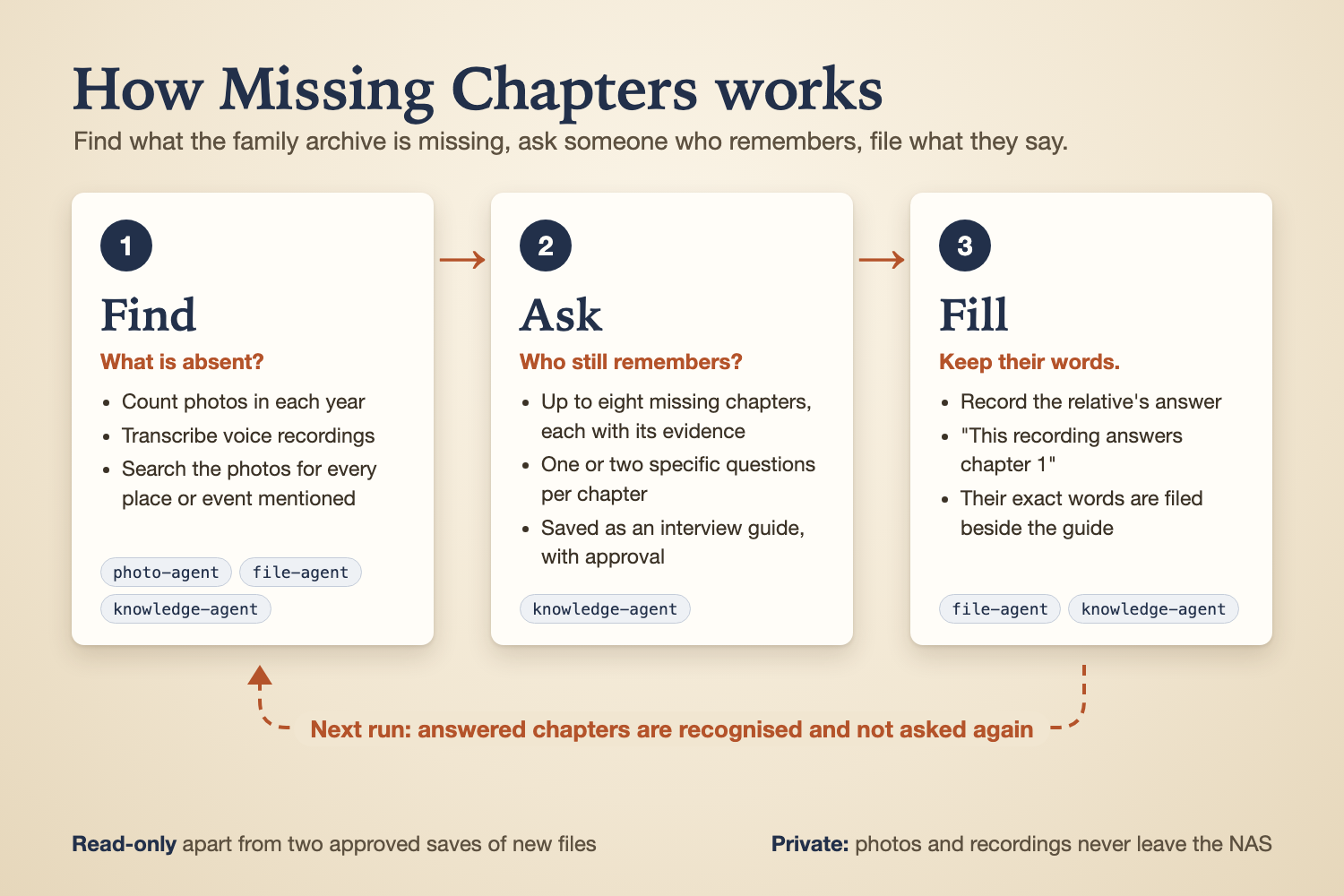
Missing Chapters audits the photos and voice recordings on a UGREEN AI NAS for what is absent, and turns each gap into something you can act on.
It finds three kinds of "missing chapter":
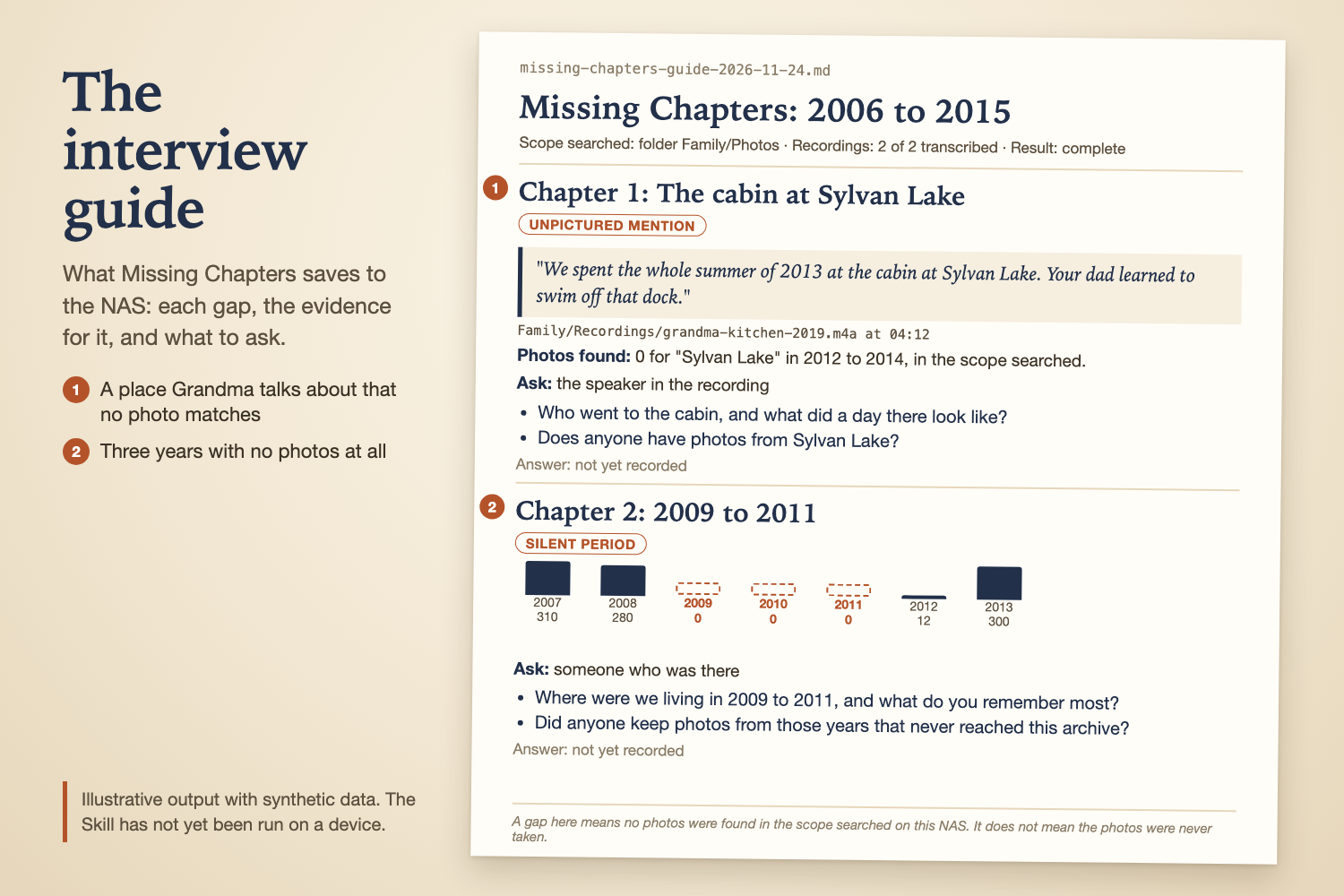
- Silent periods: years with no photos, or far fewer than the years around them.
- Unpictured mentions: a place or event a relative names in a voice recording that has no matching photo. Example: "Grandma's recording mentions the cabin at Sylvan Lake; no photo matches."
- Fading faces: a named person who appears for years and then stops.
For each chapter it shows the evidence (photo counts, or the exact quote with the recording's path), suggests who to ask, and writes one or two specific questions. It saves these as an interview guide on the NAS.
Then it closes the loop. After you record the relative's answer, you say "this recording answers chapter 1". The Skill transcribes it, shows you their exact words, and files them beside the guide. On later runs, answered chapters are recognised and not asked again, so the archive gets more complete each time.
It is read-only apart from saving those new text files, each with approval. It never moves, edits, tags or deletes anything, and nothing leaves the NAS.
How I built it
I built it with the official UGREEN Skill Developer Package (the Uliya Skill creation tool and capability catalog 2.0.0)
- Capabilities first. Every step was mapped to an action in the capability catalog before any of the Skill was written.
- Three registered experts. The parent Skill only delegates.
photo-agentcounts and searches photos,file-agentlists recordings and reads saved files, andknowledge-agenttranscribes recordings and saves the guide and answers. - Fixed rules. Thresholds for silent and thin years, mention selection, and ranking are written down with worked examples, so two runs over the same archive give the same chapters.
- Evidence rules. A failed or incomplete search never becomes a gap; it is listed under "Could not check". Quotes are word for word with their source path. A gap is always worded as "not found in the scope searched", never "does not exist".
- Static validation. The package passes the kit's checker with zero errors and zero warnings.
The Round 1 package is a SKILL.md and five linked references: gap rules, file formats, validation tests, setup and removal, and disclosures.
Challenges I ran into
- Designing without a device. Round 1 has no NAS access, so every behaviour I could not confirm from the catalog needed a written fallback. The biggest unknown is whether photo search returns a full count per year. If it returns only part of the results, the Skill treats that year as "has photos, total unknown" and never calls it silent.
- The obvious action was the wrong one. The catalog's photo timeline action looked ideal for counting by year, but it is listed as a state-changing, approval-gated operation. I used read-only search instead.
- False gaps. A photo taken at the cabin with no location data and no visible text cannot be found by name. Rather than hide that, the Skill also returns possible scene matches and asks the relative, "Are these from that place?" Either answer improves the archive.
- Making a second run worthwhile. The first design would have reported the same gaps every time. Each chapter now carries a key, and a filed answer with the same key marks it as answered.
- Checker and template mismatch. The kit's English template uses two headings its own checker rejects, which took some reading of the checker to work out.
Accomplishments that I'm proud of
- A memory Skill that points the other way: it reports absence, with evidence, and produces questions instead of a slideshow.
- A complete loop from gap, to question, to a relative's own words filed back into the archive.
- Honest failure handling: fourteen named failure cases, all five delegation states, and a result that is labelled "partial" whenever anything could not be checked.
- A clean static pass, and a test plan with two core cases and one edge case that each have observable pass conditions.
What I learned
- Reporting what is missing is harder than reporting what exists, because a failed search and a real gap look the same unless you track the difference carefully.
- An orchestration Skill is mostly about boundaries: what each expert is asked, what comes back, and what happens when it does not.
- Scope discipline matters. I cut a music feature and made the per-person check opt-in, because everything promised in Round 1 has to work in a one-day device session.
What's next for Missing Chapters
- Round 2, if selected: install on the assigned iDX6011 Pro, run the three validation tests with synthetic photos and recordings, confirm the open device questions, and record the demo.
- After that: use scanned letters and diaries as a second source of mentions, suggest a likely decade for undated scanned prints, and let a family work through chapters together over time.
- Ideally: make it awesome and something everyone will use
Built With
- agent-skills
- claude-code
- local-llm
- markdown
- multi-agent-orchestration
- nas
- photo-search
- skillhub
- speech-to-text
- ugos
- ugreen
- ugreen-ai-nas
- ugreen-skill-developer-package
- uliya
