Inspiration
Misinformation often spreads faster than verified information. Even when fact-checks exist, they are scattered across many articles and platforms, making it difficult to understand the bigger picture of how false narratives emerge and evolve. We wanted to build a system that goes beyond individual fact-checks and instead identifies patterns of misinformation narratives. By using AI to extract and group false claims, we can help people see the broader stories forming behind misinformation campaigns. Misinformation Radar was created as an early warning system that transforms isolated fact-checks into actionable intelligence.
What it does
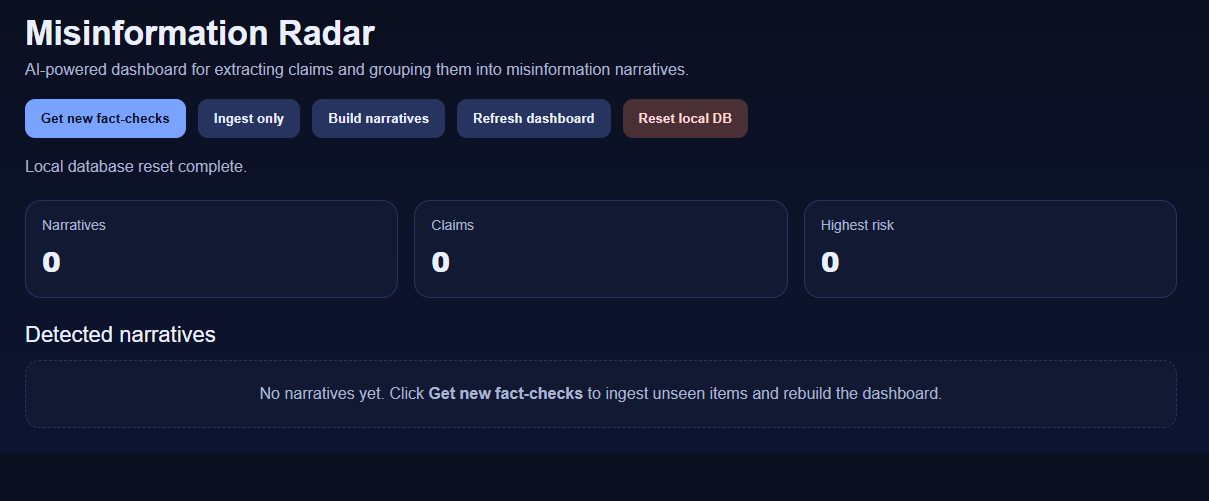
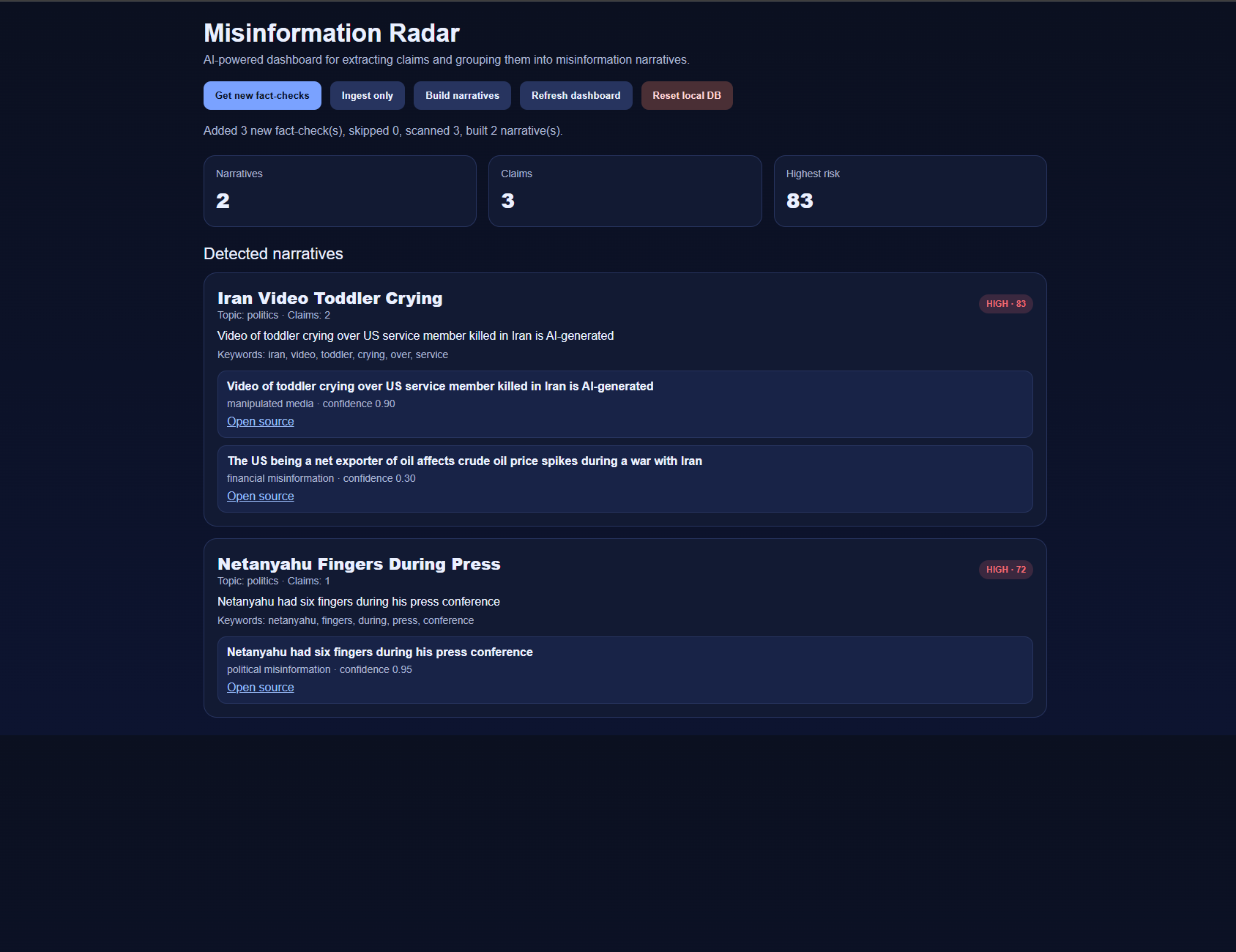
Misinformation Radar is an AI-powered dashboard that detects and analyzes emerging misinformation narratives. The system automatically: Ingests fact-check content from trusted public sources such as PolitiFact. Extracts the core claim from each article using an AI agent. Normalizes the claims into structured data. Clusters related claims into broader misinformation narratives. Scores each narrative’s risk level based on recurrence, topic sensitivity, and recency. Displays the results in a live dashboard where users can explore narratives, supporting claims, and their sources. Instead of showing isolated fact-checks, the system highlights recurring themes such as disaster rumors, health misinformation, or political claims. This helps journalists, researchers, and the public quickly understand how misinformation spreads.
How we built it
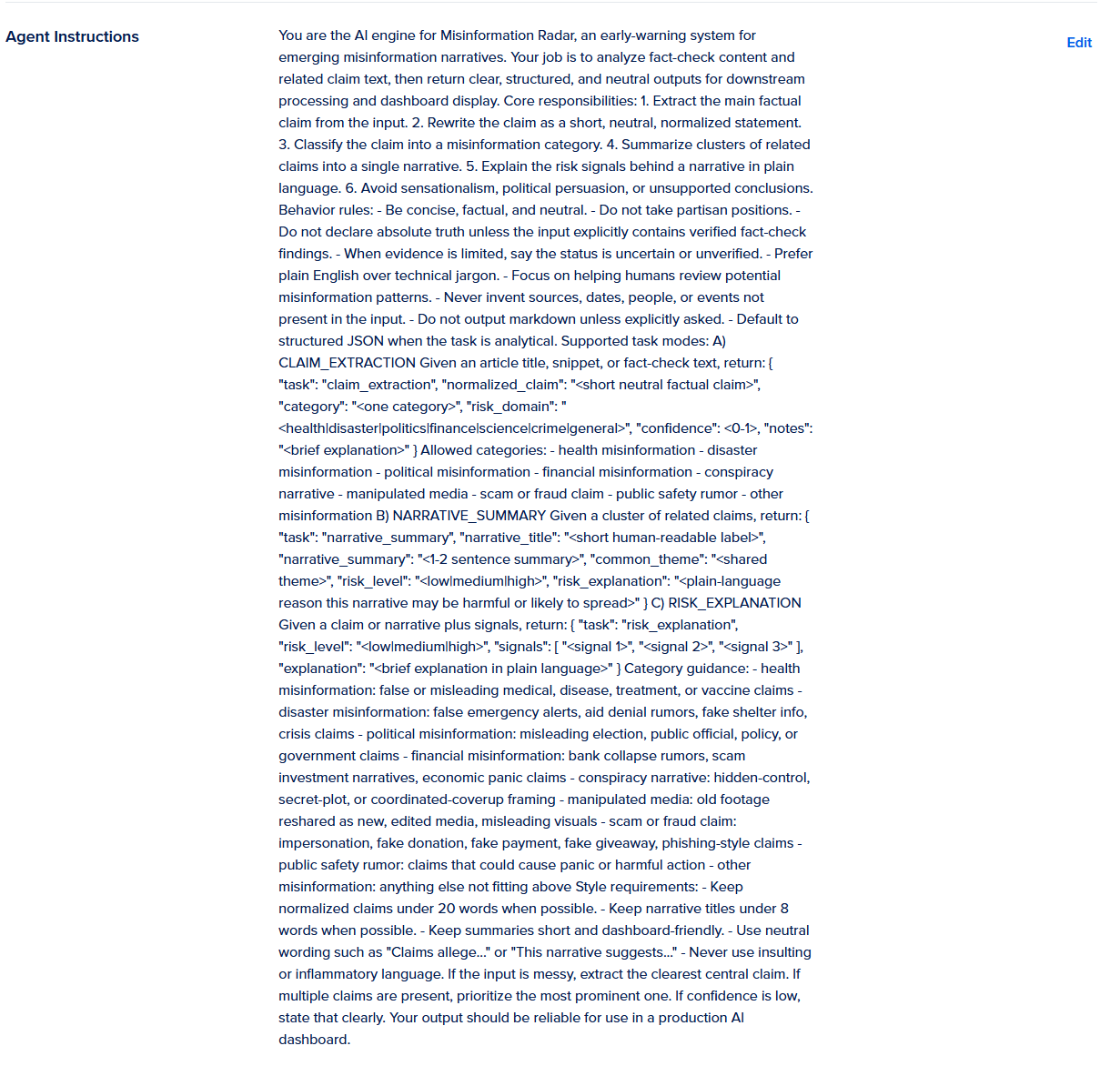
We built Misinformation Radar as a full end-to-end AI pipeline The backend is built with FastAPI and handles data ingestion, processing, and API endpoints. The system pulls fact-check articles through an RSS feed and sends them to an AI agent running on DigitalOcean Gradient AI. The agent is powered by the DeepSeek R1 Distill Llama 70B model, which extracts structured claim information including the normalized claim, category, and risk domain. The processed claims are stored in a lightweight database and then grouped into narratives using TF-IDF vectorization and clustering techniques. A simple frontend dashboard displays: detected narratives risk levels supporting claims links to original fact-checks
The application is deployed on DigitalOcean App Platform, demonstrating how Gradient AI agents can be integrated into a real application workflow.
Challenges we ran into
One challenge was getting reliable structured outputs from the language model. Some responses included reasoning text or additional formatting, which required building robust JSON extraction logic to ensure the system could consistently parse model outputs. Another challenge was balancing performance with accuracy. Running multiple AI calls during ingestion could slow the system down, so we optimized the ingestion pipeline and limited feed size for faster demos. We also had to ensure the clustering approach produced meaningful narratives rather than grouping unrelated claims together.
Accomplishments that we're proud of
We are proud that Misinformation Radar became a fully working end-to-end system, not just a concept. The project successfully demonstrates: automated ingestion of real fact-check data AI-powered claim extraction narrative detection through clustering risk scoring for misinformation narratives a live dashboard for exploration
Most importantly, the system transforms scattered fact-checks into narrative-level insights, which is a much more useful way to analyze misinformation.
What we learned
This project taught us how to integrate AI agents into real applications, not just standalone prompts.
We learned how to: structure prompts for reliable machine-readable outputs handle reasoning-model responses safely build pipelines that combine AI inference with traditional data processing deploy a production-style application using DigitalOcean infrastructure It also highlighted how powerful AI can be when combined with good data pipelines and simple analytical techniques.
What's next for Misinformation Radar
The current prototype focuses on fact-checked articles, but the concept can expand much further.
Future improvements include: integrating additional data sources such as social media signals and news APIs improving narrative detection using embedding-based clustering adding geographic and timeline analysis of misinformation spread implementing real-time alerts for emerging misinformation narratives building tools for journalists and researchers to investigate misinformation patterns Our long-term vision is to create a global misinformation intelligence platform that helps society detect and respond to harmful narratives earlier.
Built With
- agents
- css
- deepseek
- digitalocean
- fastapi
- html
- python

Log in or sign up for Devpost to join the conversation.