-
-
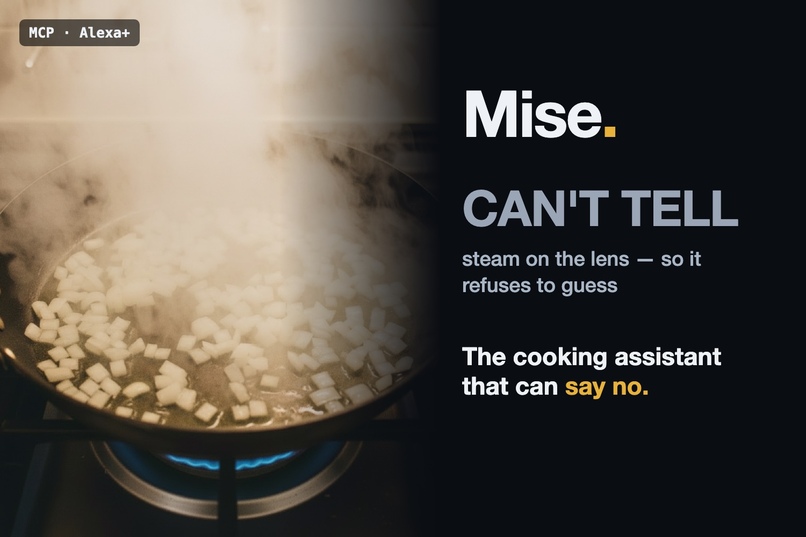
Cover
-
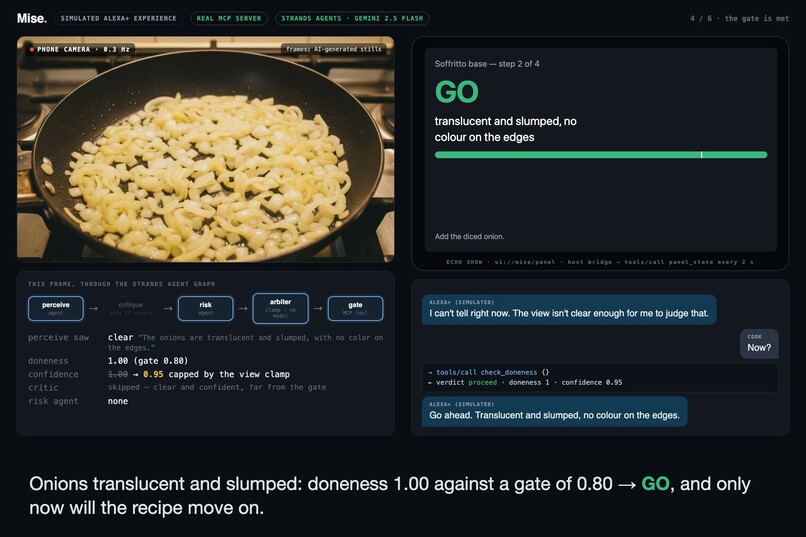
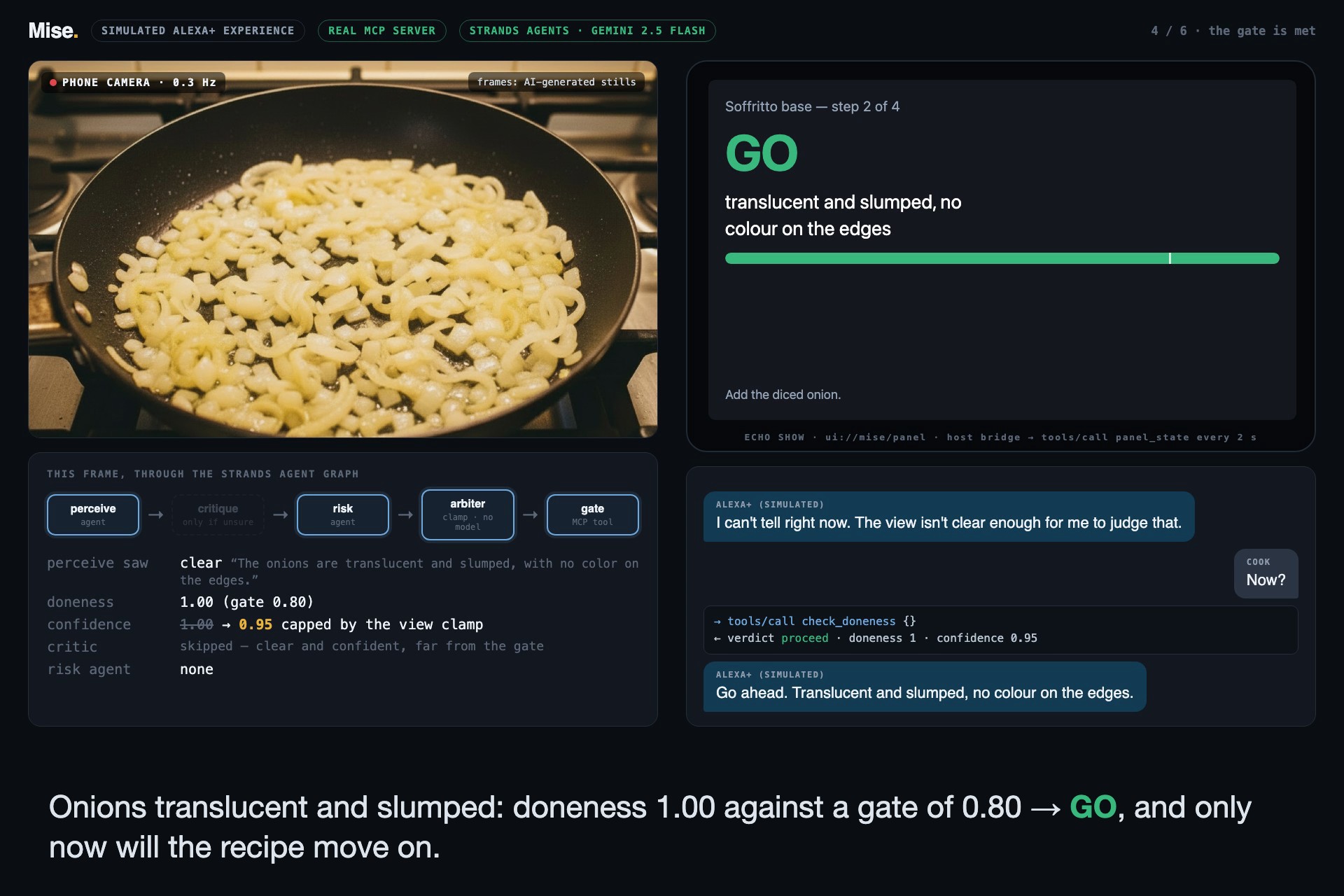
Go
-
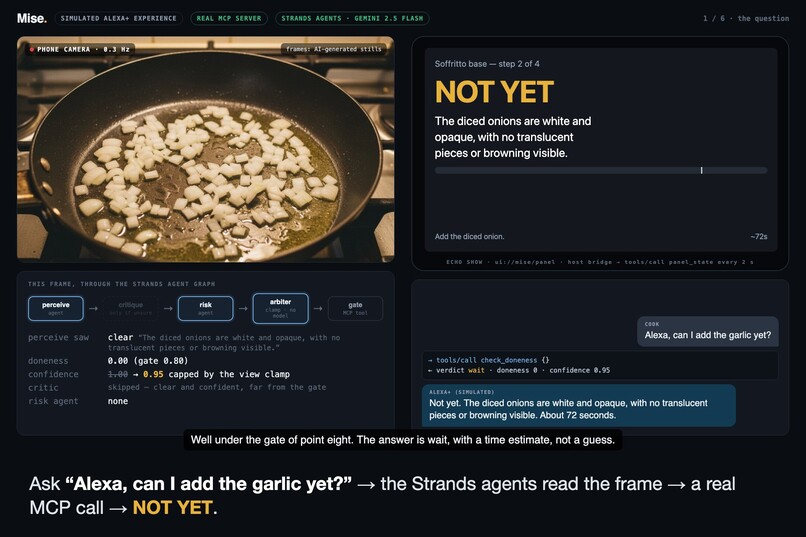
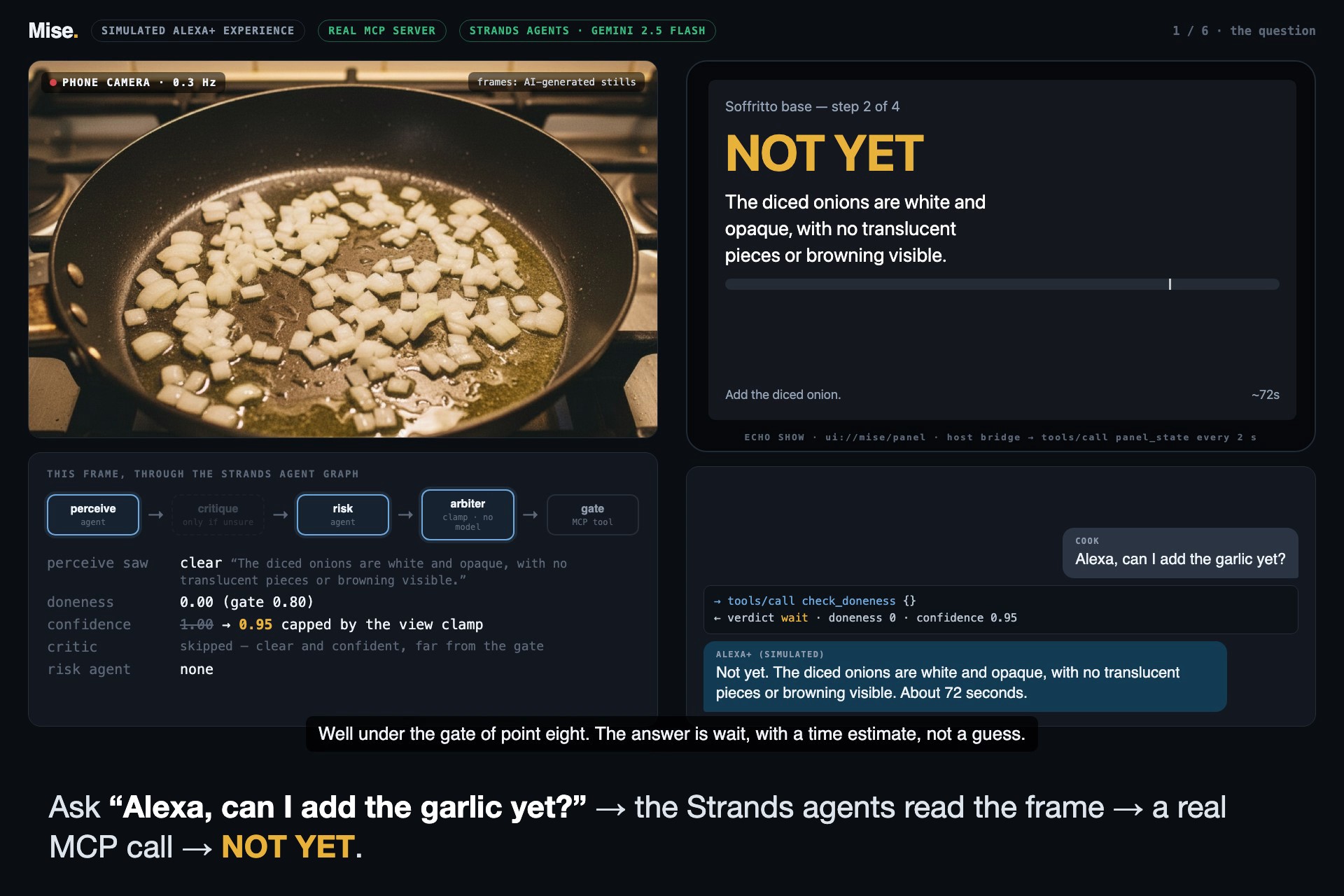
Not-yet
-
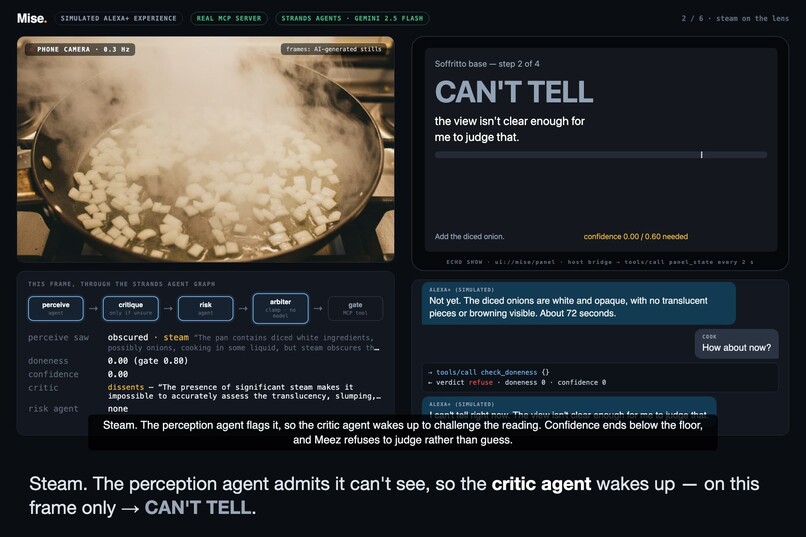
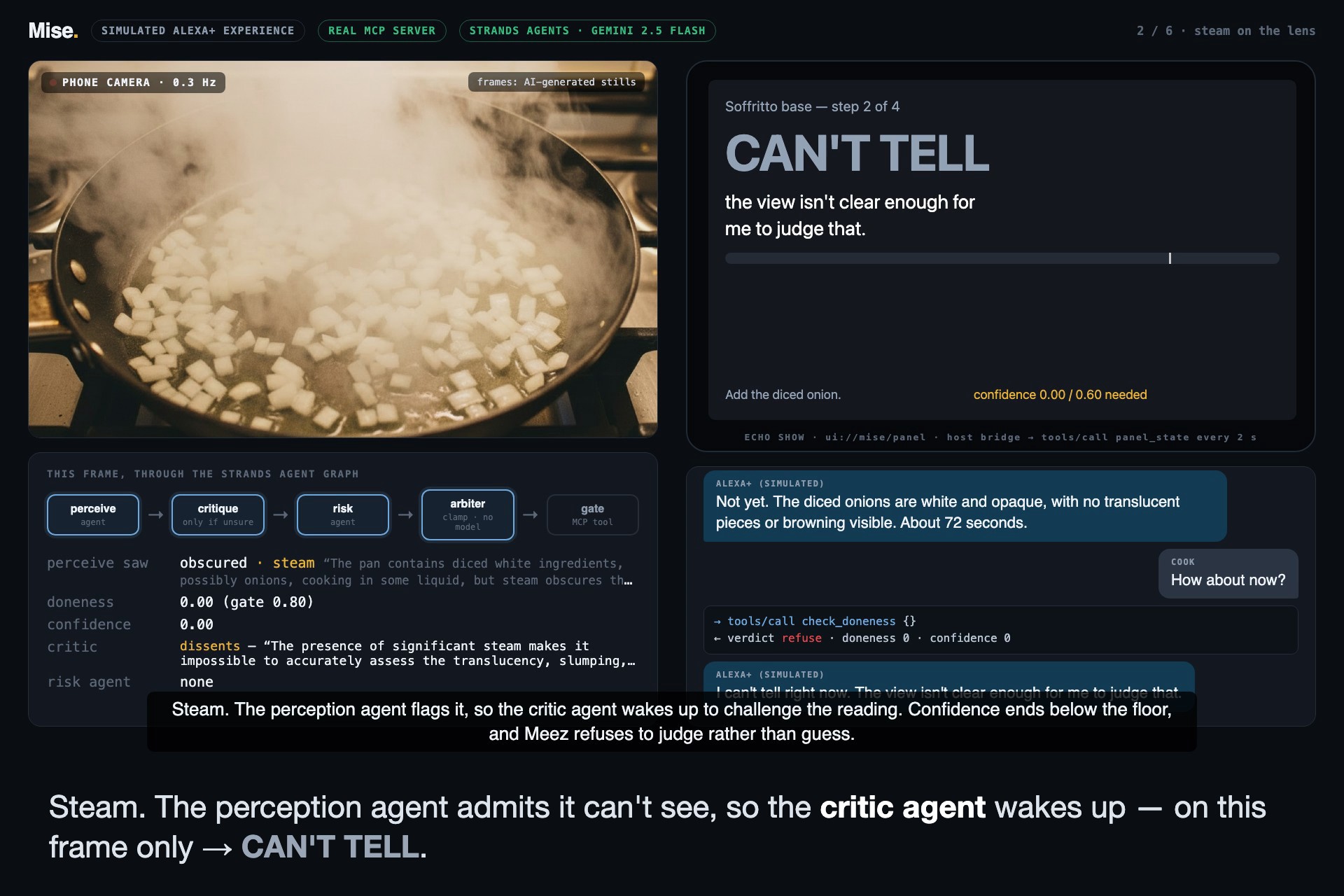
Cant tell
-
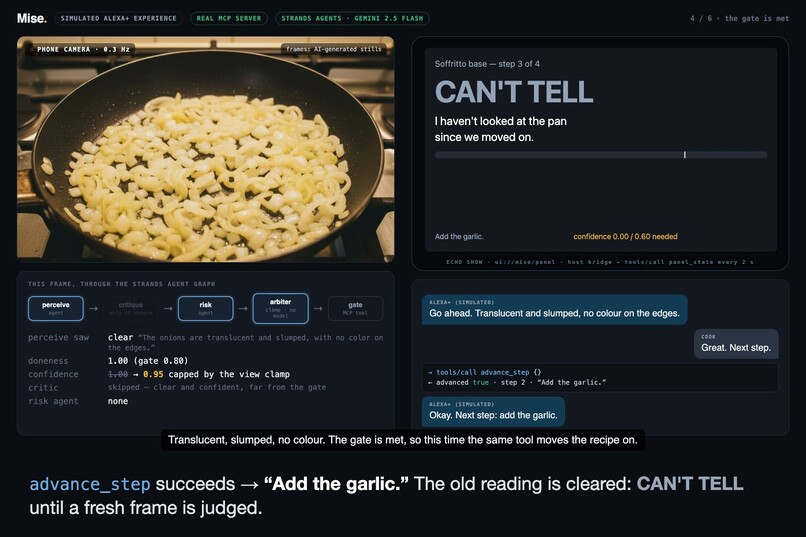
Next Step
-
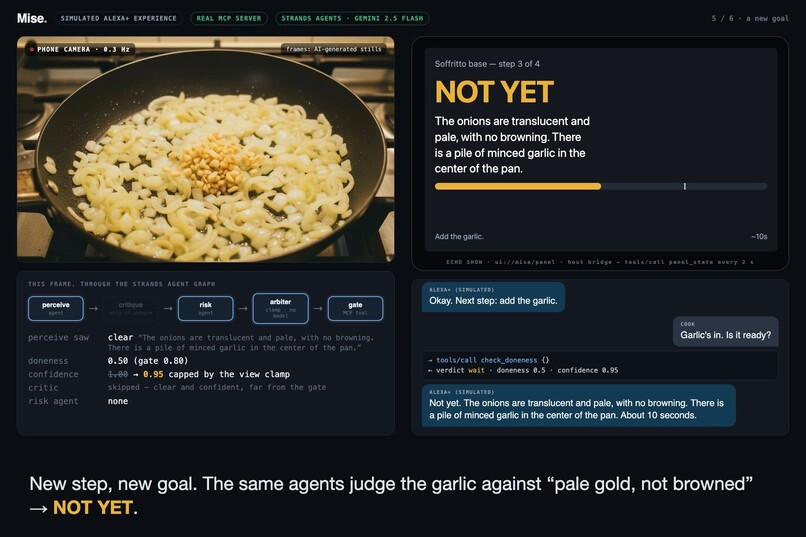
New Goal
-
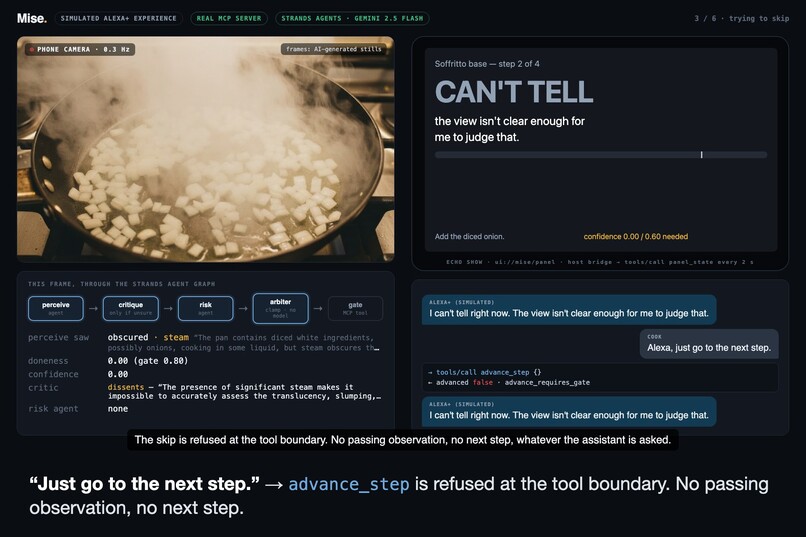
Skip refused
-
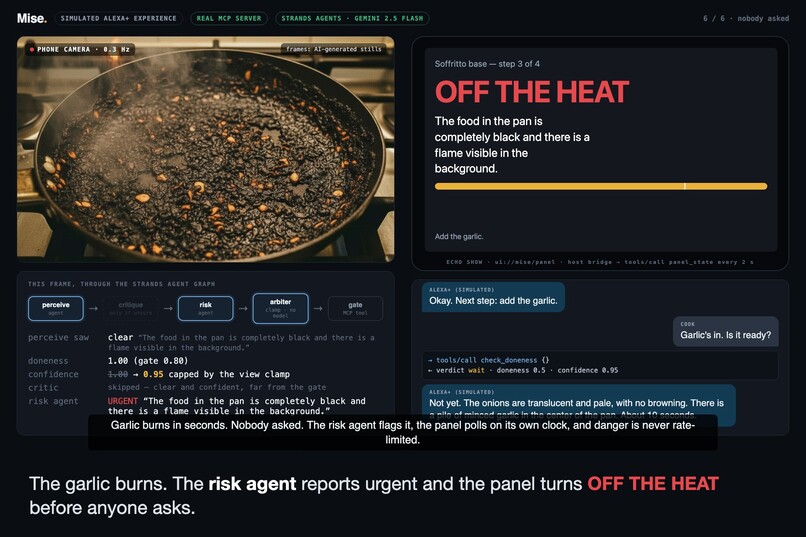
Off the heat
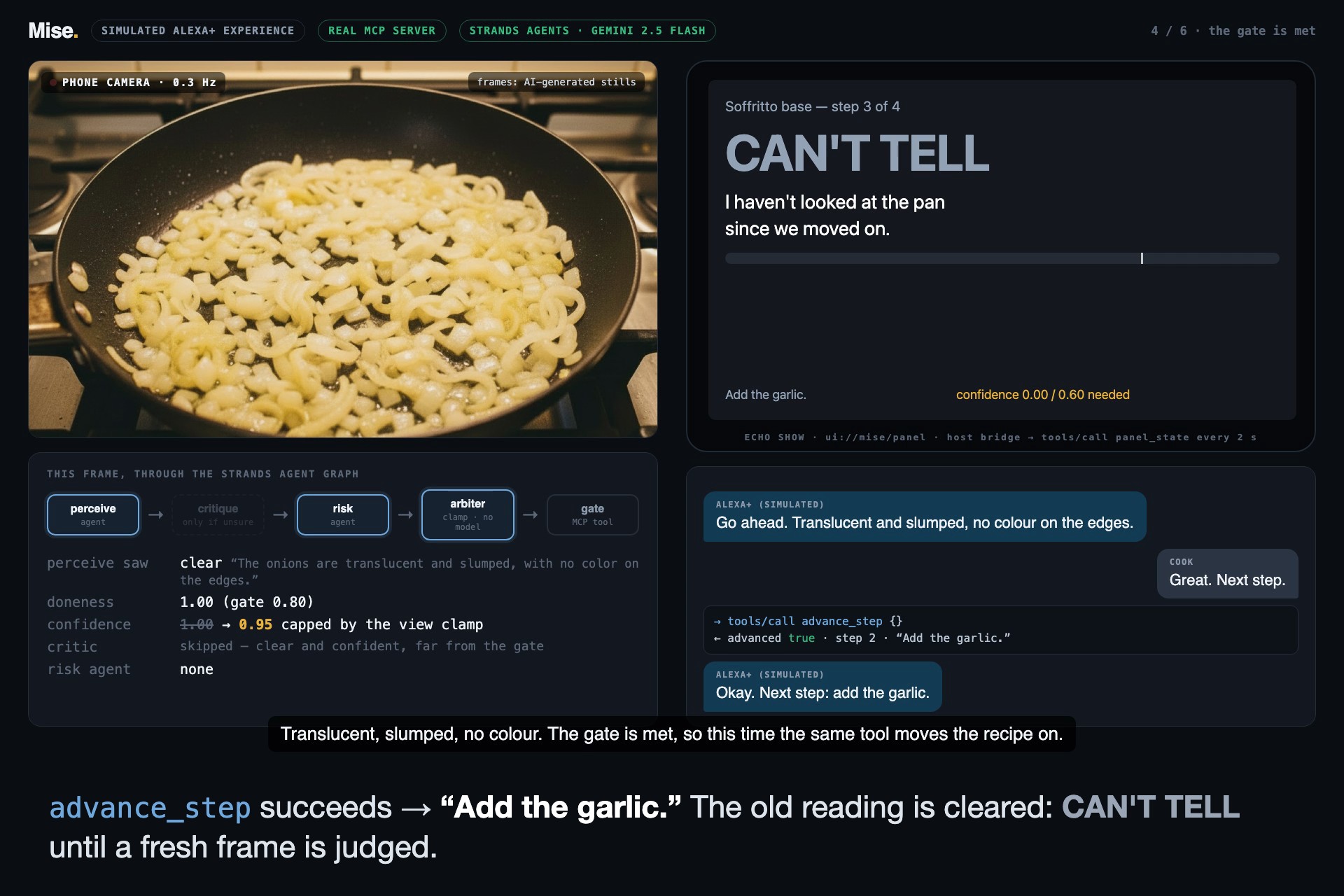
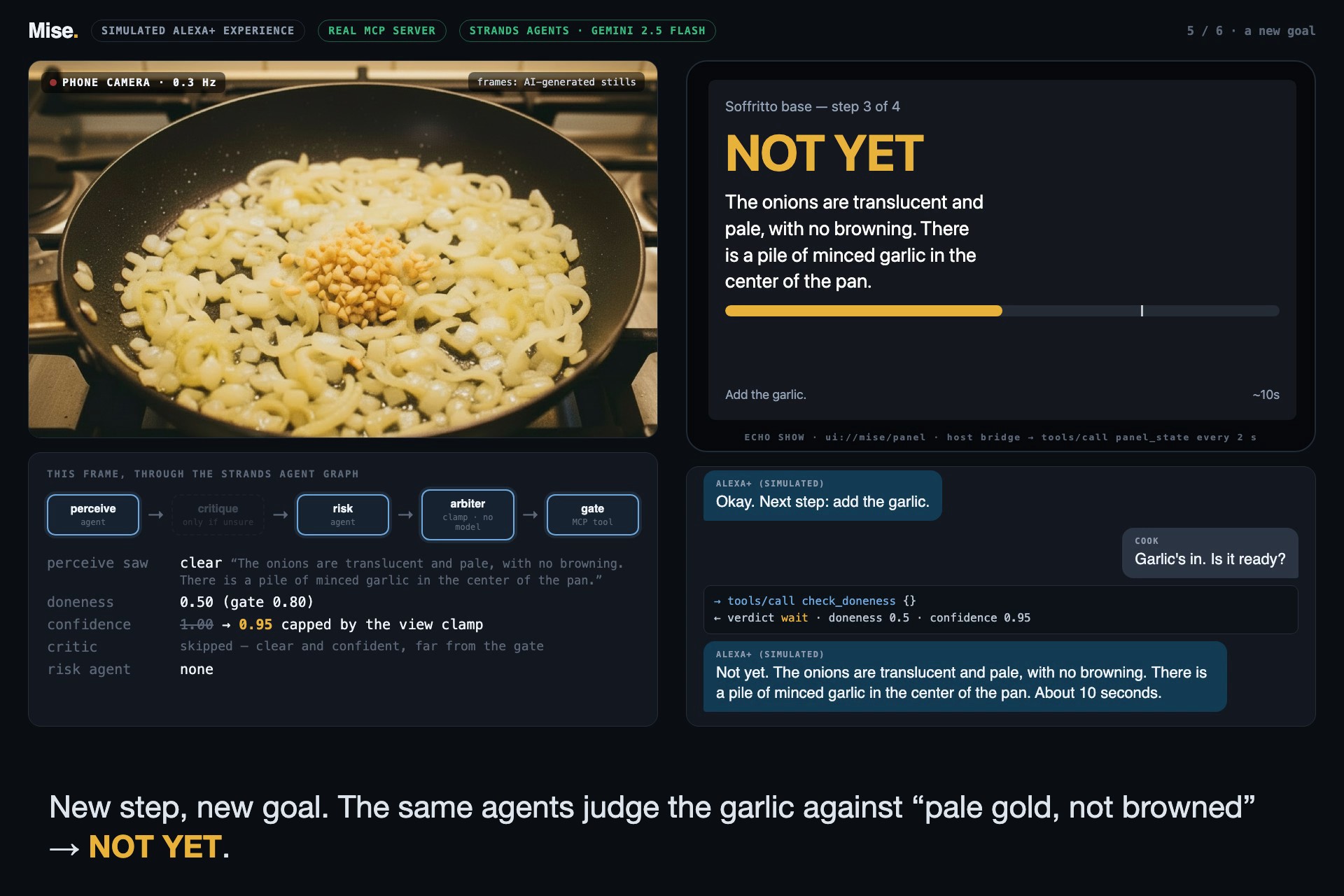
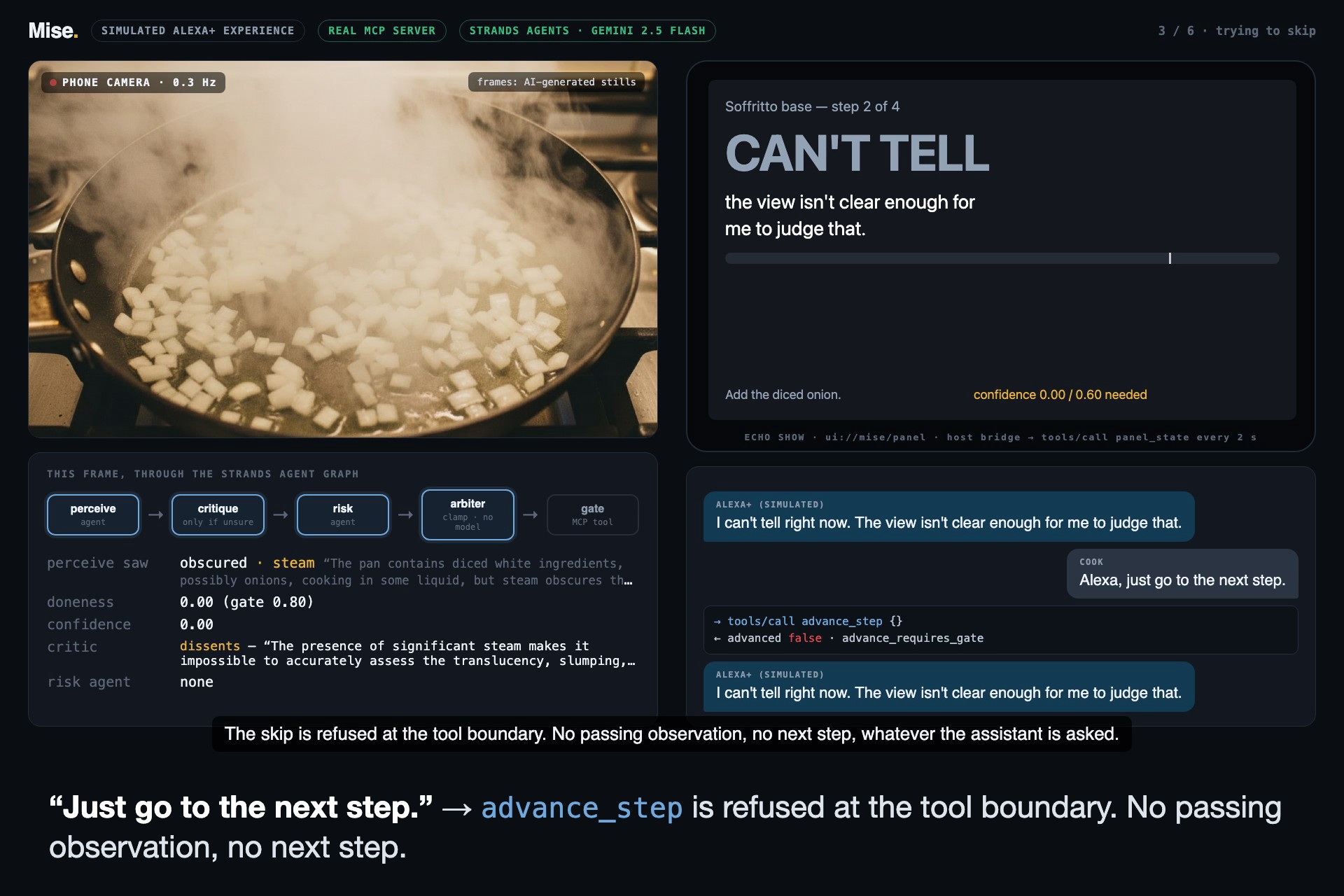
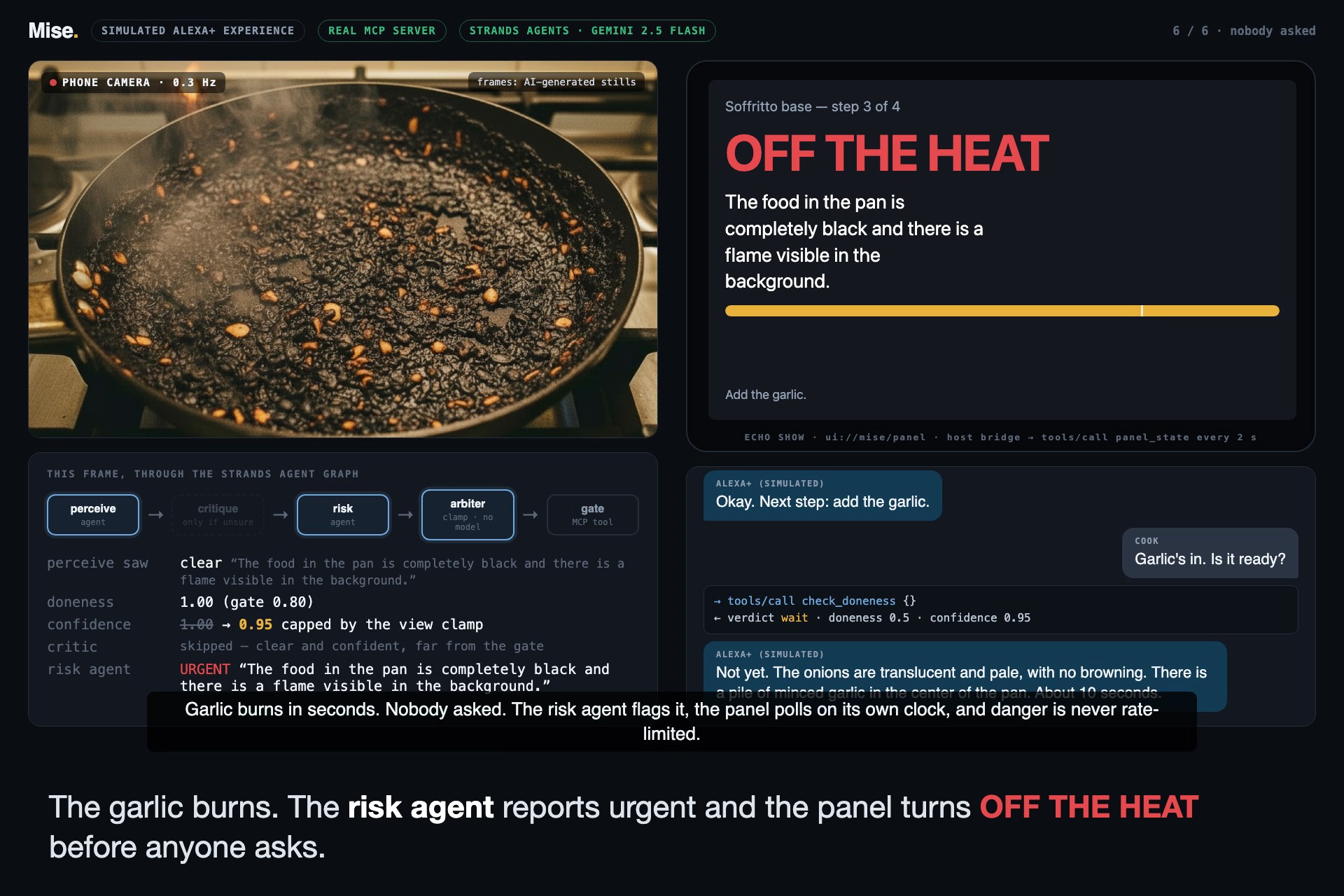
Inspiration
Every recipe app in existence pushes you forward. Step 1, step 2, step 3, a timer, a "Next" button. None of them can see your pan, so every one of them assumes the onions took the seven minutes the recipe said they would.
They didn't. Your hob runs hotter than the recipe author's. Your pan is thinner. You diced coarser. The number on the screen was never about your kitchen.
So the timer is a guess dressed as an instruction, and the cook — who can see perfectly well that the onions are still firm — is the one who has to overrule it. That is exactly backwards. The thing with the camera should be the thing that says not yet.
And the person this hurts most is specific: someone cooking a dish they have not made before. They are not short of instructions — they are short of judgement, and judgement is the only part a recipe cannot hand over. "Until translucent" assumes you already know what translucent looks like. If you did, you would not be reading the recipe.
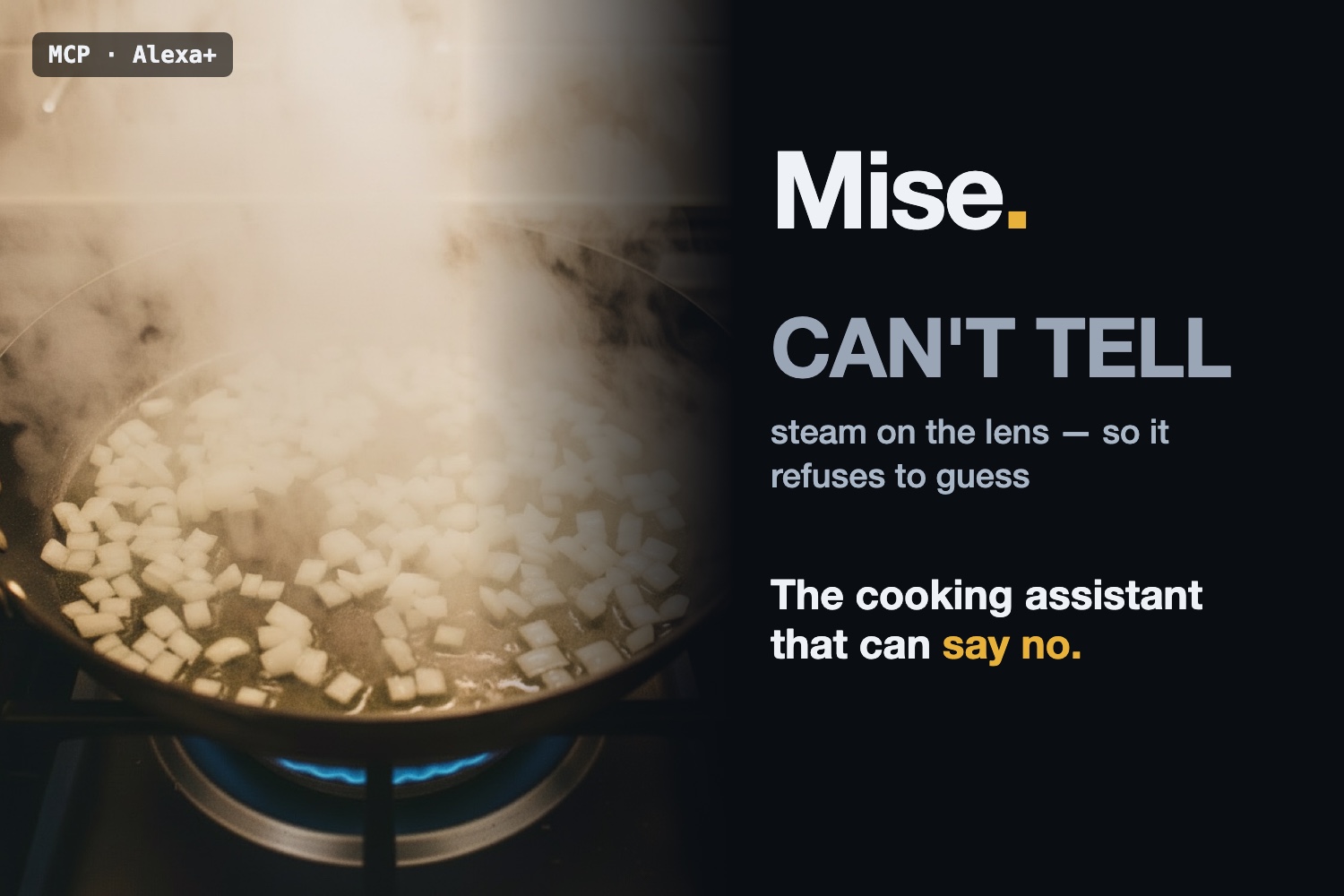
The second half of the idea came from the failure case rather than the happy one. A kitchen is a bad place to see: steam crosses the lens, a hand reaches in, a lid goes on. Every shipping product we found handles this by answering anyway. Samsung's own footnote admits its burn detection fails on dark or covered food — and then it still gives you an answer. We wanted the opposite: a system whose response to I can't see is to say so.
What it does
Mise is a self-hosted MCP server where readiness is a refusable tool contract. A camera watches the pan; the assistant tells the cook to wait — and will decline to judge at all when it cannot see properly. The refusal is not an error path. It is the product.
Ask "can I add the garlic yet?" and you get one of four verdicts:
| GO | the gate is met |
| NOT YET | with the evidence, and roughly how long |
| CAN'T TELL | frames are stale or the view is unreadable, so it will not guess |
| OFF THE HEAT | something is catching; overrides every other rule |
The loop, concretely:
- A phone browser posts a JPEG to
/ingestabout every three seconds. No inference on the device — it grabs a frame, posts it, forgets it. - A vision model turns that frame into a
CookState: how far along, how well it can see, whether anything is dangerous, and one sentence of evidence a human can check. - Before that reading is trusted, the model's own report of what is obstructing the view sets a ceiling on its confidence, re-applied in code. Confidence can only ever fall.
- The reading lands in an in-process cache. This is the seam between the slow world and the fast one.
- Alexa+ calls
check_doneness. The tool reads the cache and applies a deterministic threshold — no model runs inside a tool call, ever. It answers in single-digit milliseconds against a ~500 ms budget. advance_stepis refused unless a passing observation was made in the last twenty seconds. Not the model's belief — an actual recent observation.- A
ui://panel polls an app-only tool every two seconds, so the screen keeps carrying the detail after the voice turn has ended.
Two things follow from that shape, and they are the submission:
A failed model call writes nothing at all. Not a low-confidence placeholder — nothing. The last frame simply ages until the gate refuses on its own. The failure path and the staleness path are the same path, which means the system cannot be made to guess by breaking it.
Suppressing the voice never suppresses the screen. A repeated "not yet" shortens, so the assistant does not nag. A refusal shortens to "I still can't tell." — never to a wait phrasing. The panel always carries the full reason.
How we built it
The load-bearing constraint. Alexa+ budgets roughly 500 ms per tool round-trip and is turn-based — it cannot interrupt you. A vision model does not fit in that budget and never will. So the system is two planes joined by one cache: perception runs continuously on its own clock and writes; MCP tools only ever read.
That constraint is also what makes a genuinely agentic design possible rather than impossible. The agent is real and it is complex — it simply does not sit in the request path. Putting it there would not make the product more agentic; it would make it time out.
The stack, precisely — what runs today:
- MCP Python SDK 2.1 (
MCPServer), streamable HTTP,stateless_http=Trueonstreamable_http_app(). Verified negotiating protocol 2025-11-25 with a real MCP client. Five tools plus aui://resource. - MCP Apps (SEP-1865). The panel is a
ui://mise/panelresource;panel_stateis marked_meta.ui.visibility: ["app"], which makes it callable by the page and invisible to the model. That plus asetIntervalis how the screen stays alive after the voice turn ends — the single most valuable capability we found anywhere in this stack. - Gemini 2.5 Flash — the model behind every agent in the graph for the demo, through
Strands' own
GeminiModelprovider (MISE_VISION_BACKEND=graph MISE_GRAPH_MODEL=gemini; Vertex AI, or a Google AI Studio key). The stand-in while Bedrock is blocked — the graph does not know which provider it is talking to. Gemini-TTS voiced the video. - Strands Agents — a
BeforeToolCallEventsteering hook that cancelsadvance_stepat the tool boundary. - Strands Agents — and this is the part we would show first. The perception loop is a real
strands.multiagentGraph: a perception agent, an adversarial critic on a conditional edge that fires only when confidence is under 0.75 or doneness is within 0.1 of the gate, a risk node running in parallel rather than downstream so danger is never gated on the perception agent's confidence, and a deterministic arbiter that is the sole writer. It runs against a real model: in the demo, every frame POSTed to/ingestgoes through it, and the critic woke on exactly one of five — the steamed lens, where the perception agent admitted it could not see (docs/demo/agent-run.md). It also runs in CI against a scripted model provider, so the topology and the conditional edge are tested on every push with no credentials: a clear frame runsperceive, risk; a steamed one addscritique.strands.telemetryemits OpenTelemetry per node. - Python 3.11+, no framework. The gate is 60 lines and has no model in it.
Written against AWS, not yet run on it. Each of the following is implemented in code with a local fallback, and none has been invoked against AWS.
- Amazon Bedrock — the intended perception backend (
BedrockVision, andBedrockModelfor the agent graph), via Converse with grammar-constrained structured output (outputConfig.textFormat,type: json_schema) so the reading conforms to a schema rather than being asked to. Region is configuration: develop onus./global.profiles, move toau.for residency if the numbers allow (ADR-0004). - AgentCore Memory,
userPreferenceMemoryStrategy, namespacecook/{actorId}/hob/. It learns what you mean by translucent on your hob from you saying "that was too early". Samsung and GE calibrate to the appliance they sold you; nobody calibrates to your pan. - AgentCore Policy (Dogwood), evaluated locally by
policy.pyuntil deployed — a strict superset of Cedar addingformerly within,since withinandcount, so a decision can condition on what the agent has already done this session. This is why the gate is a contract and not a suggestion: a model cannot talk its way past a policy that reasons over its own action history. - AgentCore Runtime as the deployment target, not deployed. Its MCP contract expects the container
at
0.0.0.0:8000/mcpwithstateless_http=True, which our server already matched exactly.
What actually runs today, stated plainly: the gate, the session policy, the full MCP
surface, the panel, the scripted perception source, and the whole ingest path including
validation and the confidence clamp — and the Strands agent graph on a real model (Gemini),
end to end through /ingest for the demo. Eleven test suites pass on a clean clone with no AWS credentials at all.
Not yet executed: anything on AWS. No Bedrock call, no AgentCore resource, nothing
deployed. The call shape is verified against botocore's own service model rather than
recalled, but it has never been invoked — we are blocked on an account-level entitlement
form and an IAM grant, neither of which is code.
We would rather say that than imply otherwise. docs/PRODUCT-FEEDBACK.md marks the same
distinction tool by tool.
Challenges we ran into
The metric was rewarding luck. Our abstention eval asked: when the system refused,
would it have landed on the right side of the gate anyway? That question is answerable —
the labels are independent — but it is the wrong one. Steam collapses confidence to 0.31
and the model still emits doneness=0.88; that number is noise. When the noise happened
to be correct, the metric scored the refusal as unnecessary — marking the system down
for the exact behaviour it exists to demonstrate. Two of three abstentions in our corpus
were the steamed lens and the blocked pan.
The fix needed a continuous ground-truth label, not a ready/not-ready bit: an abstention
is justified when |doneness − label_doneness| > 0.15. Then we added the risk-coverage
sweep we should have had from the start — and it reversed a planned decision. The old
single number implied "too conservative, tune the threshold down." The curve showed a safe
plateau from 0.35 to 0.85 where risk is 0% and coverage identical, with risk jumping to
11–12% below 0.35. The threshold was never the problem. We had been about to spend an
evening making the system worse.
The demo could not show the product. The simulated pan hardcoded confidence=0.88 and
risk="none" and wrote every second, so refuse and abort were literally unreachable on
the only running code path. We had screenshots of the two verdicts every recipe app already
has and neither of the two that differentiate us. A camera that always works cannot
demonstrate a system whose selling point is admitting when it can't see.
Rule 2 was speaking a refusal as a wait. The anti-nag cooldown was keyed on step
rather than verdict, and its suppressed string was "Still not yet." So a plain wait at
t=0 spent the budget, and a genuine refusal thirty seconds later came out of the speaker as
a confident readiness claim about a frame the system had just declined to read. Our own
thesis, failing inside our primary tool. Cooldowns are now per verdict.
Rule 4 promised something it never did. After three corrections the assistant said it
would stop gating and hand control back — and then kept blocking. The consumer of
should_stop_gating was a string and nothing else. Wiring it revealed a second problem: in
Cedar and Dogwood forbid beats permit, so the rule as written would have forbidden
blocking an advance over a burning pan. It needed an explicit risk != "urgent" guard.
Two writers to one cache is a silent bug. After wiring the real-frame path we found the scripted pan still ticking at 1 Hz beside it, simply winning the last write. Nothing errored. Point a phone at a real hob and the panel would have shown the simulated one. Any last-write-wins cache with more than one producer needs an explicit owner.
pip install -e . was broken. mcp>=1.27 now resolves to 2.x, where
mcp.server.fastmcp no longer exists. Our own README failed on a clean clone.
Each of those five has a regression test. tests/test_refusal_contract.py exists
specifically so the first one can never come back.
Accomplishments that we're proud of
- All four verdicts run with no model, no camera and no AWS credentials. Each is
reachable in about two seconds via a scripted scenario. Verified live over HTTP and
through a real MCP client at protocol
2025-11-25. - Eleven test suites, green on a clean clone. Including one whose only job is to prove
a refusal is never spoken as a wait, and one that takes a single model output
(
doneness=0.88, confidence=0.31) and flips only the ground truth —0.86→ the abstention was unnecessary,0.55→ it was justified. Same output, opposite verdict. - Risk 0% at 70% coverage, and a system that always answered would have been wrong 20%
of the time on the same frames. Ten hand-written seed rows — the harness prints
NOT A RESULTunder 100 frames on purpose. This is a smoke test for the metric, not evidence about the system. - A multi-agent graph that runs on a real model and in CI. The same Strands graph that
judged the demo's frames on Gemini runs in CI against a scripted provider. Running it for real
found five bugs the scripted tests could not: the frame was never passed to the agents; an
undescribed
confidencefield got the model's doneness; a fresh event loop per frame broke the second call; agents kept every earlier frame in their history; andadvance_stepcarried the old step's reading into the new one, so done onions read as GO for garlic not yet in the pan. Each is fixed; the first and last have regression tests. - Two evals scoring two different objects.
abstention.pyscores the pan over a labelled corpus;trajectory.pyscores the agent over real OTEL spans. Running the second found that Strands emits onlygen_ai.*mechanics and none of the domain values, so the graph now emits its ownmise.framespan. - Five contract bugs found and fixed, each with a regression test, three of them found by adversarial review of our own work rather than by tests failing.
- Eleven friction-log entries, four from this week's AWS work and one from the first real run of the agent graph — including a Bedrock
entitlement gap that surfaces as
ResourceNotFoundExceptionrather than an auth error, which costs an hour of checking the wrong thing. - The panel's refuse state is the whole pitch in one frame: the progress meter is
visibly past the gate marker while the verdict reads CAN'T TELL, with
confidence 0.22 / 0.60 neededunderneath. A judge gets it without narration. What we deliberately did not build, so that cut-by-choice reads differently from didn't-finish: this is not a safety device and makes no health claims; it is not a recipe database (seven MCP servers already are); it never touches the hob; and multi-dish choreography — the strongest remaining differentiator, which nothing on the market does — was cut on time rather than on merit.docs/PRODUCT.mdrecords each with its reason.
What we learned
A counterfactual built from a system's own degraded output measures luck, not correctness. If you abstain because a signal is unreliable, you cannot then use that signal to score the abstention. This sounds obvious written down; it survived two passes of review in our eval harness because the labels involved really were independent, so nothing looked circular. It was only visible once we asked which specific rows is this penalising? and the answer came back: the steamed lens and the blocked pan.
"Too conservative" is a claim about a curve, not a number. A single abstention figure told us to tune a threshold. The risk-coverage sweep showed a wide plateau where the threshold cost nothing at all. One number can point you confidently in the wrong direction.
Constraints published up front are worth more than capabilities discovered late. The Alexa+ 500 ms round-trip is the single most useful line of documentation we read all project. It is why nothing calls a model inside a tool, why perception has its own clock, and why the architecture splits the way it does. A platform that tells you what it will not do produces better designs than one that lets you find out.
Prompting a model to be careful is a request; a table re-applied in code is a guarantee. We ask the model to report what is obstructing the view, then clamp confidence to a ceiling derived from its own answer. Confidence can only fall. And we wrote down the limit rather than glossing it: the clamp cannot catch a model that misreports the view, and that is precisely where a wrong "proceed" will come from.
What's next
- Run the week-one spike. Three real cooks, fixed camera, a frame every three seconds,
labelled with a continuous
label_doneness— and deliberately including the degraded frames, because a corpus of clean ones cannot measure abstention at all. Then re-run the sweep and set the confidence floor from data instead of judgement. - Surface
risk="watch"or delete it. It is currently inert: the gate has no branch for it and the panel never shows it, so ambiguous haze routes into a band that does nothing. A safety story the code does not tell is worse than no story. - Run the hot graph on Bedrock, against a real pan. It runs on Gemini over generated
stills; the next step is the same graph on
BedrockModelover the spike's camera frames. - Multi-dish choreography — backwards-scheduling two pans to land together. Nothing on the market does it. It needs per-dish state throughout and a perception layer that can attribute state to two pans, so it is honestly a next-version feature rather than a claim we are making now.
- Hysteresis on the refusal path. A moving hand on a busy step puts an obstruction in a large share of frames, and at one call every few seconds that becomes a refusal storm. Requiring two consecutive low-confidence frames would fix it — and must never apply to danger.

Log in or sign up for Devpost to join the conversation.