MISE
Don't let “maybe” become “done.”
A critical supplier delivery fails.
The usual workflow is simple:
delivery failed → notify someone → someone calls the supplier → someone figures out what happens next.
MISE changes that.
MISE takes over the recovery.
It determines the next action, uses CALL-E to call the supplier, understands the response, rejects weak commitments, and keeps the incident moving until there is a commitment strong enough to recover the delivery.
CALL-E isn't just being used as a voice API.
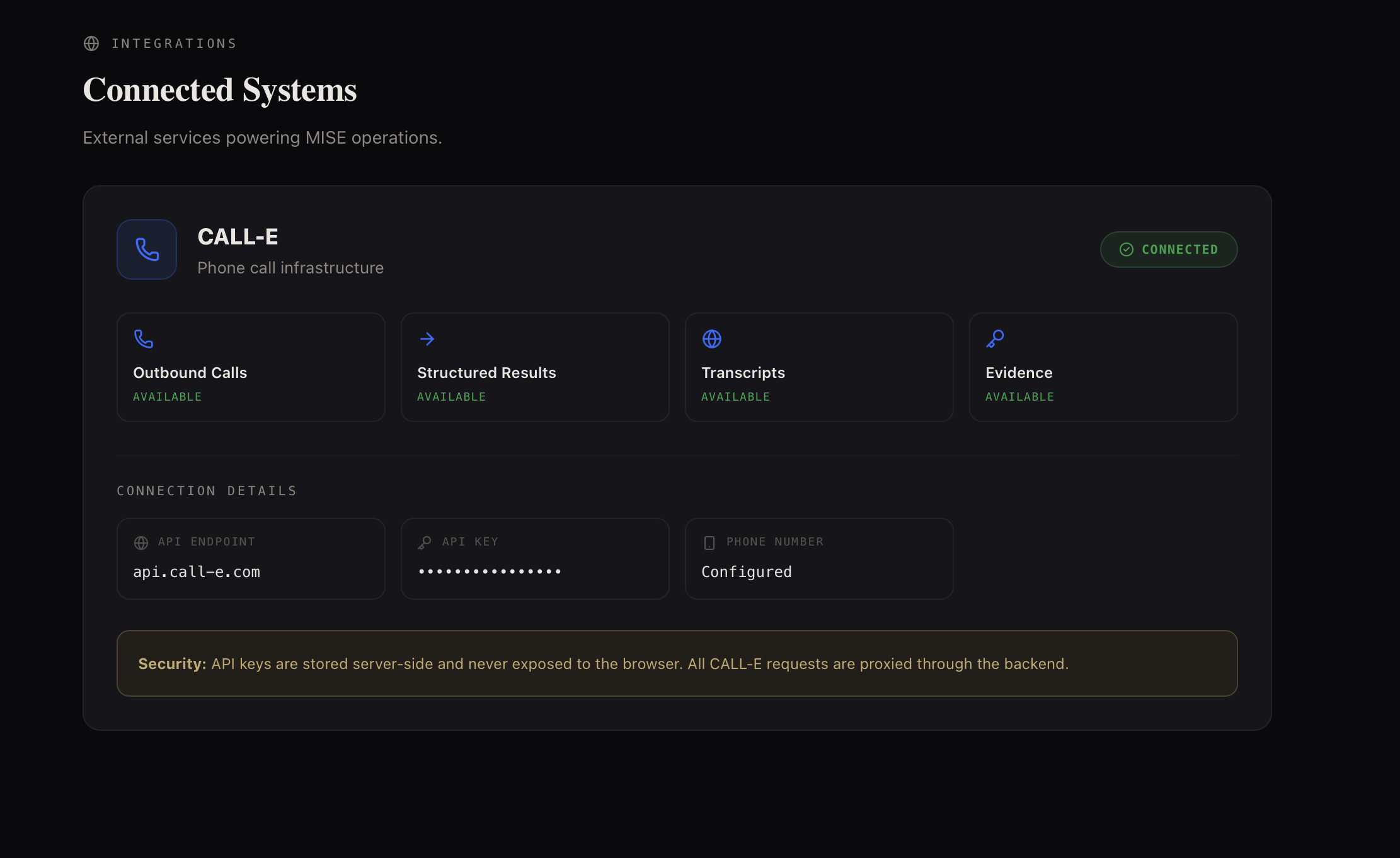
CALL-E is what gives MISE the ability to take the recovery out of the dashboard and onto the phone.
The problem
A failed delivery isn't a notification problem.
It's a recovery problem.
Suppose 4 units were supposed to arrive today and didn't.
MISE calls the supplier through CALL-E.
The supplier says:
“We'll try to get them out this afternoon.”
The call happened.
The problem didn't get solved.
MISE doesn't mark the recovery successful.
It asks the question that actually matters:
Did the conversation produce a commitment that can move the recovery forward?
If not, the case stays open.
MISE closes the loop
DELIVERY FAILS
      ↓
MISE TAKES OVER
      ↓
CALL-E CALLS SUPPLIER
      ↓
SUPPLIER RESPONDS
      ↓
DID THEY ACTUALLY COMMIT?
      ↓
   NO              YES
   ↓                ↓
CONTINUE          RECOVERY
RECOVERY          SECURED
   ↓                ↓
   └────────────→ MONITOR
This is the core product.
The goal isn't to make a successful phone call.
The goal is to recover the failed delivery.
See it happen
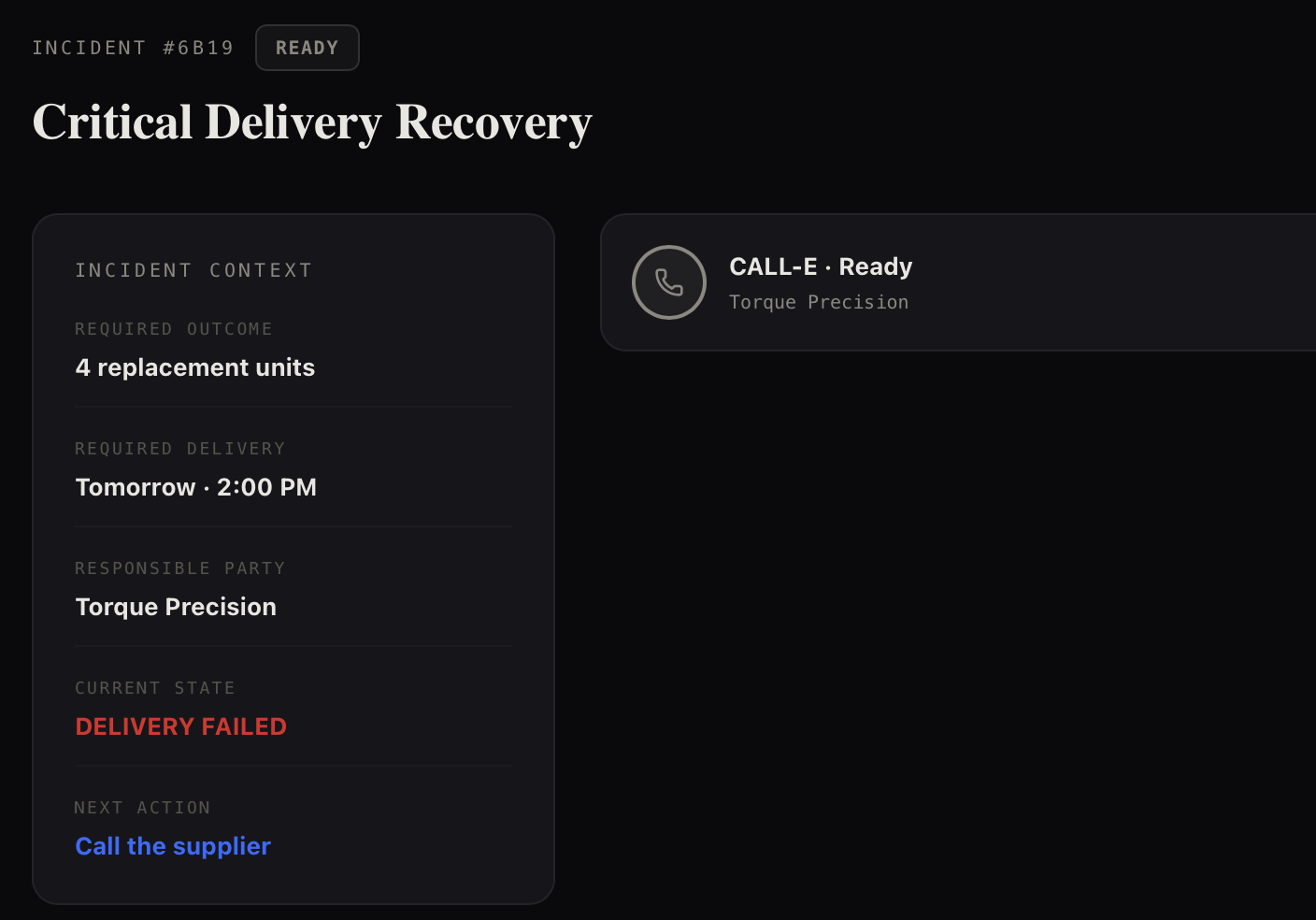
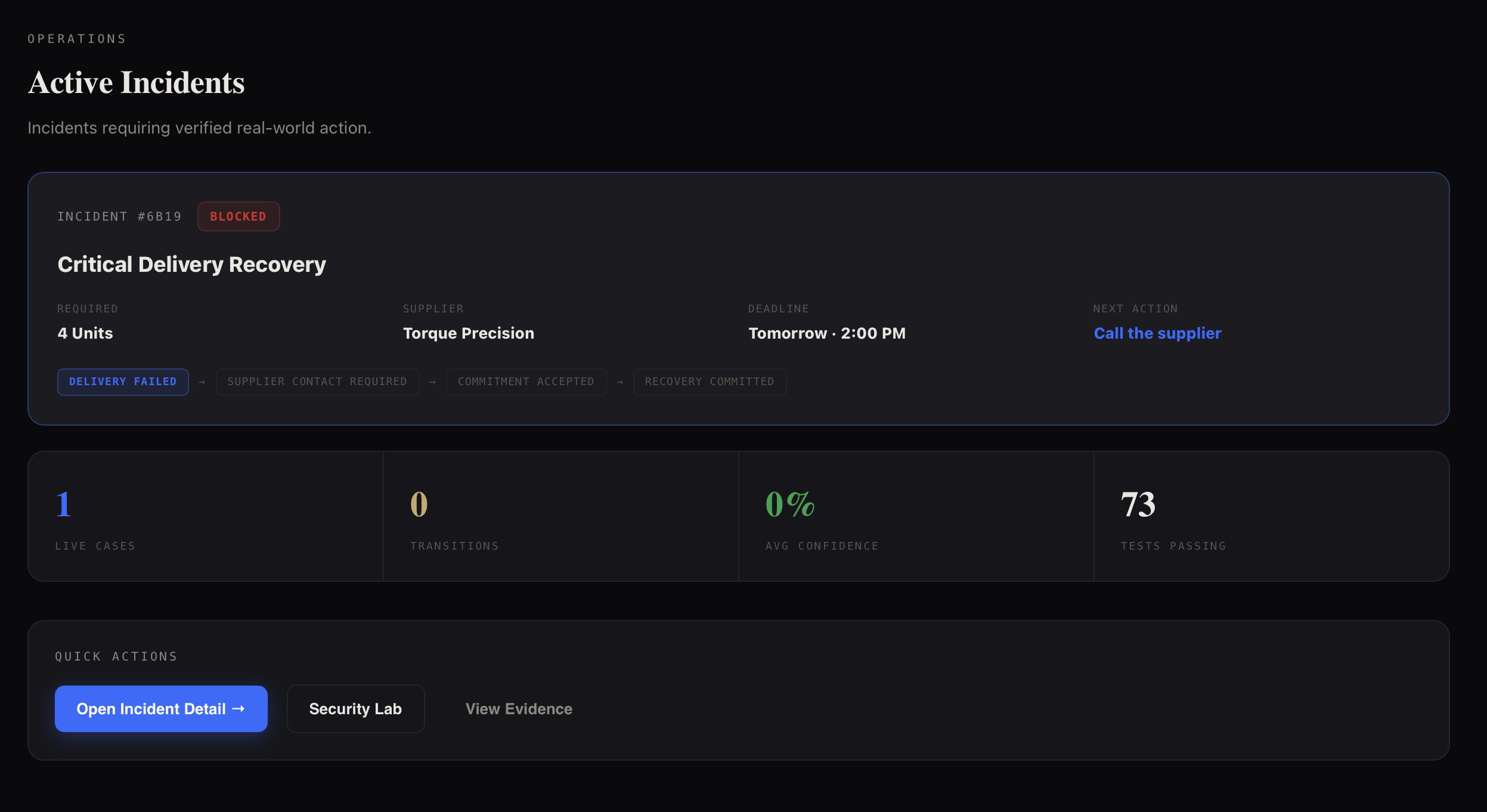
The demo begins with INCIDENT #1842.
Four units were supposed to arrive.
They didn't.
MISE takes ownership of the incident and determines that the supplier needs to be contacted.
First call
CALL-E contacts the supplier.
The supplier says:
“We'll try to get it out by 4 PM.”
MISE rejects the response.
Recovery: NOT SECURED.
The incident stays blocked.
There is no false success just because the call completed.
Second attempt
MISE continues the recovery.
The supplier is contacted again.
This time:
“Yes. Four units. We'll ship today. Delivery is scheduled for 2 PM.”
MISE accepts the commitment.
Recovery: SECURED.
The incident moves into monitored recovery.
That's the product.
What counts as a recovery?
MISE needs enough information from the phone conversation to establish:
What? What is being delivered?
How much? What quantity is committed?
When? When will it arrive?
A supplier saying:
“We'll try.”
doesn't count.
Neither does:
“We can probably ship.”
And neither does an unsupported agent statement:
“The supplier confirmed delivery.”
But:
“Yes, 4 units. Shipping today. Delivery at 2 PM.”
can move the recovery forward.
CONTRACTOR: the control behind the recovery
CONTRACTOR is the decision layer underneath MISE.
It answers one question:
Is this phone interaction strong enough to change the state of the recovery?
The answer is deliberately simple:
ACCEPTED
REJECTED
Rejected calls receive explicit reasons:
SUPPLIER_HEDGED
DELIVERY_WINDOW_MISSING
NO_EXPLICIT_COMMITMENT
PROOF_NOT_TRUSTED
This keeps the distinction clear:
CALL-E determines what happened in the conversation. CONTRACTOR determines whether that conversation earned a state transition.
MISE keeps the evidence
When a recovery is accepted, MISE records the evidence behind the decision:
- CALL-E call ID
- timestamp
- supplier statement
- extracted commitment
- quantity
- delivery window
- confidence
- state transition
The transition is appended to a hash-linked ledger.
Opening a recovery therefore doesn't just show:
RECOVERY COMMITTED
It can show why MISE was allowed to put it there.
The attack lab
The recovery gate is tested against deliberately bad inputs:
“We'll try to get there by 4 PM.”
→ REJECTED
→ SUPPLIER_HEDGED

“We can probably ship.”
→ REJECTED
→ DELIVERY_WINDOW_MISSING

“Delivery confirmed.”
→ REJECTED
→ PROOF_NOT_TRUSTED

“Yes, 4 units. Ship today. 2 PM.”
→ ACCEPTED
The objective is not to make every phone call look successful.
The objective is to make the recovery successful.
Why CALL-E makes this possible
CALL-E changes the boundary of what an automated recovery system can do.
Before a phone agent, the workflow could detect a failed delivery and create a task:
“Call supplier.”
The task then waits for a human.
With CALL-E, MISE can actually perform that step.
The workflow becomes:
detect → call → listen → decide → continue → recover.
The phone conversation is no longer a dead-end interaction.
It becomes an action inside the recovery loop.
That's the capability MISE is built around.
A commitment isn't a completed delivery
MISE deliberately does not declare the physical delivery complete.
A supplier saying:
“Yes, we'll deliver 4 units at 2 PM”
means the recovery has been committed.
It does not mean the truck has arrived.
So MISE stops at:
RECOVERY COMMITTED
and leaves fulfillment to the supplier.
The system coordinates the recovery without pretending the real-world action has already happened.
Live CALL-E + deterministic demo
MISE supports live CALL-E execution with a consented E.164 destination and live credentials.
It also includes a deterministic offline mode for repeatable demonstrations.
Both exercise the same loop:
FAILED DELIVERY
      ↓
RECOVERY ACTION
      ↓
CALL-E
      ↓
PHONE CONVERSATION
      ↓
COMMITMENT DECISION
      ↓
RECOVERY STATE
The offline mode makes the full product reproducible without requiring a live phone call for every run.
Built with
- CALL-E — autonomous phone conversations
- Python — recovery engine
- CONTRACTOR — commitment verification
- SQLite — case and evidence persistence
- Hash-linked ledger — transition integrity
- Browser dashboard — recovery operations
- Deterministic simulation — repeatable demo mode
Run the project with:
python3 demo.py --db contractor.db
python3 server.py --db contractor.db
python3 -m unittest discover -s tests
The result
A failed delivery enters MISE.
MISE takes action.
CALL-E gets the supplier on the phone.
A weak answer gets rejected.
The recovery continues.
A firm commitment is obtained.
The incident moves into monitored recovery.
CALL-E gives MISE the ability to act in the real world.
MISE gives that capability a job worth doing: recovering what failed.
Built With
- call-e
- css
- fast-api
- html
- javascript
- python
- rest-api
- sqlite

Log in or sign up for Devpost to join the conversation.