-
-
Misconception Map
Inspiration
Teachers often know which students answered incorrectly, but understanding why they answered that way is much harder. After grading an exit ticket or short assessment, teachers are left with dozens of individual responses but little support for identifying common reasoning patterns across an entire class.
We wanted to build a tool that shifts the focus from grading to understanding student thinking. Instead of simply assigning scores or generating generic feedback, Misconception Map helps teachers identify recurring misconceptions, organize students into targeted instructional groups, and immediately translate those insights into actionable teaching plans.
Our goal was to build an AI system that supports teacher decision-making rather than replacing teacher judgment.
What it does
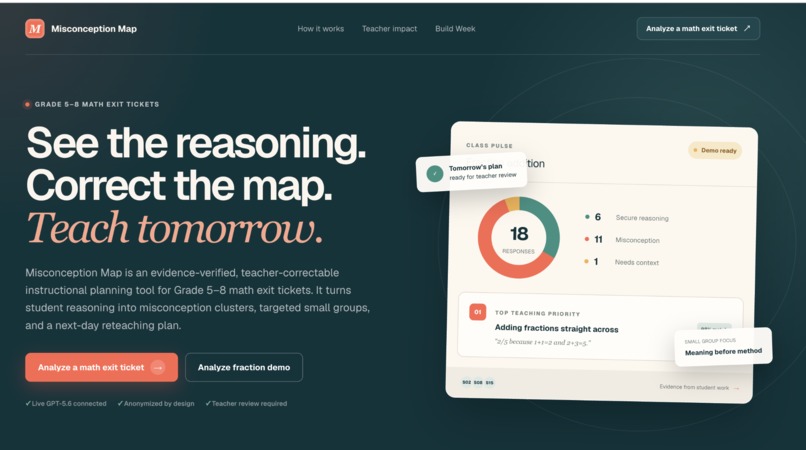
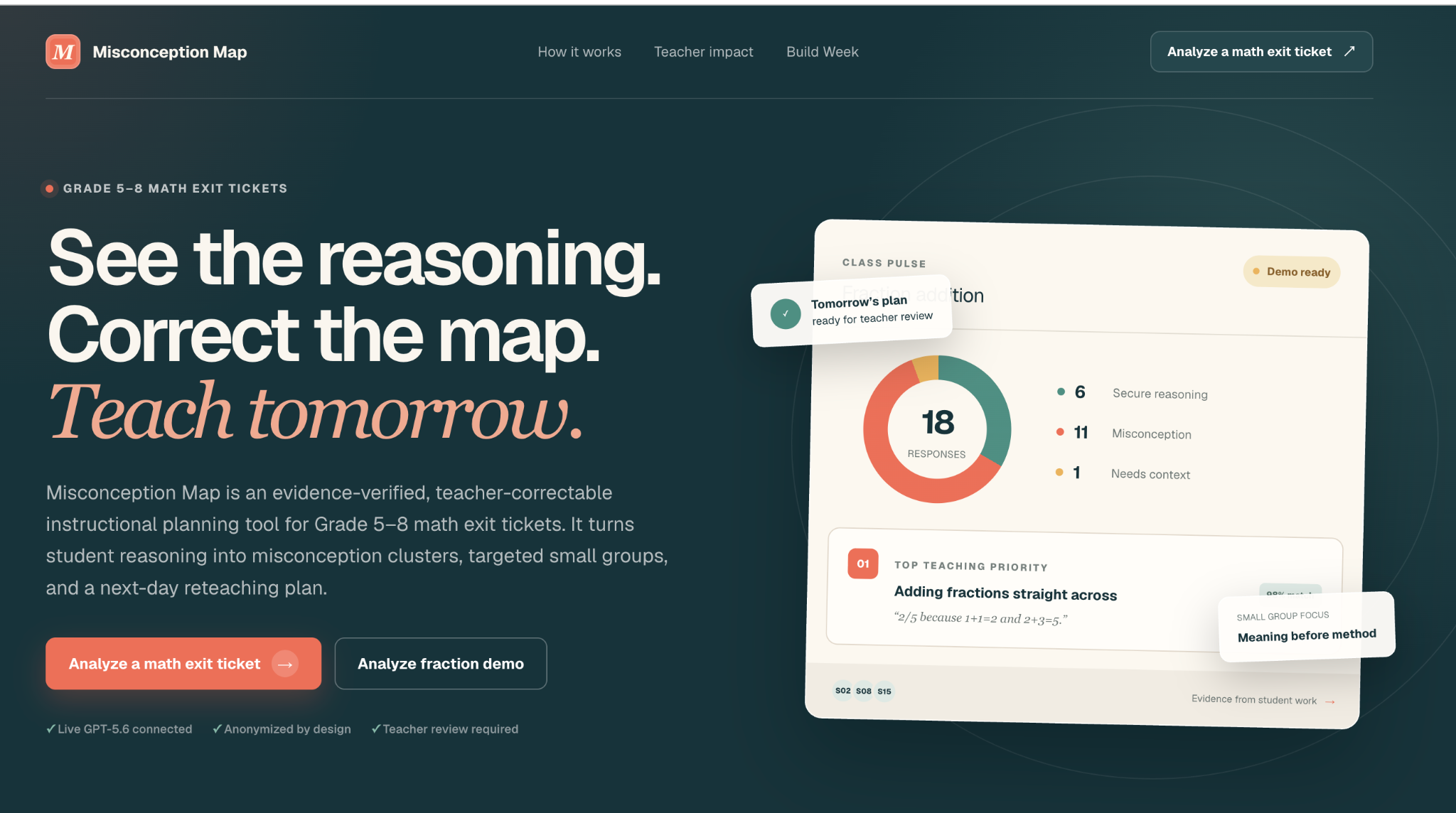
Misconception Map is an evidence-based instructional planning tool for Grade 5–8 mathematics teachers.
Teachers provide:
A learning objective A question and rubric Anonymous student responses
The application then:
Identifies recurring misconception patterns Groups students by reasoning strategy rather than correctness alone Shows evidence from student work supporting each pattern Generates teacher-friendly instructional recommendations Creates targeted small groups Suggests a mini lesson and practice questions Produces an exit ticket for the following lesson Exports reports for planning and documentation
Unlike traditional AI graders, Misconception Map emphasizes student reasoning rather than simply marking answers correct or incorrect.
How we built it
We built Misconception Map as a modern full-stack web application using:
Next.js React TypeScript Tailwind CSS OpenAI GPT-5.6 Codex Zod Markdown & CSV export utilities
GPT-5.6 powers the instructional reasoning layer by analyzing anonymous student responses and identifying evidence-based misconception patterns.
Codex accelerated nearly every stage of development, including:
scaffolding the application architecture building reusable React components implementing the server-side GPT-5.6 integration designing structured JSON schemas generating export functionality creating automated tests improving UI consistency writing documentation and deployment materials
To improve reliability, we also implemented a structured analysis pipeline with schema validation and a clearly labeled demo mode for judges who want to explore the application without configuring API credentials.
Challenges we ran into
One of our biggest challenges was avoiding the trap of building "just another AI grader."
Teachers need trustworthy instructional support, not black-box decisions. We therefore focused on presenting evidence that teachers can review rather than treating AI output as final truth.
Another challenge was balancing reliability with usability. We wanted judges to experience a polished application even without API credentials, while still supporting live GPT-5.6 analysis. Building both a live mode and a deterministic demo mode required additional engineering but greatly improved the overall product experience.
Designing outputs that are genuinely useful in a classroom—rather than simply impressive AI text—also required careful iteration.
Accomplishments that we're proud of
We're especially proud that Misconception Map:
focuses on student reasoning instead of grades translates AI analysis into concrete instructional actions organizes students into meaningful reteaching groups produces lesson-ready teaching materials keeps teachers in control of instructional decisions provides a polished, demo-ready experience while remaining easy to run locally
What we learned
Throughout this project we learned that building educational AI is not only about producing accurate outputs—it is about earning teacher trust.
Teachers need systems that are transparent, actionable, and easy to verify. The most valuable AI products are often those that reduce cognitive workload while keeping humans firmly in control of important educational decisions.
We also learned how much faster high-quality software development becomes when combining GPT-5.6's reasoning capabilities with Codex's software engineering workflow.
What's next for Misconception Map
Future versions could support:
Science explanations Writing and rubric-based assessment Algebra and geometry Multi-question classroom analytics LMS integrations (Canvas, Google Classroom, Schoology) Longitudinal misconception tracking across an academic year Collaborative teacher dashboards Privacy-preserving district deployments
Built With
- ai
- api
- apis
- codex
- css
- csv
- development
- frameworks
- git
- github
- gpt-5.6
- javascript
- languages
- markdown
- next.js
- node.js
- openai
- react
- tailwind
- typescript
- zod


Log in or sign up for Devpost to join the conversation.