-
-
01-project-overview
-
02-explainable-diagnosis
-
03-concept-map
-
04-socratic-coach
-
05-learning-memory
-
06-responsible-ai
Inspiration
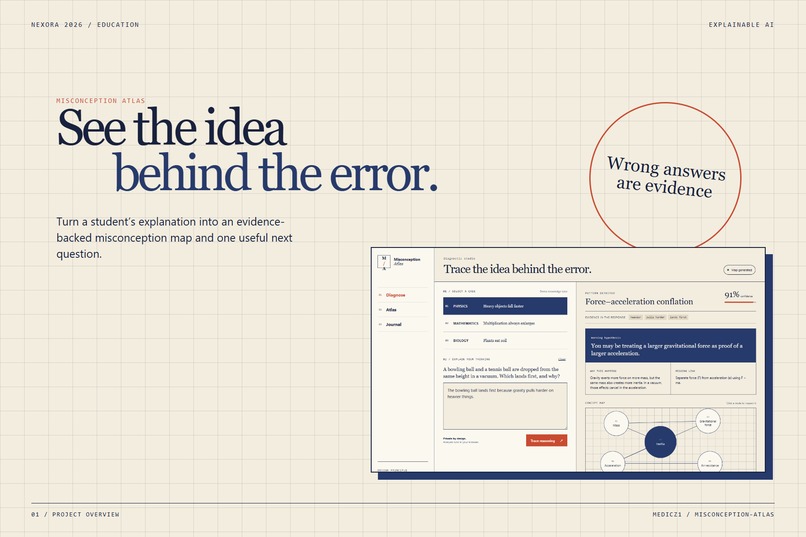
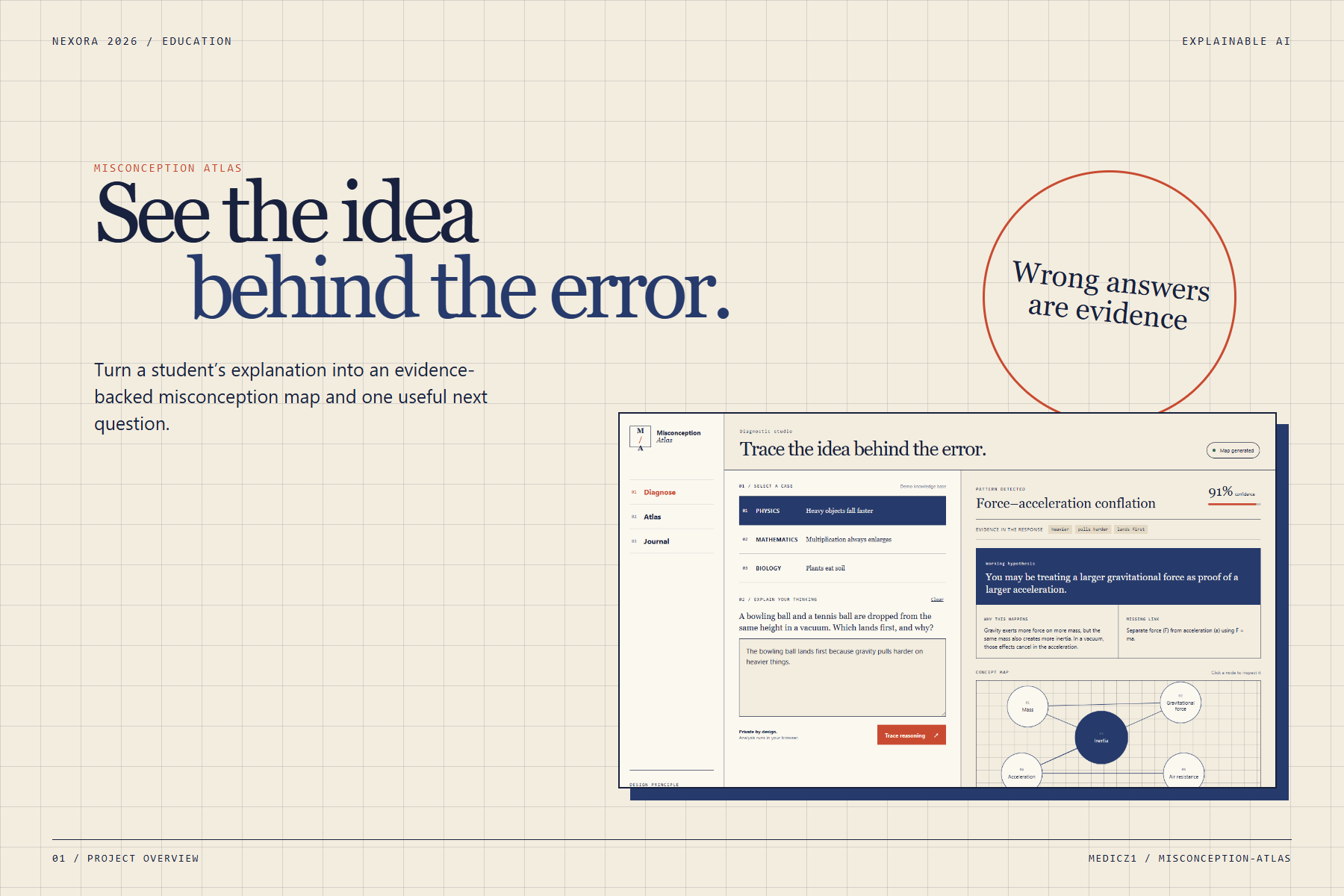
Most educational tools focus on whether an answer is right or wrong. However, the same wrong answer can come from very different mental models. Simply revealing the correct answer may fix one exercise without correcting the underlying misconception. We built Misconception Atlas around a different idea: a wrong answer is evidence, not an endpoint. By making a learner’s reasoning visible, we can provide more targeted feedback, encourage metacognition, and help students build explanations that transfer to new problems.
What it does
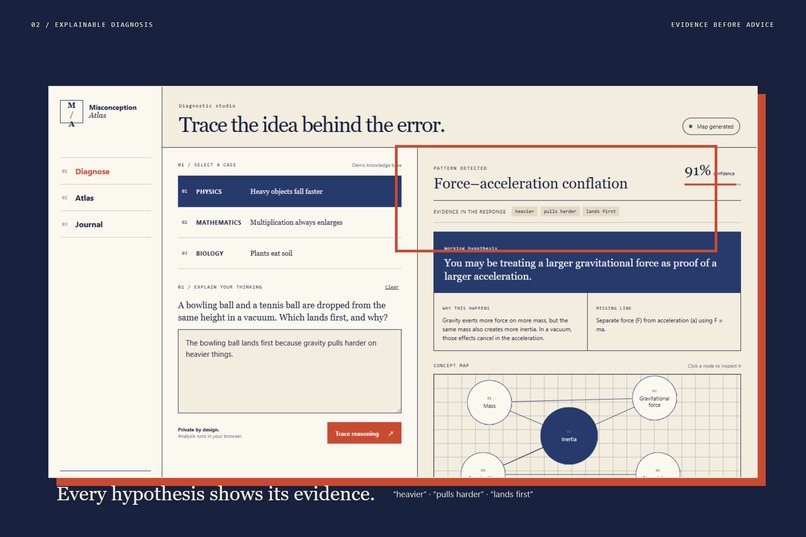
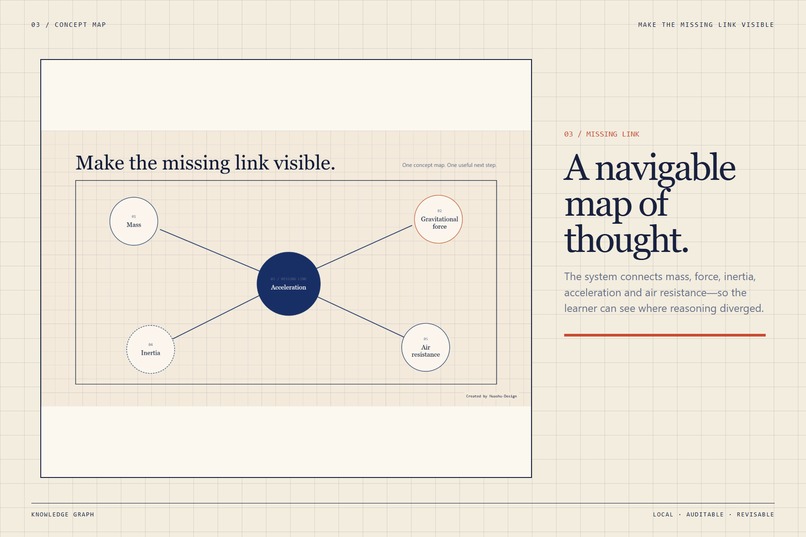
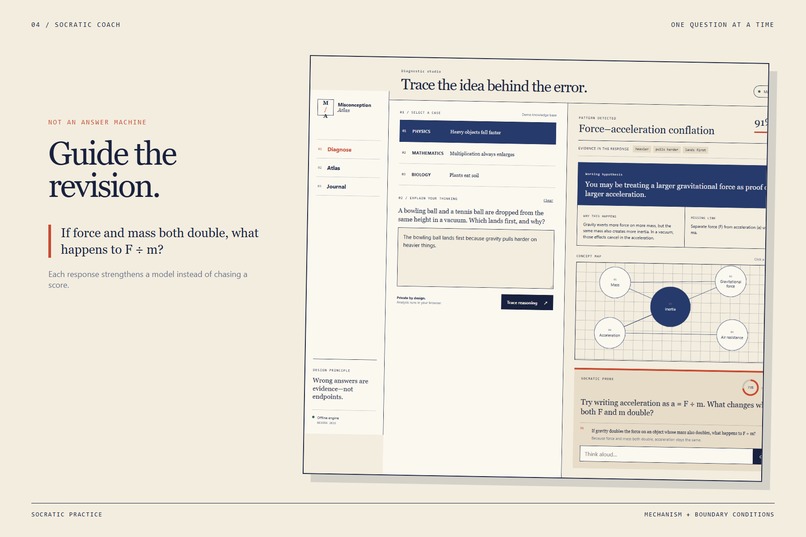
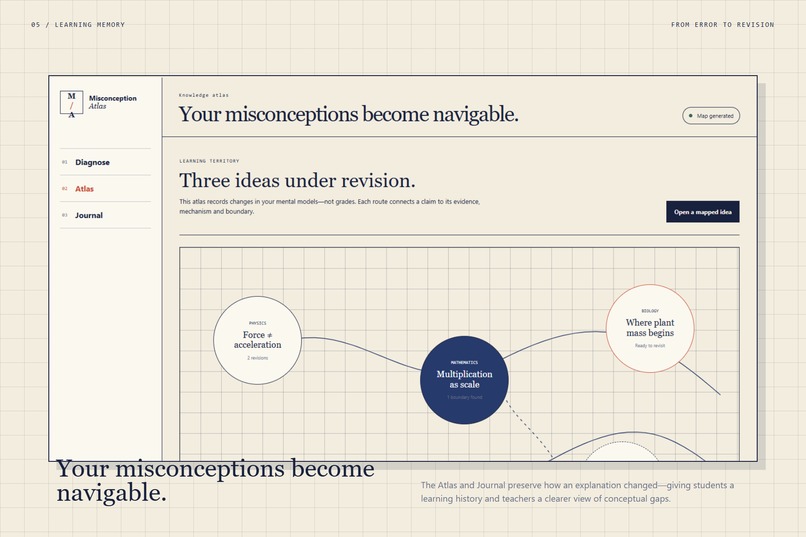
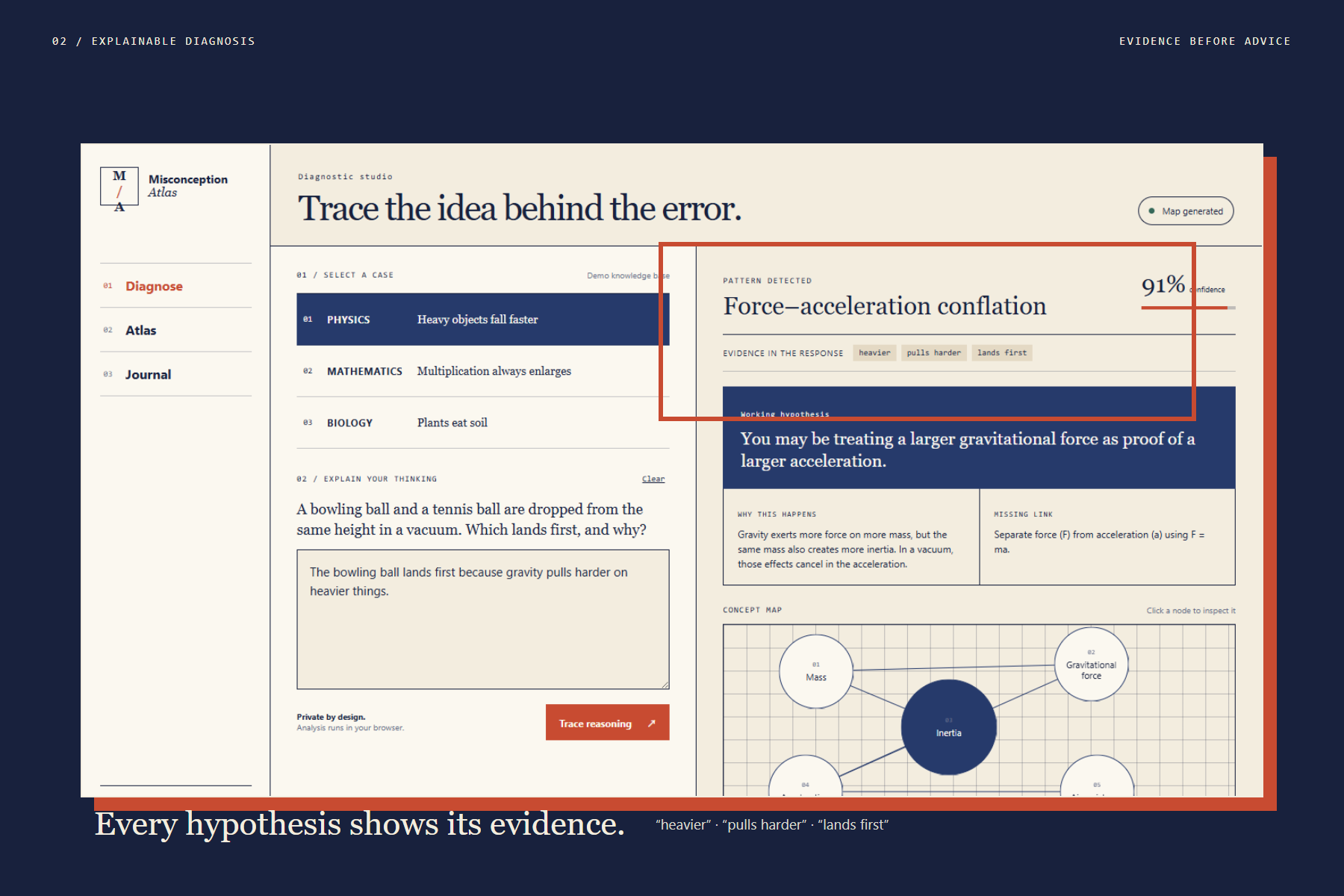
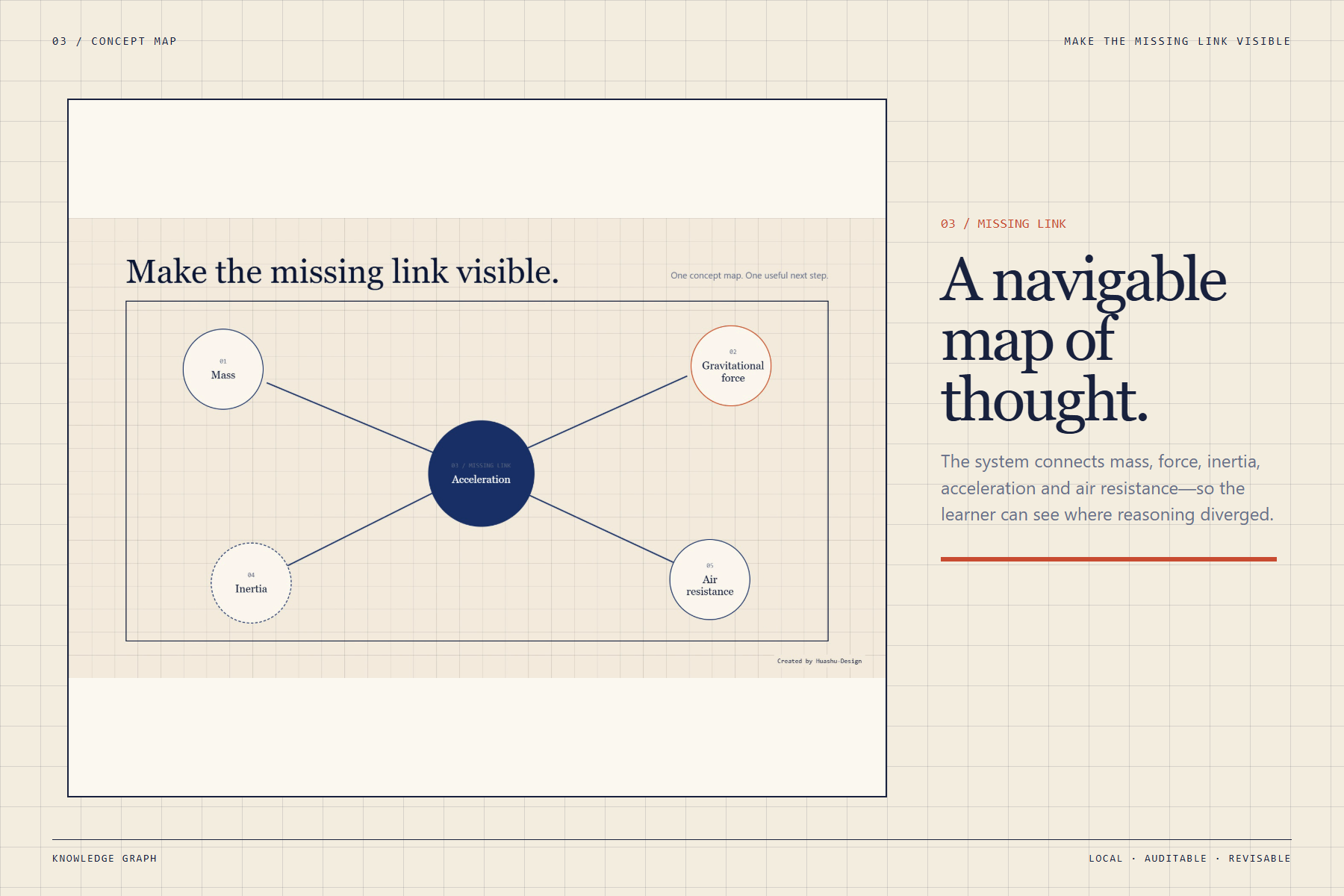
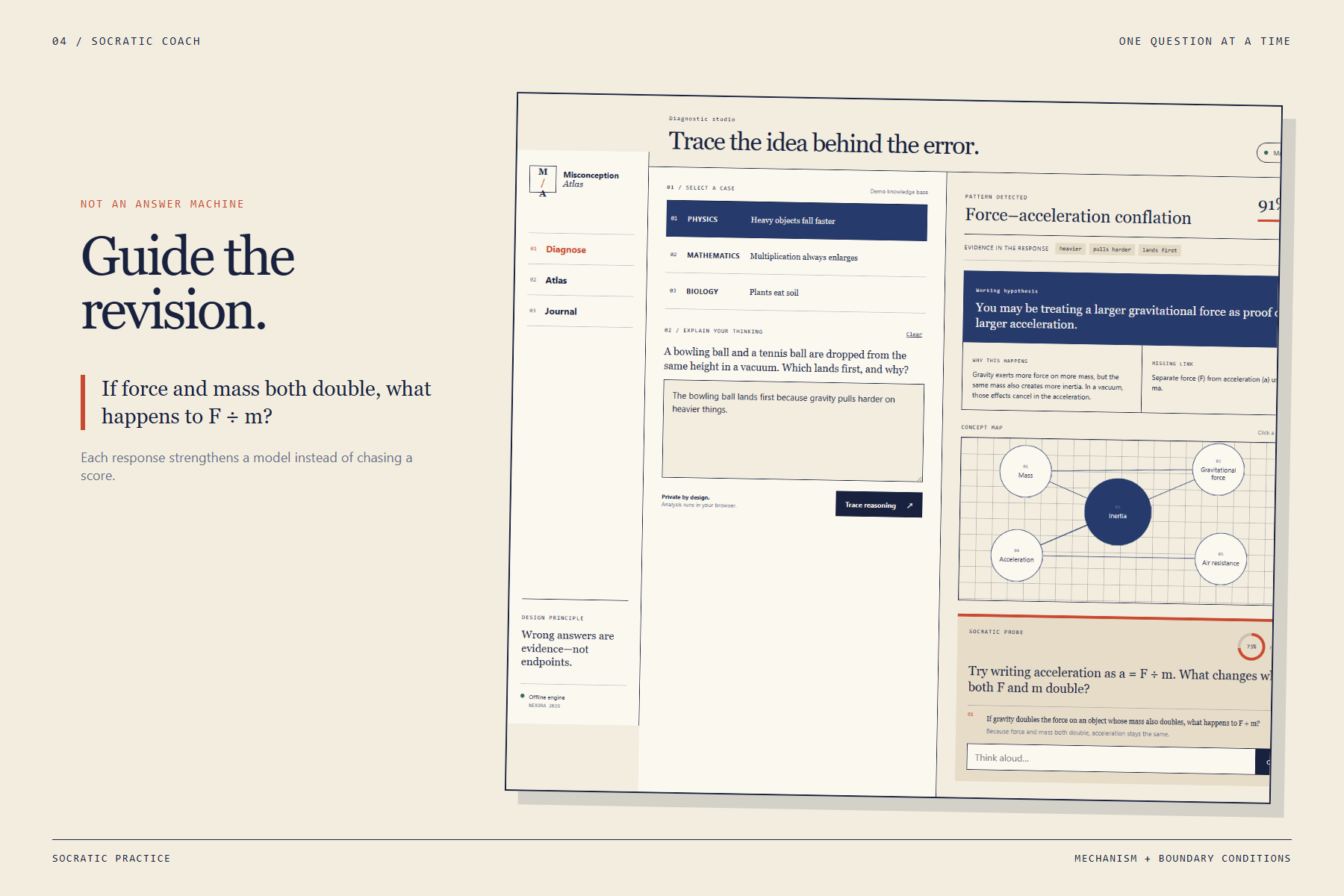
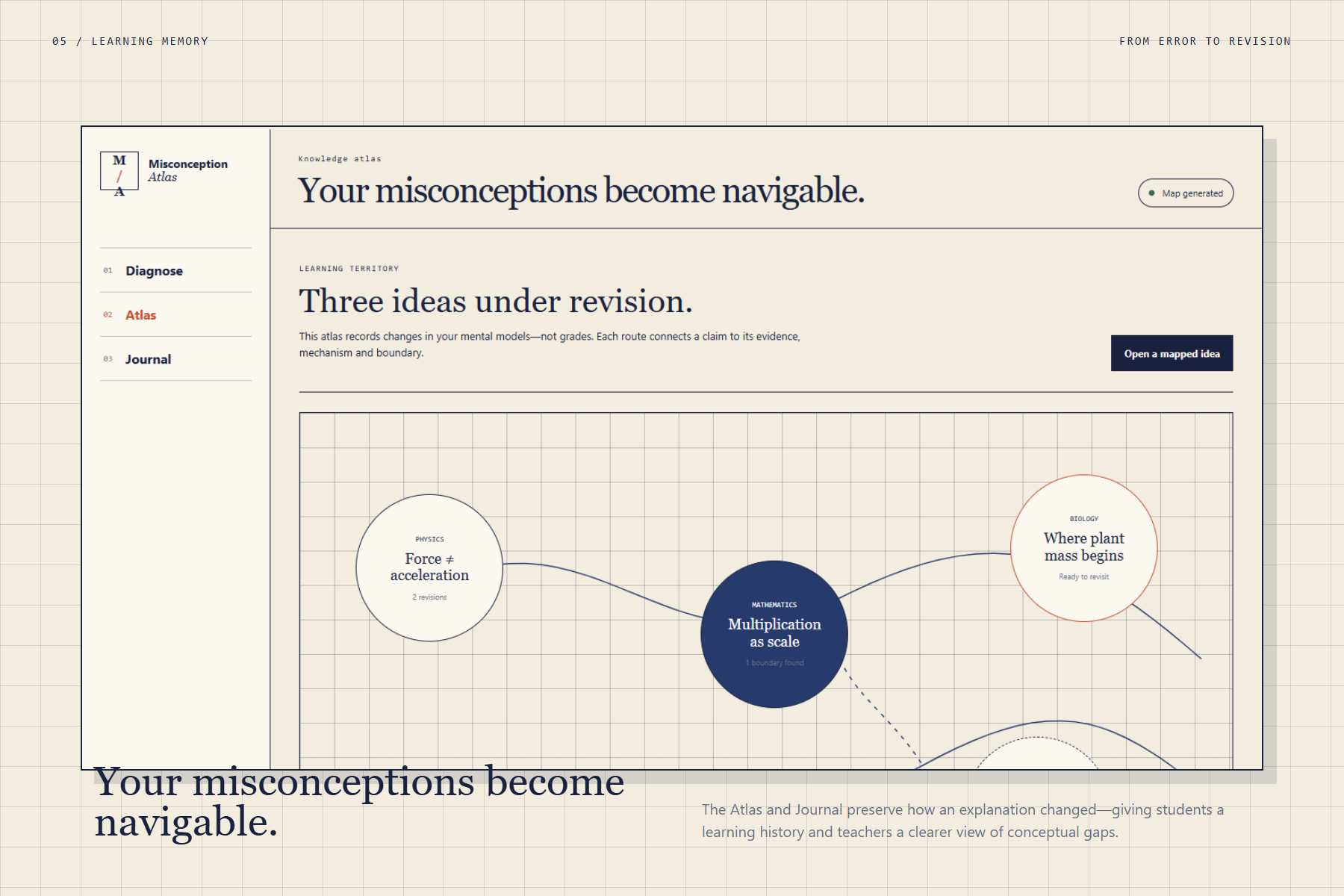
Misconception Atlas is an explainable AI learning coach that turns a student’s written reasoning into a navigable map of thought. A learner can: Select a learning scenario or enter an explanation. Ask the system to trace their reasoning. Review the likely misconception and confidence level. See the exact phrases that influenced the diagnosis. Explore a visual map of related and missing concepts. Answer one Socratic question at a time. Compare their original and revised explanations in a learning journal. The prototype includes interactive cases covering: Forces and motion Multiplication as scaling Photosynthesis Generic reasoning through a safe fallback mode Instead of immediately giving away an answer, the coach asks targeted questions that help the learner discover the missing mechanism or boundary condition.
How we built it
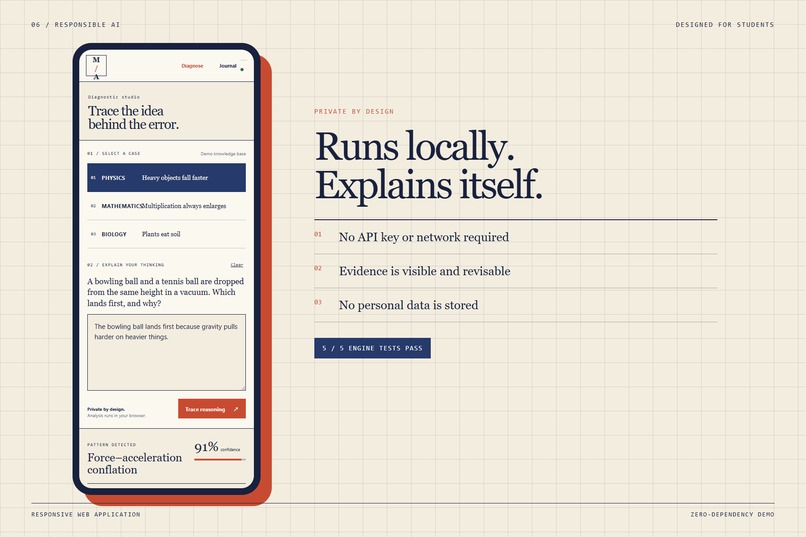
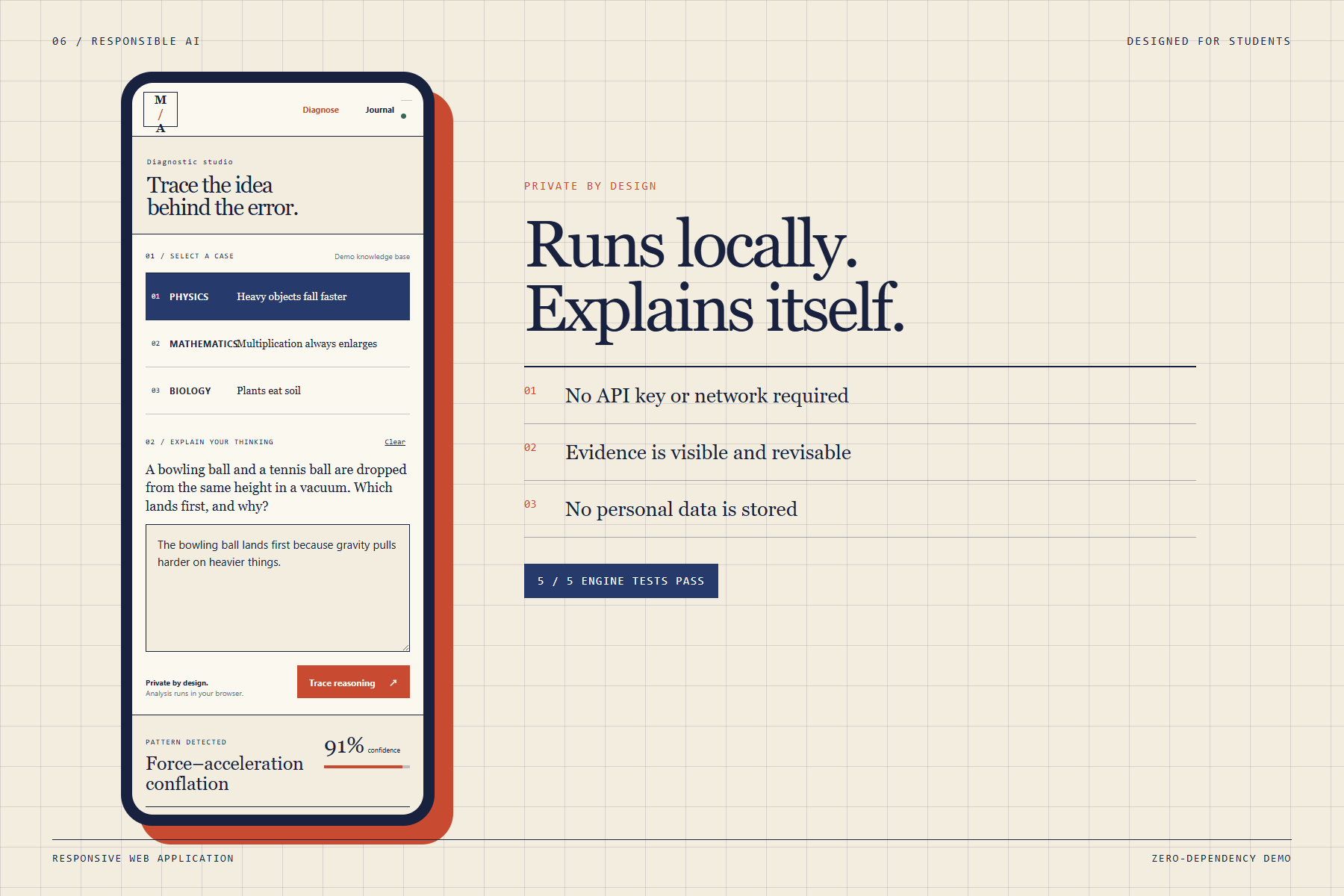
The application is a responsive browser-based experience built with: Vanilla JavaScript and ES modules HTML5 and modern CSS SVG concept-map connections A curated misconception knowledge base An explainable semantic scoring engine Node.js’s built-in test runner HyperFrames and GSAP for the demo video The reasoning pipeline normalizes the student’s explanation, identifies relevant concepts and linguistic signals, weighs supporting and contradictory evidence, and produces a revisable diagnostic hypothesis. Conceptually, each candidate misconception receives an evidence score: [ S(m)=\sum_i w_i e_i-\sum_j p_j c_j ]where (e_i) represents supporting evidence, (w_i) its weight, (c_j) contradictory evidence, and (p_j) the corresponding penalty. The interface exposes the evidence behind the result instead of presenting the output as an unquestionable AI judgment. It then selects a counterexample or mechanism-focused Socratic question and evaluates whether the learner’s revision includes stronger causal reasoning and appropriate boundary conditions. Everything runs locally in the browser. The prototype requires no API key, sends no student text to an external service, and stores no personal information.
Challenges we ran into
The hardest challenge was diagnosing reasoning without overclaiming. Student explanations can be incomplete or ambiguous, so Misconception Atlas presents each diagnosis as a revisable hypothesis rather than a permanent label. We also had to balance flexibility with explainability. Instead of relying on a black-box model, we built a transparent reasoning engine that shows the supporting phrases, contradictory evidence, confidence score, and concept relationships behind every result. Another challenge was turning diagnosis into useful teaching. The system needed to guide learners without simply revealing the answer, so we designed a Socratic flow that introduces one counterexample, mechanism, or boundary condition at a time. Finally, we built and verified the application, responsive interface, automated tests, visual assets, and narrated demo within the hackathon timeframe.
Accomplishments that we're proud of
Built a complete, responsive educational AI experience Created an explainable reasoning engine with visible evidence Added interactive cases for physics, mathematics, and biology Implemented adaptive Socratic coaching and revision tracking Designed a visual atlas of connected misconceptions Created a before-and-after learning journal Made the application run locally without API keys Kept student reasoning private and on-device Added automated tests and desktop/mobile browser verification Produced a narrated 1080p demonstration video
What we learned
We learned that explainability can be part of the learning experience, not merely a technical audit feature. When students can see why the system formed a hypothesis, they are encouraged to examine both their own reasoning and the AI’s reasoning. We also learned that uncertainty should be communicated clearly. A confidence score should not make an AI appear authoritative; it should help users understand how much evidence supports a conclusion. Most importantly, we found that conceptual progress is often better represented by a stronger explanation than by a higher score. Preserving before-and-after reasoning makes that progress visible.
What's next for Misconception Atlas
Next, we plan to add: A teacher authoring studio for curriculum-specific misconception maps Multilingual text and voice interaction An on-device language model for open-domain explanations Privacy-preserving classroom analytics Spaced repetition driven by concept-map changes Import and export through open learning standards Collaborative tools for identifying classroom-wide learning gaps More subjects, age groups, and accessibility options Our long-term goal is to create educational AI that does not merely generate answers, but helps learners test, revise, and strengthen their own understanding.
Built With
- css3
- edtech
- es-modules
- explainable-ai
- gsap
- html5
- hyperframes
- javascript
- knowledge-graph
- local-first-ai
- natural-language-processing
- node.js
- privacy-preserving-ai
- responsive-design
- socratic-learning
- svg
- symbolic-ai


Log in or sign up for Devpost to join the conversation.