-
-
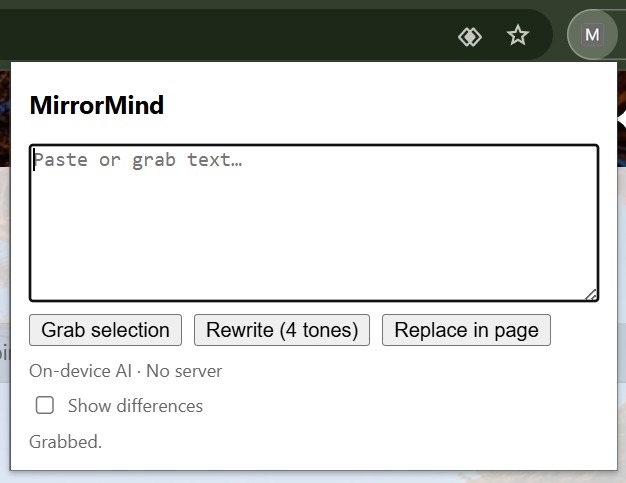
On-device AI. No server
-
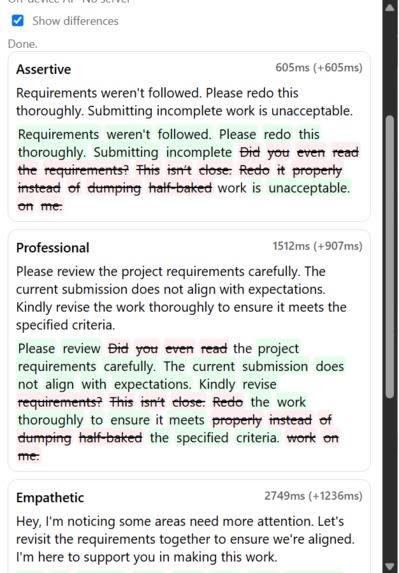
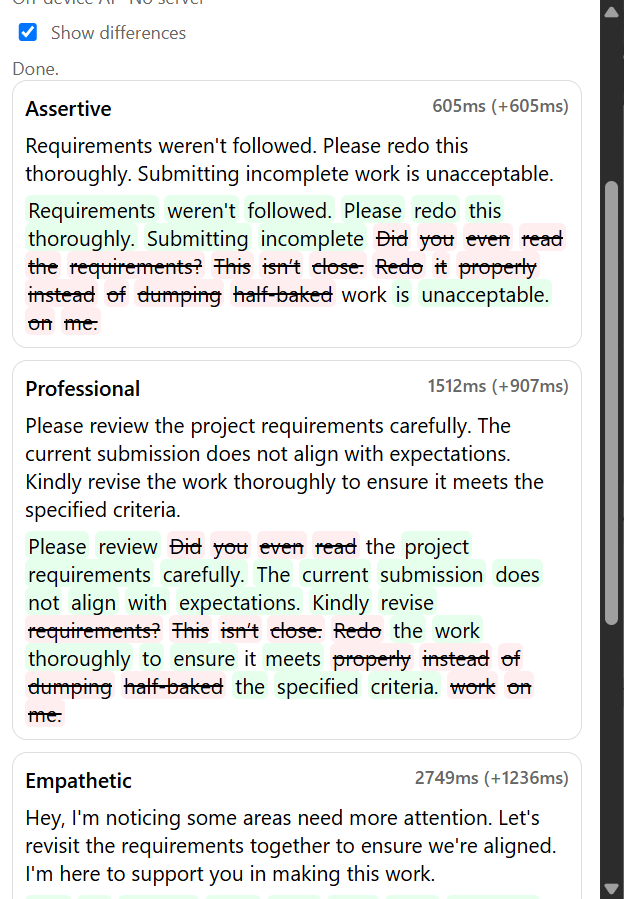
Diff: see exactly what changed
-
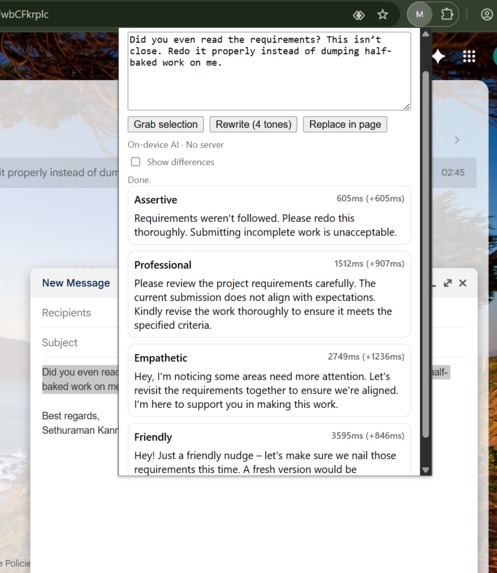
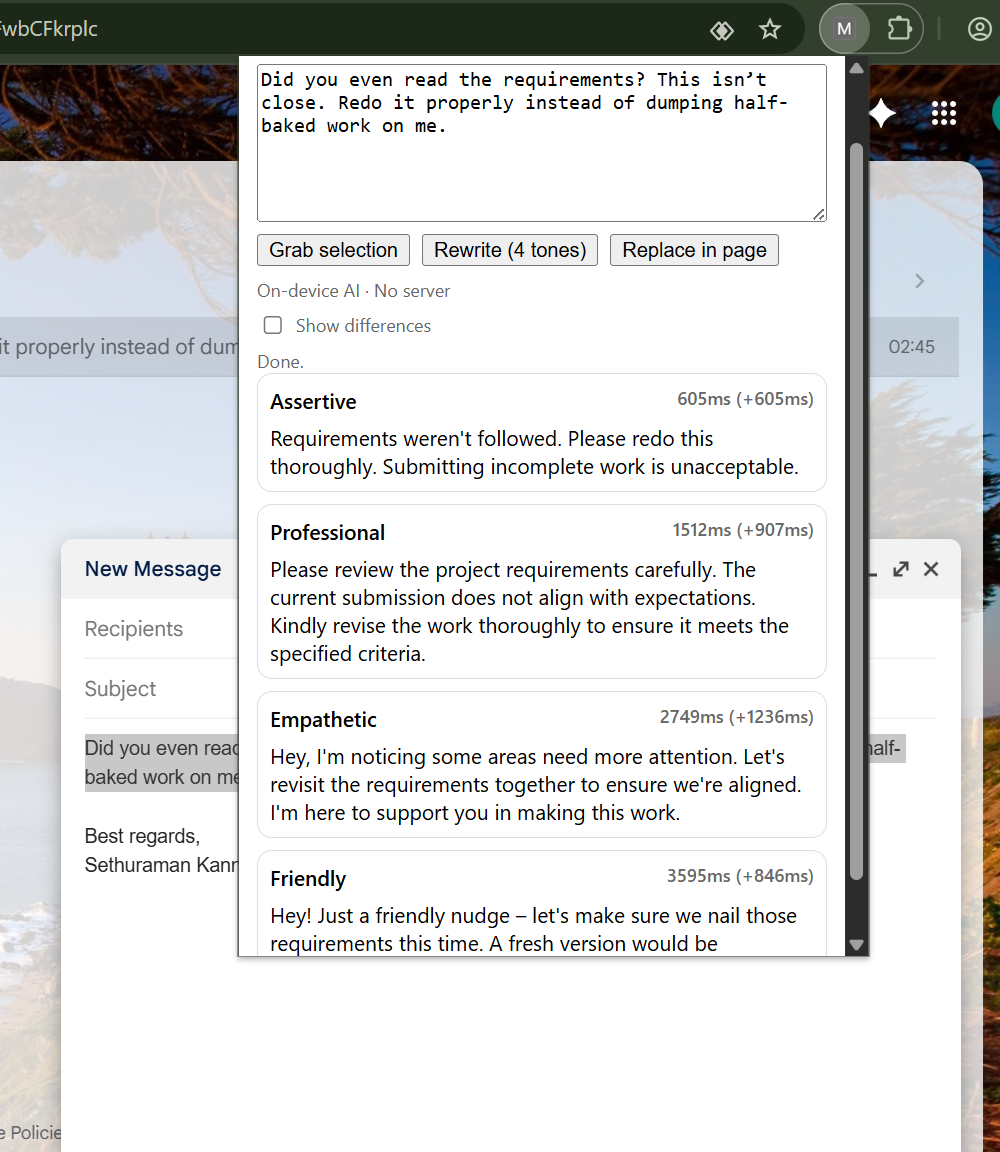
Select text --> Rewrite (4 tones)
Inspiration
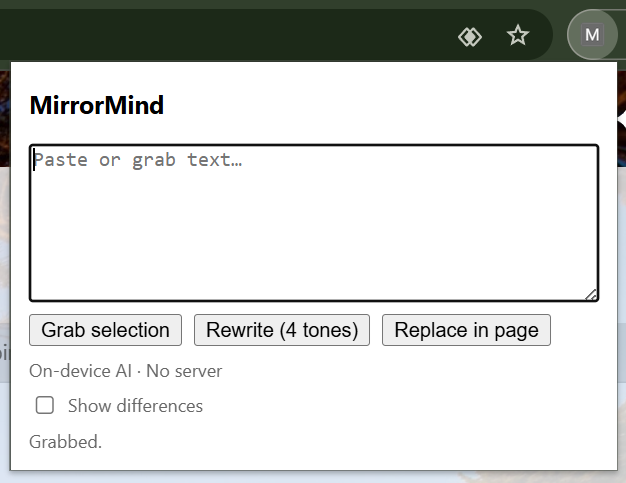
Poorly toned emails and PR comments waste time, damage trust, and create avoidable back-and-forth. Existing tone tools feel slow, cloud-dependent, or too configurable for real work. Chrome’s built-in AI changes the equation: on-device rewriting with predictable latency and strong privacy. MirrorMind is a focused experiment in fast, visible correction of tone inside the page you’re already using.
What it does
- Rewrites selected text into four tones: Assertive, Professional, Empathetic, Friendly.
- Streams variants in parallel, showing per-tone latency and \( Δ \) since the previous completion.
- Optional diff view to highlight insertions and deletions.
- Replace in page (button or double-click a card) with preserved URLs, IDs, and code.
- Runs entirely on-device via Chrome’s Rewriter API (Gemini Nano); no servers.
How we built it
- MV3 extension architecture
- Popup UI: minimal HTML/CSS/JS; renders cards incrementally.
- *** Content script (all frames,
match_about_blank): *** robust Grab Selection and safe Replace. - *** Service worker: *** popup open behavior; no network calls.
- Model usage
- Rewriter API (Gemini Nano) with
format: 'plain-text'andoutputLanguage: 'en'. - One warm singleton per popup session; four concurrent
rewrite()calls with compact, tone-specific contexts.
- Performance discipline
- Hardware acceleration enabled; prefer dGPU when available.
- Timers: show per-tone runtime \( t_i \) and inter-arrival \( Δ_i = t_i - t_i-1 \)
- Avoided sliders/knobs to keep interaction cost near zero.
Challenges we ran into
- Availability & gesture gating: the model must download under a trusted user gesture. Fixed by triggering
Rewriter.create()inside the click handler and surfacing progress. - Performance variance (CPU fallback): when the GPU was disabled, latencies spiked. Solved by forcing Chrome to the high-performance GPU and keeping a warm instance.
- iframe editors (Gmail, LinkedIn): selections often live in child frames. Solved with an all-frames content script plus an all-frames
executeScriptfallback. - Language requirement: Rewriter requires an explicit output language; enforced at both create() and rewrite() to silence runtime warnings.
- Scope creep pressure: resisted adding sliders/micro-actions; focused on speed, clarity, and reliability.
Accomplishments that we're proud of
- Consistent warm performance: four tones completing in a few seconds end-to-end, with visible streaming and per-tone timing.
- Clean replace flow across common editors without extra configuration.
- Zero backend: privacy by default, simple permissions, deterministic UX.
- Readable prompts/guards: concise constraints that preserve meaning and avoid invented commitments.
- Privacy posture: All rewriting happens locally in Chrome’s built-in AI. No text leaves the browser. Permissions are limited to activeTab, scripting, and host access to support cross-frame selection and in-page replace.
What we learned
- On-device LLM UX is won by token discipline and persistent instances, not just API calls.
- Real-world editors require all-frame thinking and careful fallbacks.
- Exposing latency as a first-class signal (\( ms \) and \( Δ \)) builds trust more than slideware.
- Minimal UI beats configurability for this task: choose, insert, move on.
What's next for MirrorMind - On-device tone rewriter for Chrome
- Team presets and org guardrails: curated tone profiles with domain-specific constraints.
- Inline mini-toolbar: appear near selections inside editors; fewer clicks.
- Multilingual variants: switch
outputLanguage(e.g., es, ja) with localized tone guidance. - Local history and undo: privacy-preserving, on-device only; no telemetry.
- Hardening & tests: structured prompts, regression samples, and perf budgets per environment.
Built With
- chrome
- css
- gemini
- html
- javascript
- nano
- rewriter-api

Log in or sign up for Devpost to join the conversation.