-
-
MirrorMe 1
-

MirrorMe 2

The Problem
Every year, shoppers return over $550 billion worth of clothing — not because it was the wrong size, but because it didn't look right on them. Try-on apps show you the garment. Skin apps analyze your face. Nobody has ever connected the two into one unified intelligence.
MirrorMe is the first platform to treat skin health and clothing choice as a single, co-dependent decision.
What It Does
MirrorMe is an agentic AI styling platform that:
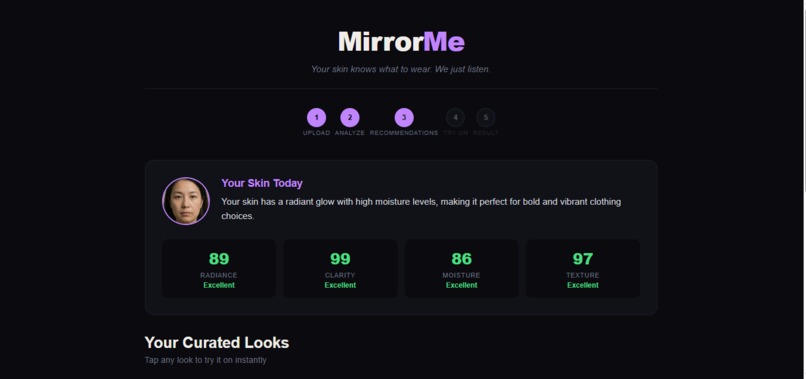
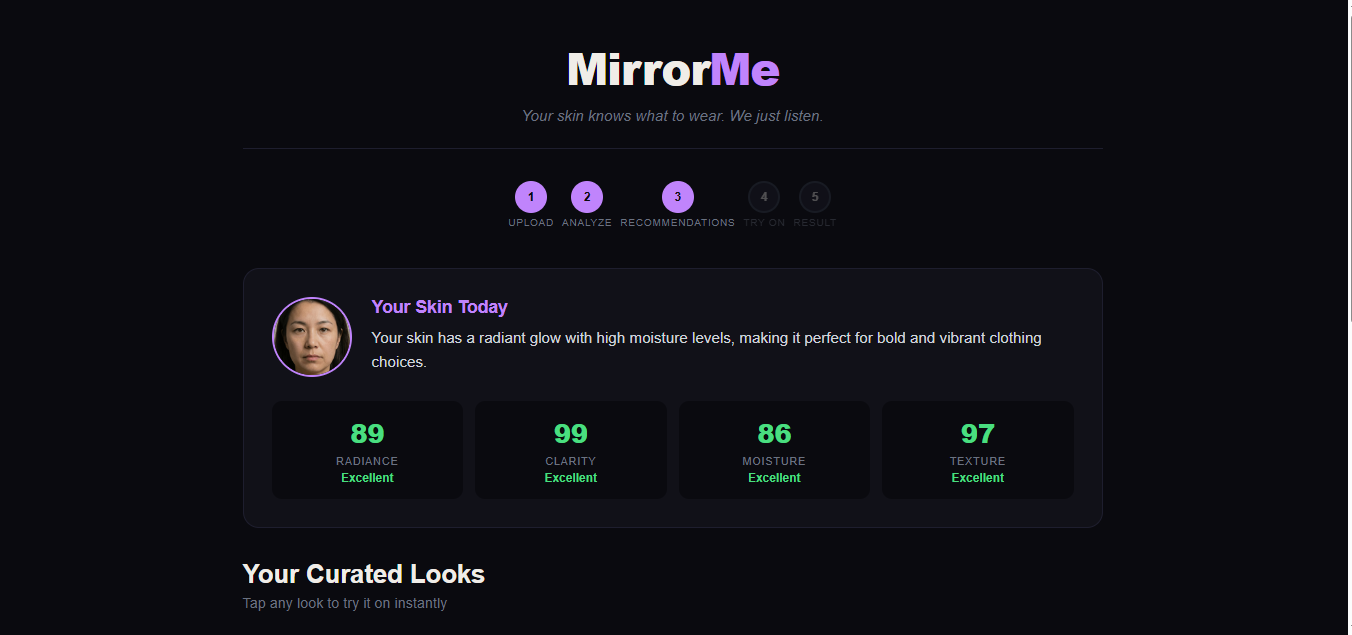
- Reads your skin using YouCam's Skin AI API — analyzing radiance, redness, moisture, texture, acne, and oiliness from a single selfie
- Reasons across your skin data using an LLM agent that applies color theory, neckline compatibility, and fabric science to your real skin scores
- Curates 3 garment recommendations with confidence scores and explanations of why each garment works for your skin today
- Renders each look on you using YouCam's generative Apparel VTO API
The agent's reasoning is visible. The connection between your skin and your clothing is explicit. This is not two features side by side — it is one unified intelligence.
How I Built It
Backend: FastAPI (Python) deployed on Render.com
Skin Analysis: YouCam Skin AI API — SD mode analyzing 7 dimensions: radiance, redness, moisture, acne, texture, oiliness, and skin type
Style Agent: Groq API running LLaMA 3.3 70B — receives real skin scores and reasons across color theory and fabric science rules to rank garments
Virtual Try-On: YouCam Apparel VTO cloth-v3 API — renders selected garment onto user photo
Frontend: React 18 deployed on Vercel
Agent Reasoning Rules (built on real YouCam skin score fields):
radiance > 75→ Bold jewel tones amplify natural glowredness < 50→ Cool blues and greens counterbalance inflammationmoisture < 50→ Avoid satin; recommend matte linen or cottonacne < 50→ Solid colors over busy printsoverall > 75→ Bold choices encouraged
The Non-Obvious Insight
Beauty and fashion decisions rarely happen in isolation. What someone wears and how their skin looks are part of the same self-image. A person with high redness today gravitates toward cool-toned clothing. Someone with high radiance wants bold colors that match their glow. These are real, documented consumer behaviors that no single platform has addressed as a unified workflow.
MirrorMe addresses this at the API level — not as a UX feature, but as a reasoning architecture.
Challenges
The biggest challenge was the photo requirement conflict between the two YouCam APIs. Skin AI requires the face to occupy 60-80% of the image width, while Apparel VTO performs best with full upper body photos. I resolved this by implementing automatic image resizing and building the UX flow to guide users toward the optimal photo format for each step.
The second challenge was parsing the YouCam Skin AI response correctly — results come as a ZIP file containing a score_info.json with nested score objects. Building a robust parser that extracted the right fields for the agent reasoning layer required careful reading of the real API documentation.
What I Learned
Reading the real API documentation before writing code is non-negotiable. Every hour spent on documentation saved three hours of debugging. The YouCam API response schema, image requirements, and async polling pattern were all critical details that only appeared in the actual docs — not in any third-party tutorial.
YouCam APIs Used
- Skin AI —
POST /s2s/v2.0/task/skin-analysis(SD mode, 7 dimensions) - Apparel VTO v3 —
POST /s2s/v2.0/task/cloth-v3
Live Demo
Try it: https://frontend-plum-nu-bkt57sgnz5.vercel.app
Upload a clear front-facing selfie. The app will analyze your skin, reason across the scores, and show you three garments curated specifically for your skin profile today.
Built With
- cloudinary
- fastapi
- groq
- llama-3.3
- python
- react
- render
- vercel
- youcam-apparel-vto-api
- youcam-skin-ai-api

Log in or sign up for Devpost to join the conversation.