

Inspiration
We've all been there—rehearsing in the mirror before a tough conversation, replaying what we should have said, or walking away from a meeting wishing we’d handled it better. Whether it's asking for a raise, confronting a friend, or giving critical feedback at work, these moments often define relationships, careers, and self-worth. But most people never get a chance to practice them safely.
What it does
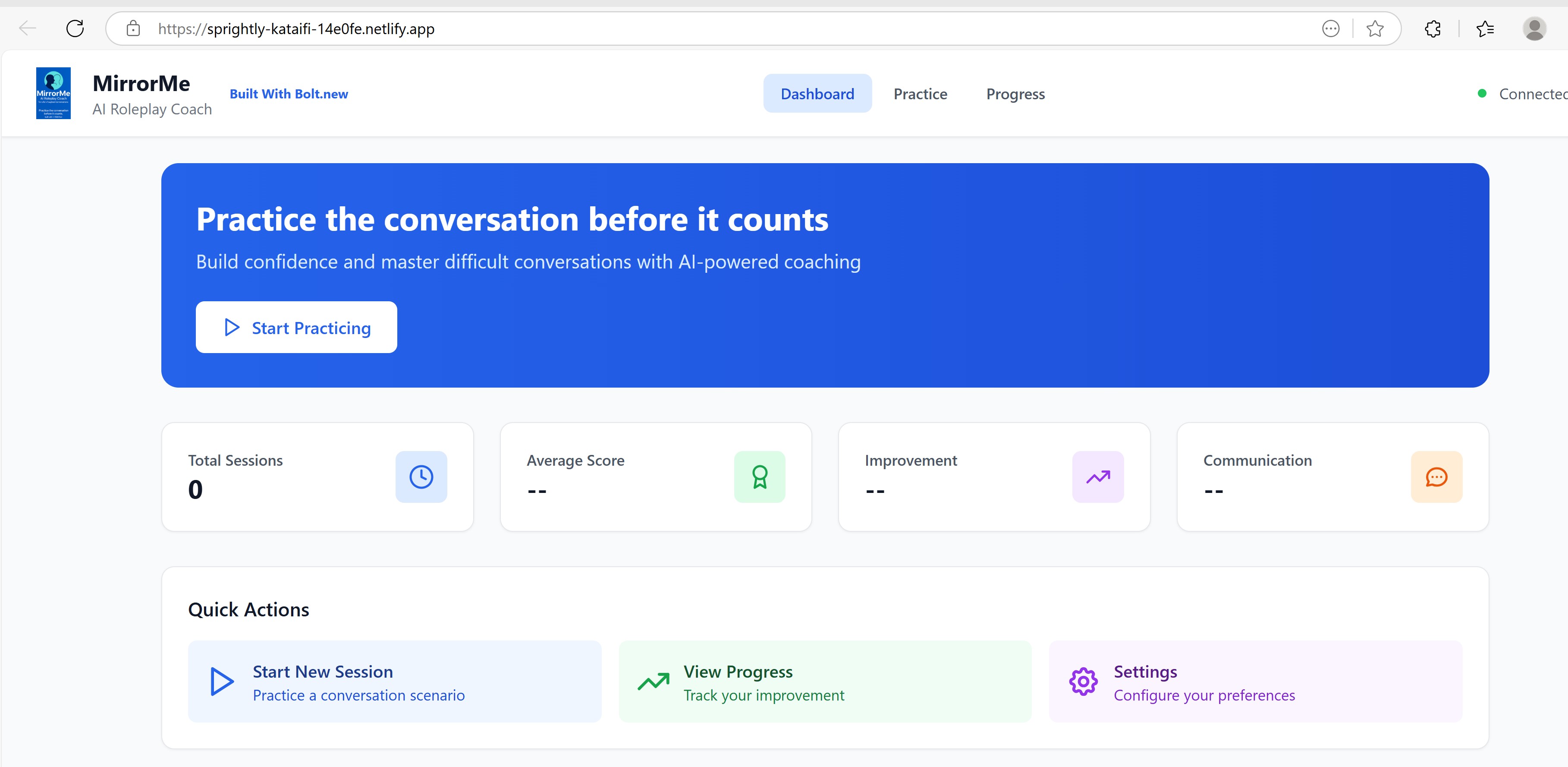
Inspired by the simple human need to feel heard, understood, and prepared, MirrorMe transforms your screen into a safe, smart rehearsal space powered by AI. We envisioned a coach that’s always available—non-judgmental, emotionally intelligent, and trained on the psychology of real human conversations. In a world increasingly shaped by communication—remote work, interviews, difficult social dynamics—we wanted to remove the fear of “saying the wrong thing.” What if, instead of avoiding hard conversations, people had the confidence to face them head-on? MirrorMe isn’t just an app. It’s a practice partner for the conversations that matter most. Because preparation isn't just about having the right words—it's about building the courage to say them well.
How we built it
Our Build Process
- Requirements-Driven Development Instead of writing code, we authored a comprehensive Product Requirements Document (PRD) outlining all user stories, core features, and acceptance criteria. We communicated directly with Bolt.new by submitting detailed prompts, describing desired functionality, UX flows, and improvement requests.
- Iterative Prompting & Rapid Enhancement The development cycle was highly interactive: • We submitted requirements or improvement prompts. • Bolt.new instantly generated new features or refined existing ones based on our feedback. • This allowed for rapid prototyping, continuous user testing, and iterative enhancements in near real time.
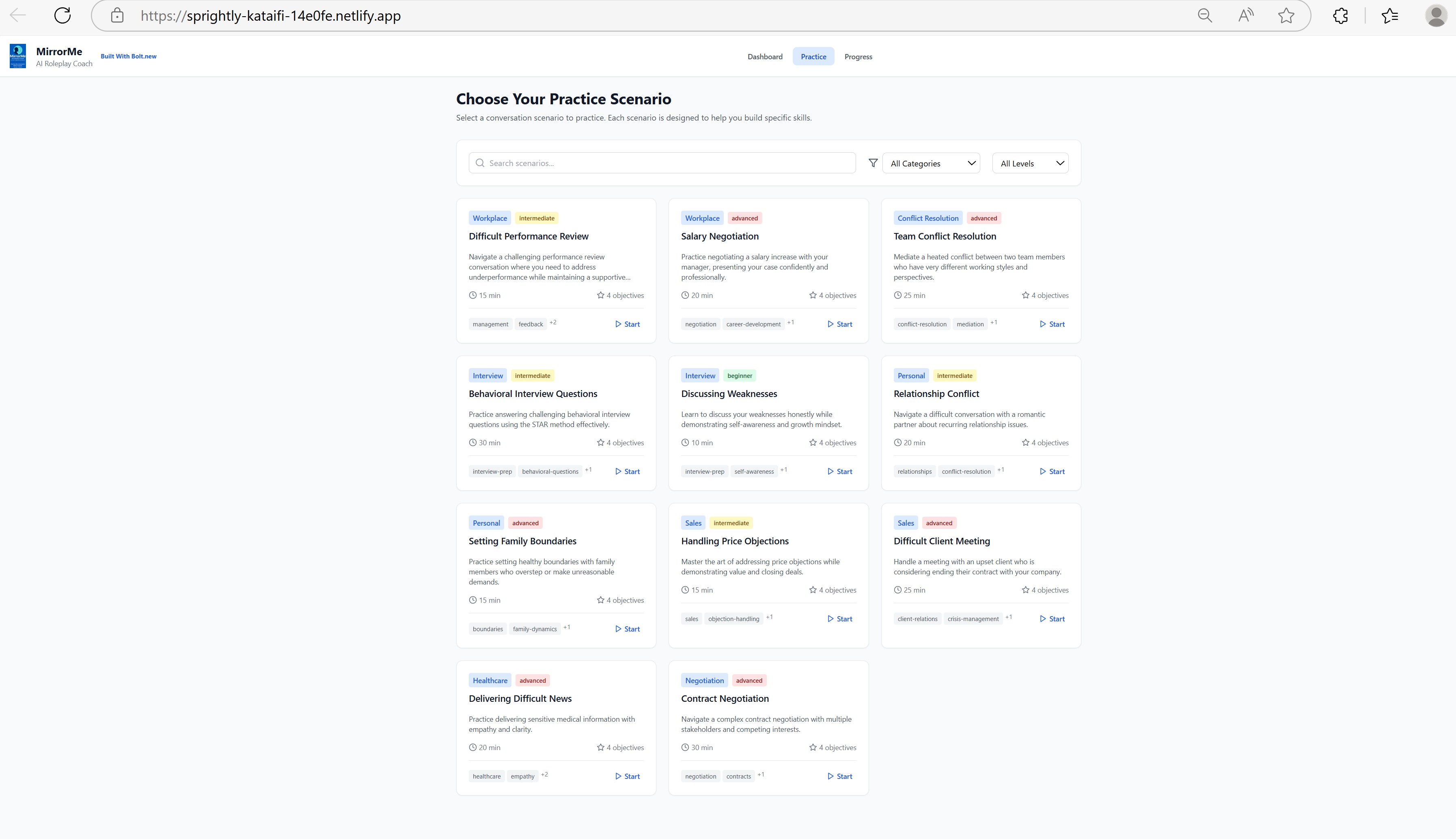
- Scenario Library & Personalization We defined the categories, difficulty levels, and customization options for our scenario library within our requirements. Bolt.new’s visual tools made it easy to expand and adapt the scenario architecture as we iterated on user feedback.
- AI Conversation Engine Integration Rather than setting up backend infrastructure, we used Bolt.new’s prebuilt modules and integration system: • We specified the need for advanced NLP, emotional intelligence, and fast multi-turn conversation support in our prompts. • Bolt.new handled the technical integration, ensuring seamless AI-driven dialogue and sentiment analysis.
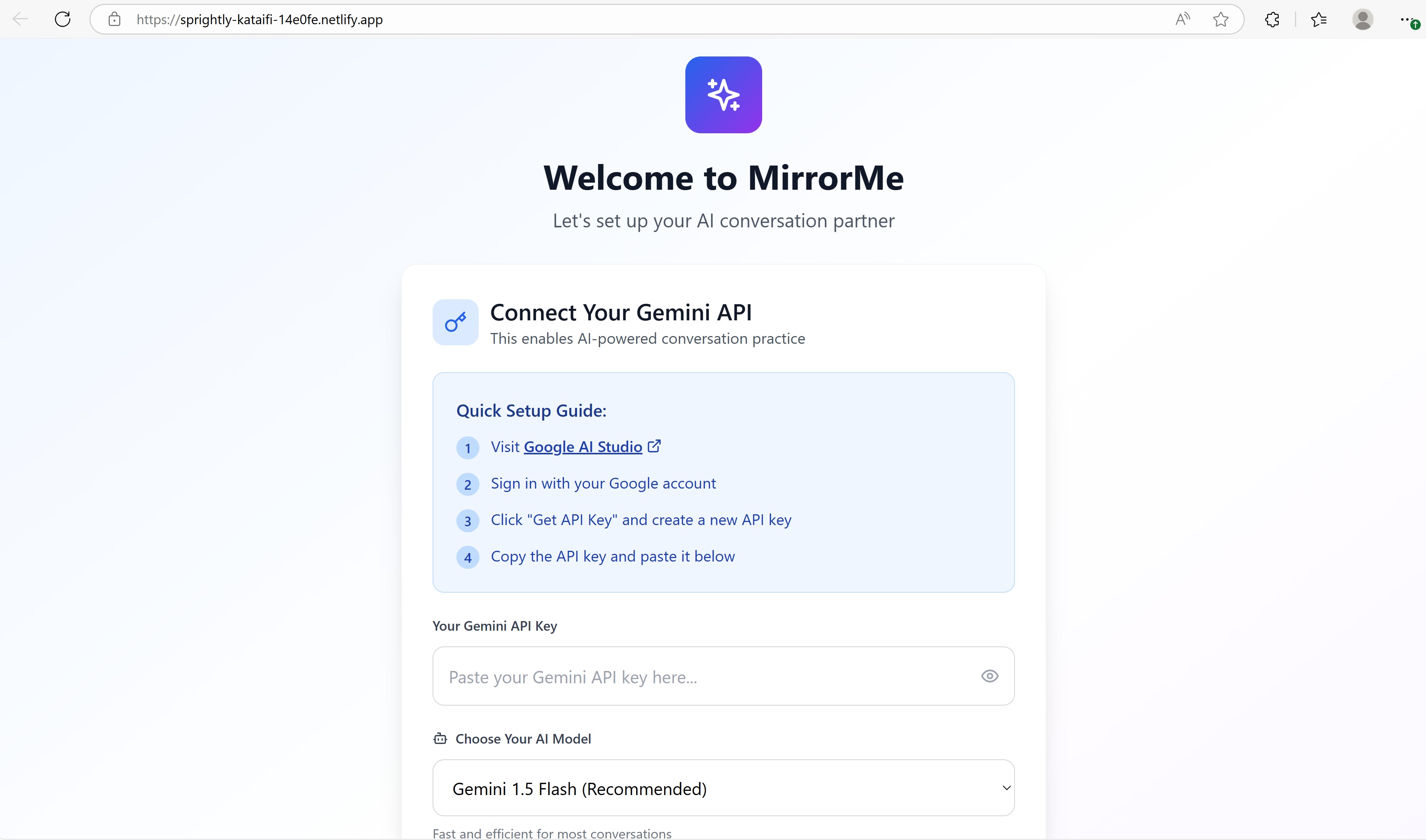
- Cost-Efficient LLM Usage with Gemini Key Input Managing the cost of large language models (LLMs) was a major concern. To address this: • We prompted Bolt.new to add a Gemini API Key input feature. • This allows each user to enter their own Gemini key, unlocking the AI features for themselves. • As a result, we eliminated the need to cover ongoing LLM expenses centrally, making our solution scalable and sustainable for both us and end users.
- User Experience & Feedback Throughout, we focused on clarity, accessibility, and actionable feedback. Bolt.new’s vibe coding platform ensured consistent UI/UX design across devices, and our feedback prompts quickly translated into tangible product improvements.
Challenges we ran into
• Prompt Precision and Ambiguity: Translating nuanced product requirements into actionable prompts for Bolt.new was sometimes challenging. Small ambiguities could result in unexpected behaviors or require multiple iterations to get features just right. • Scenario Complexity: Designing scenarios that felt realistic, emotionally nuanced, and adaptive required careful balancing. Ensuring the AI maintained context and character consistency across multi-turn conversations was especially demanding. • User Onboarding for Gemini Key: Introducing the Gemini API key input feature improved scalability, but it also created a new onboarding step for users. We needed to make the process intuitive and provide clear instructions, especially for non-technical users. • Real-Time Feedback Tuning: Delivering feedback that was timely, actionable, and supportive—without overwhelming the user—required several rounds of user testing and refinement. • Managing AI Response Quality: Ensuring that AI-generated responses were consistently appropriate, context-aware, and emotionally intelligent across a wide variety of topics sometimes required prompt or scenario re-engineering. • Scalability of Content: As our scenario library grew, organizing, tagging, and maintaining quality across hundreds of scenarios became more complex, highlighting the need for scalable content management tools.
Accomplishments that we're proud of
• Prompt-Driven Development: We successfully built a robust, user-friendly AI coaching platform entirely through requirements and iterative prompts, without writing traditional code—demonstrating the power and agility of the Bolt.new vibe coding platform. • Cost-Efficient AI Integration: By enabling users to input their own Gemini API keys, we overcame one of the biggest hurdles for AI products: managing large language model (LLM) costs at scale. • Rich Scenario Library: We curated and structured a diverse library of 500+ realistic conversation scenarios, making MirrorMe relevant for professionals, students, and individuals navigating personal relationships. • Personalized, Emotionally Intelligent AI: Our platform delivers highly personalized, emotionally aware roleplay sessions that adapt to user input, tone, and context, offering an experience close to real-life coaching. • Rapid Iteration: We were able to implement user feedback and new ideas in real time, leading to a more polished and user-centered product within a short hackathon timeframe.
What we learned
• Prompt Quality is Key: Clear, detailed prompts are essential when building with low-code/no-code platforms like Bolt.new. The more specific our requirements, the better the output. • Iterative Feedback Accelerates Success: Frequent testing and iterative improvement cycles drastically reduced development time and increased product quality. • User Experience Matters: Real-world testing with users surfaced valuable insights about scenario design, feedback delivery, and onboarding, underscoring the importance of continuous user involvement. • Cost Management is Crucial: Building in a way that empowers users to bring their own AI credentials (like Gemini keys) not only makes the business model sustainable but also increases user agency and trust. • Vibe Coding Platforms Enable Innovation: Using Bolt.new allowed us to focus on creativity, user needs, and rapid prototyping rather than technical implementation hurdles.
What's next for MirrorMe
• Community Scenario Sharing: We plan to introduce features that allow users to create, share, and rate conversation scenarios, fostering a collaborative ecosystem. • Advanced Analytics: We aim to provide deeper insights into conversation skills, including communication strengths, progress trends, and tailored improvement suggestions. • Multimodal & AR/VR Expansion: We’re exploring the integration of video, voice, and eventually AR/VR to create even more immersive and realistic practice environments. • Partnerships & Industry Customization: We hope to partner with organizations to provide industry-specific modules and best-practice scenarios for corporate training, education, and healthcare. • Broader Language Support: Expanding MirrorMe’s language capabilities to reach more users globally. • Accessibility Enhancements: Prioritizing features for users with diverse needs, such as text-to-speech and adaptable UI modes.
Built With
- bolt.new
- css
- gemini
- netlify
- react
- tailwind
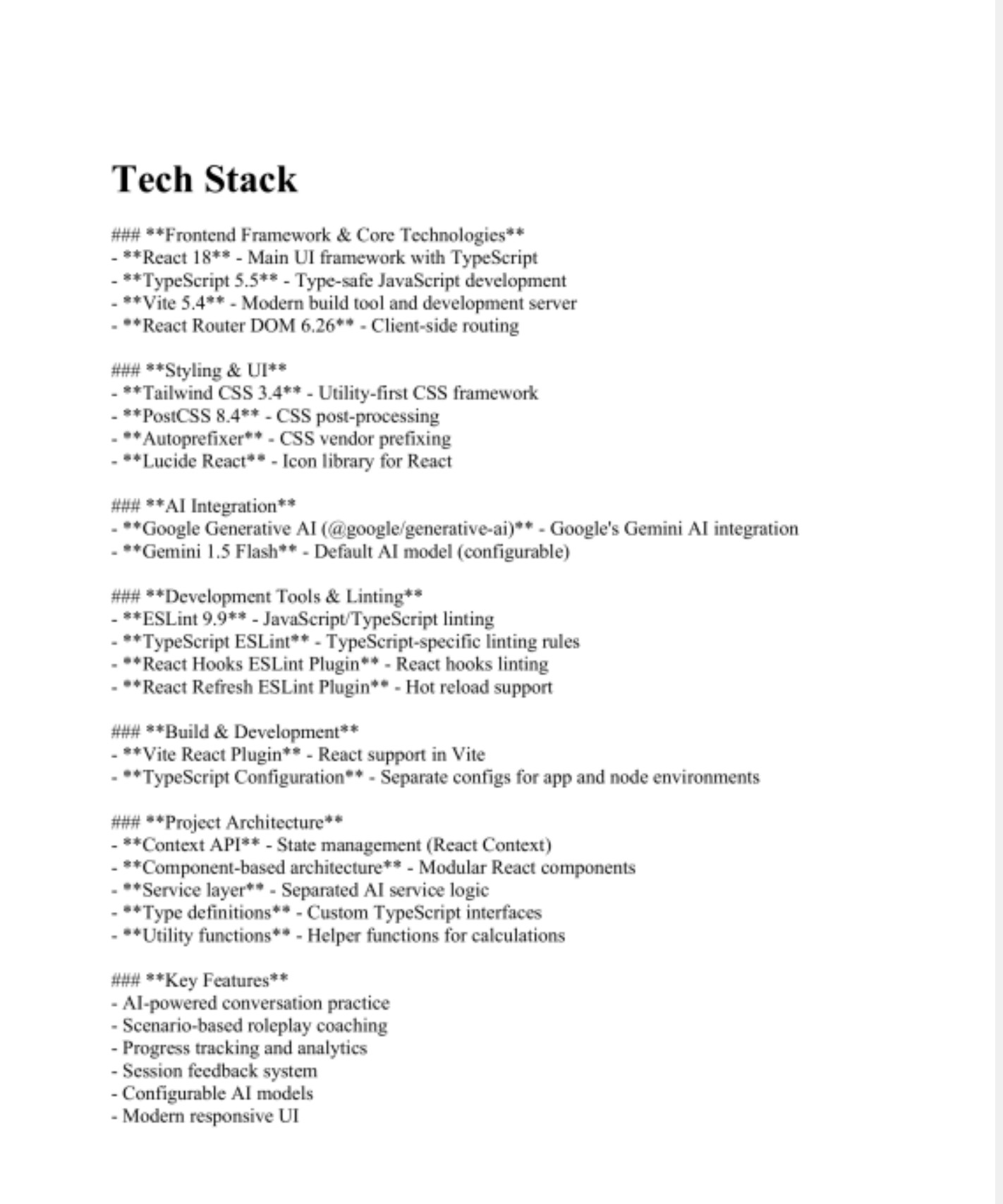
- typescript
- vite


Log in or sign up for Devpost to join the conversation.