MirrorInSeconds
Inspiration
Demos and QA always hit the same moment:
“What happens if the webinar is already full?”
Now someone has to:
- create test users
- modify the database
- restart the app
- pray the state matches the scenario
It wastes time and breaks the flow of demos.
We wanted a way to instantly recreate any product situation without manually preparing environments or data.
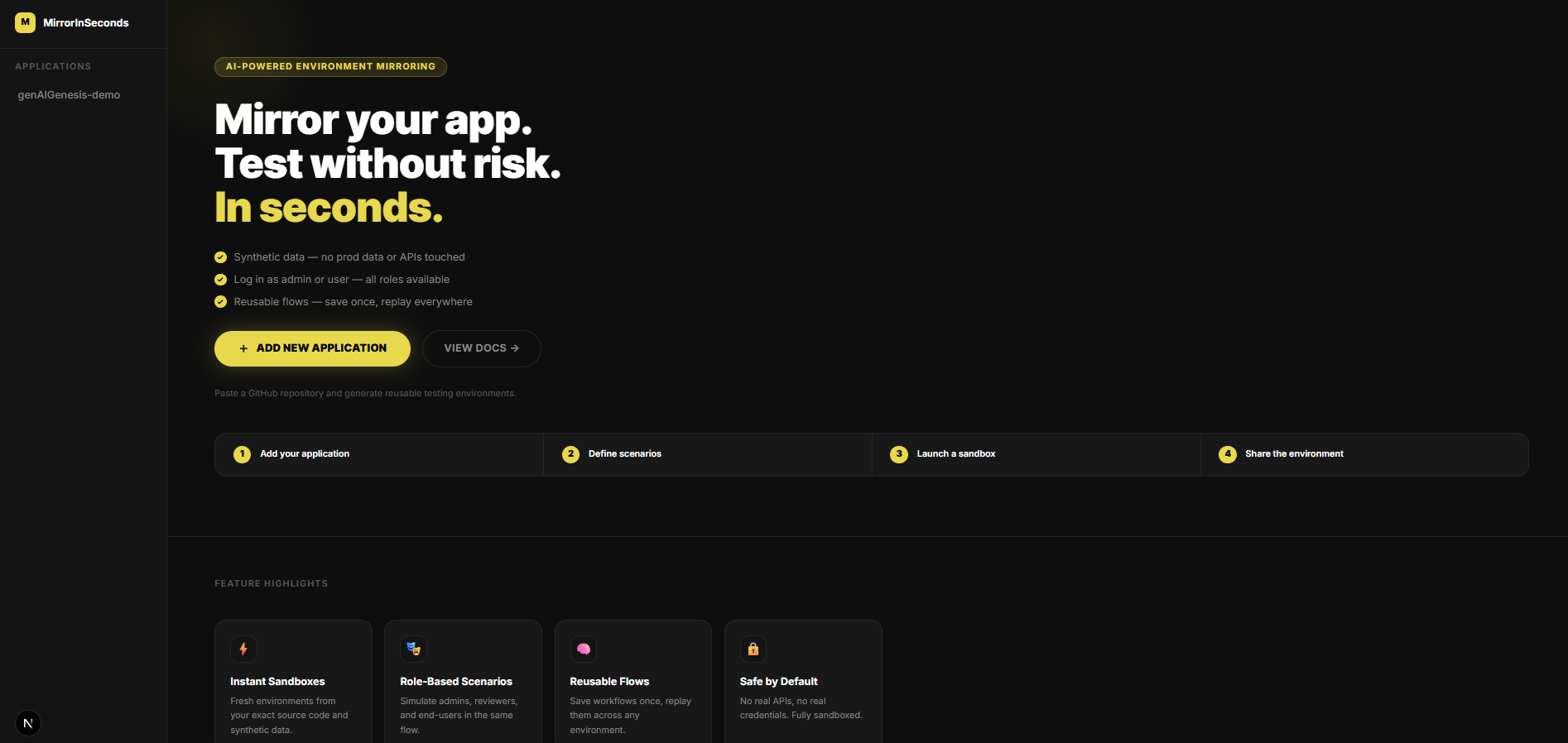
So we built MirrorInSeconds — describe a situation, and a live version of the app in that state spins up.
What it does
MirrorInSeconds creates a runnable copy of your application in seconds, already configured with the situation you want to test.
Example prompt:
student opens a webinar and the webinar is full
Instead of manually preparing data, MirrorInSeconds:
- generates synthetic database data using GenAI
- spins up a MongoDB container
- seeds it with that scenario data
- builds the application from the GitHub repo
- launches the app in a sandbox
You instantly get a live URL to interact with the app in that exact situation.
Perfect for:
- product demos
- QA scenario testing
- reproducing edge cases
- exploring "what happens if..." flows
How we built it
1. Project onboarding
A developer pastes a GitHub repository URL to onboard a new project.
An MCP server analyzes the repo and automatically detects:
- application roles (admin, user, student, etc.)
- database collections / schema structure
Those fields get auto-populated in the project setup.
2. Scenario generation
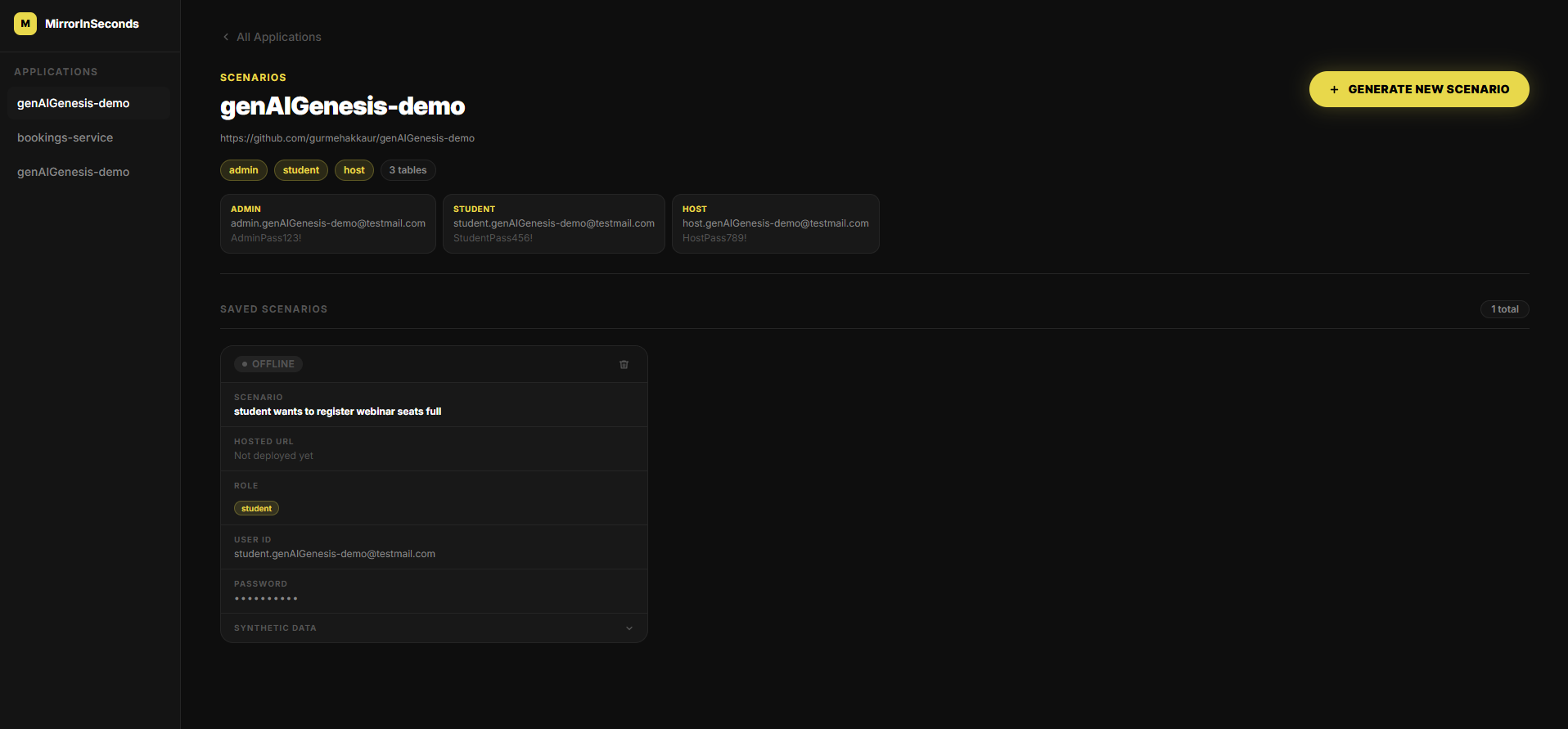
The user writes a short scenario like:
student tries to register but webinar is full
GenAI then generates:
- synthetic database data for that situation
- a login + password for the scenario role
- the collections needed to represent that state
3. Launching the sandbox
When the user clicks Launch:
- the GitHub repo is cloned
- a Docker image is built
- a MongoDB container is started
- the synthetic data is seeded into the database
- the application container is launched with the sandbox DB
Everything runs inside isolated containers.
4. Live environment
Within seconds the system returns a live URL.
The developer can open it, log in using the generated credentials, and experience the exact scenario inside the app.
No manual setup.
No staging database manipulation.
Just prompt → environment → test.
Challenges we ran into
- Dynamically seeding databases with unknown schema structures
- orchestrating multiple Docker containers per scenario
- ensuring MongoDB is ready before seeding data
- safely executing repo cloning and container builds
Basically… building a tiny environment orchestration system.
Accomplishments that we're proud of
- turning natural language scenarios into runnable environments
- auto-detecting roles and database structures from repos
- generating scenario-specific synthetic data
- launching fully isolated sandbox apps in seconds
Seeing a prompt instantly become a live app environment felt magical.
What we learned
This project taught us a lot about:
- container orchestration with Docker
- automated environment creation
- AI-generated datasets
- connecting AI reasoning with real infrastructure
We realized debugging and QA could become much more interactive and scenario-driven.
What's next for MirrorInSeconds
Next we want to expand MirrorInSeconds into a full debugging assistant:
- reproduce bugs from support tickets
- snapshot and replay user scenarios
- support Postgres, Redis, and microservices
- attach sandbox environments directly to GitHub issues
The goal:
Any product scenario should be one prompt away from running.
Built With
- Node.js
- Express
- React
- Docker
- MongoDB
- AWS EC2
- GenAI for synthetic data generation
- GitHub
Built With
- amazon-web-services
- data
- docker
- ec2
- express.js
- for
- genai
- generation
- mongodb
- node.js
- react
- synthetic

Log in or sign up for Devpost to join the conversation.