-
Icon
-
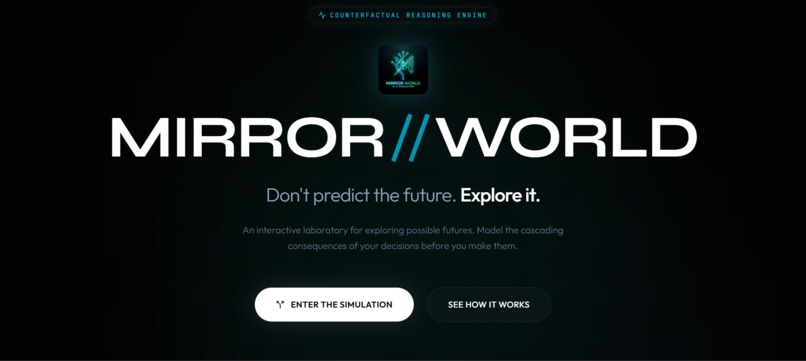
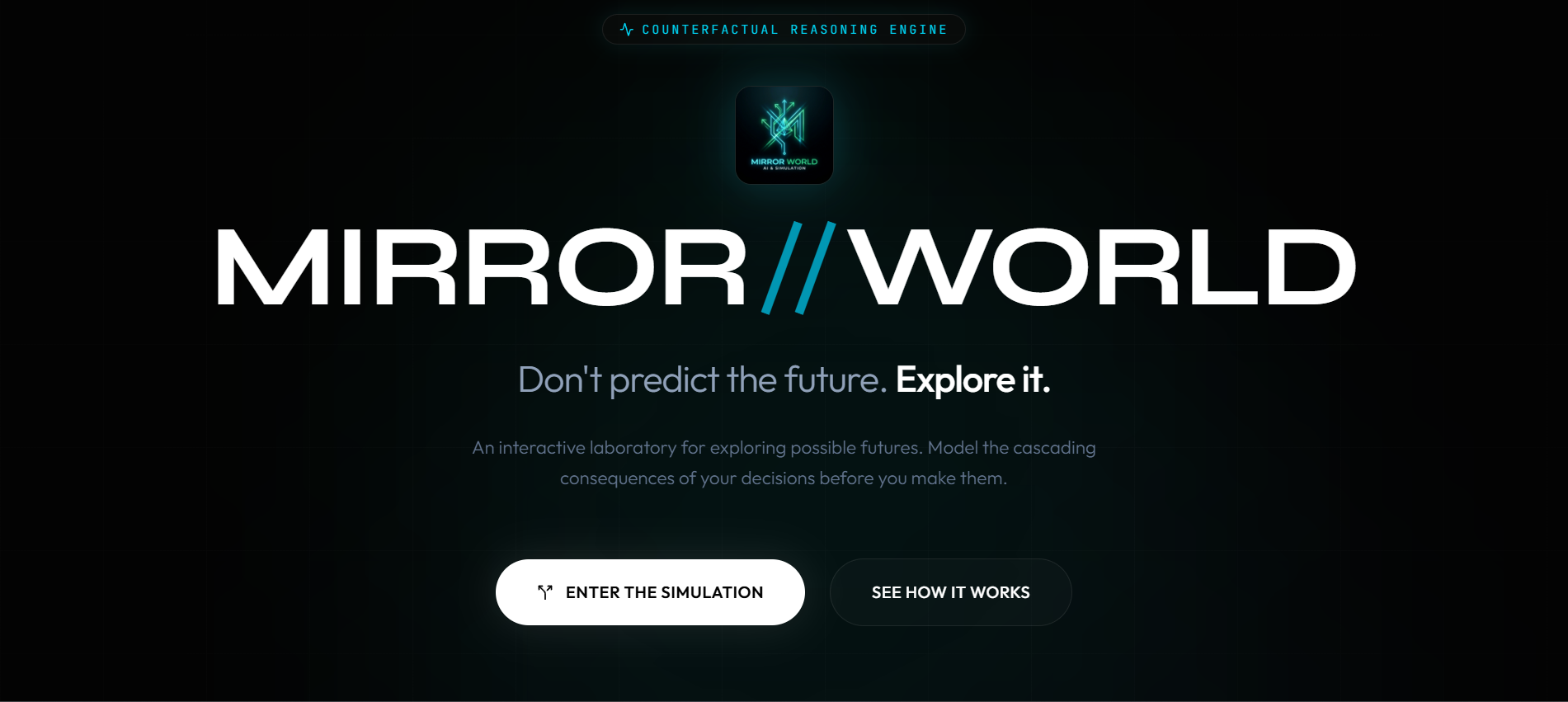
Main page
-
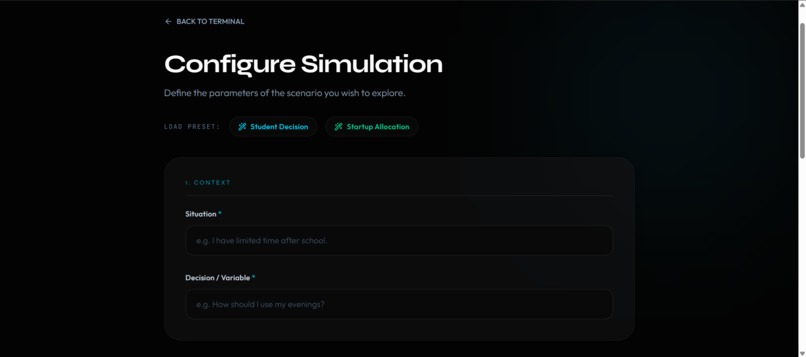
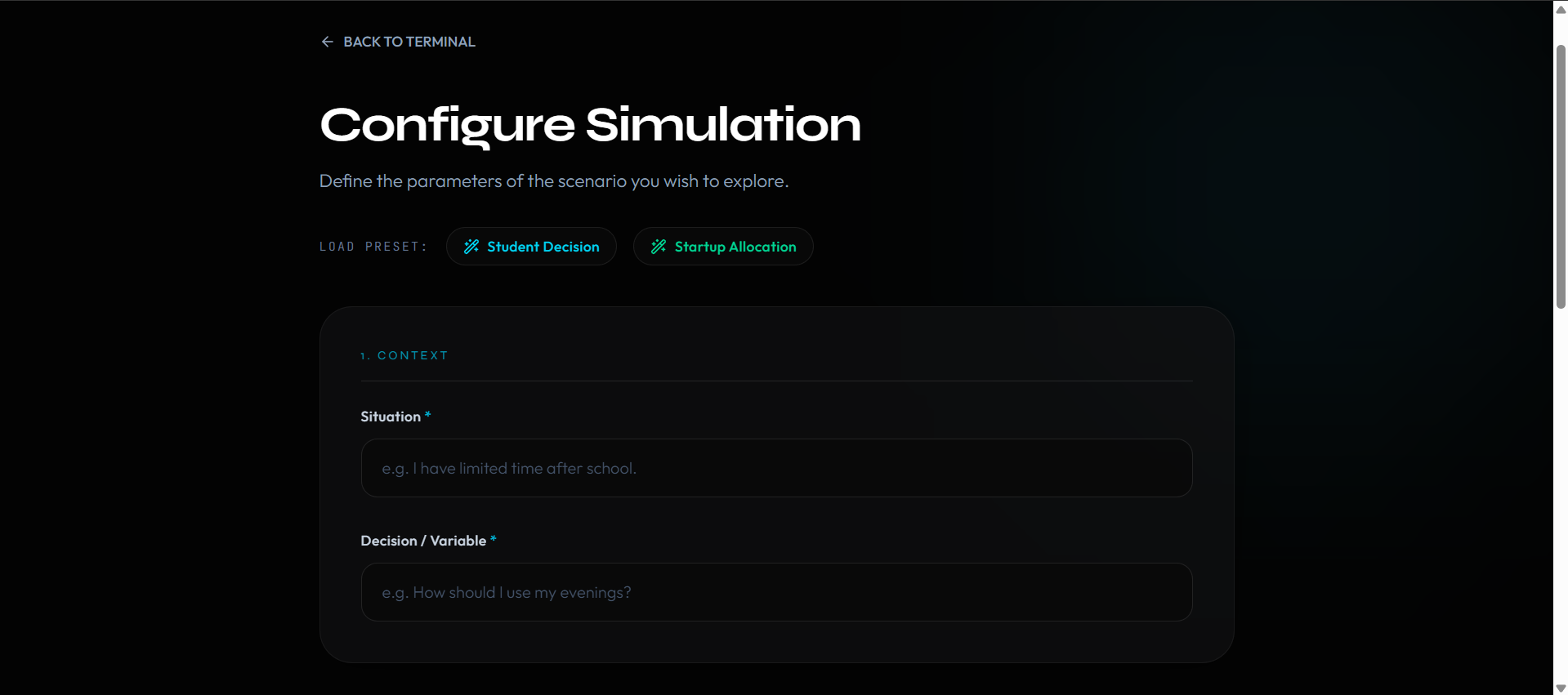
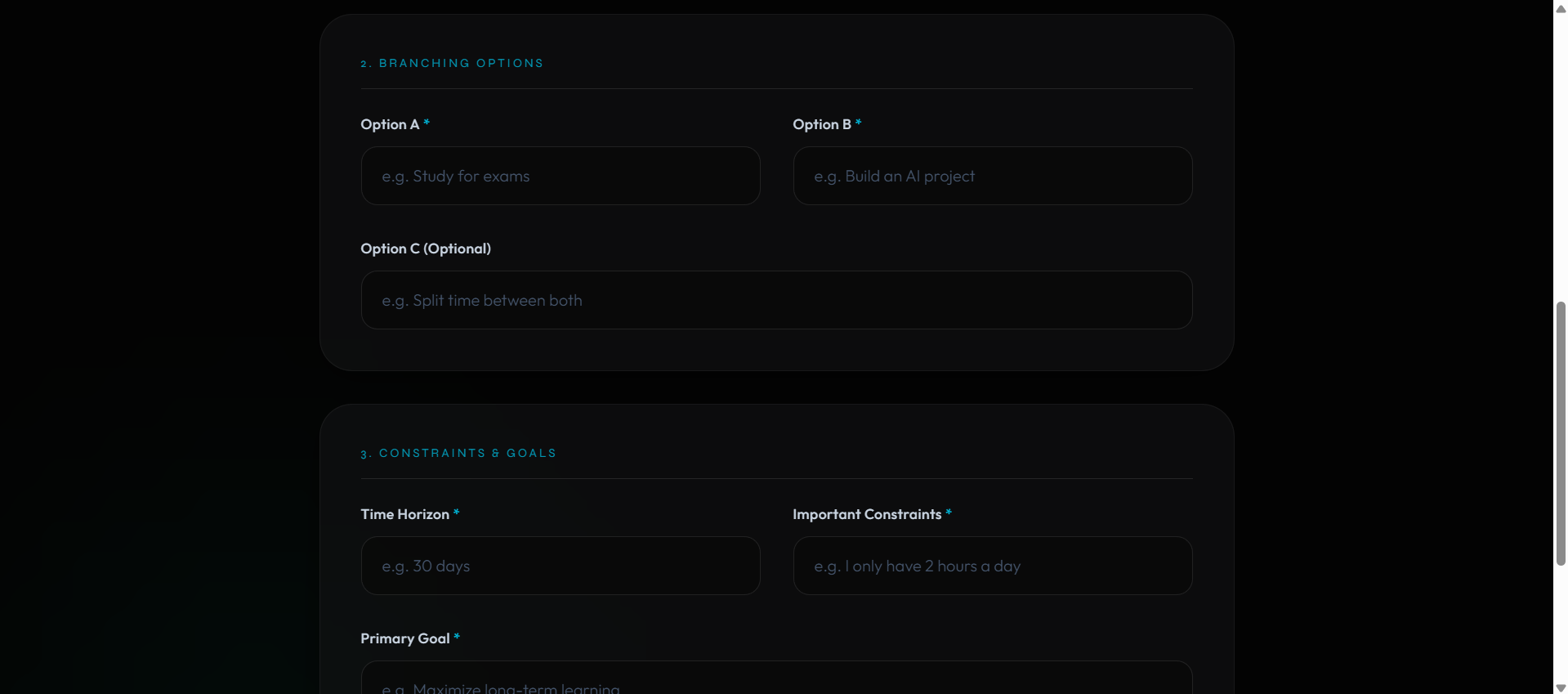
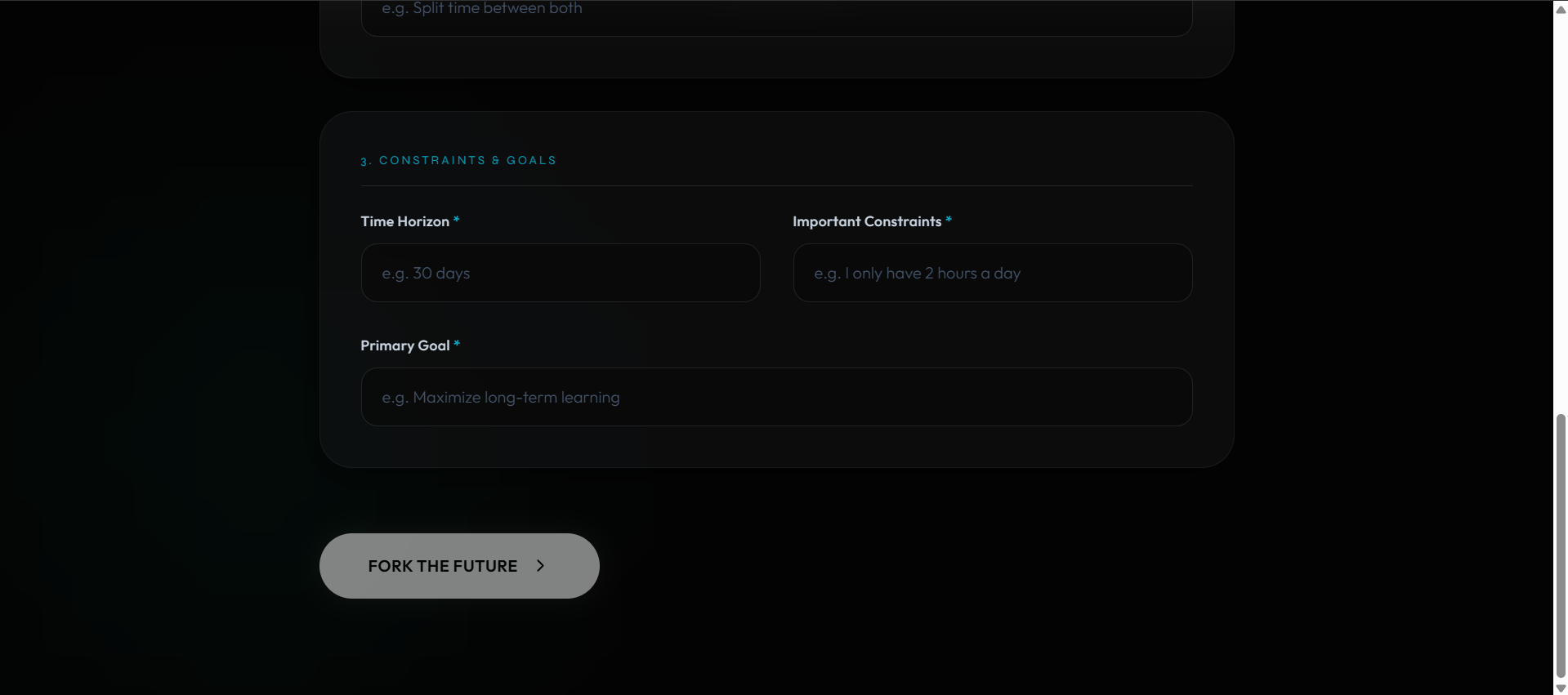
Situation configuration_1
-
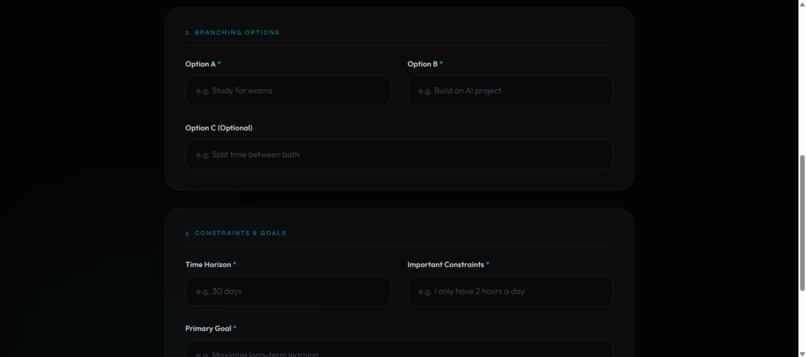
Situation configuration_2
-
Situation configuration_3
-
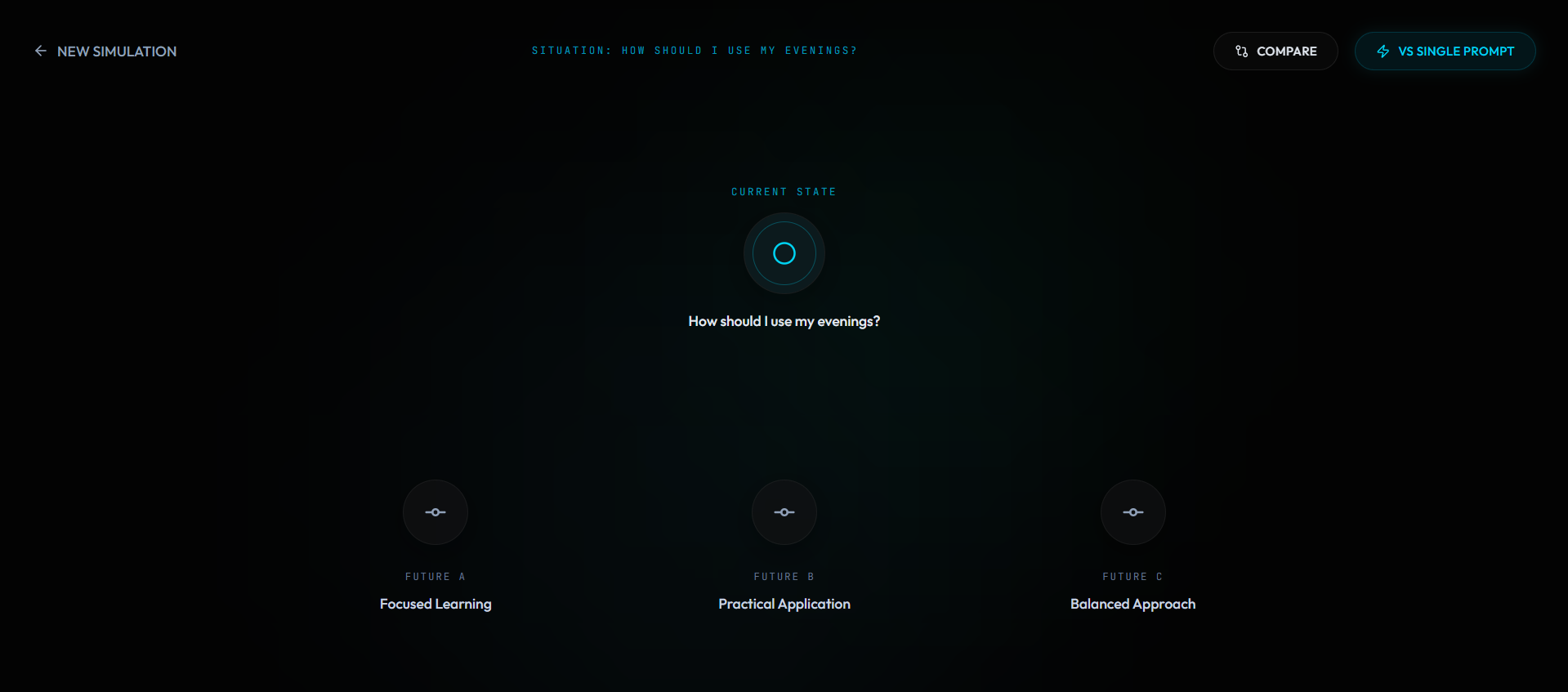
Result page
-
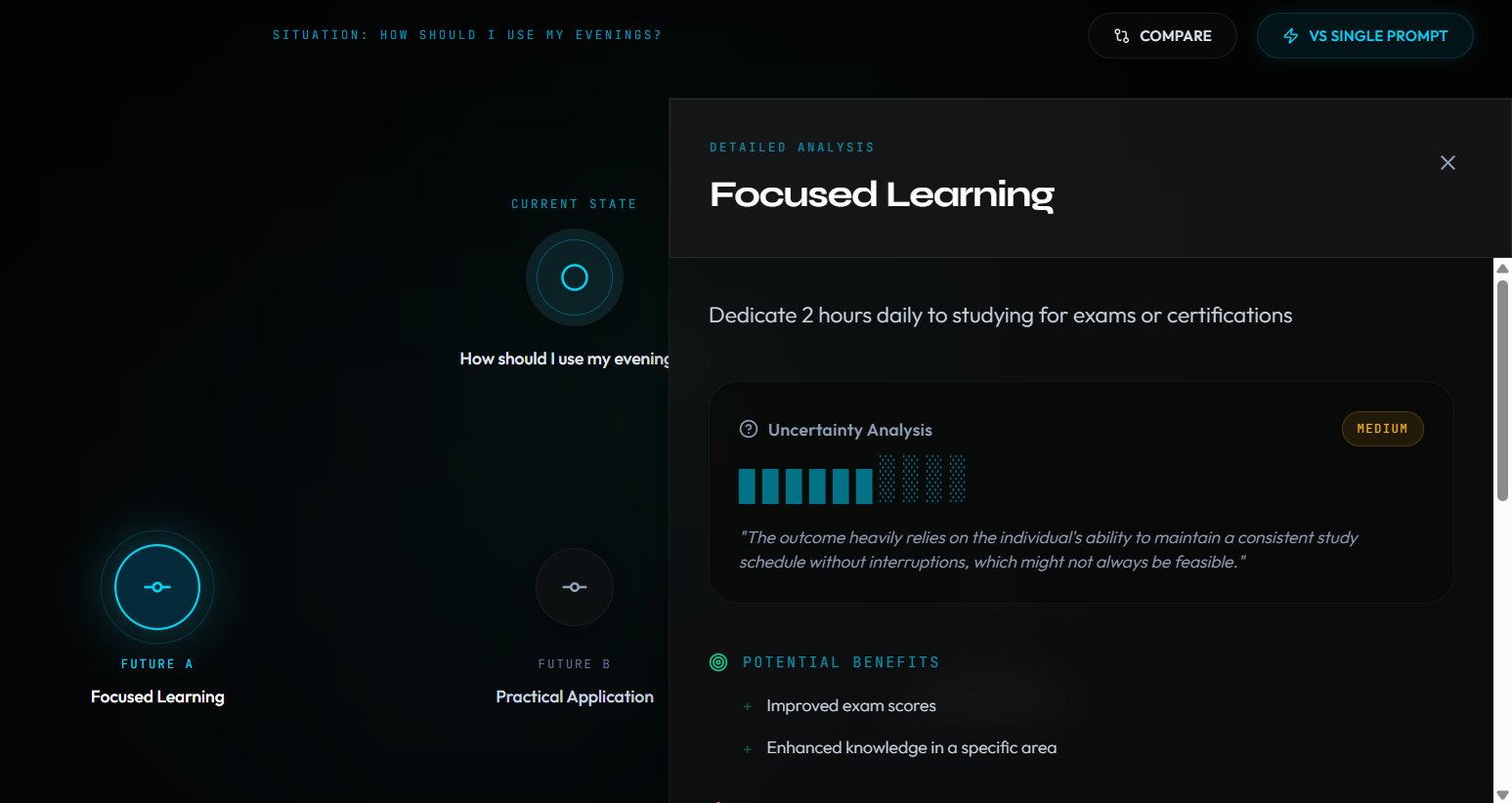
Options popup_1
-
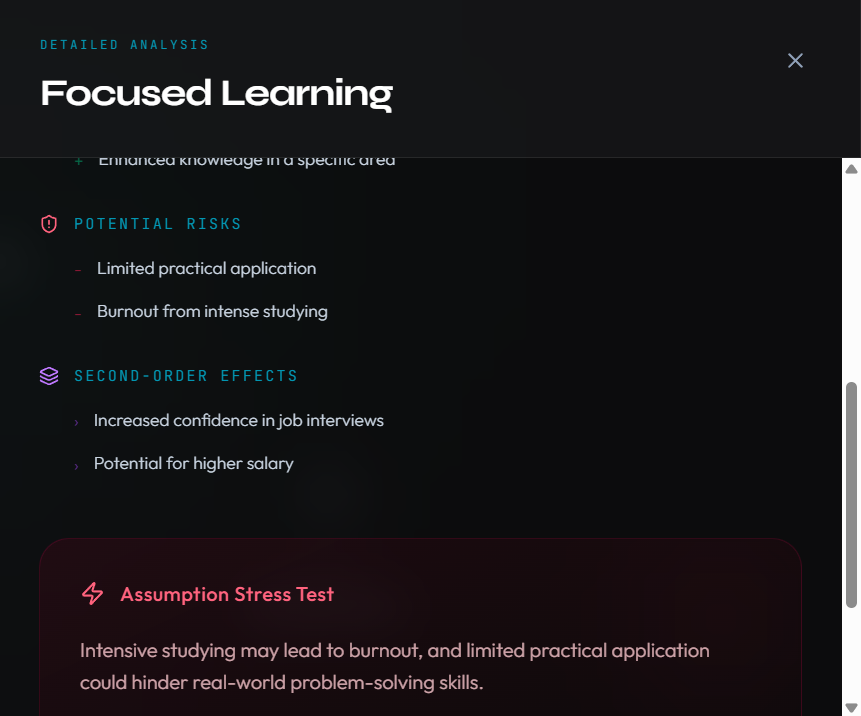
Options popup_2
MIRROR//WORLD
An AI Counterfactual Reasoning Engine
Don't predict the future. Explore it.
Inspiration
We make important decisions every day, but most AI systems approach these decisions in a surprisingly simple way: we ask a question, and the model gives us an answer.
We wanted to explore a different question:
What if AI could help us explore the decision landscape instead of simply telling us what to do?
That idea became MIRROR//WORLD.
MIRROR//WORLD is an AI counterfactual reasoning engine that takes a real-world scenario, identifies its constraints and assumptions, explores multiple possible paths, stress-tests those paths, and presents the resulting trade-offs and uncertainties in an interactive future tree.
It doesn't claim to predict the future.
Instead, it asks:
"What could happen under these assumptions?"
The Problem
A conventional AI interaction often looks like:
Question
   ↓
LLM
   ↓
Answer
This can be useful, but it has a major limitation: a single response can hide assumptions, alternative possibilities, and uncertainty.
For decisions involving multiple variables, simply generating one answer isn't enough.
We wanted to build an AI system that makes the reasoning workflow itself part of the product.
Our Core Insight
The central idea behind MIRROR//WORLD is:
A decision should be explored as a landscape of possible outcomes, not reduced to a single answer.
Instead of using one prompt, MIRROR//WORLD creates a structured workflow:
USER SCENARIO
      ↓
CONTEXT EXTRACTION
      ↓
ASSUMPTION MODEL
      ↓
SCENARIO FORKING
      ↓
┌──────────┬──────────┬──────────┐
│ FUTURE A │ FUTURE B │ FUTURE C │
└──────────┴──────────┴──────────┘
      ↓
CONSEQUENCE ANALYSIS
      ↓
CRITIC / STRESS TEST
      ↓
UNCERTAINTY ANALYSIS
      ↓
SCENARIO COMPARISON
      ↓
FINAL SYNTHESIS
The result is not simply another AI answer. It is an interactive exploration of possible futures.
How MIRROR//WORLD Works
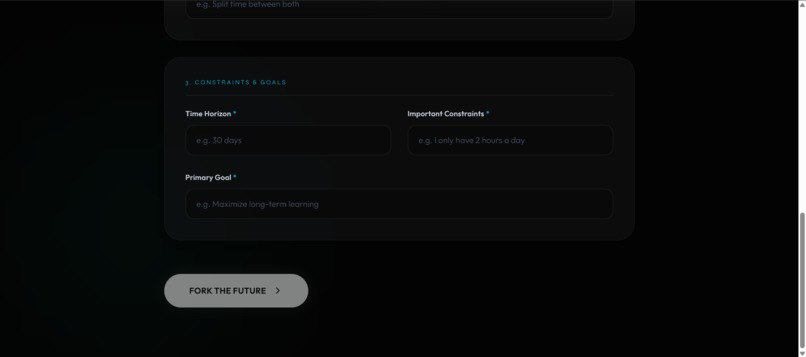
1. Scenario Understanding
The user describes a decision.
For example:
"I have 30 days. Should I spend my evenings preparing for an exam, building an AI project, or split my time between both?"
MIRROR//WORLD extracts the important context:
- objective
- available time
- alternatives
- constraints
- time horizon
- relevant assumptions
This creates a structured representation of the scenario before generating outcomes.
2. Assumption Modeling
The system separates information into:
Known information
What the user explicitly provided.
Assumptions
What the simulation needs to assume.
Unknown variables
Factors that could significantly affect the result.
This distinction is important because a simulated future is only as meaningful as the assumptions behind it.
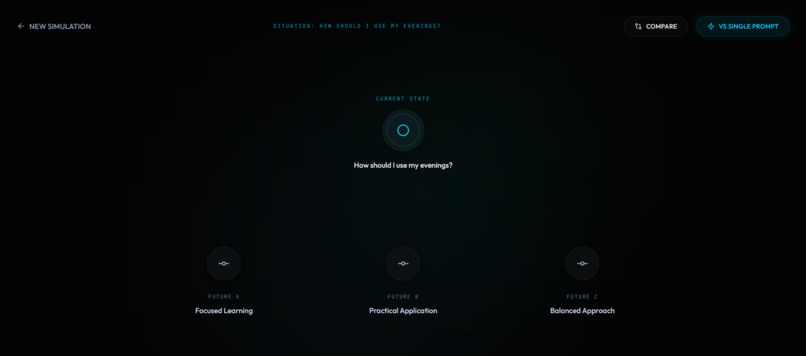
3. Scenario Forking
Instead of producing one answer, the system generates multiple possible paths.
For example:
                    CURRENT STATE
                          ●
                       /  |  \
                      /   |   \
                     ●    ●    ●
                    /     |     \
                FUTURE A FUTURE B FUTURE C
Each branch represents a different strategy or counterfactual.
The user can select a branch and explore it further.
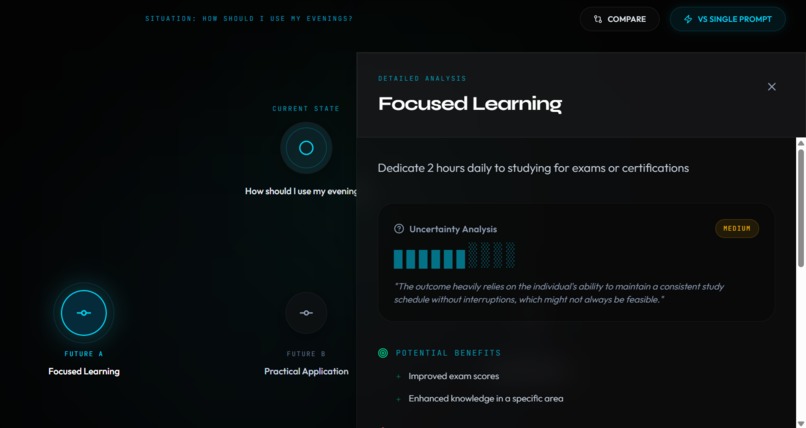
4. Consequence Analysis
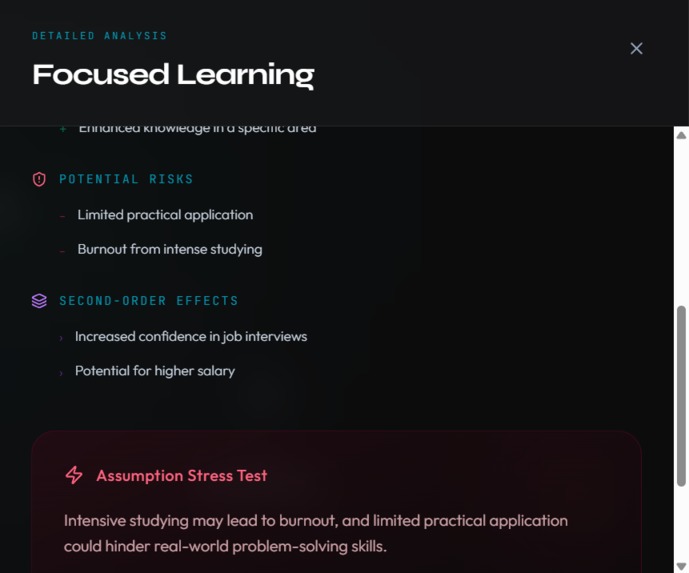
Each branch is analyzed for:
- potential benefits
- potential risks
- dependencies
- second-order effects
- important assumptions
- possible trade-offs
This prevents the system from treating a decision as having only one obvious consequence.
🧠 The Critic Engine
One of the most important parts of MIRROR//WORLD is the Assumption Stress Test.
After generating scenarios, the system asks a separate reasoning stage:
What could make this scenario wrong?
It examines:
- fragile assumptions
- ignored variables
- counterarguments
- dependencies
- conditions that could change the outcome
This creates an important distinction between:
"Here is an AI-generated possibility."
and:
"Here is a possibility, and here is why it might fail."
🌫️ Uncertainty
MIRROR//WORLD intentionally does not pretend that simulations are perfect predictions.
Instead, it identifies where uncertainty comes from.
For every scenario, the system distinguishes between:
KNOWN
ASSUMED
UNKNOWN
DEPENDENT
The interface then communicates the uncertainty level and explains its source.
We deliberately avoid fabricated numerical probabilities when there isn't enough evidence to justify them.
The system therefore makes an important distinction:
Simulation ≠ prediction.
MIRROR//WORLD explores possibilities under assumptions; it does not claim to know the future.
🌳 The Future Tree
The main visual interface is the Future Tree.
Instead of presenting the result as a wall of text, possible outcomes become an interactive graph.
Users can:
- zoom into branches
- inspect individual scenarios
- compare paths
- change assumptions
- rerun simulations
- explore counterfactuals
This turns AI reasoning into something that can be explored visually.
🔀 What If Mode
After generating a simulation, users can change an important variable.
For example:
Study time

2 hours/day
      ↓
4 hours/day
Then the user can select:
RE-SIMULATE
The system generates the changed scenario and highlights which branches were affected.
This creates an interactive counterfactual loop:
SIMULATE
   ↓
CHANGE ASSUMPTION
   ↓
RE-SIMULATE
   ↓
COMPARE
   ↓
EXPLORE
⚔️ Workflow vs. Single Prompt
A major part of our project is demonstrating that the architecture itself matters.
MIRROR//WORLD includes a comparison mode:
Single-Prompt Approach
Scenario
   ↓
One AI prompt
   ↓
One response
MIRROR//WORLD
Scenario
   ↓
Context
   ↓
Assumptions
   ↓
Multiple scenarios
   ↓
Consequence analysis
   ↓
Critic
   ↓
Uncertainty
   ↓
Comparison
   ↓
Synthesis
We don't intentionally make the single-prompt system worse.
Instead, we compare the two approaches on the same scenario and examine differences in:
- scenario diversity
- assumption visibility
- risk analysis
- counterarguments
- uncertainty
- final synthesis
This allows us to evaluate whether a structured AI workflow provides meaningful advantages over a conventional single interaction.
⚙️ Technical Architecture
The system is designed as a modular pipeline rather than a single giant prompt.
Conceptually:
                 USER
                  │
                  ▼
        ┌──────────────────┐
        │ Scenario Parser  │
        └────────┬─────────┘
                 │
                 ▼
        ┌──────────────────┐
        │ Context &        │
        │ Assumption Model │
        └────────┬─────────┘
                 │
                 ▼
        ┌──────────────────┐
        │ Scenario Forker  │
        └─────┬────┬───────┘
              │    │
             A     B     C
              │    │     │
              └────┼─────┘
                   ▼
        ┌──────────────────┐
        │ Consequence      │
        │ Analyzer         │
        └────────┬─────────┘
                 ▼
        ┌──────────────────┐
        │ Critic / Stress  │
        │ Test             │
        └────────┬─────────┘
                 ▼
        ┌──────────────────┐
        │ Uncertainty      │
        │ Analyzer         │
        └────────┬─────────┘
                 ▼
        ┌──────────────────┐
        │ Comparator &     │
        │ Synthesizer      │
        └────────┬─────────┘
                 ▼
           FUTURE TREE
The modular architecture makes individual stages replaceable and easier to test.
🤖 AI Workflow
The AI is used for several distinct tasks rather than being treated as a single answer generator.
Context Extraction
Converts natural language into structured scenario information.
Scenario Generation
Creates alternative paths based on the user's options and constraints.
Consequence Analysis
Explores direct and second-order consequences.
Critical Review
Attempts to challenge the generated scenarios.
Uncertainty Analysis
Identifies assumptions and unknown factors.
Synthesis
Combines the outputs into an understandable comparison.
This separation allows us to inspect and improve individual stages instead of treating the entire AI system as a black box.
💻 Example Workflow
A simplified conceptual representation is:
const context = await extractContext(userScenario);

const assumptions = await buildAssumptionModel(
  context
);

const scenarios = await generateScenarios(
  context,
  assumptions
);

const analyzed = await analyzeConsequences(
  scenarios,
  assumptions
);

const critique = await stressTest(
  analyzed
);

const uncertainty = await analyzeUncertainty(
  analyzed,
  critique
);

const result = await synthesize(
  analyzed,
  critique,
  uncertainty
);
The production implementation handles validation, errors, state management, and API communication around these stages.
🧮 Conceptual Model
We can represent a simulated state as:
$$ S_t = [G_t, K_t, H_t, T_t, R_t] $$
where:
- (G_t) represents goals
- (K_t) represents relevant knowledge or skills
- (H_t) represents habits or behavioral factors
- (T_t) represents available time
- (R_t) represents available resources
A decision can then be viewed conceptually as a state transition:
$$ S_{t+1} = F(S_t, a_t, \epsilon) $$
where (a_t) is an action and (\epsilon) represents uncertainty.
This is not intended to claim that human futures can be mathematically predicted with certainty. It provides a conceptual framework for thinking about how assumptions and decisions can create different simulated trajectories.
🎨 User Experience
We wanted the interface to feel less like a conventional AI dashboard and more like an interactive laboratory.
The visual language combines:
- dark cinematic surfaces
- subtle glassmorphism
- interactive nodes
- neural-style connections
- smooth transitions
- information-dense but readable panels
- responsive layouts
The Future Tree is the centerpiece because the visualization itself communicates the core idea:
There isn't necessarily one future. There are possibilities shaped by decisions and assumptions.
🧩 Challenges
Designing a Genuine AI Workflow
Our first challenge was avoiding the temptation to solve everything with one large prompt.
We had to think about which tasks should be separated, what information should flow between stages, and how to make each stage contribute something meaningful.
Avoiding False Precision
Another challenge was communicating uncertainty without inventing scientific-looking numbers.
A visually impressive prediction can still be misleading if its assumptions are hidden.
We therefore designed MIRROR//WORLD around explicit assumptions and uncertainty explanations.
Making Complex Reasoning Understandable
A multi-stage AI pipeline can become confusing for users.
The Future Tree became our solution: instead of exposing complicated internal processing, we turn the results into an interactive visual model.
Building as a Solo Developer
MIRROR//WORLD was developed as a solo project.
That forced us to prioritize the core experience instead of attempting to build an enormous platform immediately.
The focus became:
One idea. One workflow. One unforgettable experience.
📚 What We Learned
Building MIRROR//WORLD taught us that effective AI products aren't necessarily created by simply using a larger model.
The workflow surrounding the model matters.
We learned about:
- prompt decomposition
- multi-stage AI workflows
- structured context
- counterfactual reasoning
- uncertainty communication
- AI evaluation
- interactive visualization
- responsible AI product design
Most importantly, we learned to treat AI outputs as hypotheses to examine, rather than unquestionable answers.
🚀 What's Next
MIRROR//WORLD is currently focused on decision exploration, but the architecture can extend far beyond personal decisions.
Potential future applications include:
Education
Explore different learning strategies and their possible consequences.
Startups
Explore strategic choices such as hiring, pricing, product development, and resource allocation.
Urban Planning
Explore possible effects of changes in transportation, infrastructure, or policy assumptions.
Climate & Sustainability
Explore scenarios under different environmental assumptions.
Research
Create interactive environments for exploring complex hypothetical systems.
The long-term vision is to build a general-purpose counterfactual exploration layer for human decision-making.
🌍 Our Vision
AI doesn't have to be a machine that simply tells us what to do.
It can become a tool for exploring possibilities.
MIRROR//WORLD is built around one simple idea:
The future isn't a single answer. It's a landscape of possibilities.
We don't claim to predict what comes next.
We built MIRROR//WORLD to help people explore what could.
Built With
- ai/ml
- javascript
- react
- typescript
- vite

Log in or sign up for Devpost to join the conversation.