-
-
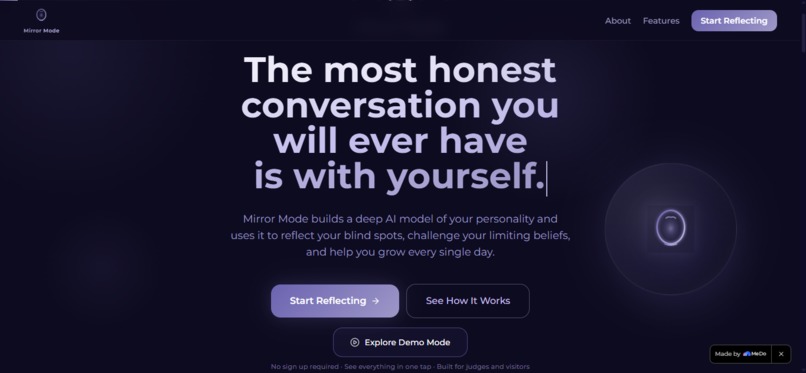
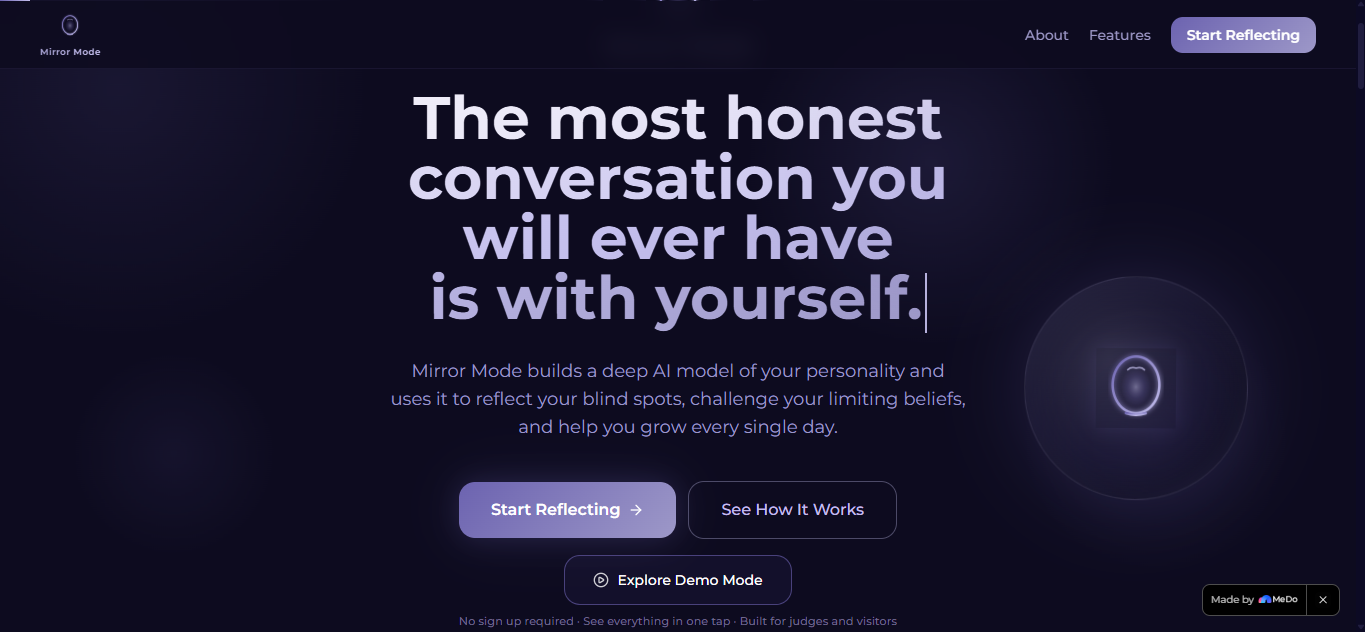
Mirror Mode landing page — the first thing judges and users see. Built to make you feel something before you even click a button.
-
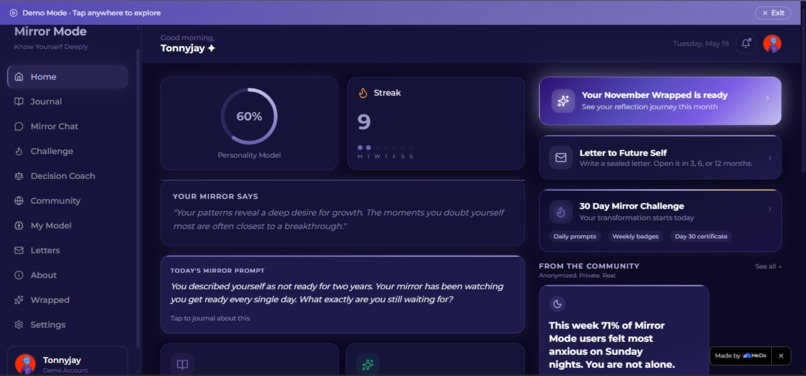
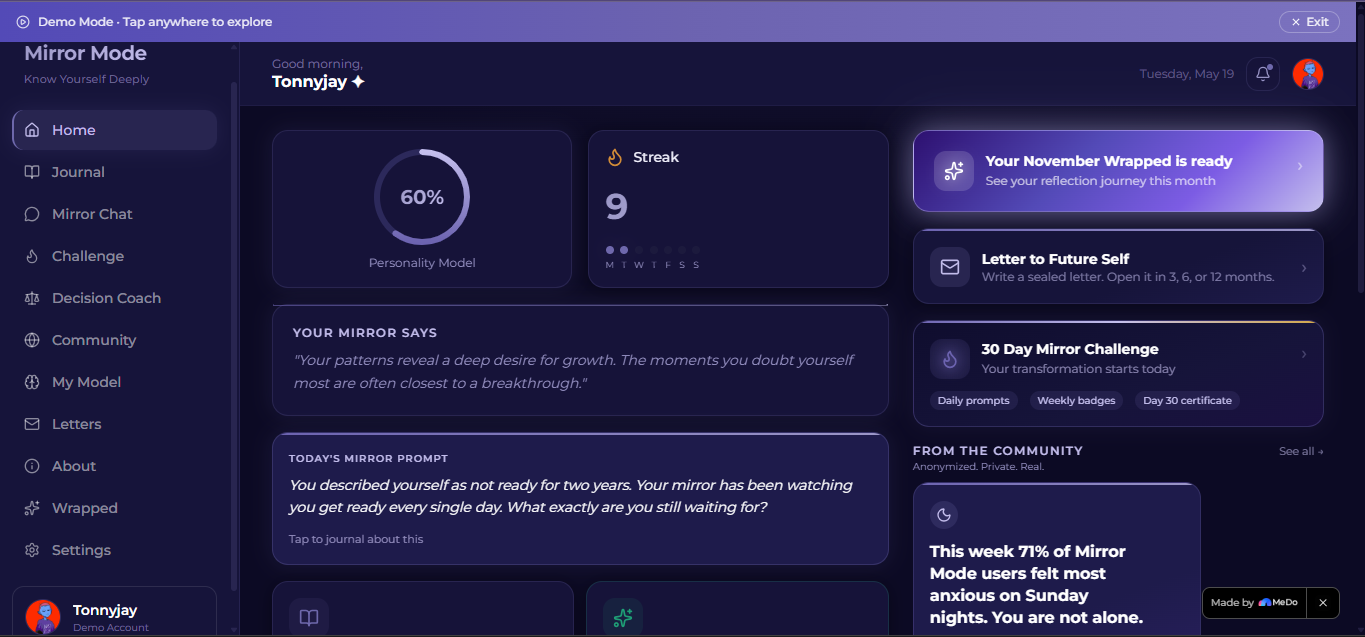
Your daily reflection hub. Personality model, AI prompt, streak tracker and community insights in one place.
-
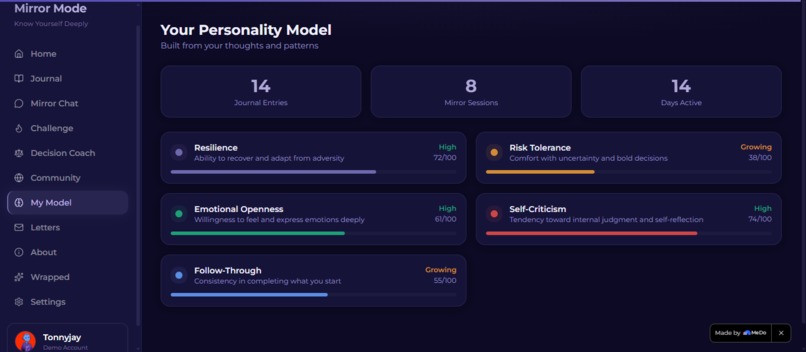
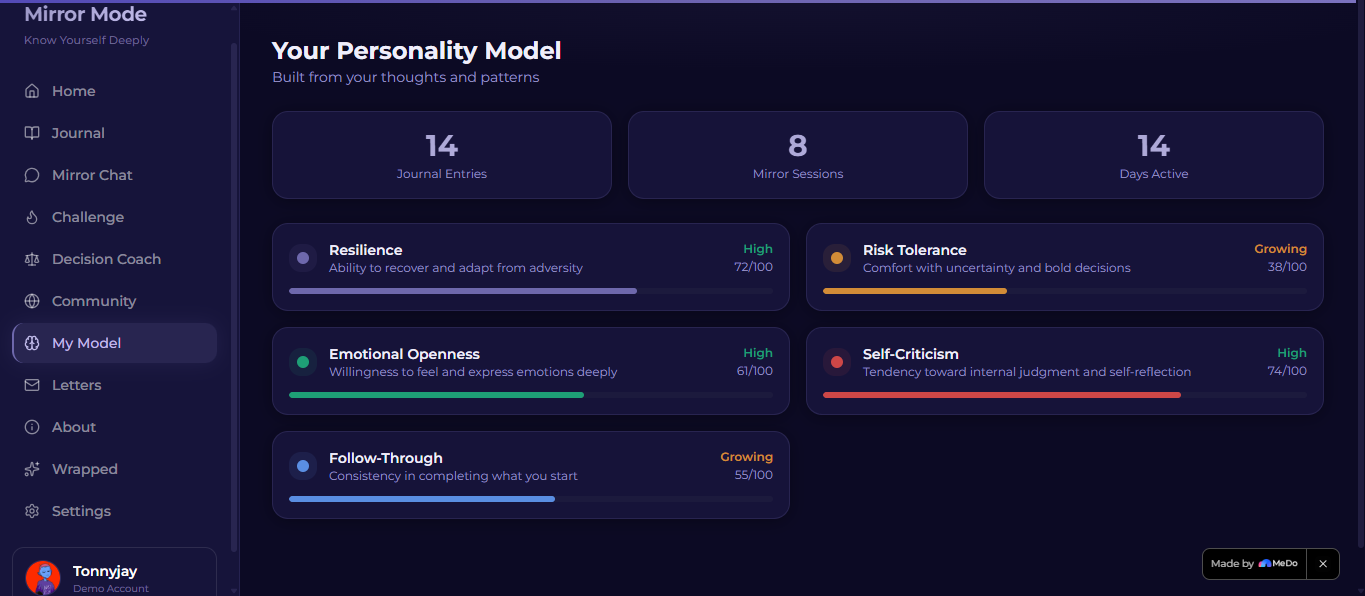
A living AI profile tracking 5 core traits that updates automatically every time you journal or chat.
-
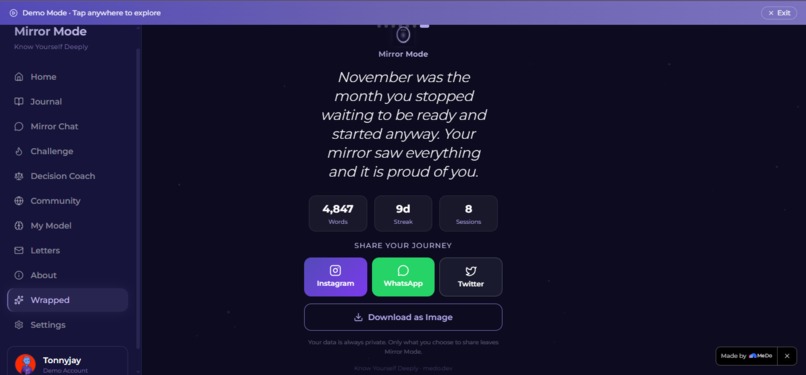
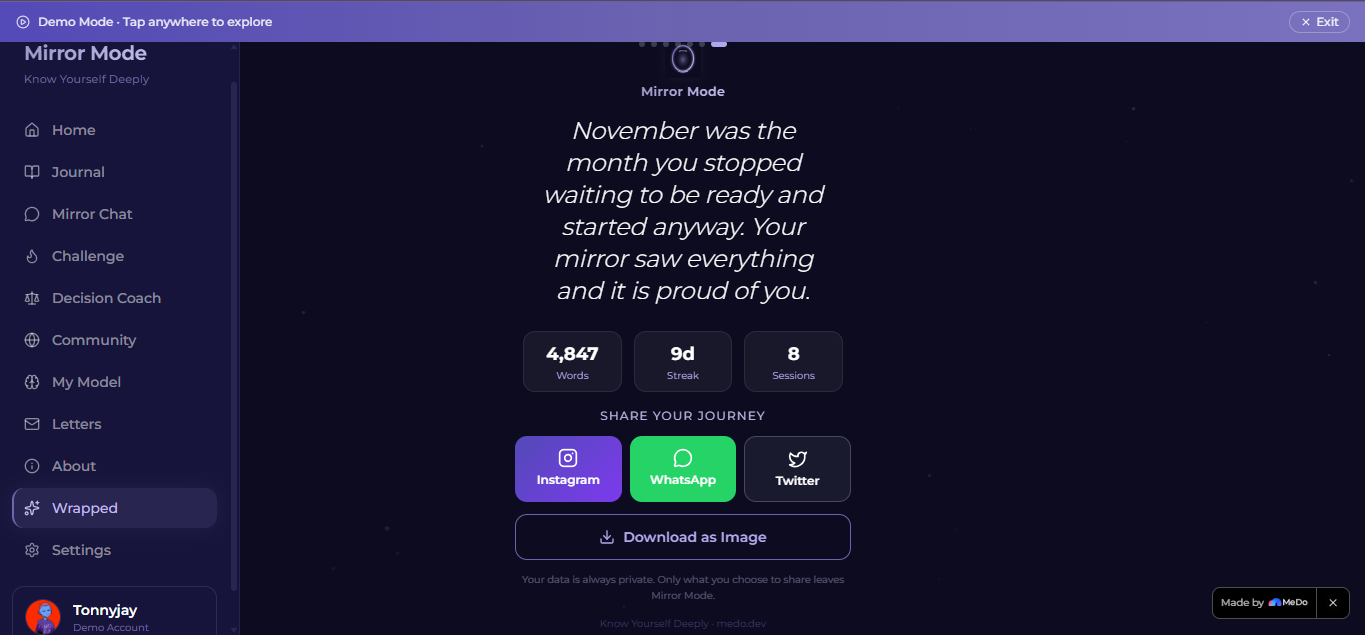
Your monthly AI reflection recap. Shareable to Instagram, WhatsApp and Twitter in one tap.
-
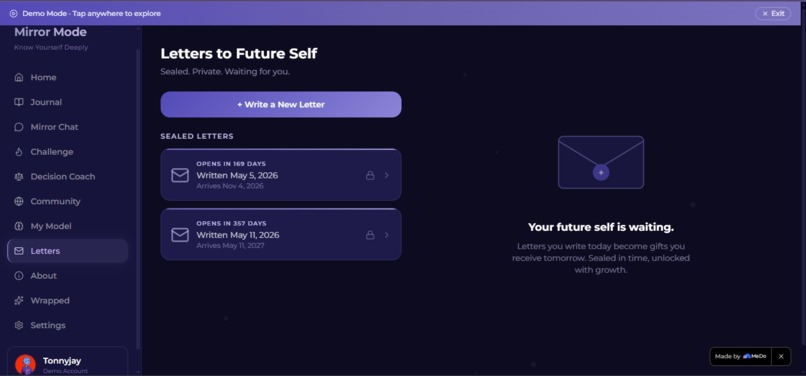
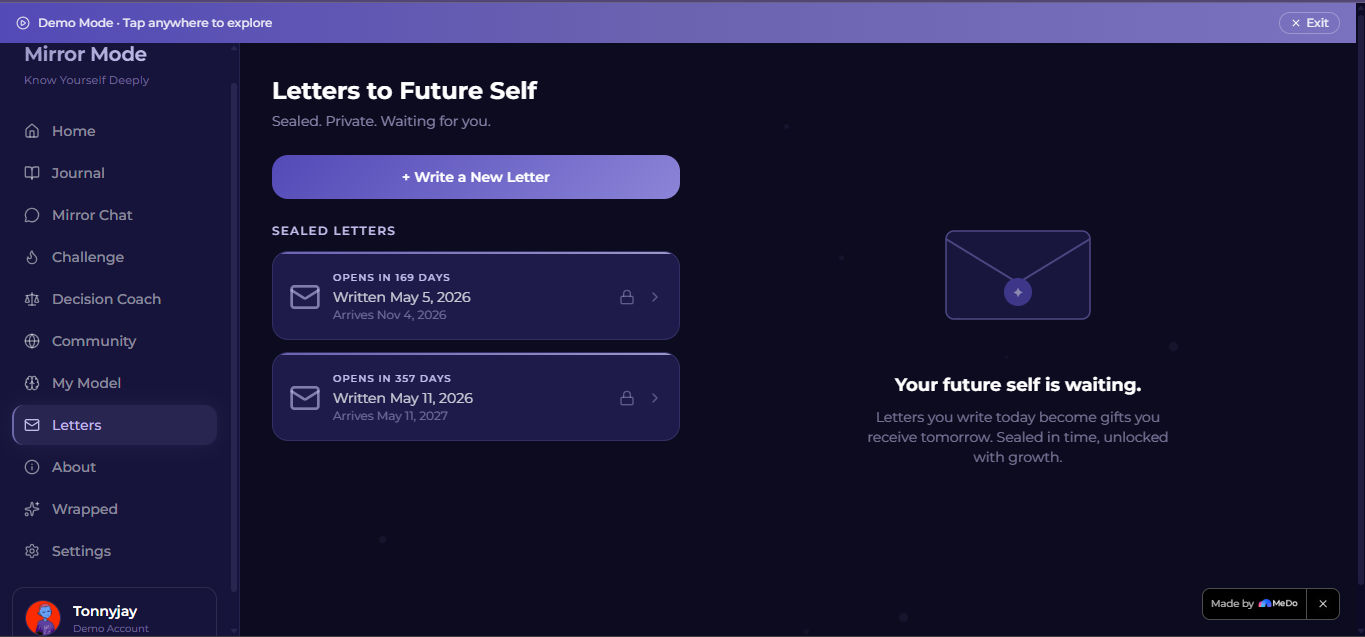
Write to the person you are becoming. Sealed today. Delivered on the date you choose.
Inspiration
I have always been someone who thinks a lot but reflects very little. I would journal sometimes, but mostly just vent without ever gaining real clarity. I would overthink big decisions, second-guess myself constantly, and somehow still end up repeating the same patterns. What frustrated me most was knowing something was off but not being able to see exactly what.
That frustration became the seed for Mirror Mode. I did not want to build another productivity app or a mood tracker. I wanted to build something that actually talked back. Something that could look at my thoughts over time, notice what I could not notice about myself, and reflect it back to me honestly. The kind of honest conversation most people never have, even with their closest friends.
The name said it all. A mirror does not judge. It just shows you what is really there.
What It Does
Mirror Mode is an AI-powered self-reflection app that builds a deep personality model of the user over time and uses it to help them understand themselves better, make clearer decisions, and break patterns that hold them back. When a user signs up, they go through a one-time onboarding that seeds their personality profile. From there, the app works across four core experiences. The Daily Journal lets users write freely. Behind the scenes, the AI analyzes each entry for emotional tone, recurring themes, and language patterns, then uses that data to update the user's personality model.
The AI Mirror Chat is where the magic happens. Users can talk to an AI that responds not like a generic chatbot but like their most honest inner voice. It listens, challenges limiting beliefs gently, and ends every conversation with a question worth sitting with.
The Decision Coach helps users think through tough choices by running them through their own values and past patterns. Instead of giving advice, it reflects back what the user already knows about themselves.
The Personality Model Dashboard shows five core traits, Resilience, Risk Tolerance, Emotional Openness, Self-Criticism, and Follow-Through, each updating automatically as the user engages with the app.
Finally, the Weekly Mirror Report delivers a personalized insight card every week, covering emotional trends, growth moments, a detected blind spot, and one challenge to try in the coming week.
How I Built It
I built Mirror Mode entirely on MeDo, a no-code AI full-stack platform that lets you describe what you want in plain language and watch it come to life. No coding was required at any point.
I started by writing a detailed prompt that described every feature, the database structure, the user flow, and the overall design direction. MeDo's multi-agent system took that description and scaffolded the entire app, frontend, backend, database, and AI integrations, automatically.
From there I used MeDo's visual editor to refine the design, adjusting the color palette to a deep purple and dark theme that felt calm and premium. I iterated on each screen through follow-up prompts, fine-tuning things like the onboarding flow, the chat interface, and the personality dashboard until every piece felt intentional.
The AI layer was powered by a carefully crafted system prompt that instructs the Mirror to respond with warmth, honesty, and a growth-focused perspective rather than generic answers. The personality model logic was built by defining specific language signals that map to trait scores, so the AI knows what to look for in each journal entry.
Deployment was one click through MeDo, giving me a live public URL ready to share.
Challenges I Ran Into
The hardest part of building Mirror Mode was not technical. It was emotional.
Designing an app that sits inside someone's inner world meant every decision carried weight. The wrong tone in the AI response, the wrong color on a screen, even the wrong word in a prompt could make the whole experience feel cold or judgmental. Getting that balance right took far more iteration than I expected.
On the technical side, getting the AI Mirror Chat to respond with real depth and personality rather than surface-level answers was a genuine challenge. I went through many versions of the system prompt before the AI started feeling like a mirror rather than a machine.
Fixing the onboarding flow was another hurdle. Early on, the app kept showing the five personality questions every time a user logged in. I had to prompt MeDo specifically to save an onboarding completion flag to the user profile and check it on every login, so the questions only ever appear once.
Building the personality model scoring logic also required patience. Teaching the AI to detect subtle language patterns, like avoidance words or self-critical phrasing, and translate them into meaningful trait score updates was something I had to define very deliberately.
Accomplishments That I Am Proud Of
Honestly, the thing I am most proud of is that Mirror Mode feels real. It does not feel like a hackathon project. It feels like something people would actually open every morning.
I am proud that I built a full-stack AI app, with authentication, a live database, a working AI chat, and a dynamic personality model, completely solo and without writing a single line of code.
I am proud of the personality model system. Watching it update in real time as journal entries come in, shifting trait scores based on the actual language a person uses, is genuinely impressive to see.
Most of all I am proud of the Mirror Chat experience. When the AI responds in a way that feels honest and challenging rather than hollow and agreeable, it creates a moment that actually makes you stop and think. That was the whole goal and seeing it work is something I will not forget.
What I Learned
Building Mirror Mode changed how I think about building products.
I learned that the prompt is the product. On a platform like MeDo, the quality of everything you build comes down to how clearly and thoughtfully you can describe what you want. Vague prompts produce vague apps. Intentional prompts produce something worth using. I learned that emotional design is its own discipline. When you are building for someone's inner life, the stakes of every small design decision are much higher than in a typical app. Trust is fragile and the UI either earns it or breaks it.
I also learned that AI without guardrails is just noise. Giving the Mirror a clear personality, a defined tone, and specific instructions for how to handle different types of messages was what separated a useful experience from a frustrating one.
And more than anything, I was reminded that the best ideas come from personal pain. Mirror Mode exists because I felt something missing in my own life. That authenticity showed up in every decision I made while building it.
What's Next for Mirror Mode
The version I built for this hackathon is just the beginning of what Mirror Mode could become.
The next thing I want to add is Personality Growth Report PDF, so users can generate and download a beautiful PDF report of their full personality model, growth journey, and key insights from their time using Mirror Mode. It includes their trait scores, breakthrough moments, favorite mirror prompts, and a personalized AI written summary of who they are becoming.
After that, I want to introduce an accountability partner feature where users can choose to share their weekly Mirror Report with a trusted friend or coach. Growth is personal but it does not always have to be private.
A native mobile app for iOS and Android is also on the roadmap. Mirror Mode belongs on your phone, with morning check-in notifications and quick journal captures throughout the day.
Finally, end-to-end encryption is something I feel strongly about adding. When someone trusts an app with their deepest thoughts, that data deserves the highest level of protection possible.
Mirror Mode started as an answer to a question I could not stop asking myself. My hope is that it becomes the space where other people finally start asking theirs.


Log in or sign up for Devpost to join the conversation.