-
-
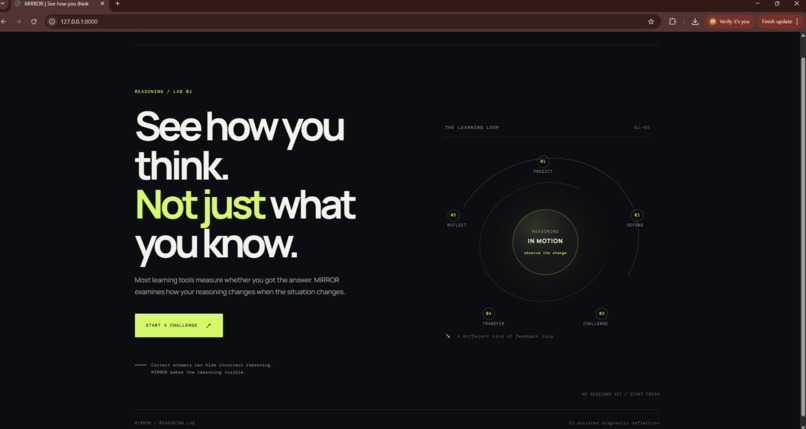
MIRROR — Reasoning Lab
-
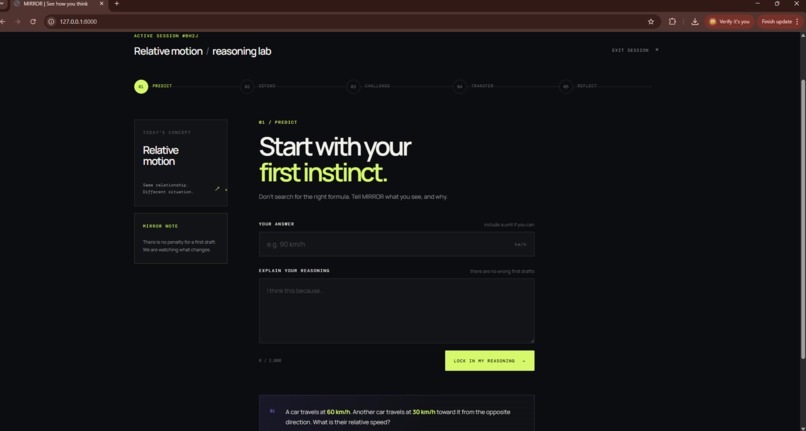
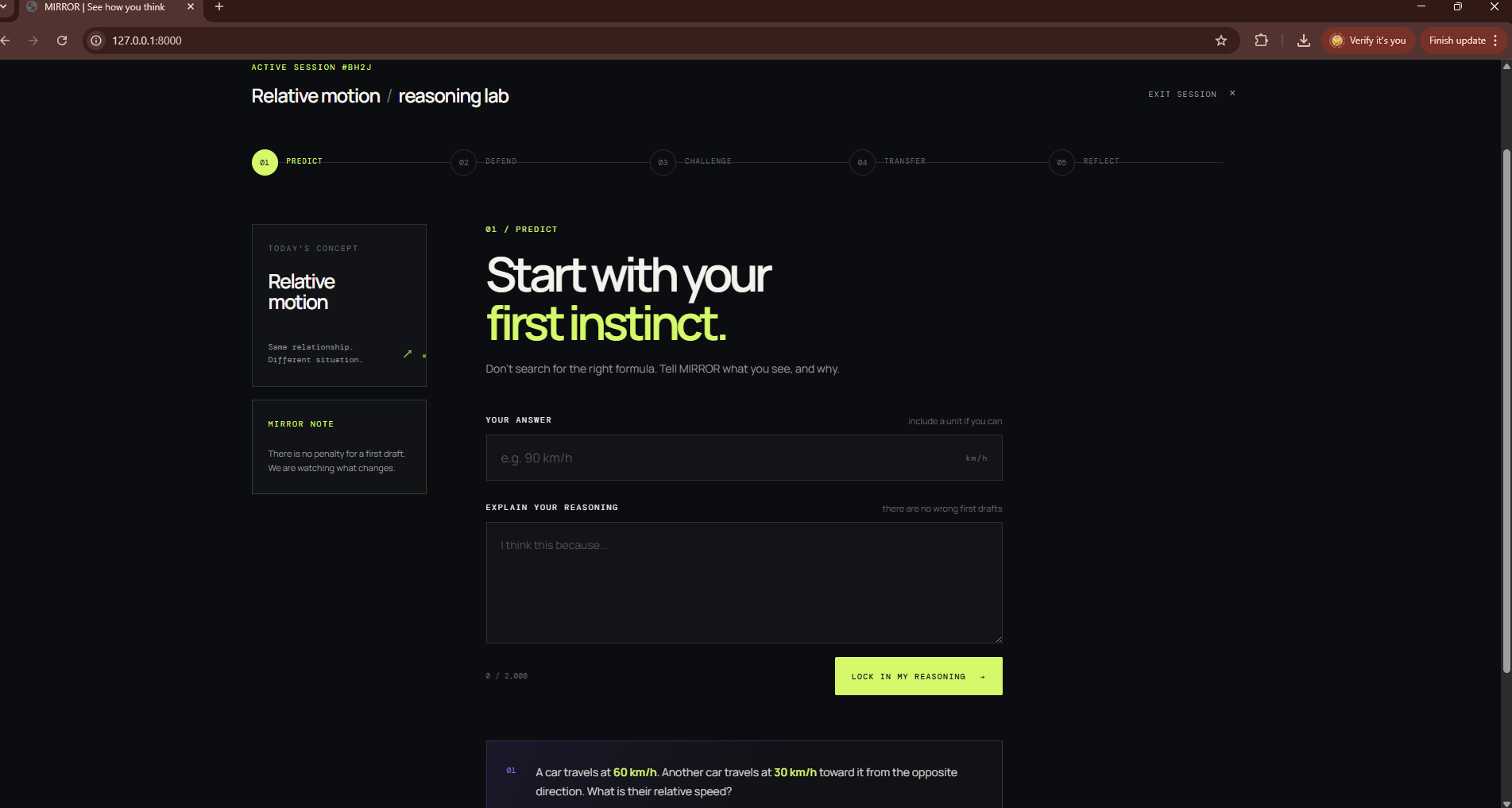
MIRROR — Predict: First Instinct
-
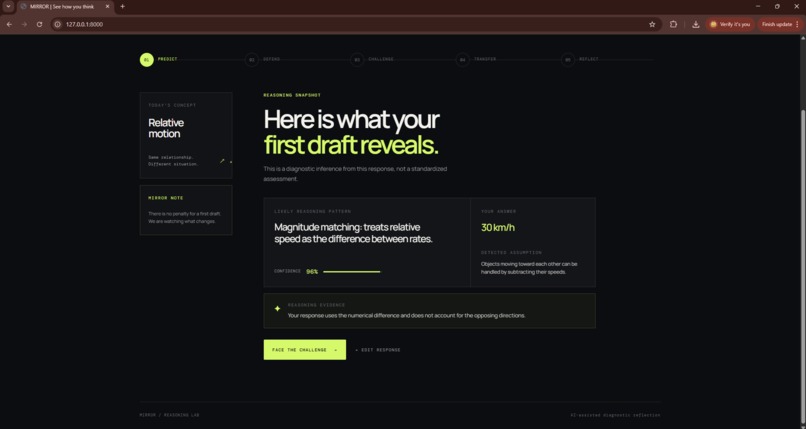
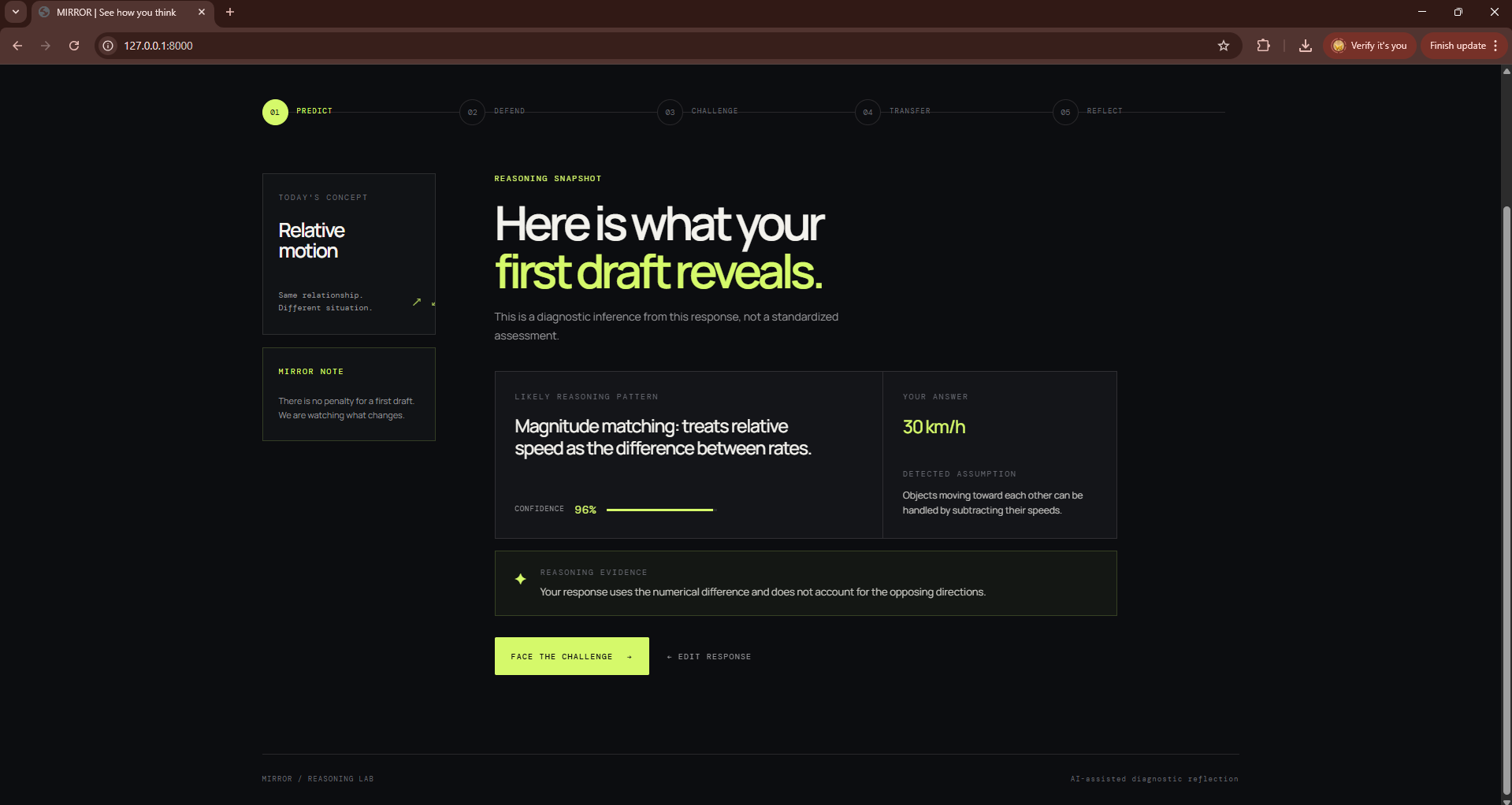
MIRROR — Reasoning Snapshot
-
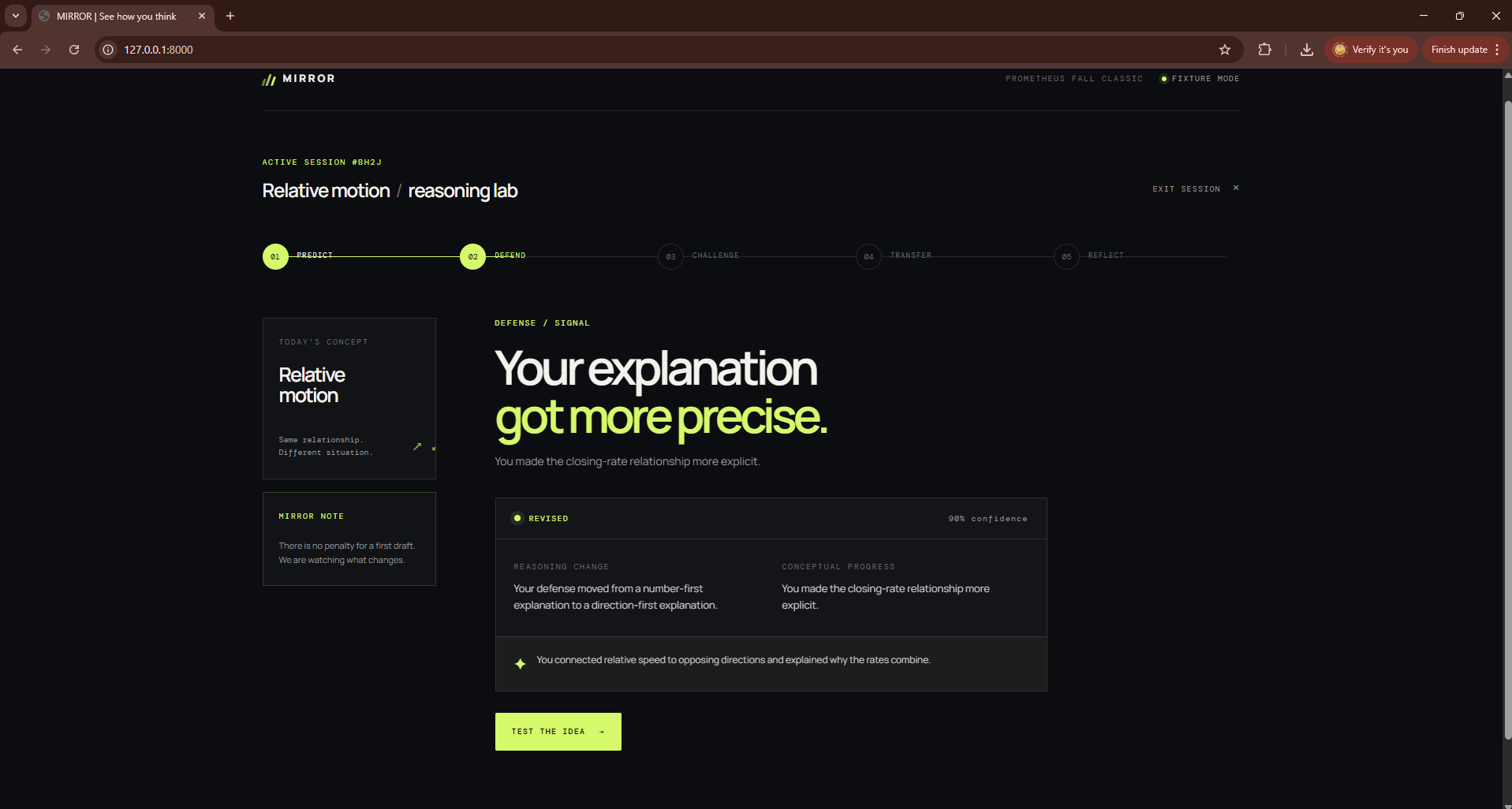
MIRROR — Defend Your Model
-
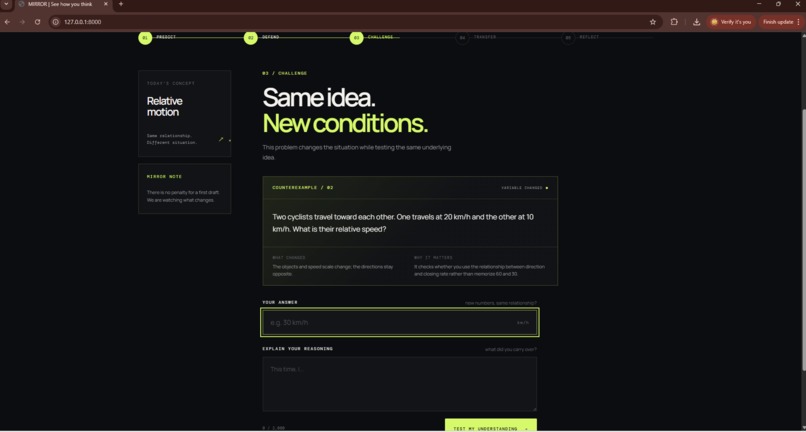
MIRROR — Defend Your Model
-
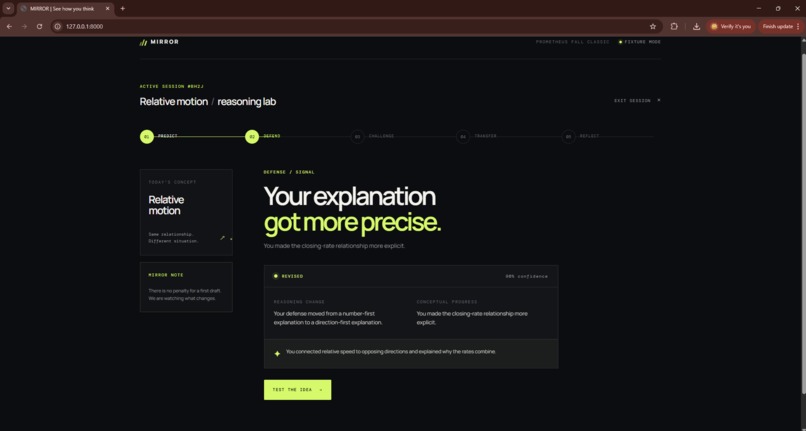
MIRROR — Defense Signal
-
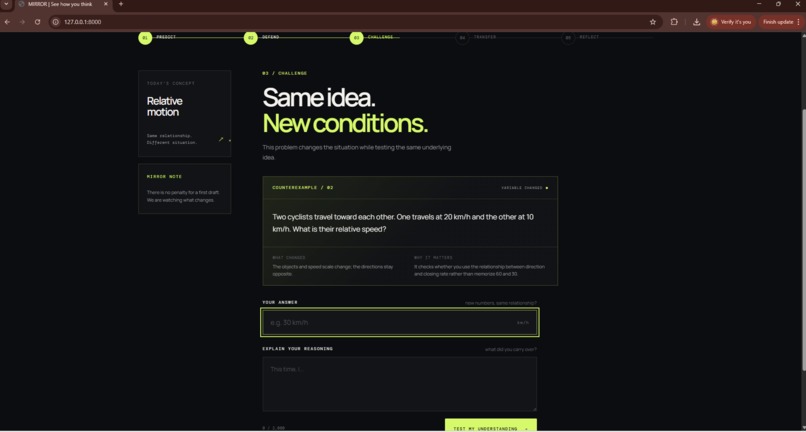
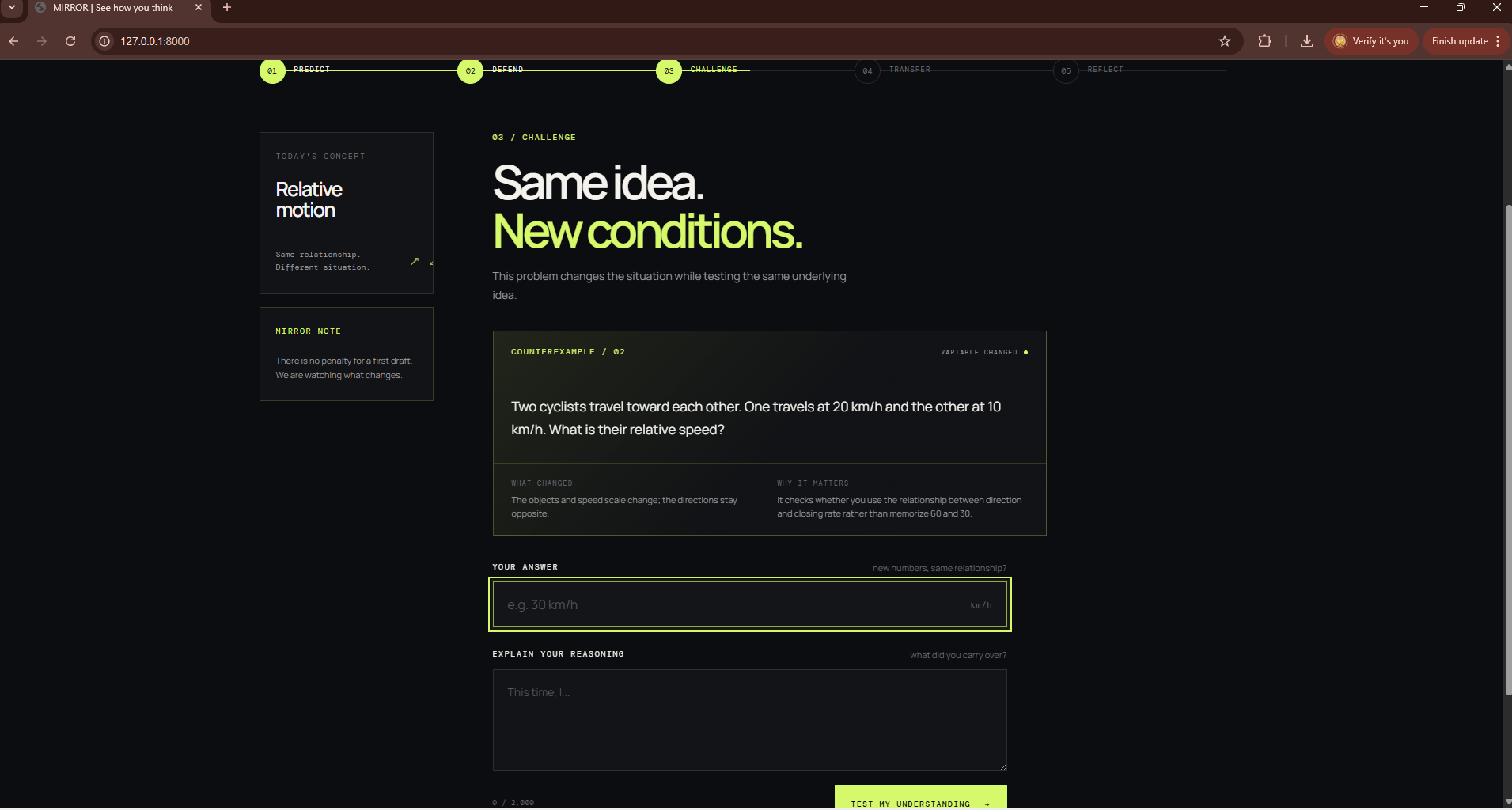
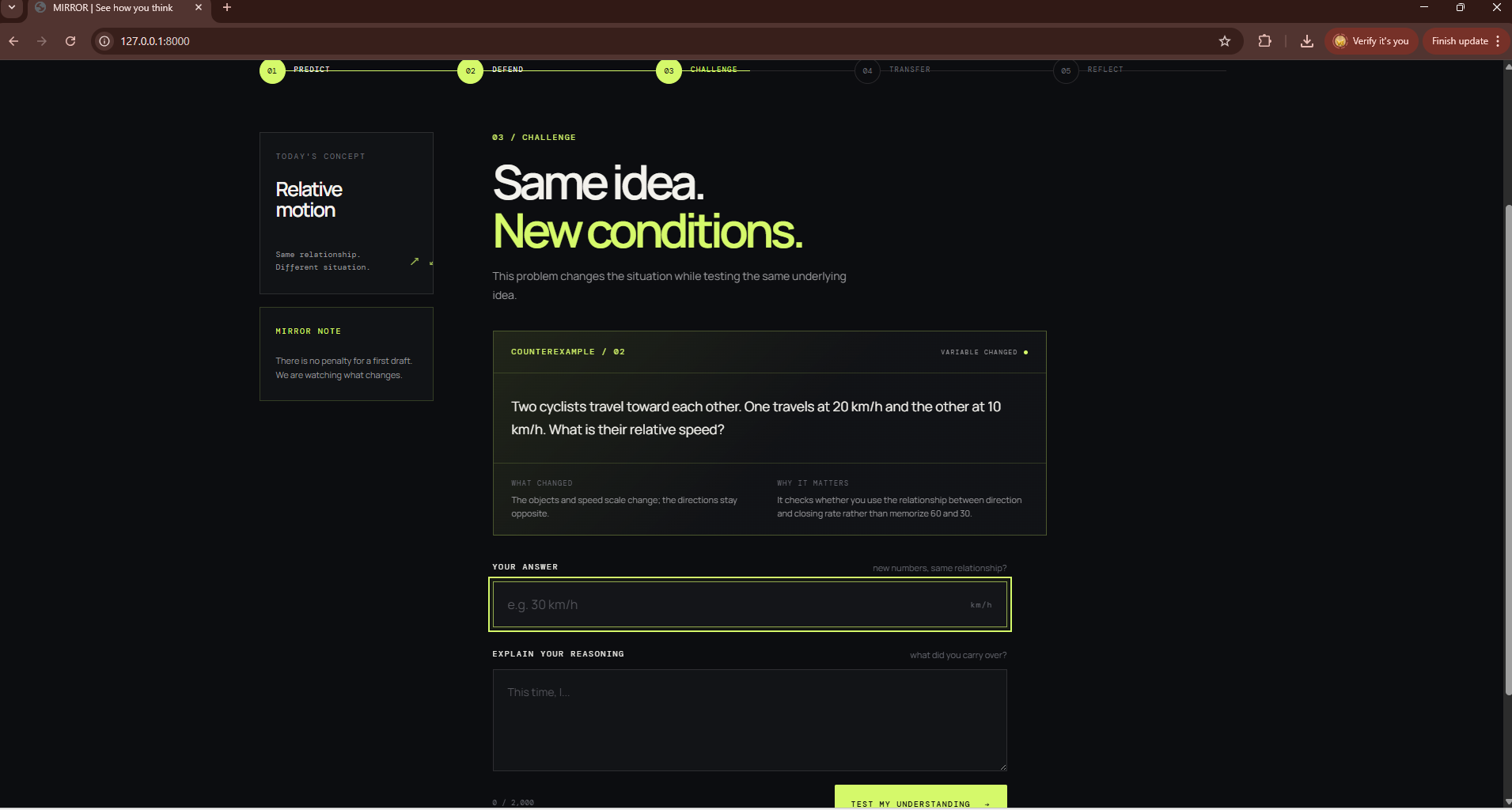
MIRROR — Challenge: New Conditions
-
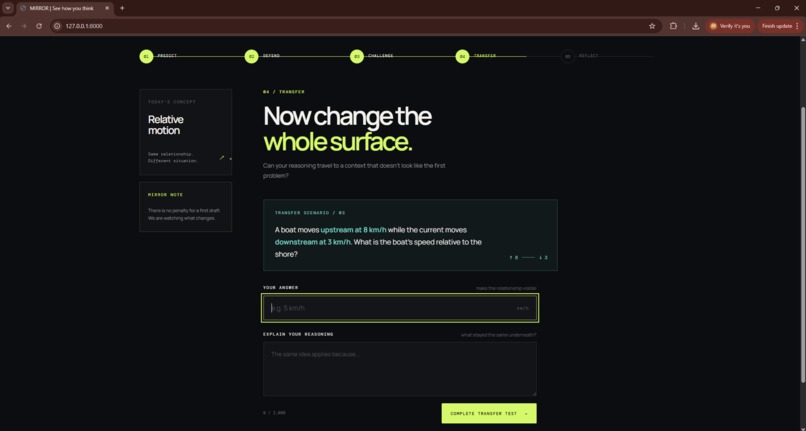
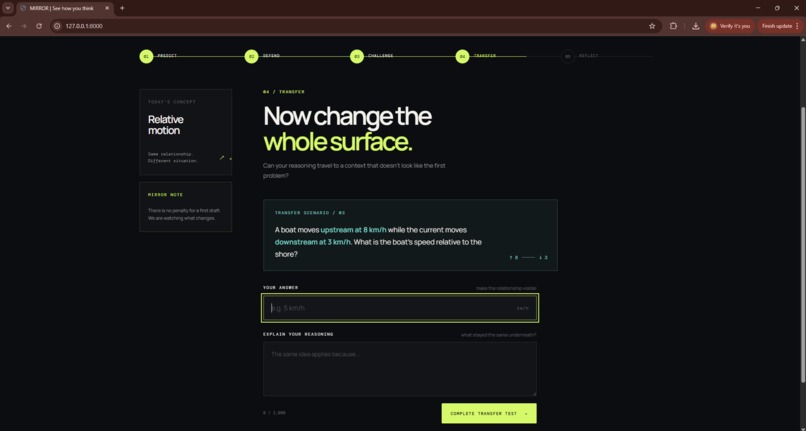
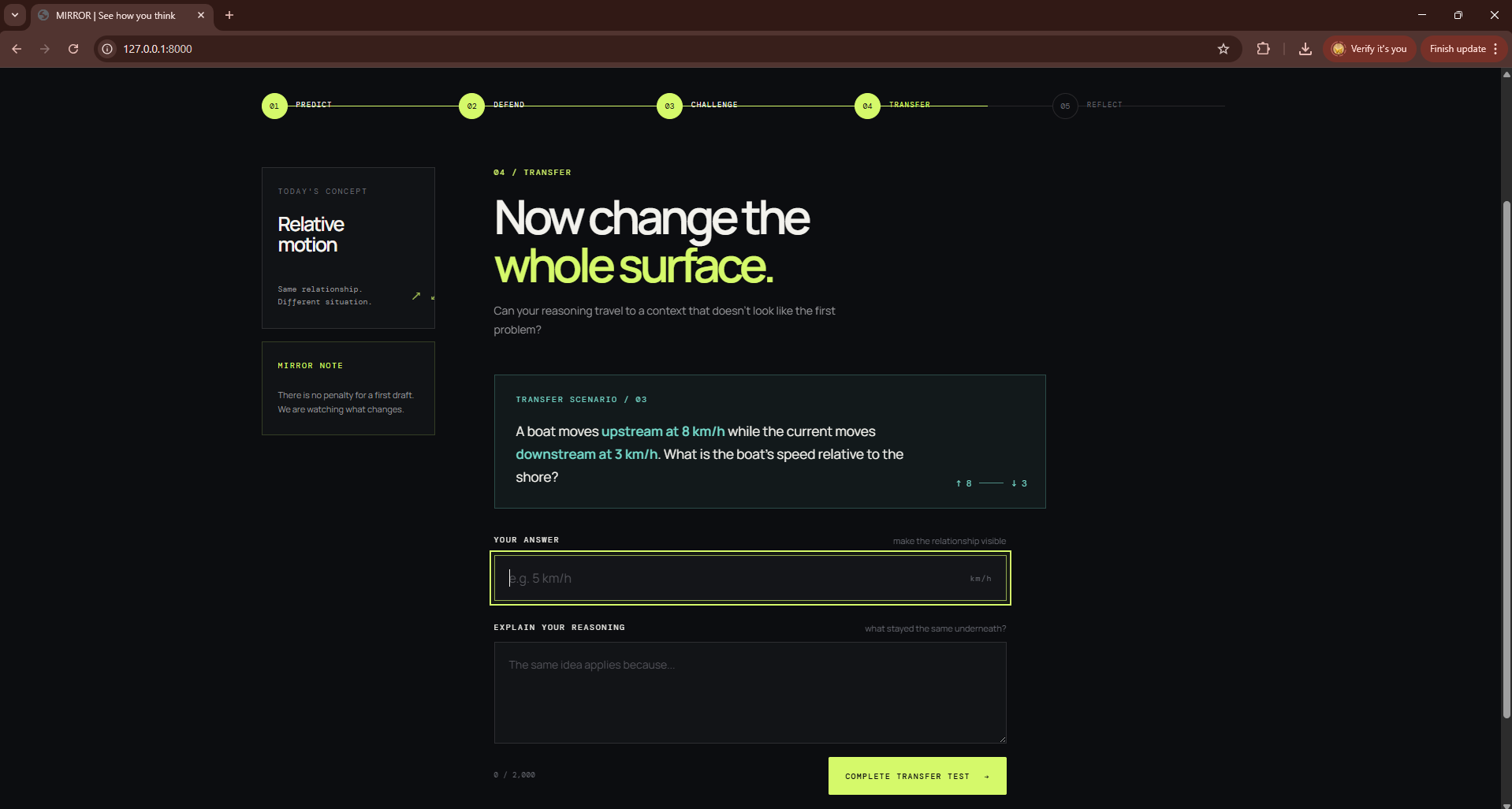
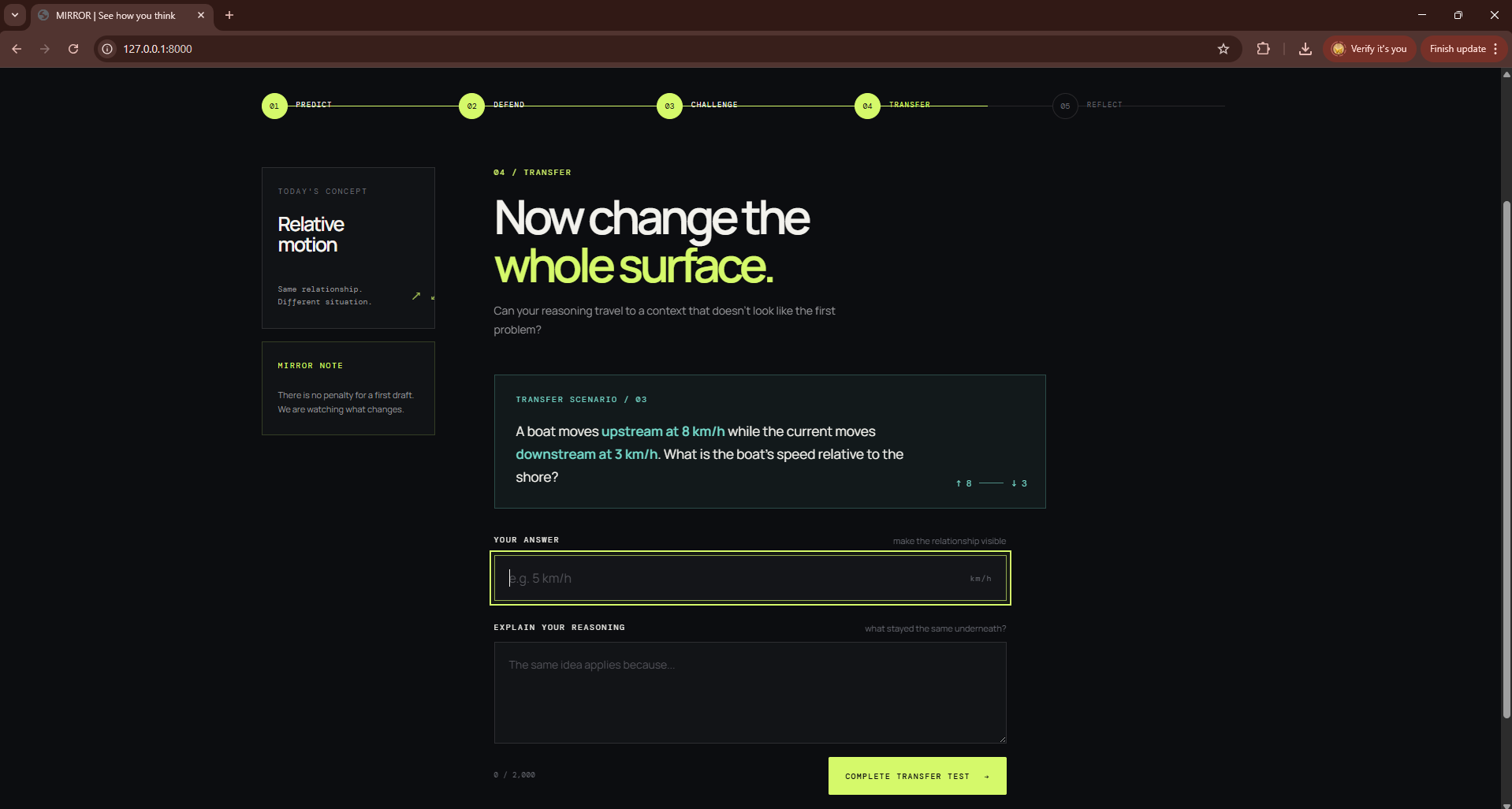
MIRROR — Transfer: Change the Surface
-
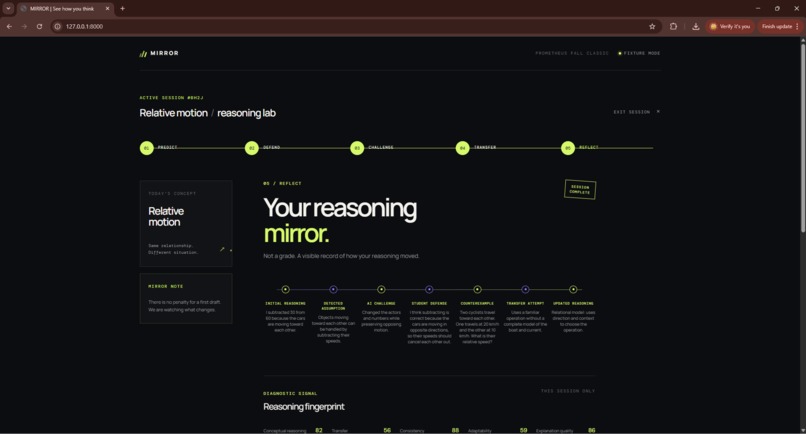
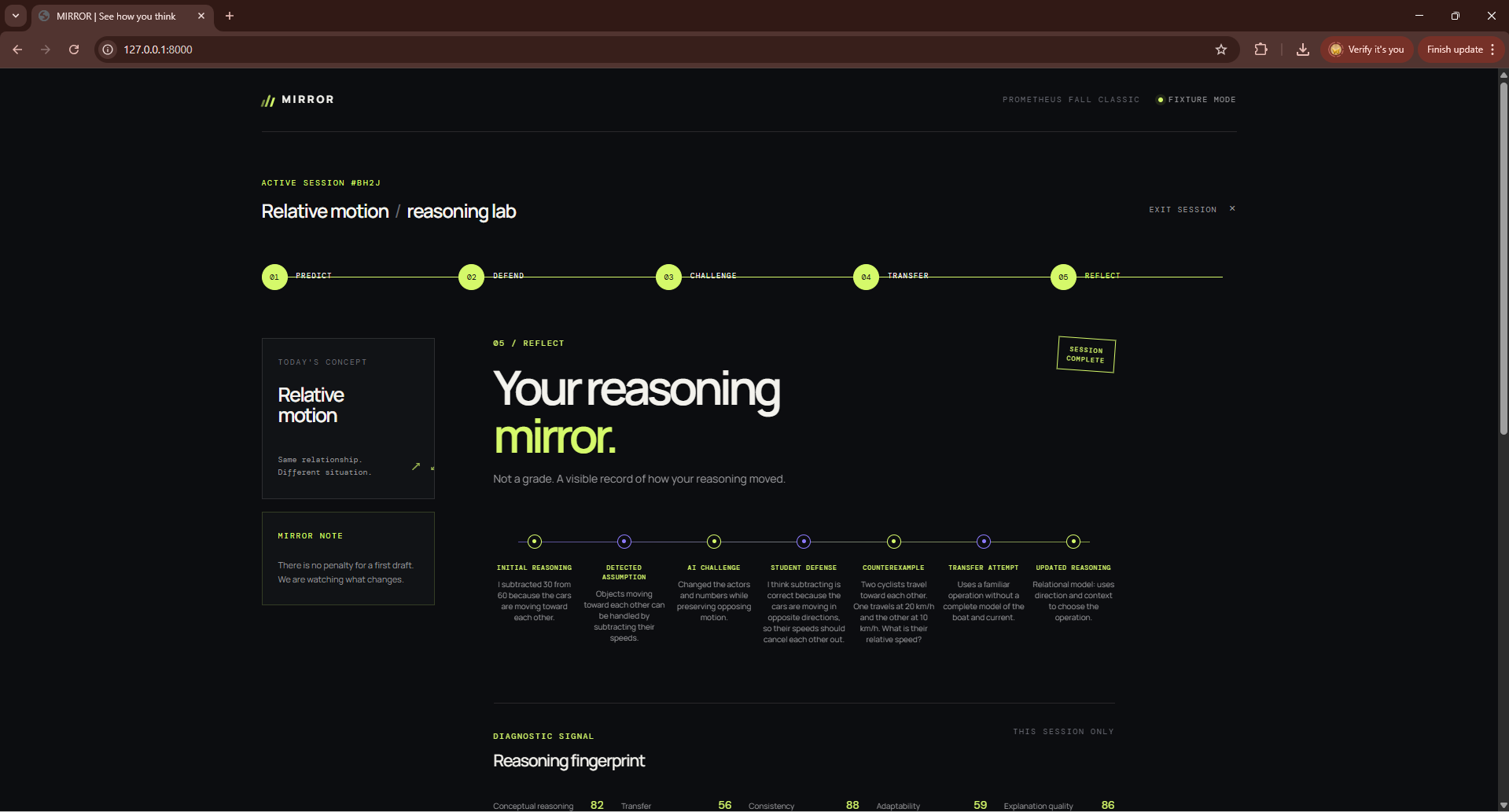
MIRROR — Reasoning Fingerprint
-
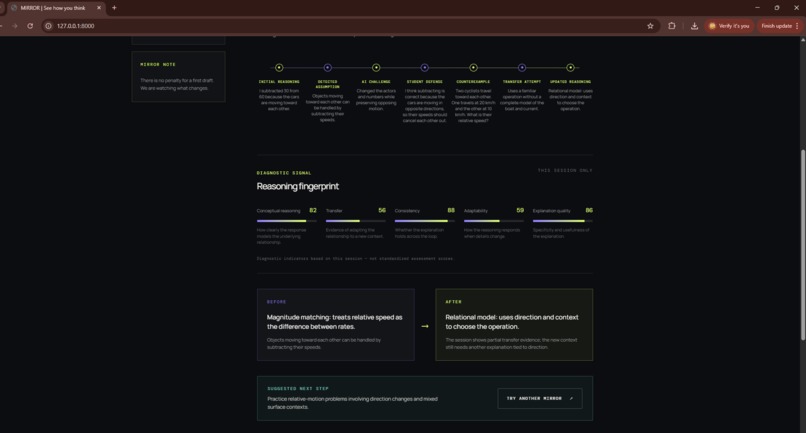
MIRROR — Before → After Reasoning
-
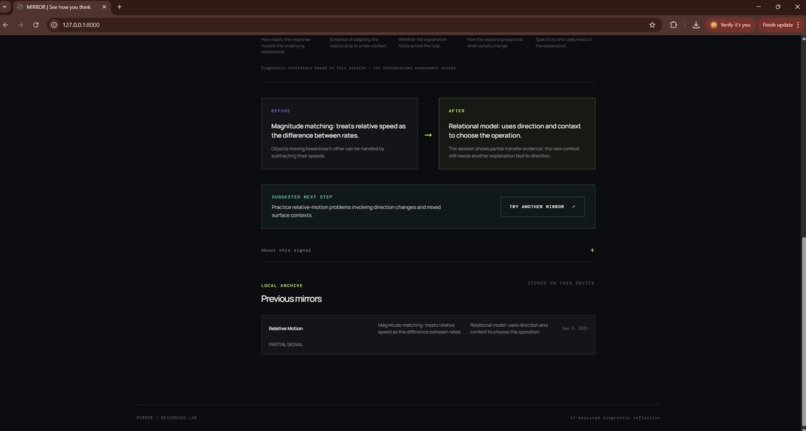
MIRROR — Learning Archive
Inspiration
A correct answer does not always mean correct understanding.
A student can arrive at the right answer through memorization, guessing, or a mental model that only works in one situation. Most learning tools measure the destination: correct or incorrect.
We wanted to explore a different question:
What happens if we measure how a learner's reasoning changes when the situation changes?
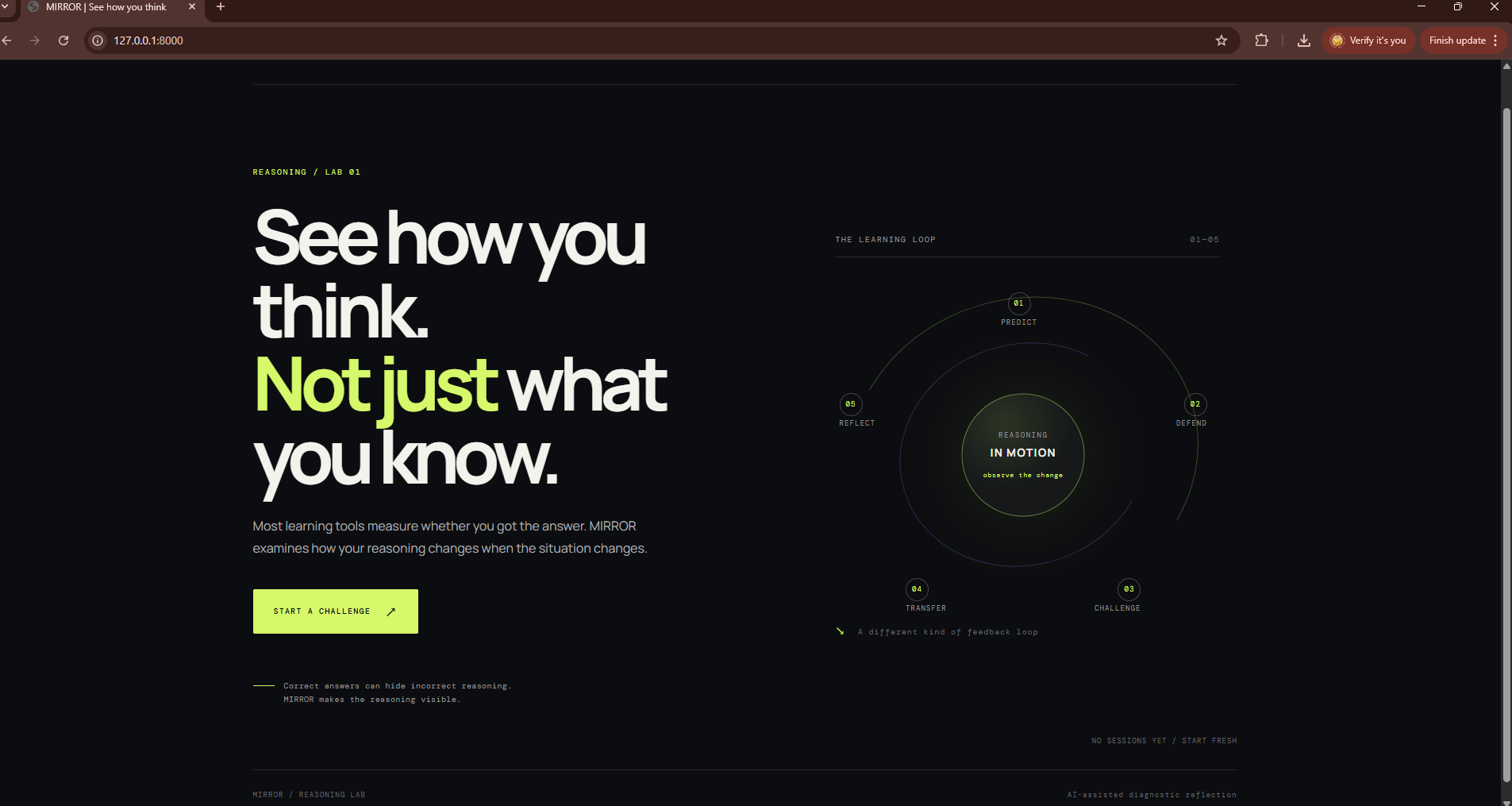
That idea became MIRROR — an AI-assisted learning instrument designed to make reasoning visible.
What MIRROR Does
MIRROR follows a five-stage learning loop:
Predict → Defend → Challenge → Transfer → Reflect
Instead of immediately correcting a learner, MIRROR first captures their explanation.
It then:
- Analyzes the written reasoning and identifies a likely reasoning pattern.
- Surfaces the assumption underneath that reasoning.
- Asks the learner to defend their model before seeing a correction.
- Changes the conditions while preserving the underlying concept.
- Tests whether the learner can transfer the relationship to a new context.
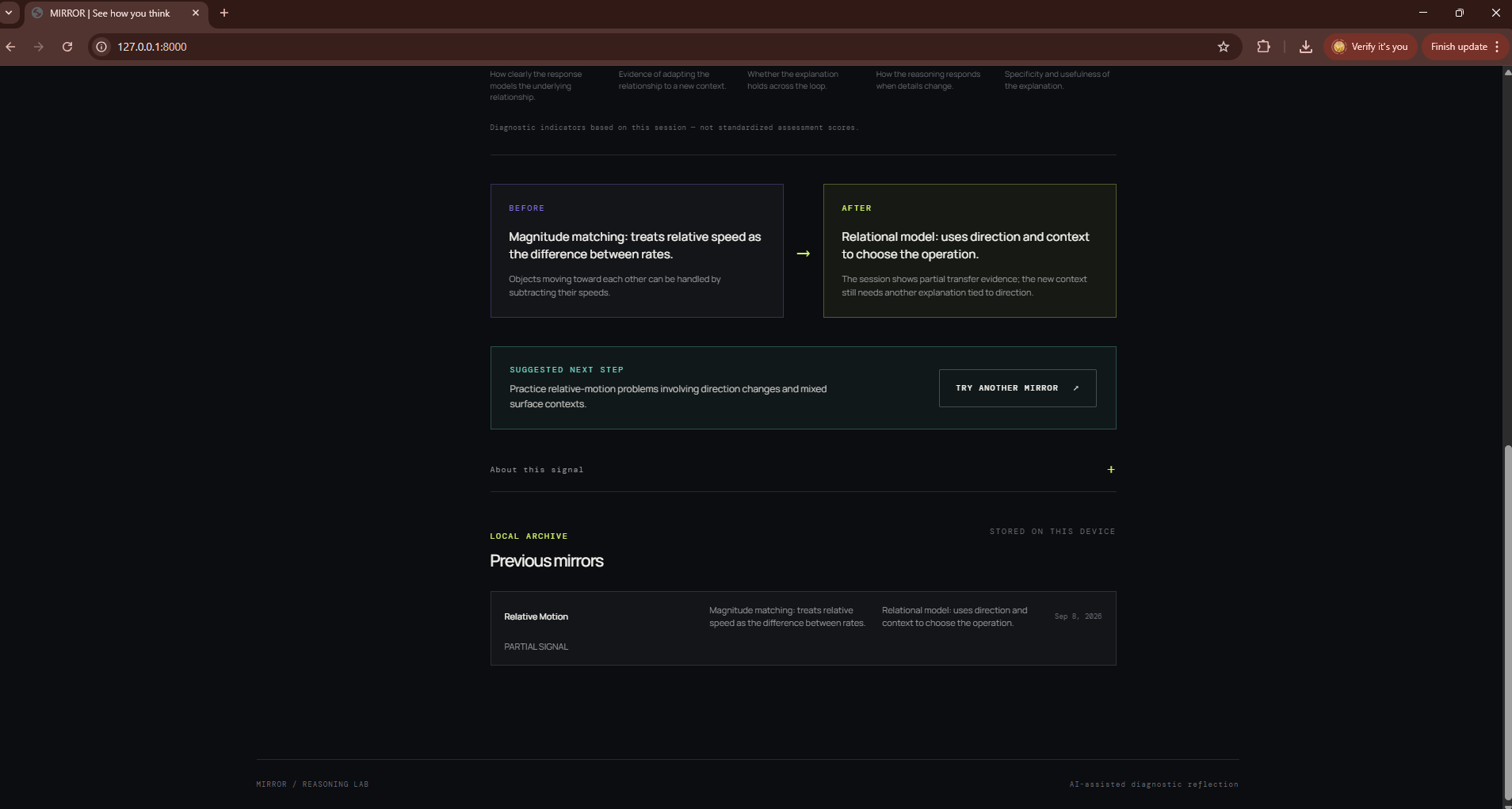
- Produces a Reasoning Mirror showing how the reasoning changed throughout the session.
For our prototype, we demonstrate this using physics and relative motion.
A learner initially sees a car problem and answers using a subtraction-based explanation. MIRROR identifies the assumption behind that response, asks the learner to defend it, then introduces cyclists and finally a boat-and-current scenario.
The goal is not simply to produce a better answer.
The goal is to make the change in reasoning visible.
Why It Is Different
MIRROR is not designed as another chatbot, homework solver, quiz generator, flashcard system, or PDF assistant.
Its core interaction is a reasoning-state comparison across changing situations.
The learner's first explanation becomes a starting point. The system then observes what happens when that reasoning is challenged and transferred.
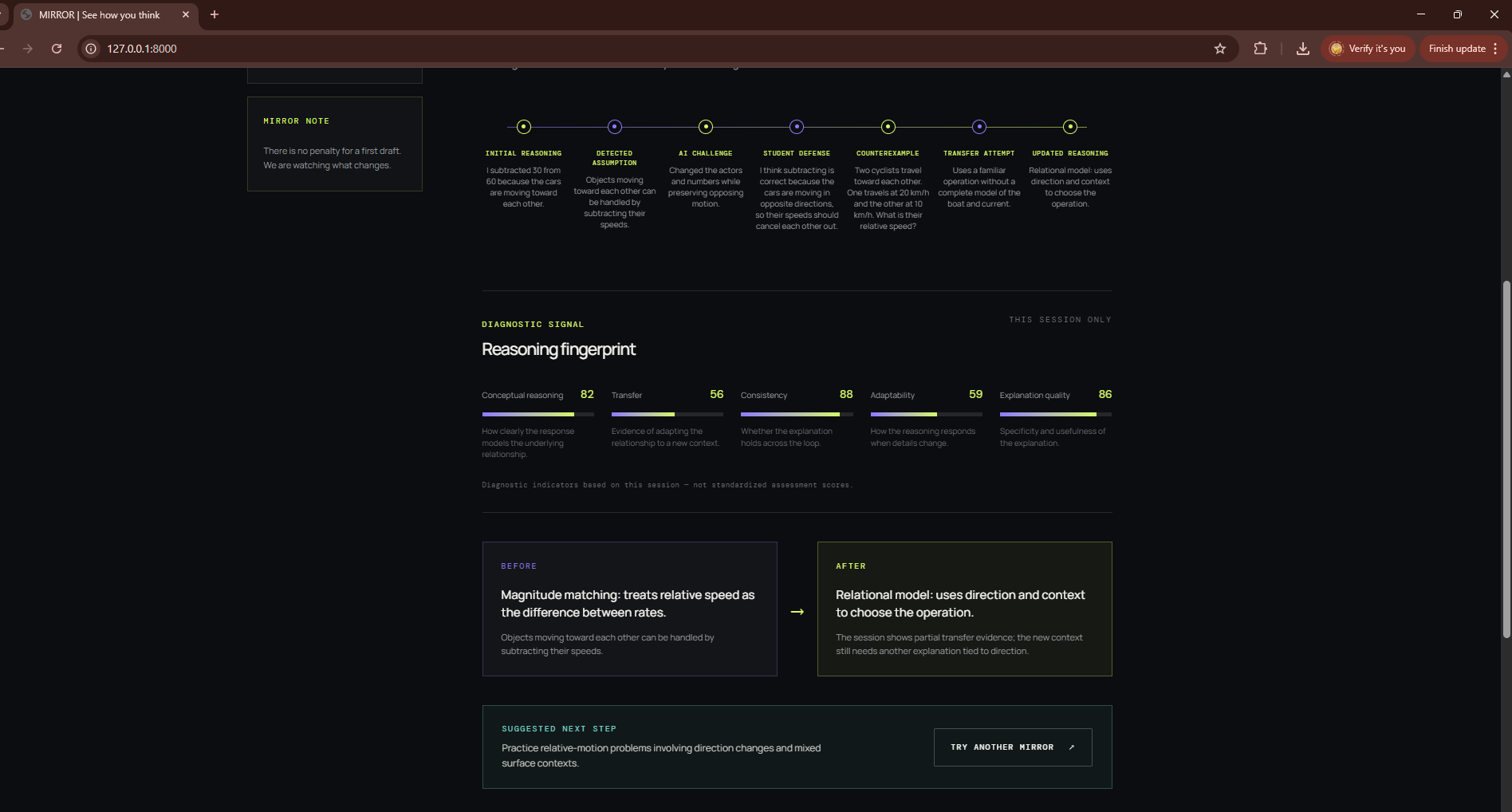
The final output is a visual Reasoning Fingerprint containing session-level diagnostic indicators for:
- Conceptual reasoning
- Transfer
- Consistency
- Adaptability
- Explanation quality
These are explicitly presented as diagnostic indicators based on the session, not standardized assessment scores.
How We Built It
MIRROR was built as a lightweight full-stack application using:
- Python
- FastAPI
- Pydantic
- Uvicorn
- Vanilla JavaScript
- HTML5
- CSS3
- Pytest
The backend maintains session state and exposes API endpoints for each reasoning stage.
AI functionality is separated behind a provider abstraction. The prototype includes a deterministic fixture mode so the complete learning loop can be demonstrated reproducibly without requiring an API credential.
The same architecture also provides a real-provider path using structured JSON validated through Pydantic contracts.
This separation allowed us to keep the reasoning workflow deterministic during development while designing the system for real AI inference.
What We Learned
The biggest lesson was that educational AI becomes more interesting when it focuses on the process behind an answer, rather than only generating another answer.
We also learned that responsible AI language matters.
MIRROR therefore uses terms such as:
- “likely reasoning pattern”
- “detected assumption”
- “reasoning evidence”
- “diagnostic indicator”
- “partial transfer evidence”
It does not claim to read a learner's mind, prove mastery, or provide scientifically validated assessment scores.
The prototype only makes inferences from the learner's written responses within the current session.
Challenges
One of the main challenges was designing an interaction that felt genuinely different from a traditional AI tutor.
A simple chatbot can explain why an answer is wrong. MIRROR needed to do something more structured: preserve the learner's original reasoning, challenge the underlying assumption, change the context, and compare the resulting explanations.
Another challenge was making the system useful without overstating what its AI analysis means.
We addressed this by using structured Pydantic models, explicit uncertainty-aware language, deterministic fixture testing, and clear responsible-AI limitations.
The Result
MIRROR turns a learning session into a visible reasoning journey:
Initial reasoning → Detected assumption → AI challenge → Student defense → Counterexample → Transfer attempt → Updated reasoning
Instead of ending with:
“Correct.”
MIRROR ends with:
“Here is how your reasoning changed.”
That is the idea behind MIRROR:
See how you think. Not just what you know.
Built With
- artificial
- css3
- fastapi
- html5
- intelligence
- javascript
- learning
- machine
- pydantic
- pytest
- python
- uvicorn

Log in or sign up for Devpost to join the conversation.