-
-
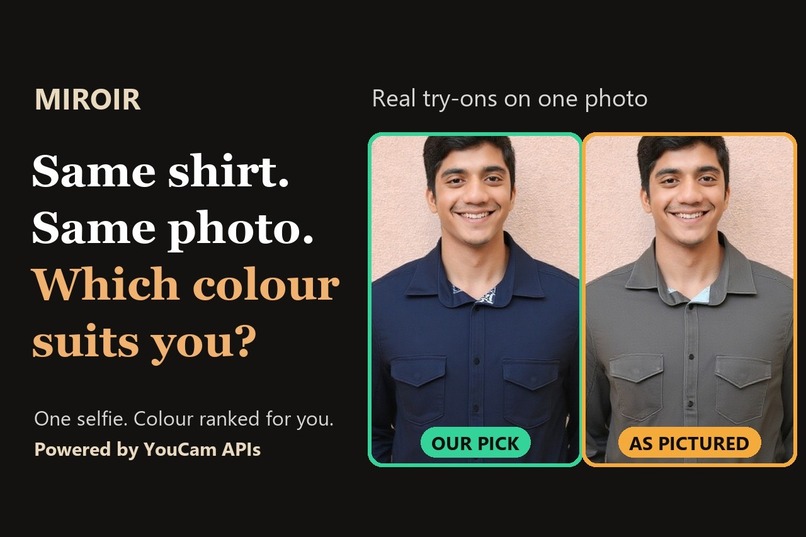
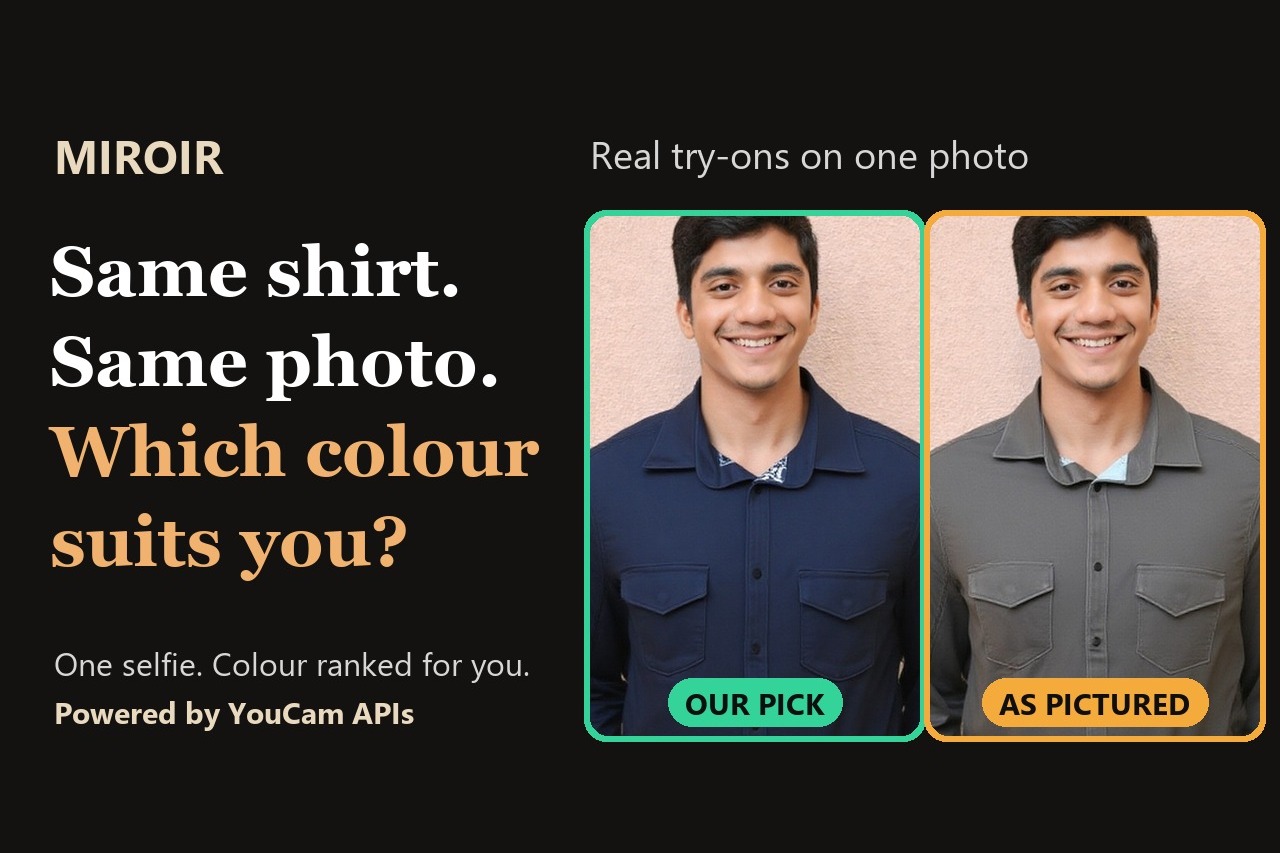
Same shirt, same photo: MIROIR's navy pick vs the colour in the product photo, as real YouCam try-ons.
-
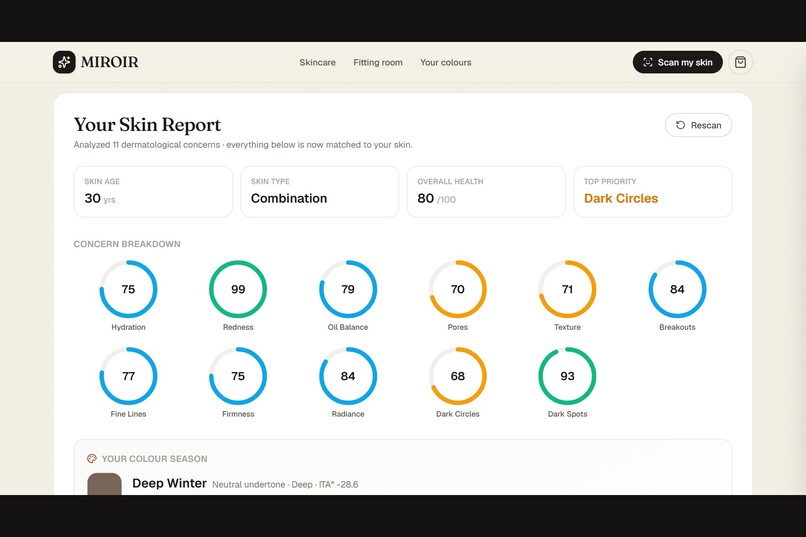
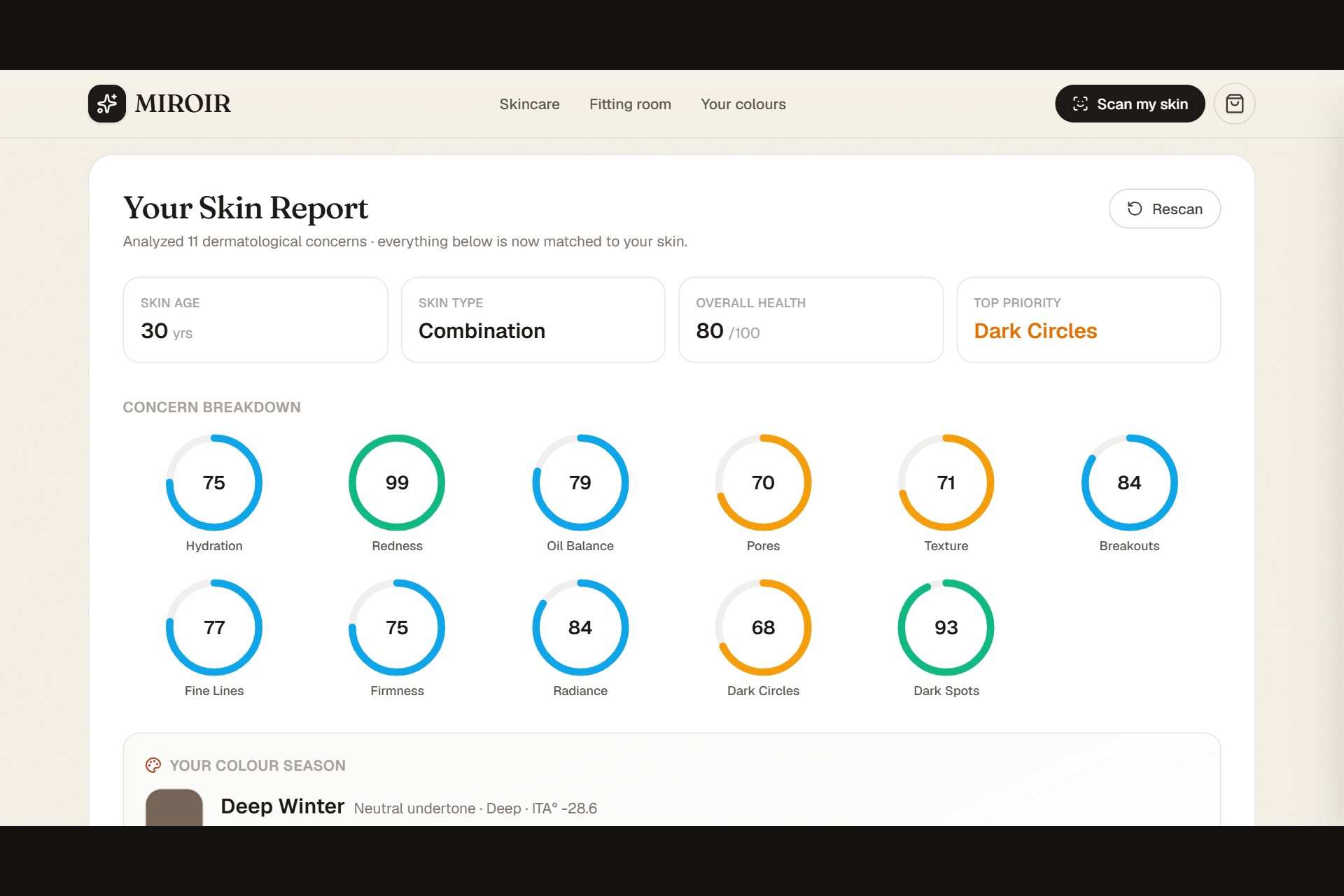
Live YouCam Skin Analysis: eleven concern scores, skin type and skin age from one selfie.
-
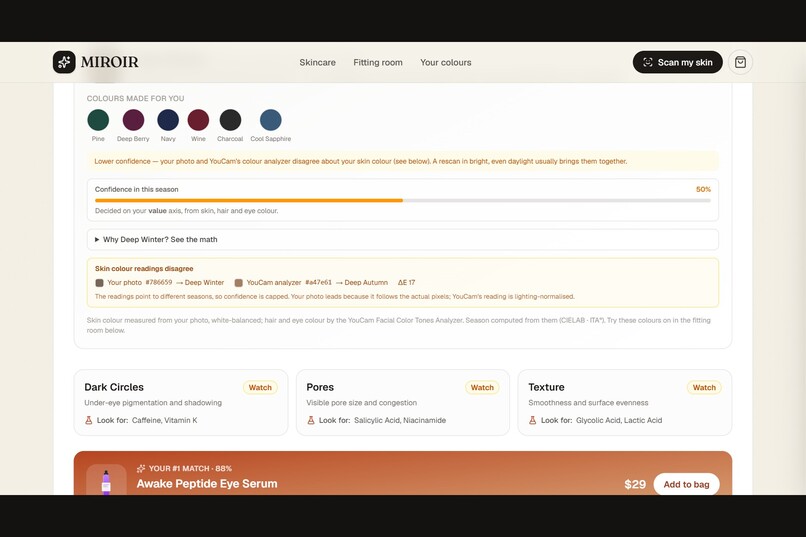
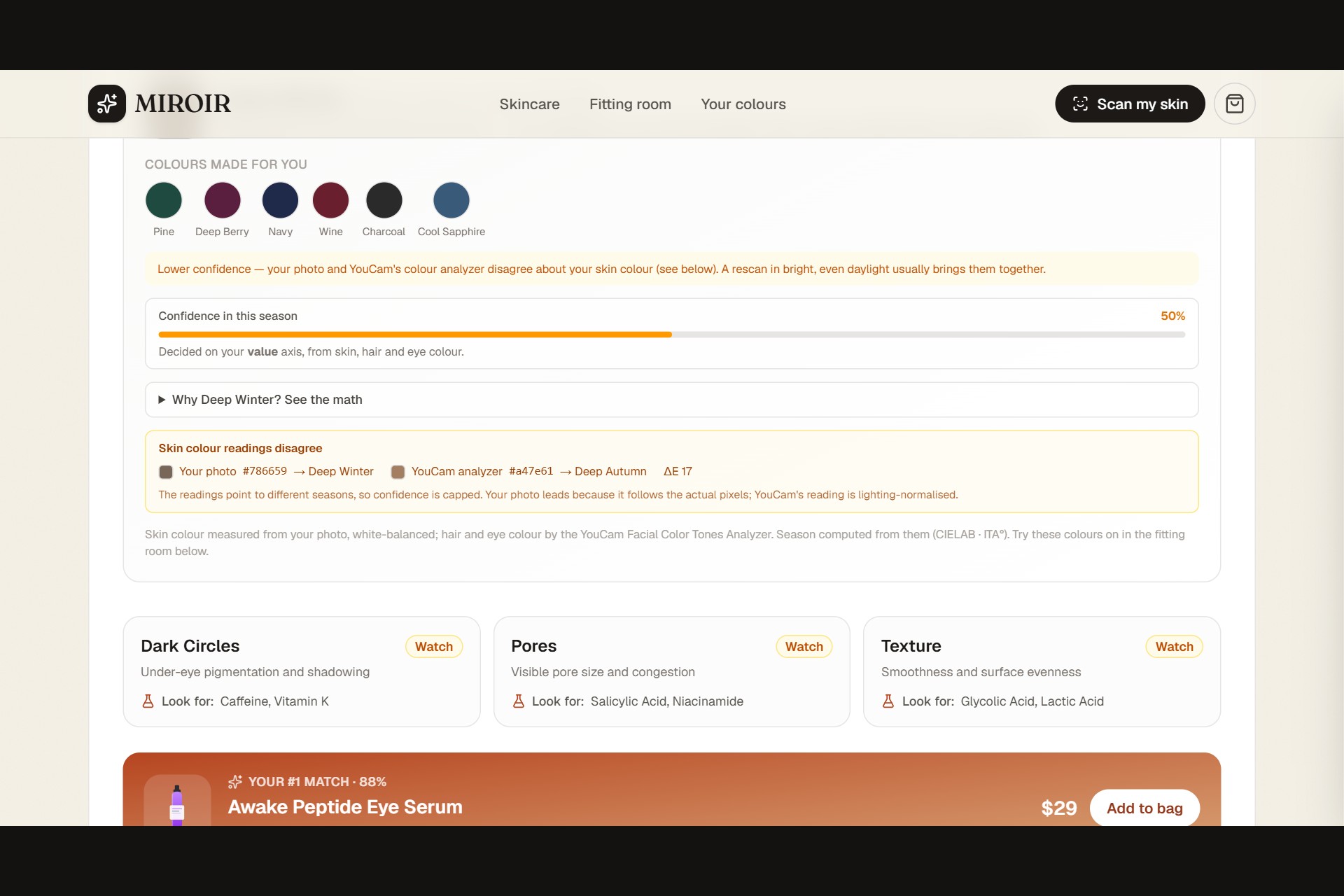
Two skin readings disagree, so MIROIR shows both, explains why and caps its confidence at 50%.
-
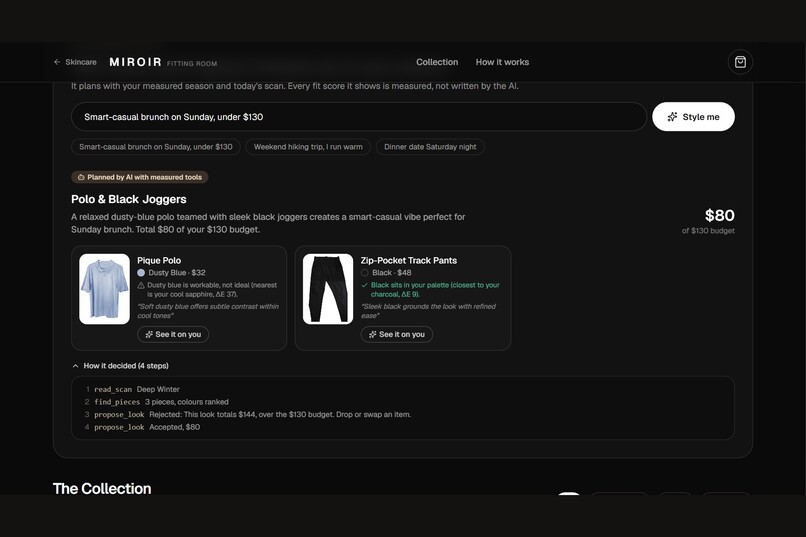
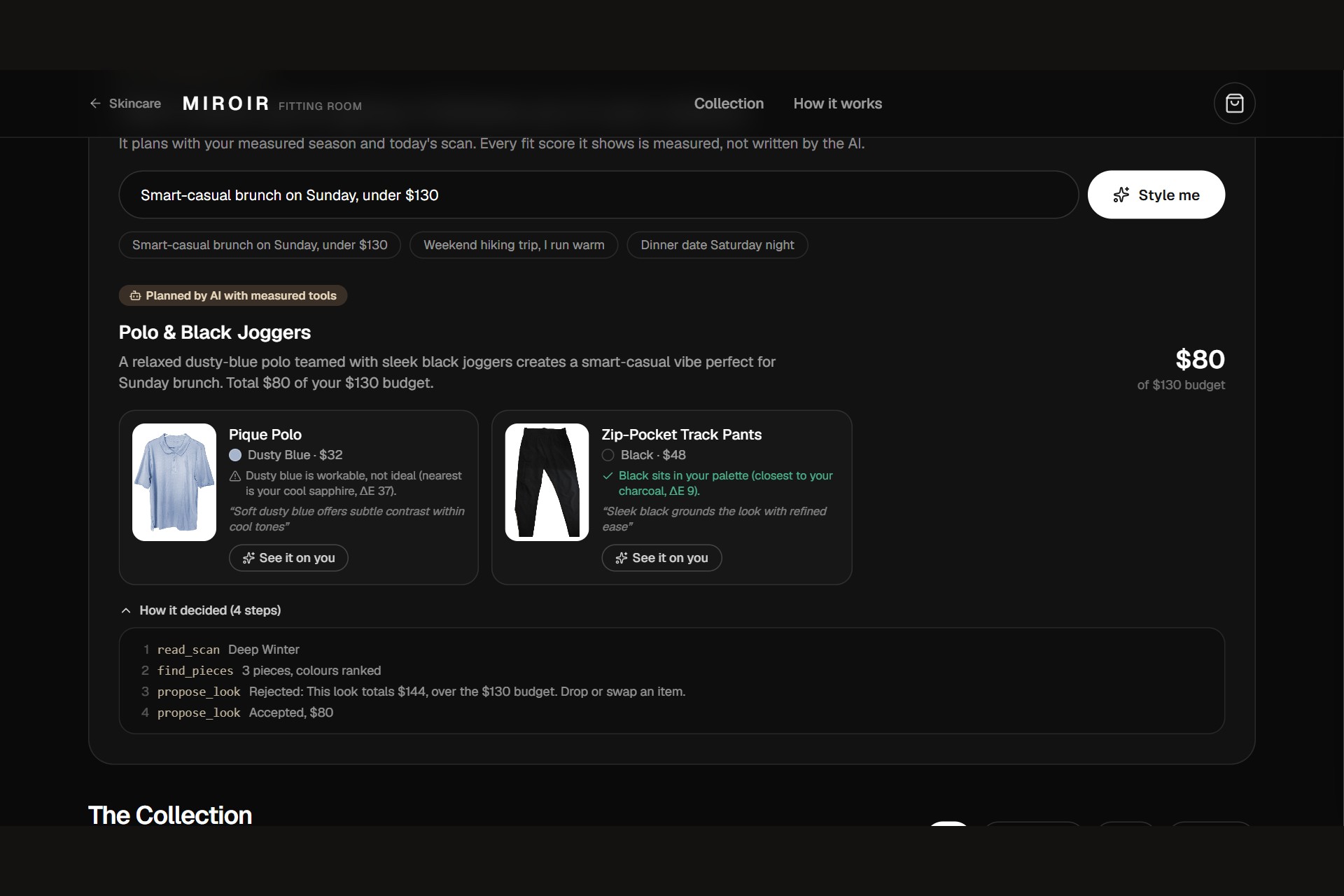
The AI stylist's over-budget look is rejected by the store. It tries again at $80, and every step is shown.
The problem
You find a shirt you like online, and it comes in five colours. You pick from a product photo, with no way to tell which colour suits you. In Coresight Research's 2023 survey of US apparel brands and retailers, colour was the second most-cited reason for online apparel returns (16% of respondents), behind size and fit (53%). Personal colour analysis exists, but it's usually a paid service with a stylist.
What it does
- Scan: take a selfie. If your face is small in the frame, MIROIR zooms in first. No selfie handy? Click See a sample result.
- See your season: MIROIR places you in one of twelve colour seasons and states how confident it is.
- Shop by colour: every colour of every garment is ranked for you, with the number behind it.
- Prove it: one garment is rendered on your photo twice, in our pick and in the colour from the product photo.
- Plan a look: type "Smart-casual brunch on Sunday, under $130". An AI stylist builds a look from the collection, and you can open every step it took.
Why you can check it
- Measured, not generated: fit scores are CIELAB distances to your palette. The AI can't write its own scores.
- The store can say no: invented items, clashing colours and over-budget looks are rejected. In our demo, the first look came to $144 against a $130 budget and was rejected; the second came to $80.
- Disagreement is shown: skin colour is read twice, from a white-balanced sample of your photo and by YouCam. If the two imply different seasons, MIROIR shows both and caps confidence at 50%.
- Failures are labelled: if YouCam rejects a photo, the report says "Demo data" and gives the reason.
- Published tests: we committed pass/fail rules before testing, then published the results, including the failures: https://skin-ai-lake.vercel.app/evidence
How we built it
Three YouCam APIs, all called from the server so the key never reaches the browser:
- Skin Analysis (S2S v2.1): eleven concern scores, skin type and skin age. They drive the skincare shelf, and the redness score lowers red colours on the same scan.
- Facial Color Tones Analyzer (S2S v2.0): hair and eye colour for the season engine, plus the skin cross-check.
- Apparel VTO (S2S v2.0): renders the chosen colour on your photo, including the side-by-side proof.
The app uses Next.js 16, React 19, TypeScript and Tailwind on Vercel. The stylist is an agent loop on Groq, and a labelled rules planner takes over without an AI key. CI runs type checks, lint, 417 test assertions, season validation and a production build. AI tools were used during development, including Claude Code for code and ElevenLabs for the demo narration.
Challenges
YouCam's skin colour reading was repeatable but darker than the photo showed, so we cross-check it against the photo rather than trusting either one silently. Selfies at arm's length were rejected as "face too small", so the app now finds the face and reframes the photo first.
What we learned
In our pilot, five photos of one person gave five different seasons, and simulated lighting changed the season in about 22% of cases. The colour correction helps a lot (median ΔE 4.2 vs 20.4 without it), but it isn't enough on its own. Measuring that changed how the product talks about confidence.
Honest limits
- No accuracy claim: the season engine has not been validated against trained colour analysts. We tested consistency, not correctness, on one person.
- Seasons can shift between photos: treat one scan as a starting point.
- Small demo catalogue: five pieces, which are my own clothes photographed with logos removed. Brand names, product names and prices are placeholders. Earlier commits used third-party product photos as placeholders; these were removed before submission.
- Bottoms: trying these on needs a full-body photo.
- Not medical advice: scores are cosmetic guidance.
What's next
Test with more people and real daylight photos, ask for a second photo when a reading is uncertain, and compare results with trained colour analysts.
Built With
- elevenlabs
- github-actions
- groq
- next.js
- react
- tailwindcss
- typescript
- vercel
- youcam-api
