-
-
AppIcon
-
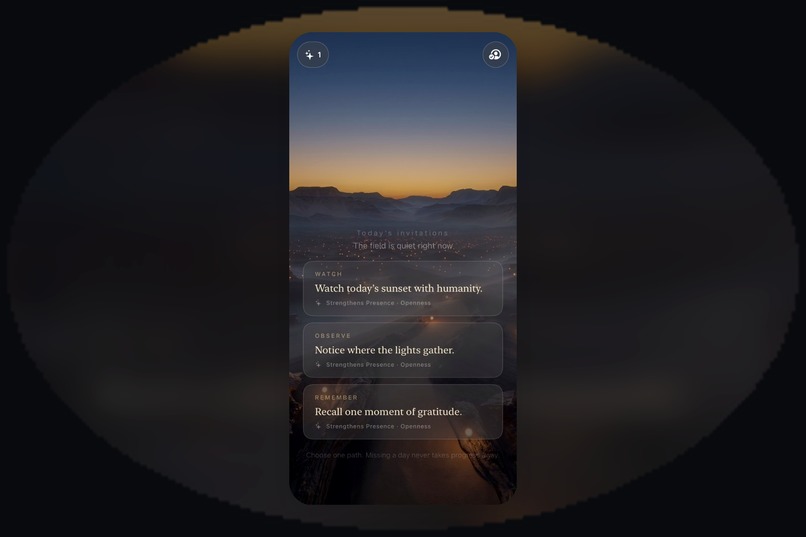
main hub
-
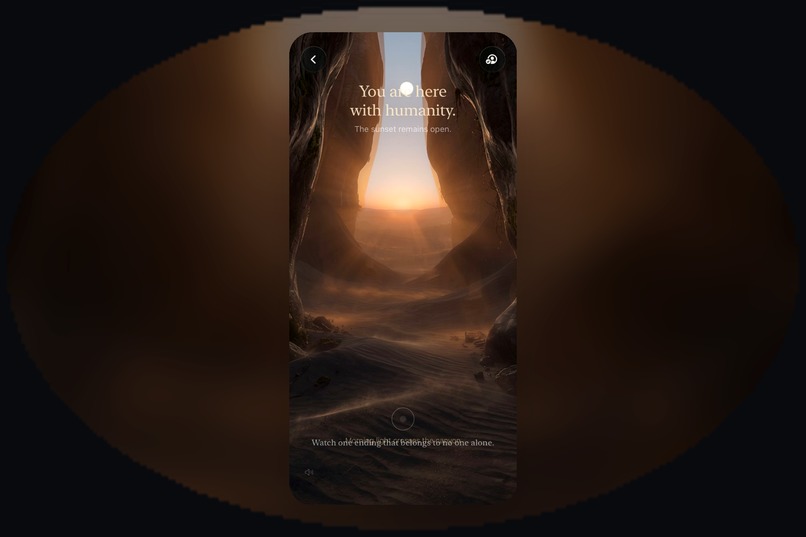
sunset experience
Inspiration
Miraunity began during a conversation with a friend about Miravelys, an app I was already developing around reflection, breathing, meditation, and emotional clarity.
My friend pointed out a practical problem in the existing experience. When someone feels stressed or anxious, they may understand that they need to pause, but they still want an immediate reward. In that moment, opening a reflective application has to feel more compelling than scrolling, smoking, drinking, or another automatic distraction.
He suggested making the entrance more immediate and game-like. One example was to show the user three metaphorical cards, let them choose one, and use that choice to begin a sequence of short questions, voice responses, breathing, and reflection.
That suggestion was the original spark.
As I developed the idea, it became larger than a new entrance flow for Miravelys. I began imagining a persistent living world that a person could enter during a difficult moment—a place where the interface was not a dashboard or content library, but the environment itself.
Miraunity emerged from that process as a companion to Miravelys, centered on anonymous shared presence.
What it does
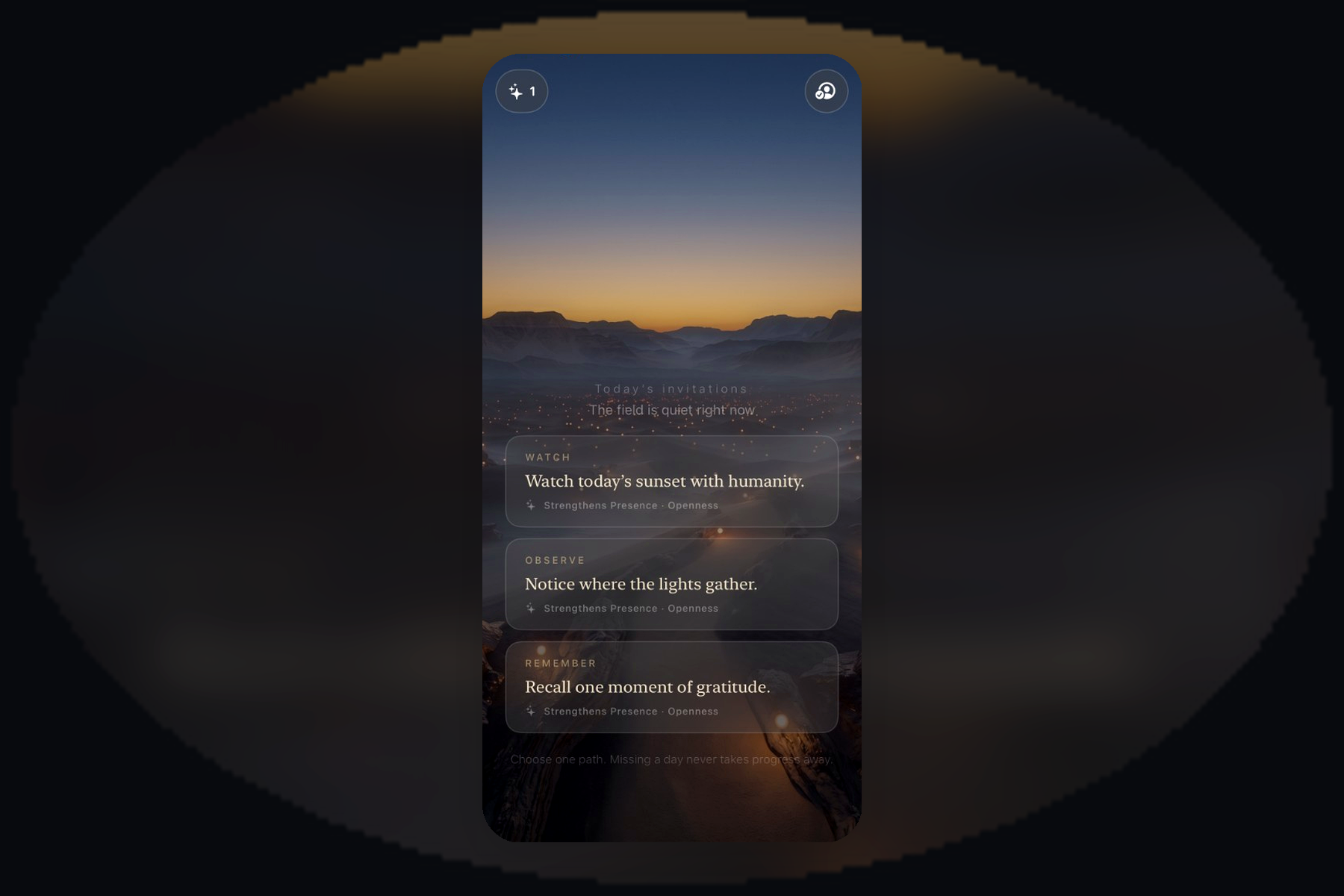
Miraunity is a living shared world where people can enter a reflective experience without creating a public identity.
There are no public profiles, follower counts, likes, rankings, feeds, or direct chat. Other people remain present, but they appear anonymously through light, aura, reflections, lanterns, movement, and changes in the collective atmosphere.
A person may enter through a metaphorical choice, a short question, a breathing experience, silence, reflection, gratitude, forgiveness, or truth-oriented work. Their actions affect what they privately experience and may also contribute, with consent, to the anonymous atmosphere of the shared world.
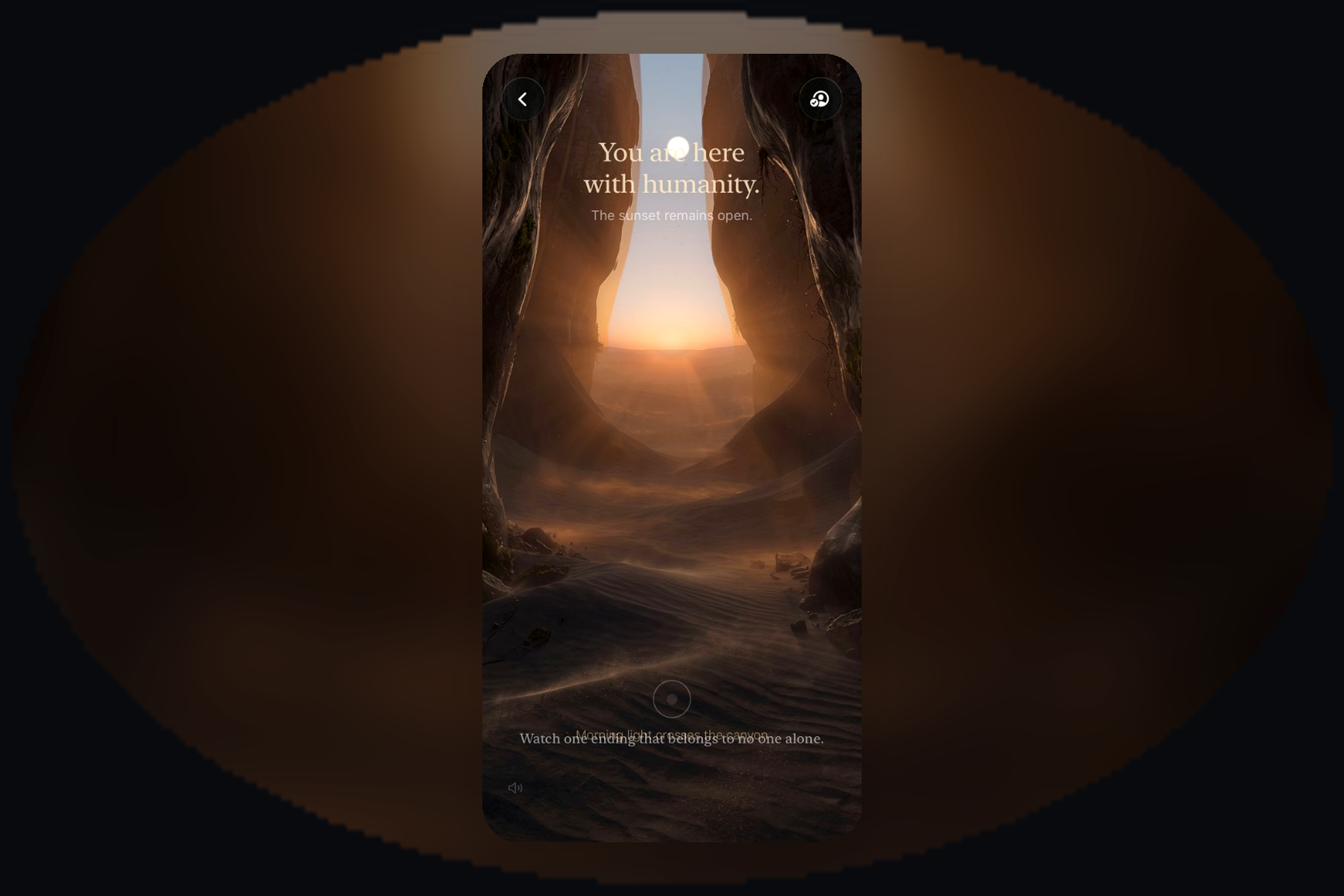
The environment is not intended to be a background behind conventional screens. The world itself is the main interface. Fog can separate, paths can appear, water can reveal distant regions, light can change, and anonymous presences can arrive or leave.
Miraunity does not attempt to diagnose the user or replace professional care. It is designed as a place for pausing, experiencing, and quietly recognizing that other people are present too.
How I built it
Miraunity is being developed as a native Apple-platform project using Swift, SwiftUI, Xcode, Apple frameworks, OpenAI models, Codex, and CloudKit.
The project began with an existing repository and a set of visual world references. A large part of the work involved inspecting what already existed, identifying which systems should be preserved, and separating prototype technology from the intended production architecture.
The early world implementation relied heavily on generated 3D terrain and procedural environments. Those systems repeatedly failed to reproduce the approved artwork and often made the worlds feel artificial.
The project therefore moved toward individually authored 2.5D environments composed of separated visual layers, depth information, controlled camera movement, atmospheric animation, lighting, water, fog, fire, and anonymous presence effects.
The current approach treats every approved world image as a product specification rather than general inspiration.
Codex has been used for repository inspection, architecture planning, implementation, debugging, refactoring, platform adaptation, validation rules, and simulator-based testing. It has also helped expose an important limitation: generating working code is easier than preserving the emotional and visual truth of a product.
Challenges I ran into
The largest challenge has been translating a very specific experiential idea into systems that do not become generic.
Several implementations were technically functional but still wrong for the product. Worlds became static backgrounds. Procedural terrain replaced the intended compositions. Visual references were interpreted loosely. Some environments contained mirrored seams, incorrect lighting, unnatural movement, or elements that did not respond as part of one living place.
Cross-device behavior introduced another set of problems. iPad layouts sometimes behaved like enlarged iPhone screens. Backgrounds did not always fill or compose correctly in portrait and landscape. Navigation controls and active-session elements could overlap. Apple Watch required a much quieter and more immediate version of the experience rather than a reduced copy of the phone application.
Another challenge has been scope. The vision naturally expanded from six opening worlds toward a much larger connected universe. At the same time, the implementation showed that expanding too early could produce many incomplete environments instead of one convincing experience.
The project has therefore required repeated decisions about what to preserve, what to rebuild, what to postpone, and what must pass a quality gate before the next stage begins.
Accomplishments that I am proud of
I am proud that Miraunity has developed into a coherent idea rather than another meditation library or social network.
The project preserves the presence of other people while removing the identity and comparison systems that usually dominate digital communities.
I am also proud of defining the world as an active part of the experience. Movement, light, atmosphere, sound, and human presence are not intended as decoration. They communicate safety, choice, reflection, belonging, and change.
Another accomplishment has been learning not to accept technical output simply because it compiles or looks impressive at first glance. Much of the progress came from identifying results that were structurally or visually untrue, rejecting them, and creating stronger constraints for the next implementation.
Miraunity is still being built. The accomplishment is not that every part is finished, but that the project now has a much clearer product identity, visual canon, architecture, and path toward a production-quality experience.
What I learned
I learned that AI-assisted development still requires strong human direction.
An AI coding agent can generate architecture and implementation quickly, but it cannot automatically know which details are essential to the identity of the product. Without precise constraints, it may replace a meaningful existing system, interpret visual references too freely, or optimize for technical completion rather than the intended experience.
I also learned that anonymous presence is not the same as removing people. Miraunity became more meaningful when people remained visible as living presences, while profiles, status, competition, and public comparison were removed.
Another lesson was that progress does not need to be represented through points or levels. In Miraunity, development can be felt through perception: a path becomes visible, fog moves away, a gate gains light, or a distant region appears in the water.
Most importantly, I learned that one deeply finished experience is more valuable than a large collection of unfinished worlds.
What’s next for Miraunity
The immediate priority is to complete one production-quality vertical slice that proves the complete experience.
That means finishing one living world with reliable movement, lighting, atmosphere, anonymous presence, navigation, reflection, breathing, sound, and cross-device behavior.
After that foundation is validated, the same standards can be applied to the remaining opening worlds and eventually to a larger connected world system.
The long-term direction remains a persistent place that people return to—not another application they simply open, complete, and close.


Log in or sign up for Devpost to join the conversation.