


Project name: Mirage
Fight scams before they find you.
Elevator pitch (20 words)
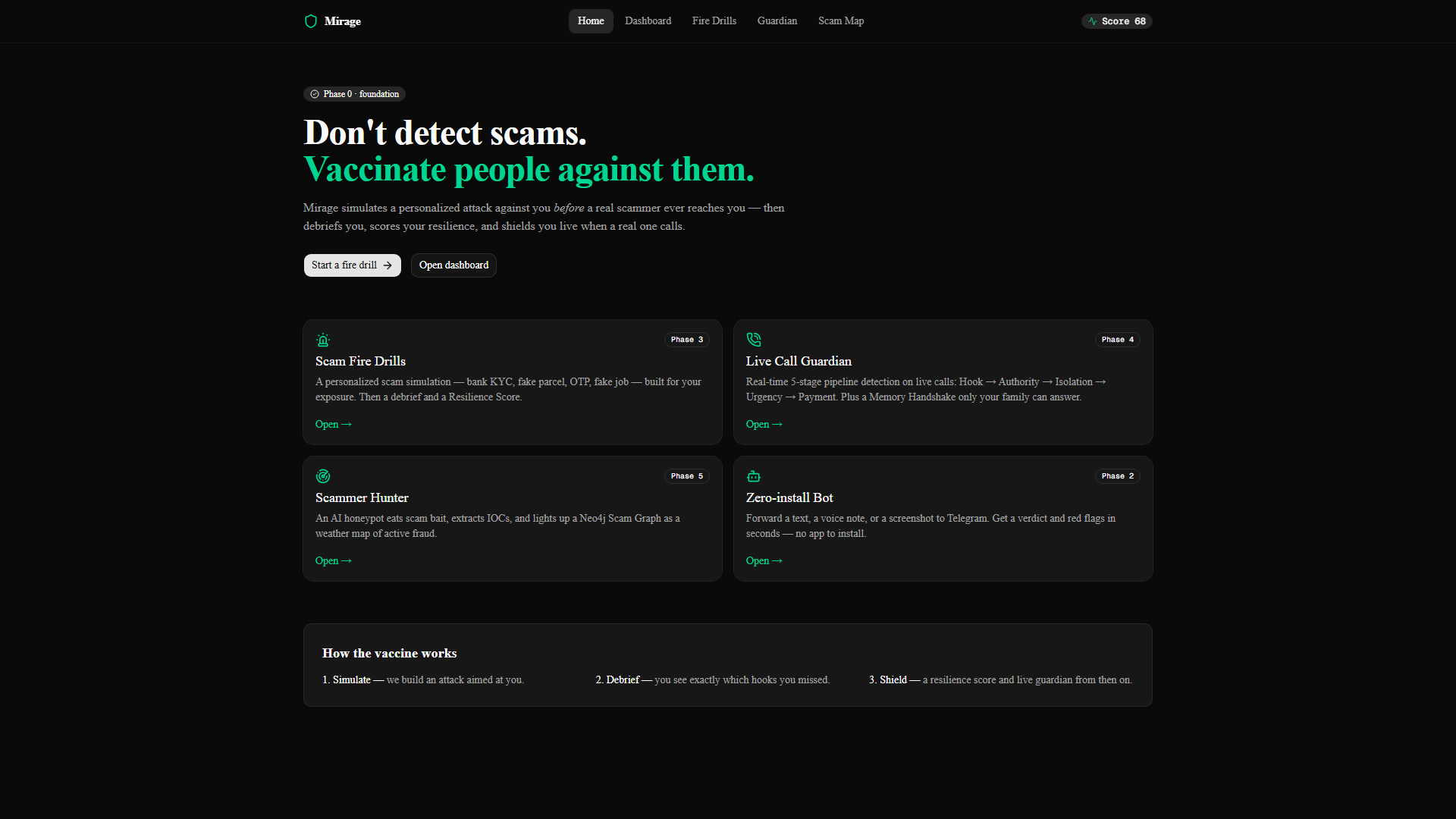
Mirage safely attacks you first with personalized scam drills, then guards live calls, verifies cloned voices, and hunts real scammers.
Inspiration
Every family in India has a scam story: an uncle who got a "digital arrest" call, a mother who nearly sent money to a cloned voice of her son, a friend drained through a fake UPI collect request. AI has made it worse. A 10-second Instagram reel is now enough to clone a voice, and scammers can personalize a script with your city, bank, and job.
Every existing tool reacts after the damage: it flags a message after you've read it or blocks a number after the call. We asked a different question: what if people were vaccinated against scams, the way we vaccinate against disease? Exposure in a safe, controlled dose builds immunity. Mirage applies that idea to fraud.
What it does
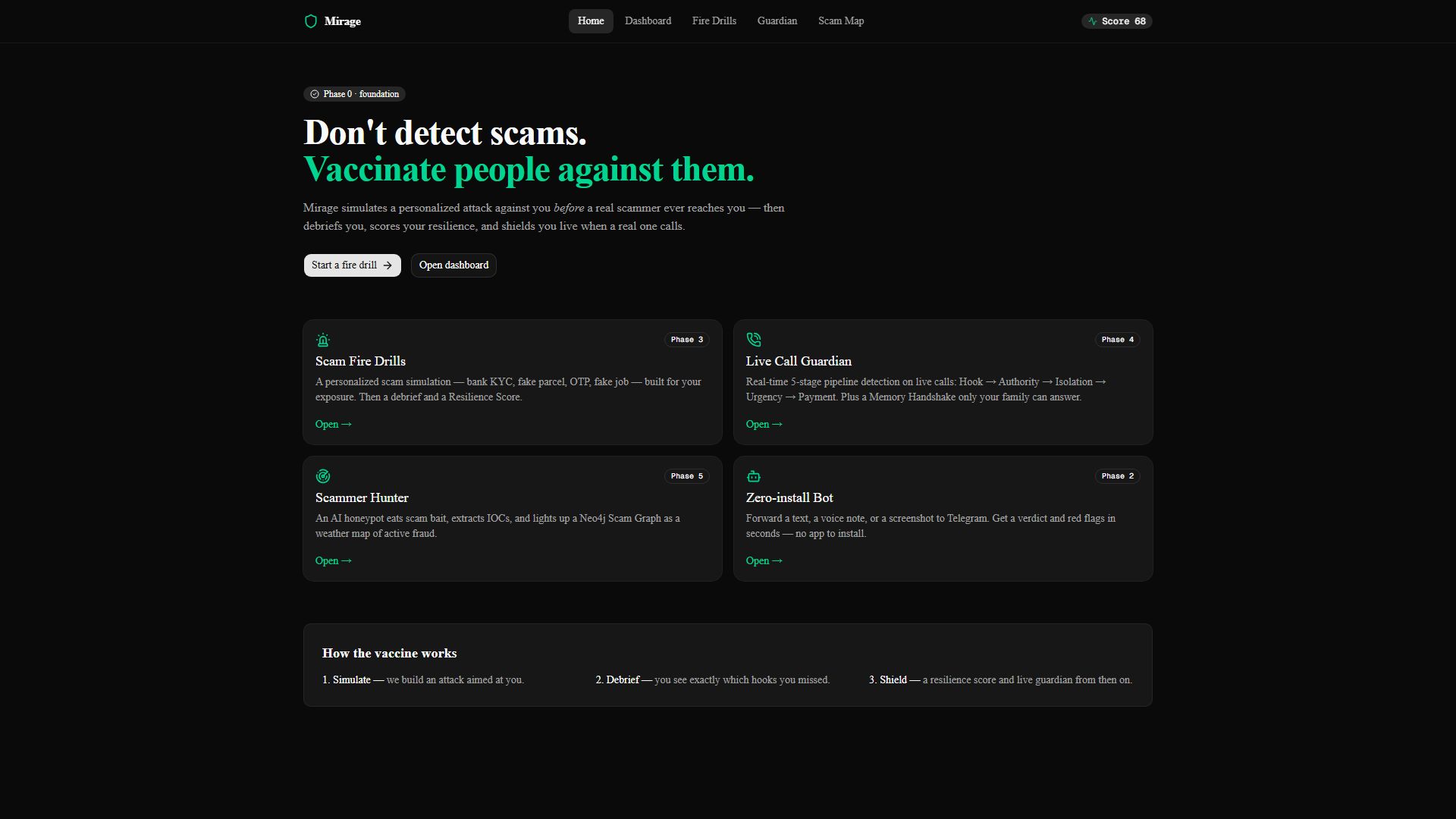
Mirage is a personal AI immune system with four layers:
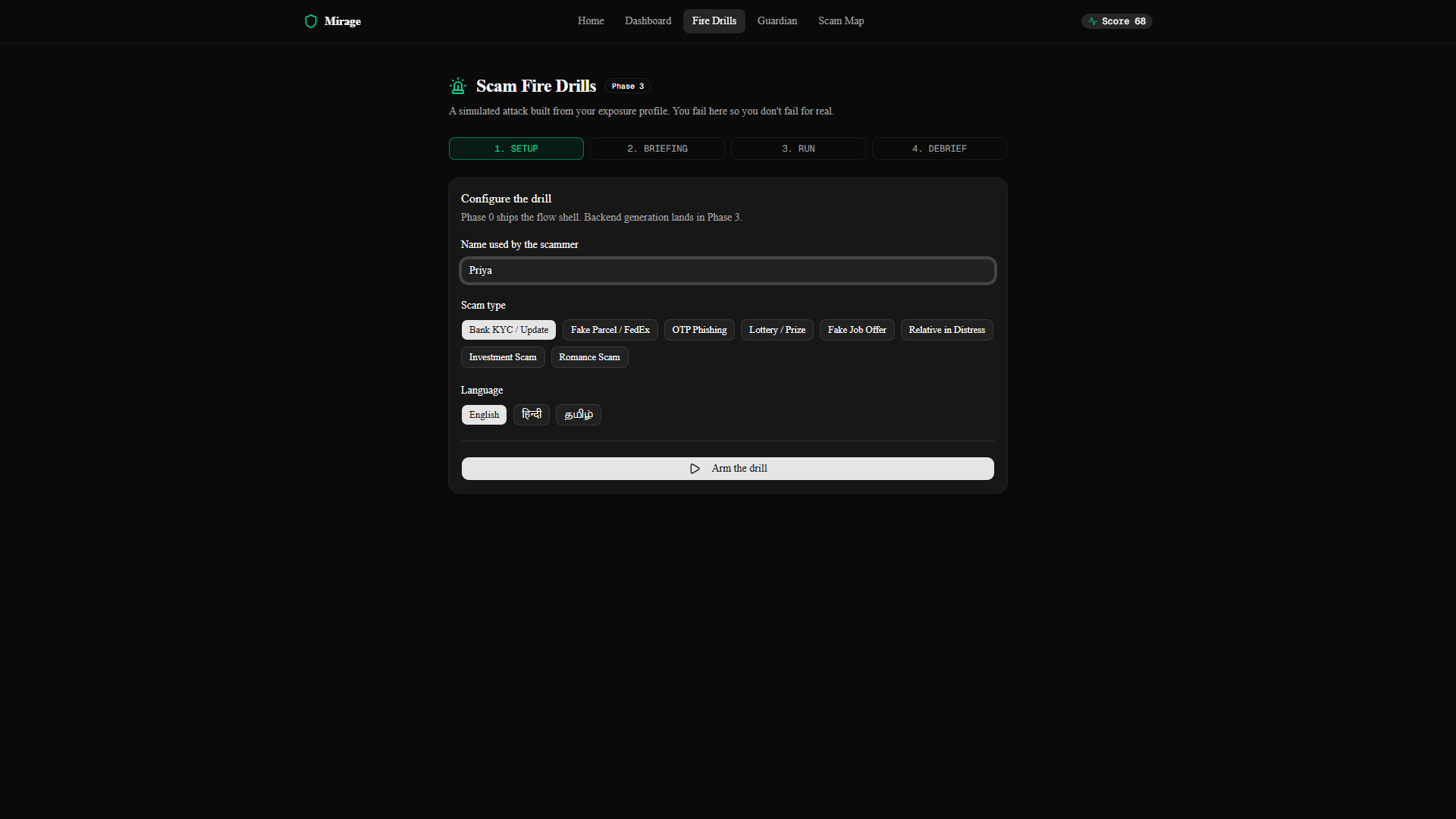
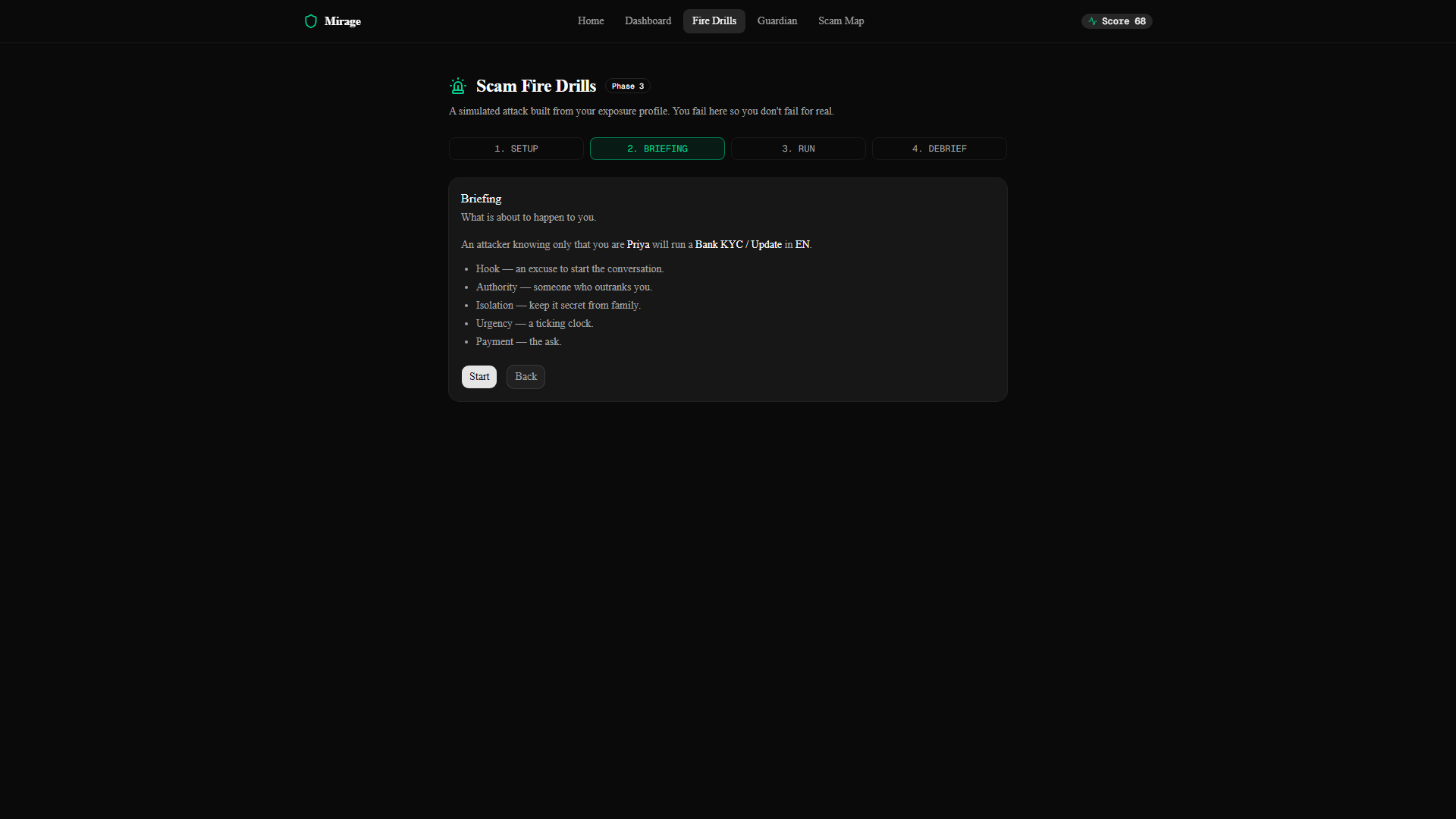
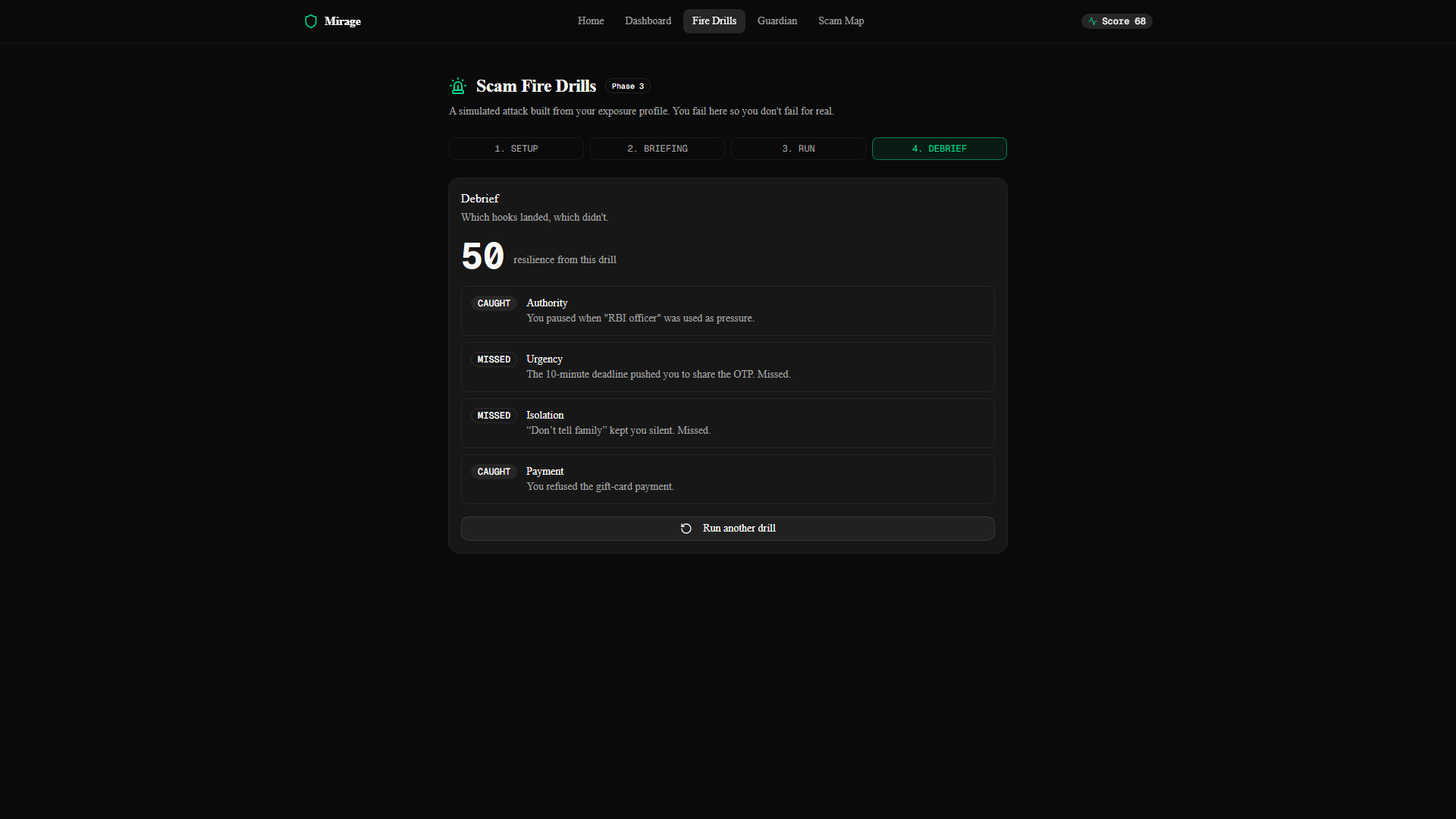
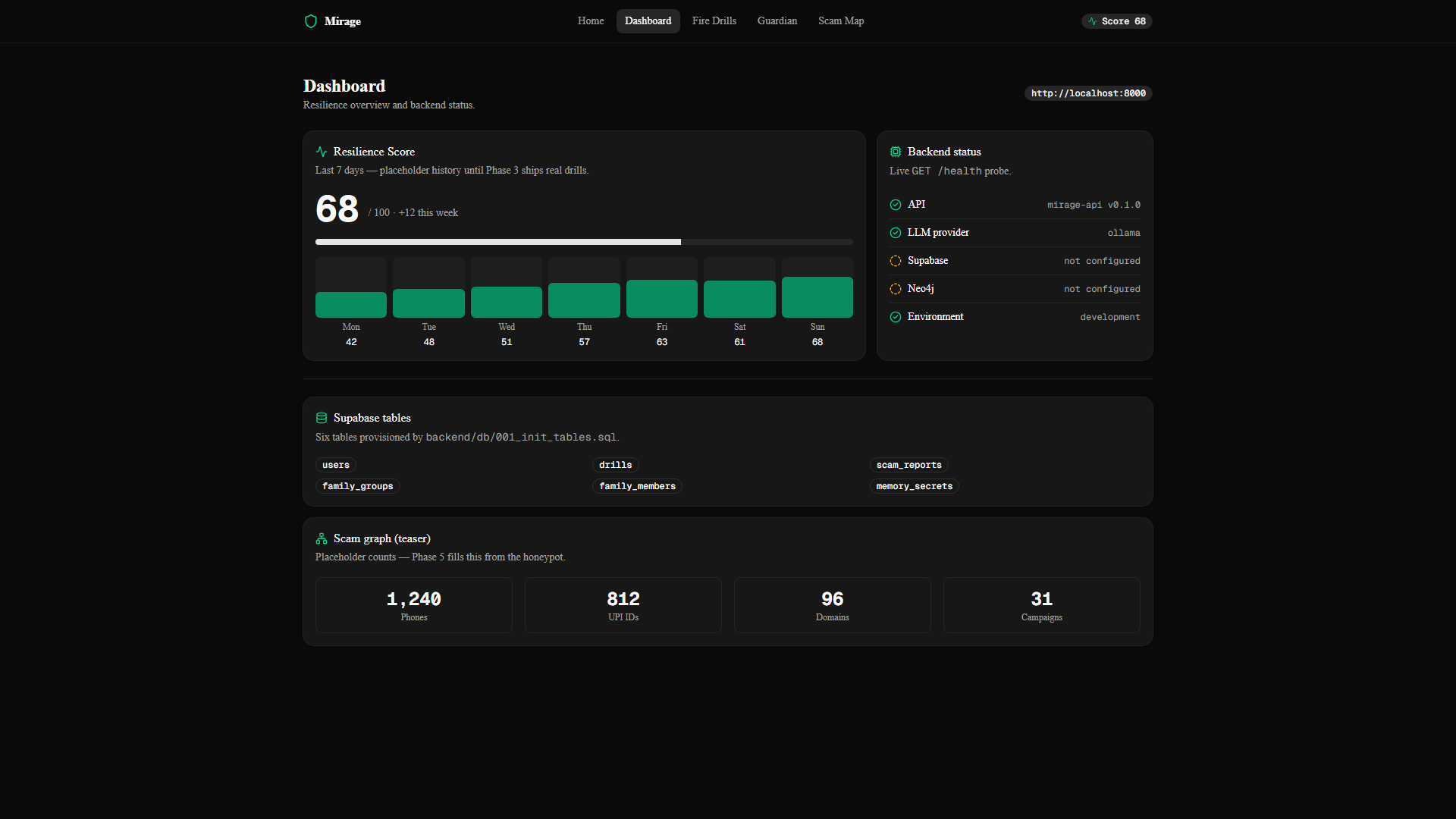
1. Scam Fire Drills (our signature feature). With explicit consent, Mirage red-teams the user. It shows how a scammer could clone a relative's voice from a public reel, then runs a harmless, personalized simulated scam call or WhatsApp message. A debrief shows exactly which red flag the user missed, and their Scam Resilience Score improves with each drill.
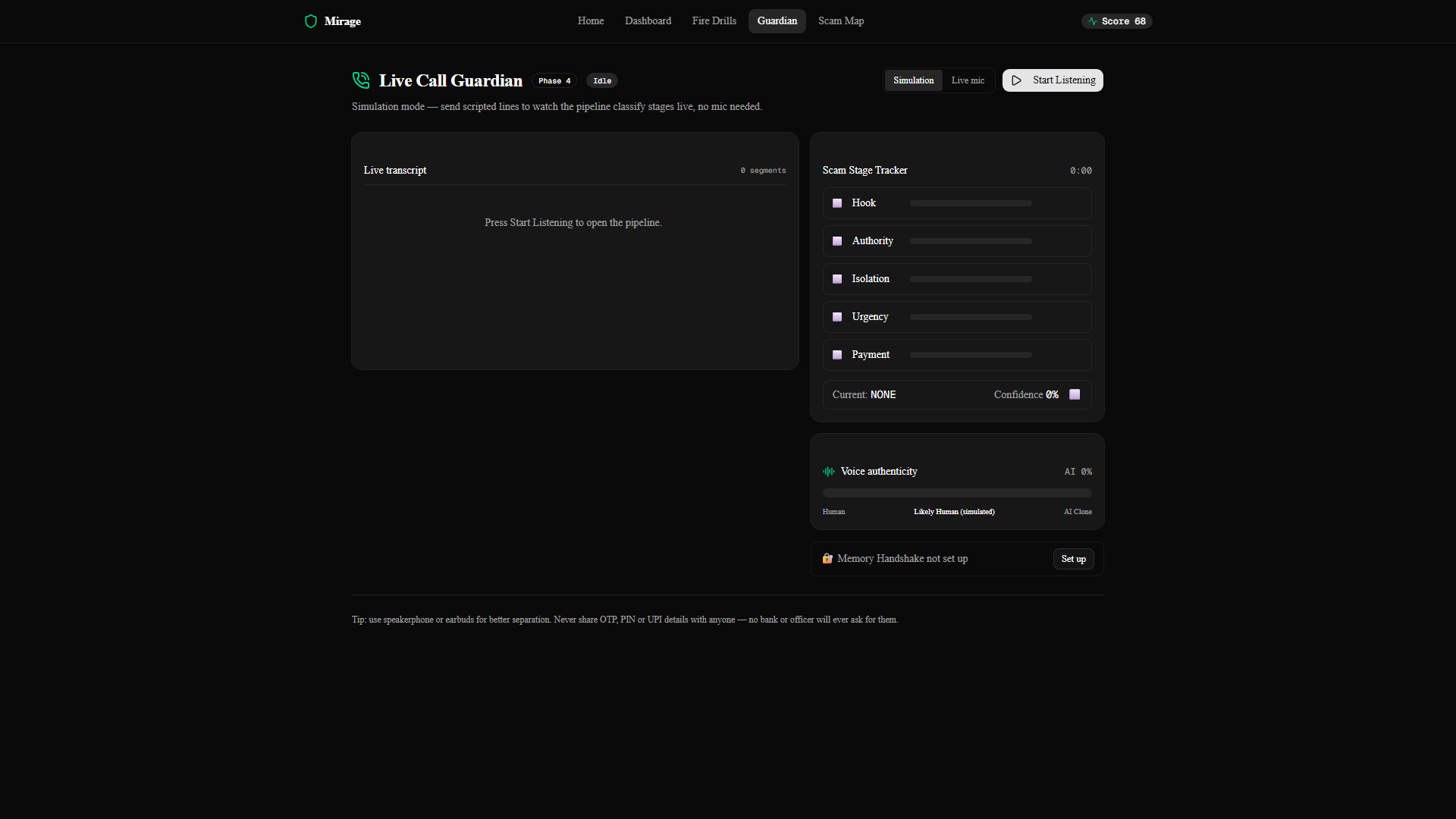
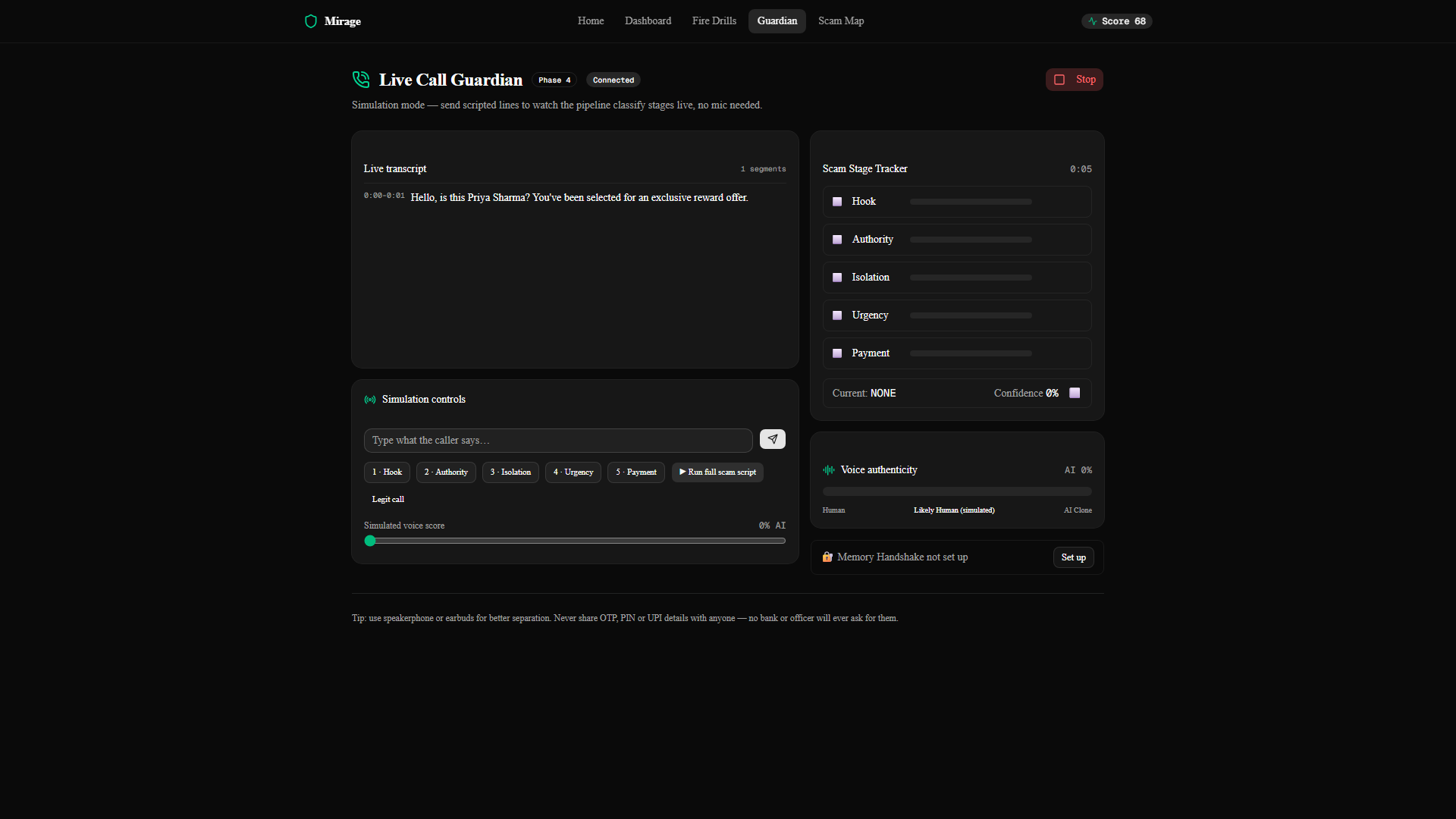
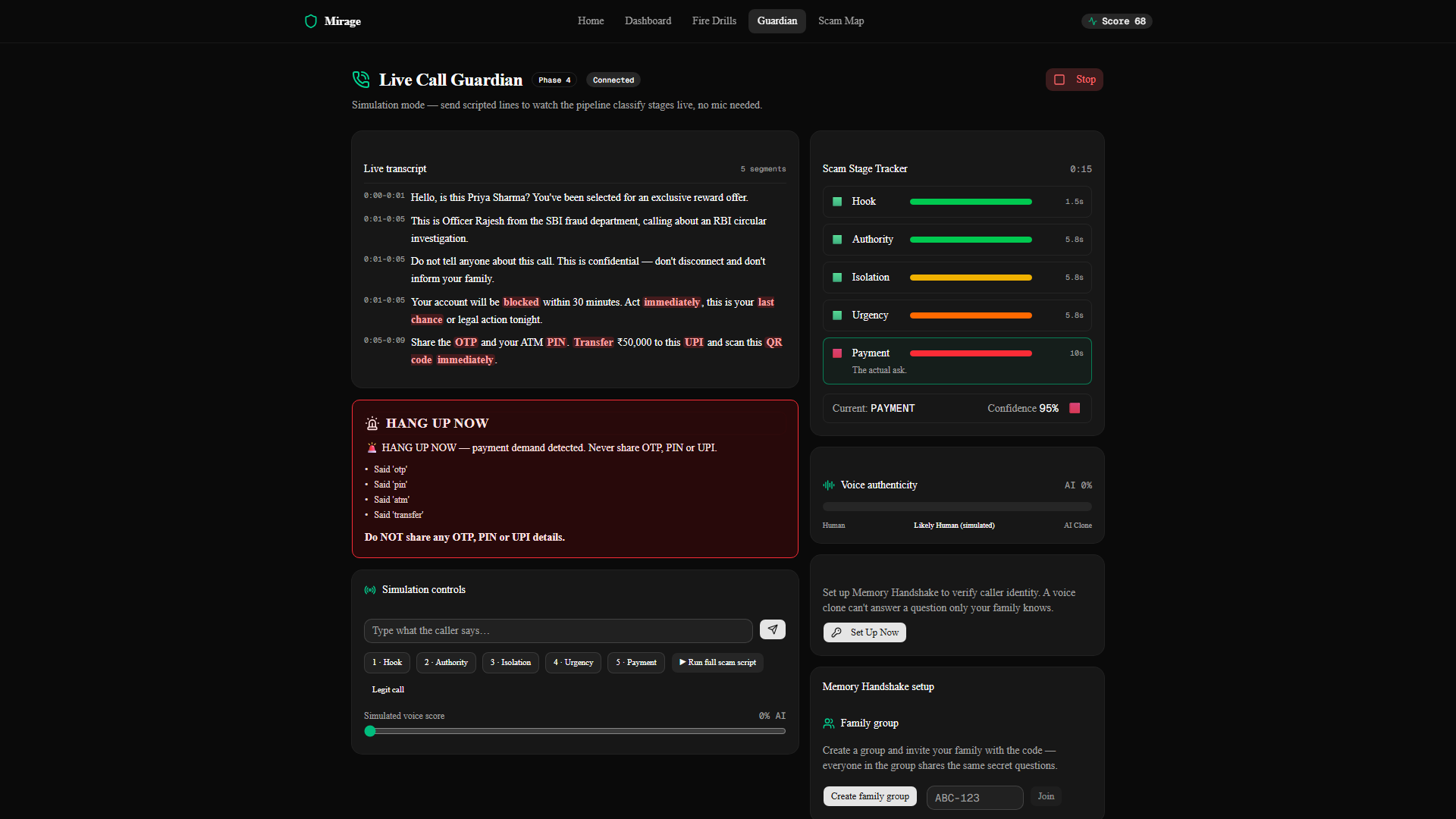
2. Live Call Guardian. It transcribes calls in real time and tracks the scam stage: hook, fake authority, isolation ("don't tell anyone"), urgency, payment demand. It warns the user before money moves. A synthetic-voice detector scores how likely the audio is AI-generated.
3. Memory Handshake and Pause Protocol.
- Memory Handshake: a rotating family code, plus challenge questions drawn from private shared memories, that a cloned voice can't answer. Think of it as an authenticator app for human voices.
- Pause Protocol: when a call is high-risk, Mirage adds a friction layer before payment: a 60-second cooling-off, a plain-language reality check, and an automatic alert to a trusted family member.
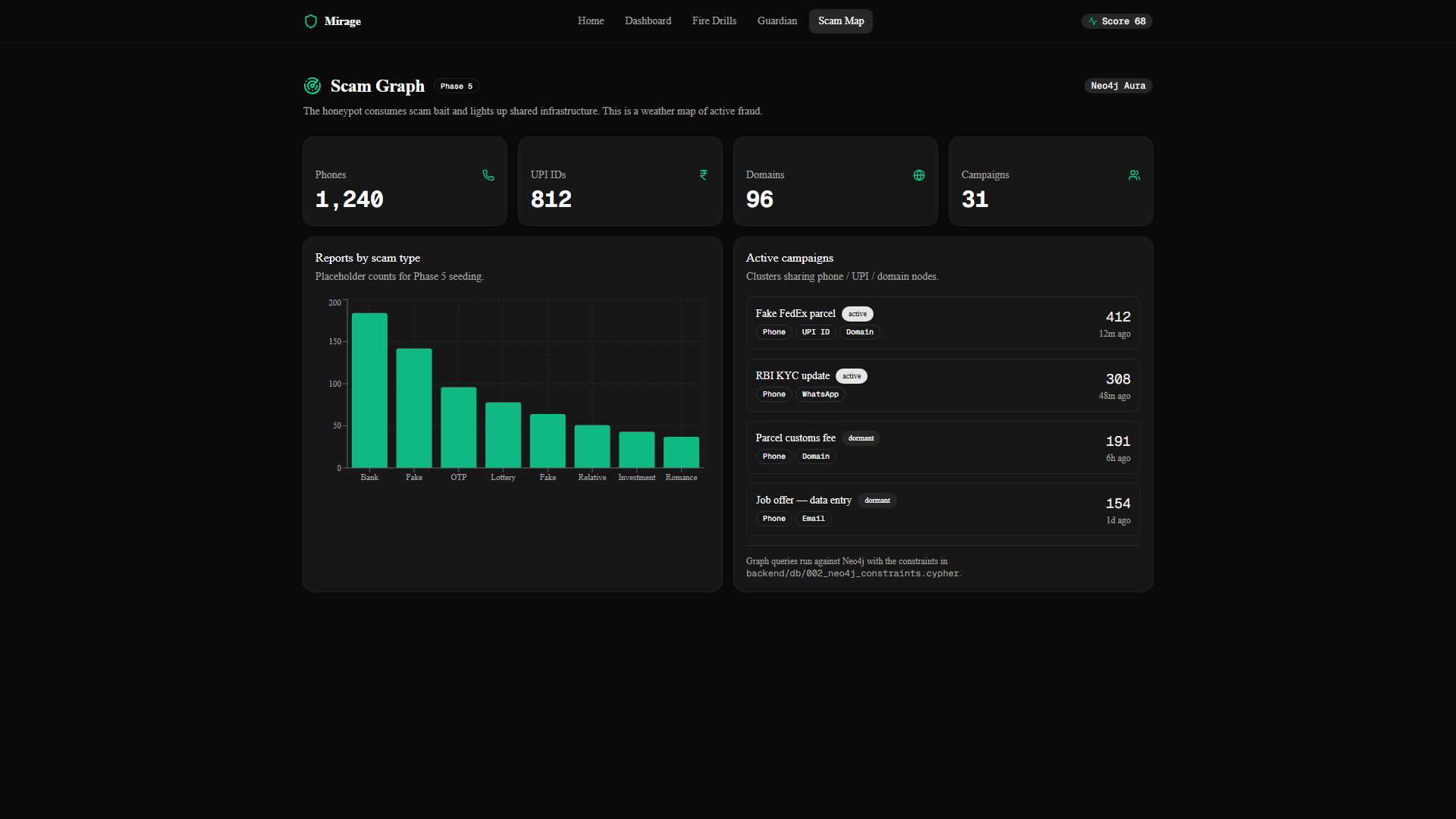
4. Scammer Hunter and Scam Weather Map. An AI honeypot persona wastes scammers' time and safely extracts UPI IDs, phone numbers, and URLs. These feed a Scam Graph linking numbers, accounts, and domains into rings. A live Scam Weather Map shows active campaigns by area, and Mirage generates a pre-filled complaint for the cybercrime portal and the 1930 helpline.
Zero-install access: a WhatsApp bot accepts forwarded texts, voice notes, screenshots, and videos. It supports Tamil, Hindi, and English, with an Elder Mode that uses one big button and automatic family alerts.
Every verdict comes with an evidence trail (domain age, lookalike-domain match, number-to-organization mismatch, known scam script patterns), so users learn why something is risky.
How we built it
- Multimodal triage: text, image, audio, and video inputs are normalized into a common format. Claude extracts claims and entities (phone numbers, UPI IDs, URLs, impersonated organization).
- Agentic investigation: a tool-using agent runs checks in parallel: WHOIS and domain age, lookalike-domain detection, official-number verification, and comparison against known scam scripts. It outputs a risk verdict with citations to its own evidence.
- Live Guardian: streaming speech-to-text (Whisper) feeds a stage-classification model that updates the scam-stage tracker as the call unfolds. An audio deepfake classifier scores each audio segment.
- Fire Drill engine: an LLM-driven simulator builds consent-gated, personalized scenarios and scores user responses against a red-flag rubric to compute the Resilience Score.
- Memory Handshake: time-based rotating codes (TOTP-style) plus a private question vault, stored end-to-end encrypted.
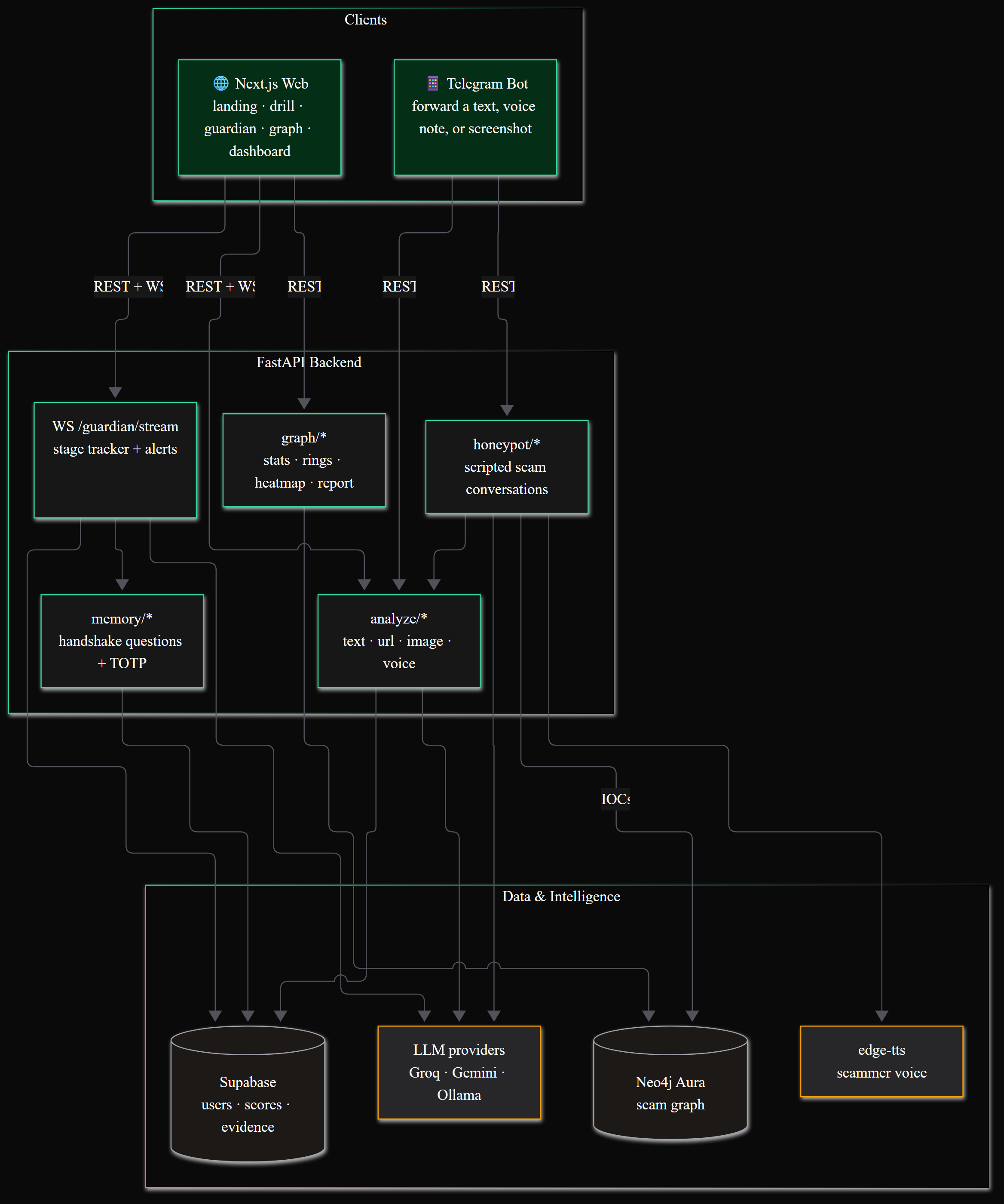
- Scam Graph: entities from every analysis and honeypot session are stored as nodes and edges (Neo4j or NetworkX) to detect rings and drive the map.
- Delivery: FastAPI backend, Postgres, a Next.js dashboard, and a WhatsApp bot via the WhatsApp Cloud API or Twilio.
- Privacy by design: minimal data retention, on-device processing where possible, and consent required for every drill.
Challenges we ran into
- Ethics of red-teaming. Simulating scams on real people is powerful but risky. We built strict consent gates, clear "this is a drill" labeling, and a rule that Mirage never contacts third parties without their agreement.
- Real-time latency. A warning that arrives after the payment is useless. We tuned streaming transcription and lightweight stage classification to alert within seconds.
- Deepfake detection is an arms race. No detector is perfect, so we paired audio scoring with the Memory Handshake, which doesn't depend on detection accuracy at all.
- Avoiding false alarms. Crying wolf makes users ignore alerts. We calibrated risk scores and always show the evidence behind them.
- Multilingual, noisy scam calls. Code-mixed Tamil, Hindi, and English speech with poor audio quality was much harder than clean English.
Accomplishments that we're proud of
(Edit this section to match what your team actually completes and demos.)
- A working Scam Fire Drill that turns a consenting user's public footprint into a safe, personalized simulation with a measurable Resilience Score
- A Live Call Guardian that flags the scam stage in real time, before the payment demand
- A Memory Handshake that defeats a cloned voice that a detector alone could miss
- A WhatsApp bot that gives a verdict and evidence trail on a forwarded message in seconds
- A Scam Graph that connects extracted UPI IDs, numbers, and domains into visible rings
- A design that treats prevention, detection, verification, and response as one connected system rather than four separate tools
What we learned
- Training beats warning. People ignore generic scam tips but remember the scam that almost fooled them personally.
- Verification beats detection. Since deepfakes keep improving, proving who someone is (shared secrets, rotating codes) is more durable than guessing what's fake.
- Explainability builds trust. Showing the evidence trail makes users more likely to act and more likely to learn.
- Distribution matters. Meeting people on WhatsApp, in their own language, matters more than a polished app they'll never install.
- Defensive AI must be built with consent, privacy, and restraint from day one.
What's next for Mirage
- Carrier and UPI-app integrations to trigger the Pause Protocol directly at the point of payment
- On-device Guardian so call audio never leaves the phone
- Community Scam Graph shared with banks, telecoms, and cybercrime units for faster takedowns
- Family and school programs: Fire Drills for senior citizens, students, and small businesses
- Voice-first support in more Indian languages and offline-friendly modes for low-connectivity areas
- Provenance and watermark checks (such as C2PA) for verifying media authenticity
- A Scam Resilience Index for banks and employers to measure and improve fraud readiness
Built With
- api
- apis
- audio
- c2pa
- cloud
- css
- deepfake
- detection
- docker
- domain-intelligence
- fastapi
- neo4j
- networkx
- next.js
- openai
- postgresql
- python
- react
- tailwind
- twilio
- vercel
- websockets
- whois

Log in or sign up for Devpost to join the conversation.