
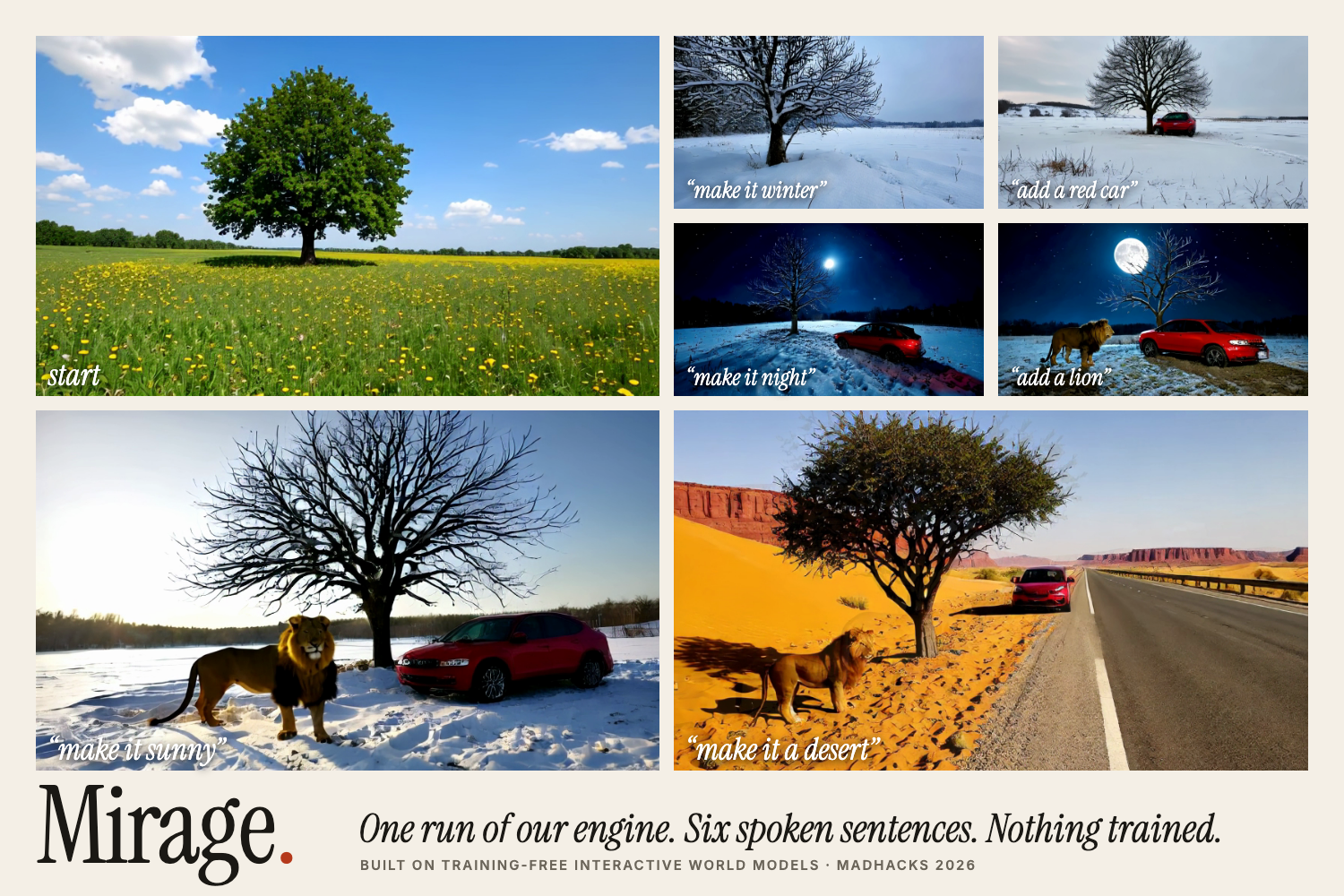
Mirage builds on Training-Free Interactive World Models, and uses Wan 2.1, Causal Forcing++, TAEHV and the KV recache idea from LongLive. Everything below describes what we built and measured on top of them this weekend. We trained nothing.
Inspiration
Video generation today is a vending machine: you type a prompt, wait, and get a clip. We wanted a video that is still being drawn while you talk to it. Say "make it winter" and the meadow you are watching turns to snow. Say "add a red car" and one arrives. No clip, no render bar, no end.
What it does
Mirage is a live, endless video that you steer with your voice. It generates 16 frames per second on one GPU. For a sentence it already knows, the first new frame appears a median of 363 ms after you finish speaking. For a sentence it has never heard, about 2 s.
Commands add up. "Make it winter", "add a red car", "make it night" gives you a red car in the snow at night, and "remove the car" removes only the car.
Why this is hard
A causal video model draws each frame from three inputs:
$$x_n = G_\theta(\varepsilon,\; c,\; C_n), \qquad C_n = {\mathrm{KV}(x_{n-21}), \dots, \mathrm{KV}(x_{n-1})}$$
Here \(\varepsilon\) is fresh noise, \(c\) is the prompt, and \(C_n\) is the model's memory: the attention keys and values of the last 21 frames it drew, about 5 seconds. Three things go wrong at once.
1. It will not obey. Your voice can only change \(c\). The memory still holds 21 frames of the old scene, and every frame drawn while the model hesitates is written back as more evidence for the old scene. We changed only the prompt from day to night and measured it: dimmer after 4 s, night after 14 s.
2. It cannot think longer. One call draws 0.25 s of video, so it has 250 ms:
$$(K+1)\cdot t_{\text{pass}} + t_{\text{decode}} \le 250\ \text{ms}$$
With a full memory, \(K=2\) denoising passes are enough: about 200 + 21 = 221 ms. With an empty memory the model needs \(K=4\), which costs 412 ms and stalls the stream.
3. It rots. The model learned from real video but at run time it continues its own output, so small errors become input and compound. Left alone, the colour drains in 20 to 50 s.
Fixing one of these breaks another. Holding all three was the weekend.
How we built it
Fix 1: on a command, empty the memory. Changing the prompt alone takes 14 s. Re-encoding the last \(k\) frames under the new prompt (the LongLive recache) is smooth, but those frames are still pictures of the old scene. We run \(k=0\):
$$C \leftarrow \varnothing, \qquad x_n = G_\theta(\varepsilon,\; c',\; \varnothing)$$
Nothing is left to argue for the old scene, so the new prompt wins in one step. To make that step affordable we cut it from 4 denoising passes to 2 and moved the memory write off the critical path: 412 ms to 162 ms. The next 8 frames are blended, \(y_j = (1-\alpha_j)\,y_{\text{old}} + \alpha_j\,y_{\text{new}}\) with \(\alpha_j = (j+1)/9\), so you see a half-second dissolve instead of a pop.
Fix 2: restart from a clean copy. Three steps after every command we save that frame's latent as a clean anchor \(a^\star\). Every 6 s we empty the memory and restart from it:
$$x = (1-\sigma)\,a^\star + \sigma\,\varepsilon, \qquad \sigma \approx 0.83$$
We tried the obvious alternatives first. Restarting from the latest frame copies the damage forward. Restarting from scratch gives a different scene each time. The clean anchor stayed clean for our whole 90 s test.
Fix 3: keep a list, not sentences. The video model never sees what you said. A reader turns each sentence into one edit of a scene list (add, change, remove), and the prompt is rewritten from the list after every edit. 136 common sentences are answered in 4 to 9 ms with no model call. Anything else goes to a language model.
The whole loop runs on one NVIDIA Blackwells. A second machine (RTX PRO 6000) runs it at 832×480 in 155 ms per quarter second.
Challenges we ran into
- The twitch. After fix 2, the scene rearranged itself every 6 s. The anchor was not moving; the noise was. A restart is 17% anchor and 83% noise, and we drew new noise each time. Seeding the noise from the video's seed and the anchor made every restart land on the same picture: the jump at a restart fell from 30.4 to 10.9, below ordinary frame-to-frame motion (about 12).
- The stall. Every command froze the stream until we got the command step under 250 ms. Median voice-to-screen time went from 717 ms to 449 ms.
- The scene jumps. An empty memory forgets the layout too, so the shot re-frames on every command (the tree moves about 175 px). We have a fix that holds it to about 36 px on our test machine, but it broke three other commands, so it is not in the demo.
Accomplishments that we're proud of
- 363 ms median from the end of a known sentence to the first new frame, on one GPU.
- 24 of 27 spoken test sentences pass when said in chains on the live engine.
- Every number on this page was measured on our own engines.
What we learned
Steering a causal video model is a memory problem, not a prompt problem. The prompt is one input against 21 remembered frames, so every fix that worked was an operation on the memory or on the noise.
What's next for Mirage
- Ship the layout-preserving command so the shot stops re-framing.
- One video per viewer instead of one shared stream.
- Faster handling of sentences the reader has not seen.
- Places we would take it: a bedtime story the picture follows, a director's first look at a scene, a classroom that visits every season on request.
Built With
- amazon-web-services
- causal-forcing
- claude
- cuda
- javascript
- node.js
- python
- pytorch
- taehv
- wan-2.1


