-
-
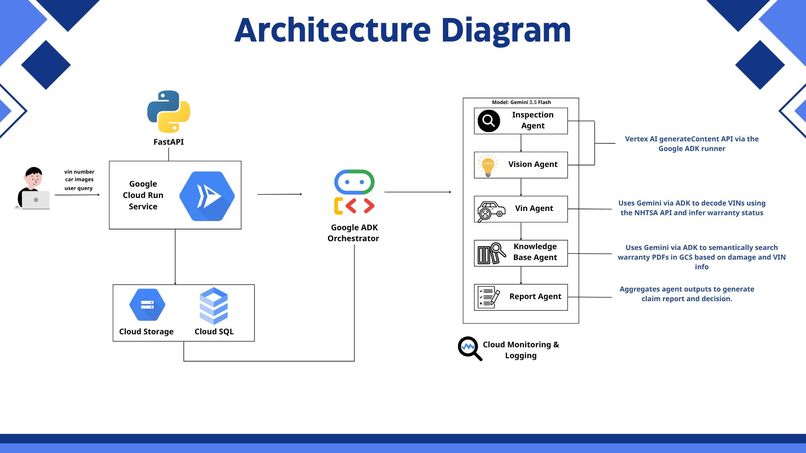
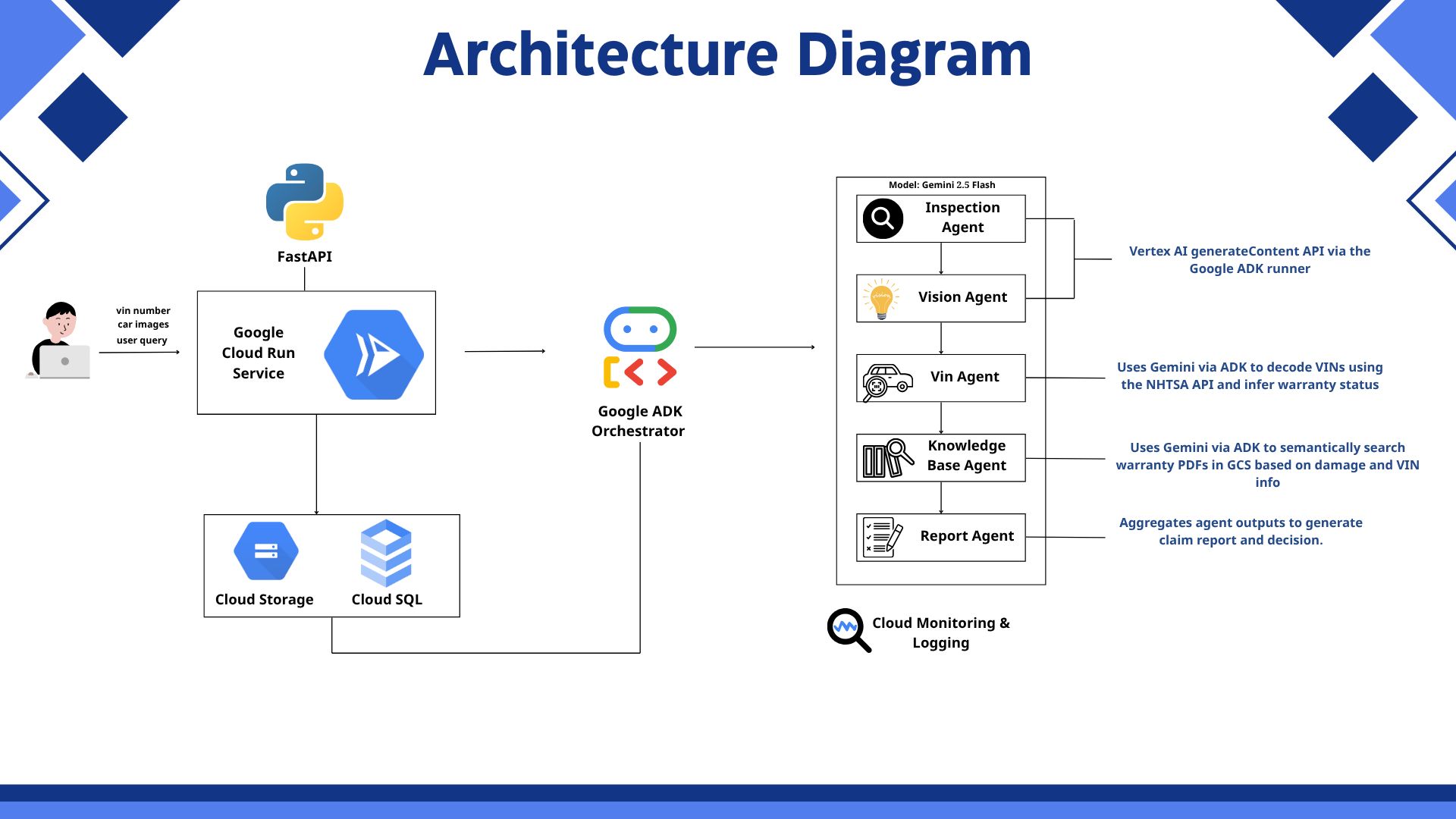
Architecture Diagram
Inspiration
Vehicle warranty claims are often slow, manual, and opaque—leading to delays, frustration, and revenue loss for dealerships. We were inspired to reimagine this process using AI. With AutoClaim360, we set out to build a transparent, real-time, and intelligent system that empowers dealerships to validate claims instantly. We were working to build agents and it is very difficult to do that especially agent orchestration. So, when google released ADK, it was an exciting thing to try out immediately because it offers very seamless cloud-native tools that work together. The ADK makes the multi-agent architecture easy to build out.
What it does
AutoClaim360 is a multi-agent AI-powered self-service portal that helps dealerships quickly pre-authorize and validate vehicle warranty claims.Instead of waiting hours for manual review, dealerships can upload a VIN, damage images, and a short explanation, and let our agents handle everything from image verification to policy matching, delivering a decision in minutes.
How we built it
We built AutoClaim360 using Google’s Agent Development Kit (ADK), which gave us the tools to create multiple intelligent agents working together in a coordinated flow. ADK’s seamless integration with Google Cloud services like Cloud Storage and Cloud SQL made it easy for our agents to access and store data throughout the process. We experimented with different agent workflows including parallel, looping, and sequential flows but found that a sequential flow worked best for our use case. It ensured that each step—like image verification, damage detection, VIN decoding, and policy matching—had the right context from the previous agent, leading to more accurate and explainable outcomes.
Challenges we ran into
One of the biggest challenges we faced was streaming the outputs from each agent in real time. Unlike a traditional API where you wait for a single response, we wanted users to see the process unfold step by step, as each agent completed its task. Implementing this required setting up a custom Streaming API to push live updates from the backend to the frontend, something that’s tricky to coordinate with multiple agents running asynchronously. But once we got it working, it really paid off by making the experience feel transparent and interactive, like the system was thinking out loud.
Accomplishments that we're proud of
We’re especially proud of building a custom streaming API that delivers real-time, step-by-step outputs from each agent as they run. It makes the entire experience feel alive—users can actually watch their claim being processed, instead of just waiting for a final decision to pop up. We’re also proud of how we brought together multiple technologies - React, FastAPI, Google Cloud, and ADK—into a smooth, end-to-end system. Each part talks to the other cleanly, and the whole thing feels fast, intelligent, and transparent. Most of all, we’re proud that we took a complex, slow manual process like vehicle claims—and turned it into something fast, automated, and AI-driven without losing the human touch.
What we learned
We discovered that the Agent Development Kit (ADK) is a remarkably powerful framework for building intelligent, multi-agent systems. Its modular design and seamless integration with Google Cloud services made it easy to orchestrate complex workflows across multiple agents, each with a specific task and reasoning capability. We realized that any organization already using GCP can significantly accelerate and supercharge their AI initiatives by adopting ADK. It not only simplifies agent coordination and state management, but also enables rapid prototyping of AI-driven processes with built-in streaming, memory, and context handling. ADK opened our eyes to what’s possible when LLMs aren’t just passive responders, but collaborative agents working in a structured system.
What's next for AutoClaim360
Next, we’re excited to explore how we can expand the agentic approach to handle more complex workflows like separating warranty claims from insurance claims, and tailoring the process for each type.We also want to reach a level of granularity where the system can summarize all findings and send them to a human manager for a final approval or rejection—essentially becoming an intelligent assistant that handles 90% of the heavy lifting and lets humans make the final call.Our long-term goal is to fully automate the decision-making process for vehicle claims—making it faster, smarter, and scalable for real-world deployment.


Log in or sign up for Devpost to join the conversation.