-
-
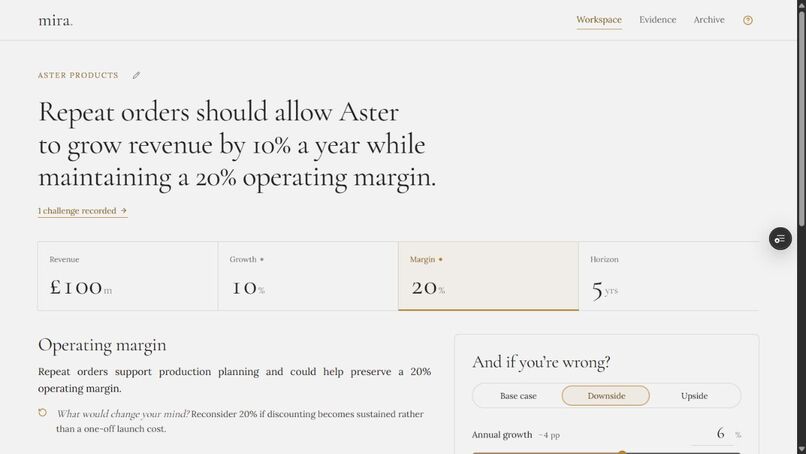
Mira workspace with linked assumptions, evidence and an operating-profit scenario. Fictional example.
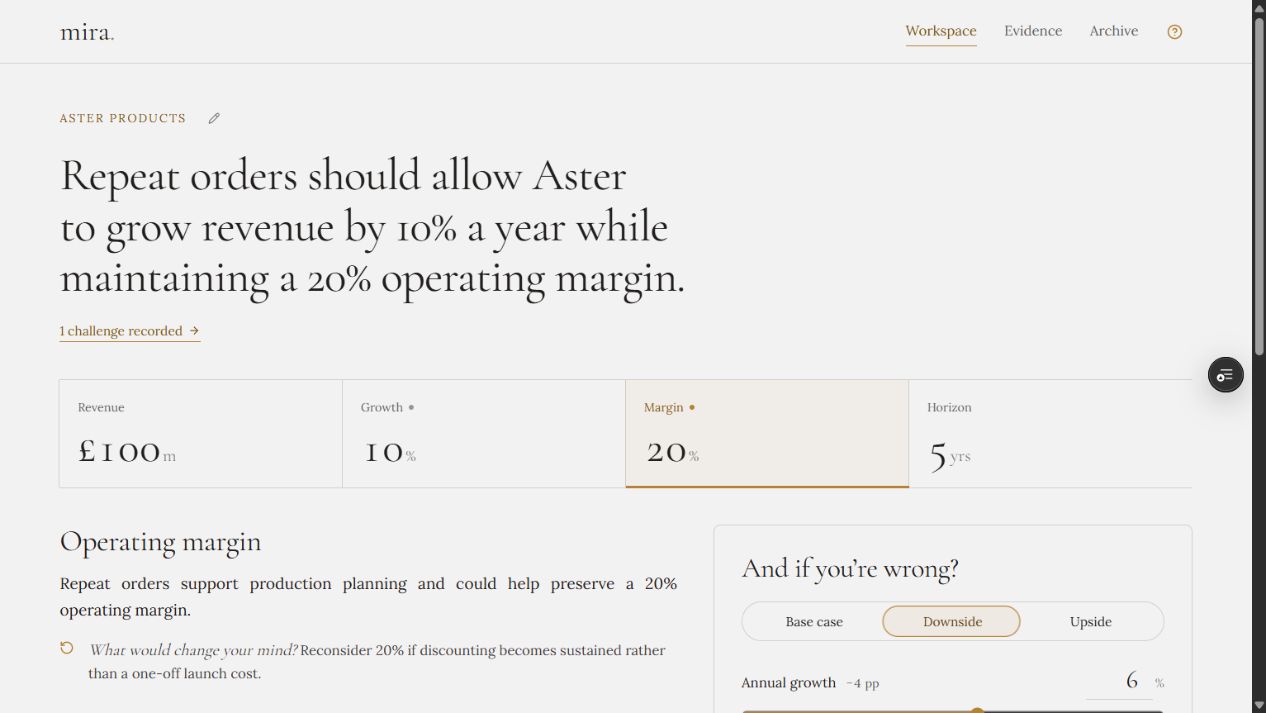
Demo status
The live app is ready at https://mira-assumption-tracker.vercel.app/. The video URL is a temporary placeholder and must be replaced with the project's own 1-3 minute recording before submission.
Inspiration
An investment thesis can sound convincing while hiding a fragile assumption. A new source may challenge a company's pricing power, yet that observation often stays in a separate note, far away from the financial model it should change.
Mira brings the belief, its supporting assumptions, the evidence and the numerical consequence into one research workspace. It is designed for individual investors and analysts who want to make their reasoning explicit and revisit it when the facts change.
What it does
Start with an investment thesis and four base assumptions: current revenue, annual revenue growth, operating margin and a time horizon. Select an assumption to inspect the rationale behind it and the condition that would make it worth reviewing.
Record dated observations, optionally link to a source, and classify each as supporting, contradicting, mixed or insufficient evidence. Add your own explanation of what the observation means. The evidence journal can be filtered by assessment and assumption, or searched by its text.
Then explore the consequences. Adjust growth and margin directly, use base/downside/upside presets, or compare combinations in a sensitivity grid. The projection chart shows the base and scenario paths, with keyboard and pointer exploration of individual years. Save a named scenario to preserve its original inputs and result in the archive.
The worked example is fictional Aster Products. A £100m revenue base with 10% growth and a 20% margin produces £32.21m in year-five operating profit. Changing growth to 6% and margin to 17% produces £22.75m, a 29.37% decrease. The original assumptions remain separate from the scenario.
How it was built
Mira uses React, TypeScript and Vite, with Zod for strict input and workspace validation. The operating-profit model is deterministic: revenue multiplied by compounded growth and operating margin. It uses no live market data, model API or financial forecast service.
Valid workspaces are saved in this browser. JSON export provides a portable backup; import validates the file and asks before replacing existing research. If saved data cannot be read, the app pauses autosave to protect it. Historical scenarios preserve their own base inputs instead of silently changing when the current assumptions are edited.
The installed Devpost Learn Skill Pack provided the planning workflow and document structure. The repository includes scope, PRD and technical specification files. Implementation was delegated to a coding agent; planning documents record their draft/delegated status, rather than claiming interviews, human reviews or learning activities that were not recorded.
The final visual direction follows a user-supplied Mira design: serif typography, a quiet grey canvas, gold accents and a compact research layout. Fonts are bundled locally. The interface adapts to narrow screens and retains keyboard focus and accessible edit dialogs.
Challenges
The main challenge was keeping financial inputs, evidence and saved history connected without treating them as the same kind of information. Evidence is linked by stable assumption IDs. Invalid numeric drafts do not replace the last valid saved state. Each saved scenario retains a snapshot of the assumptions used at the time.
Another challenge was matching the supplied design while preserving the existing calculations, storage format and import/export behaviour. The visual revision was checked against the reference in the browser, and the existing 40 automated tests and production build passed.
What this project shows
A useful research tool needs more than an editable spreadsheet. It needs a visible connection between a belief, the observation that challenges it and the consequence of changing an input. Clear boundaries matter: an illustrative operating-profit scenario is not a valuation, an investment return or a prediction of what will happen.
What's next
Record the final walkthrough, gather feedback from people who keep investment research notes, and improve how review conditions and historical decisions are revisited. Additional financial models would need explicit assumptions and tests rather than being presented as more certainty.
Mira is a research prototype. The sample company and seeded observations are fictional, classifications remain the user's judgment, and the app does not provide investment advice.

Log in or sign up for Devpost to join the conversation.