Inspiration
I did not start with a technology idea. I started with a problem I lived every single day.
As an art manager and curator working directly inside artists' studios, I watched talented, serious artists lose real opportunities not because their work was not good enough, but because they could not find it fast enough. A gallery would email asking for a portfolio. An artist would spend three hours digging through old hard drives, unnamed files, scattered Dropbox folders, and phones from four years ago. Sometimes they found what they needed. Sometimes they did not.
I watched an artist lose a collector because she could not locate the provenance record for a work sold six years earlier. I watched another miss a grant deadline because reconstructing five years of exhibition history from memory and email threads took longer than the window allowed. I saw decades of creative output treated like random files in a folder with no context, no story, no structure.
And I noticed something that felt almost absurd: accountants have better tools than artists. Real estate agents have better systems than galleries. Every other creative and professional industry had been transformed by technology. The art world had been left completely behind. The few tools that do exist are either priced for institutions, not individual artists, or they require juggling multiple disconnected systems: one for storage, one for invoicing, one for documentation, one for communication. Artists are creative people, not database administrators. They do not have the patience to stitch five platforms together, and they should not have to.
I also saw a deeper problem that nobody was talking about. When an artist dies, their archive often dies with them. Families find hard drives they cannot open, websites with expired passwords, and decades of work with no documentation, no pricing logic, and no story. That creative legacy, built over a lifetime, simply disappears.
That is what inspired Mira. Not a feature. A responsibility.
What it does
Mira is a multimodal AI studio assistant: the institutional memory every artist needs but could never afford to hire.
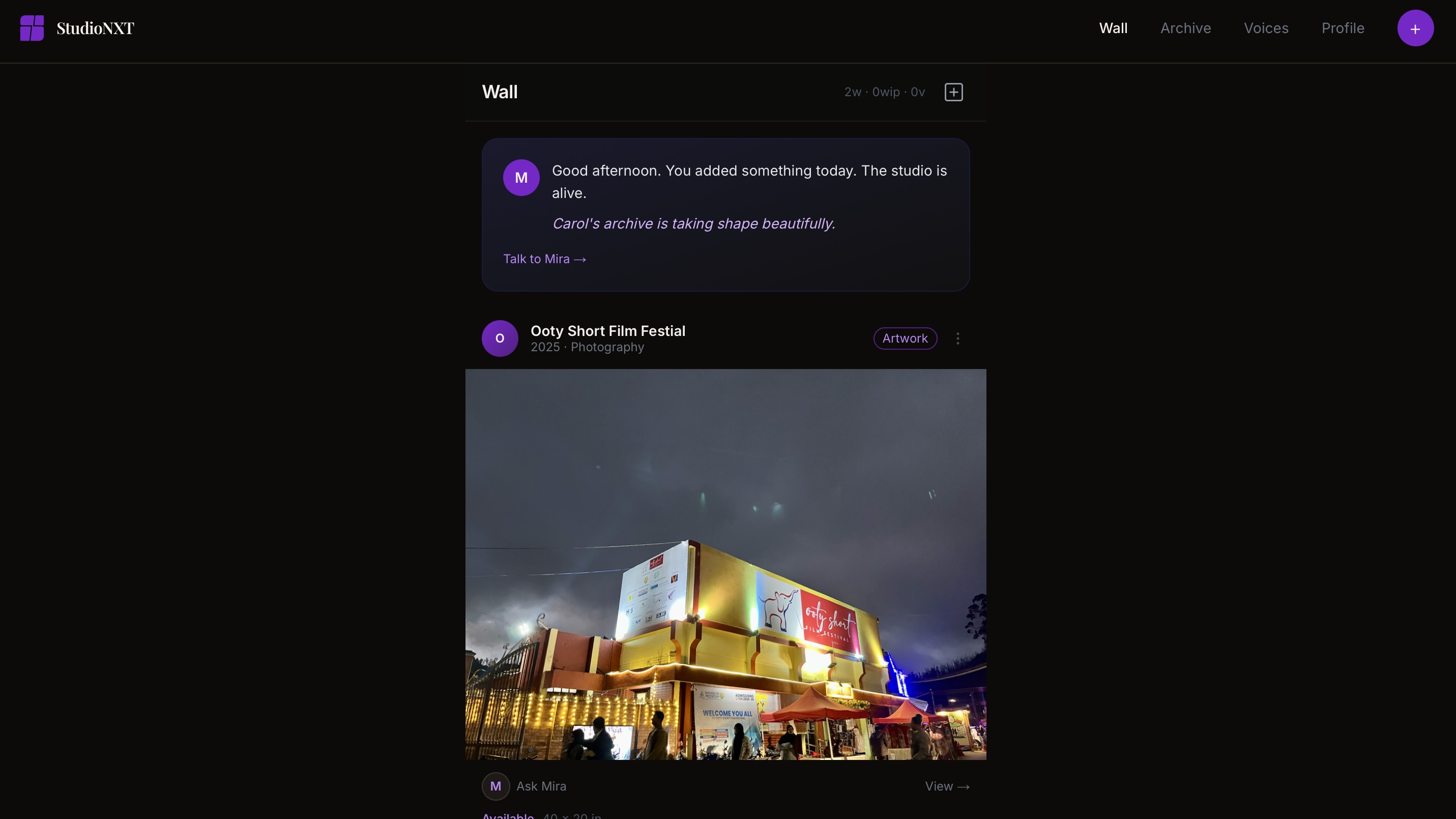
She lives inside StudioNXT, an intelligent archival platform built for working artists. Instead of clicking through a database, an artist simply speaks to Mira in natural language, and she responds in real time, in her own voice, grounded exclusively in that artist's own studio records.
Mira can:
- Answer voice queries against a live archive: "Find every oil painting I made between 2019 and 2022 that is still available."
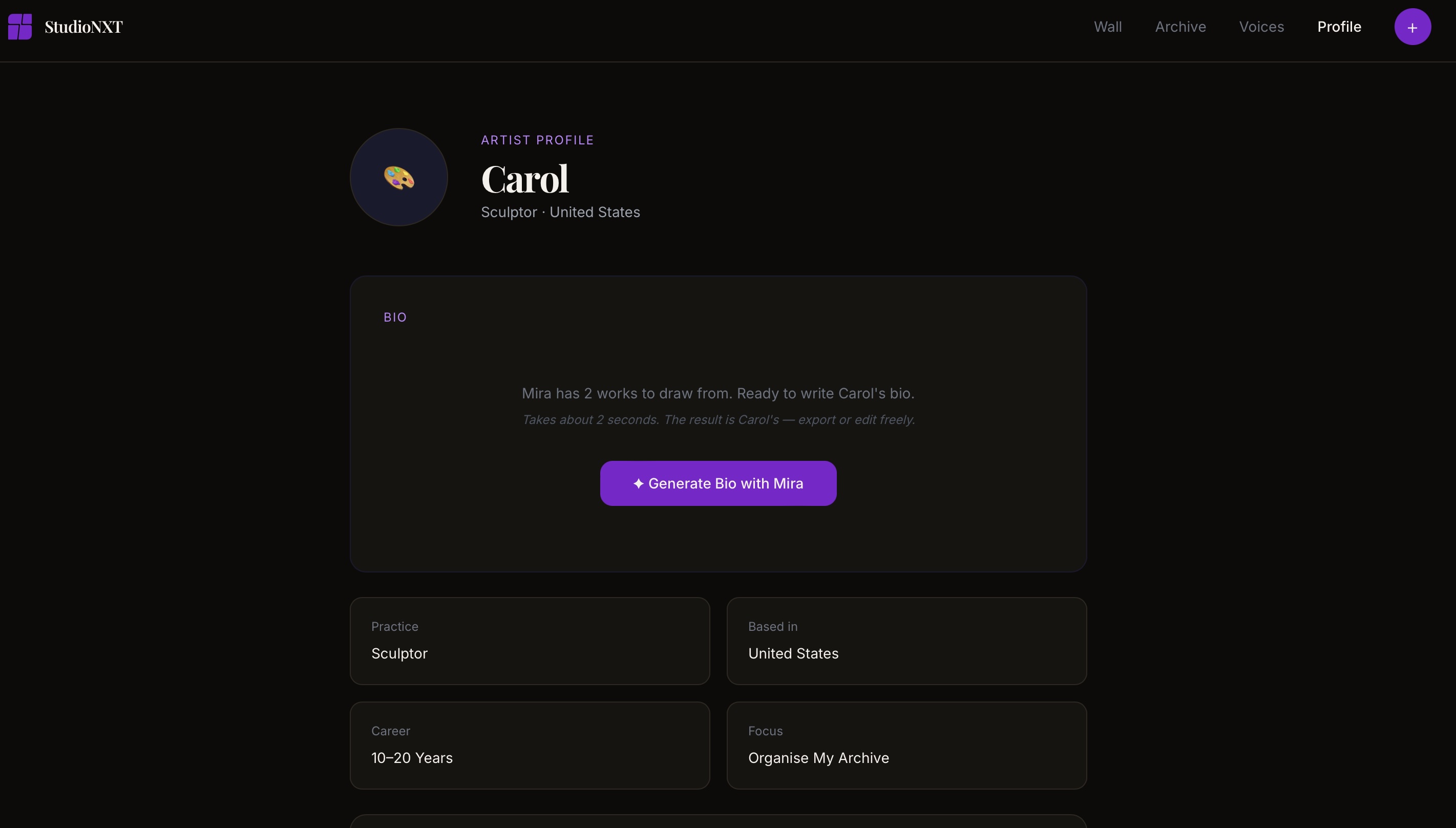
- Generate professional documents on command: artist statements, CVs, certificates of authenticity, invoices, grant texts, and exhibition proposals
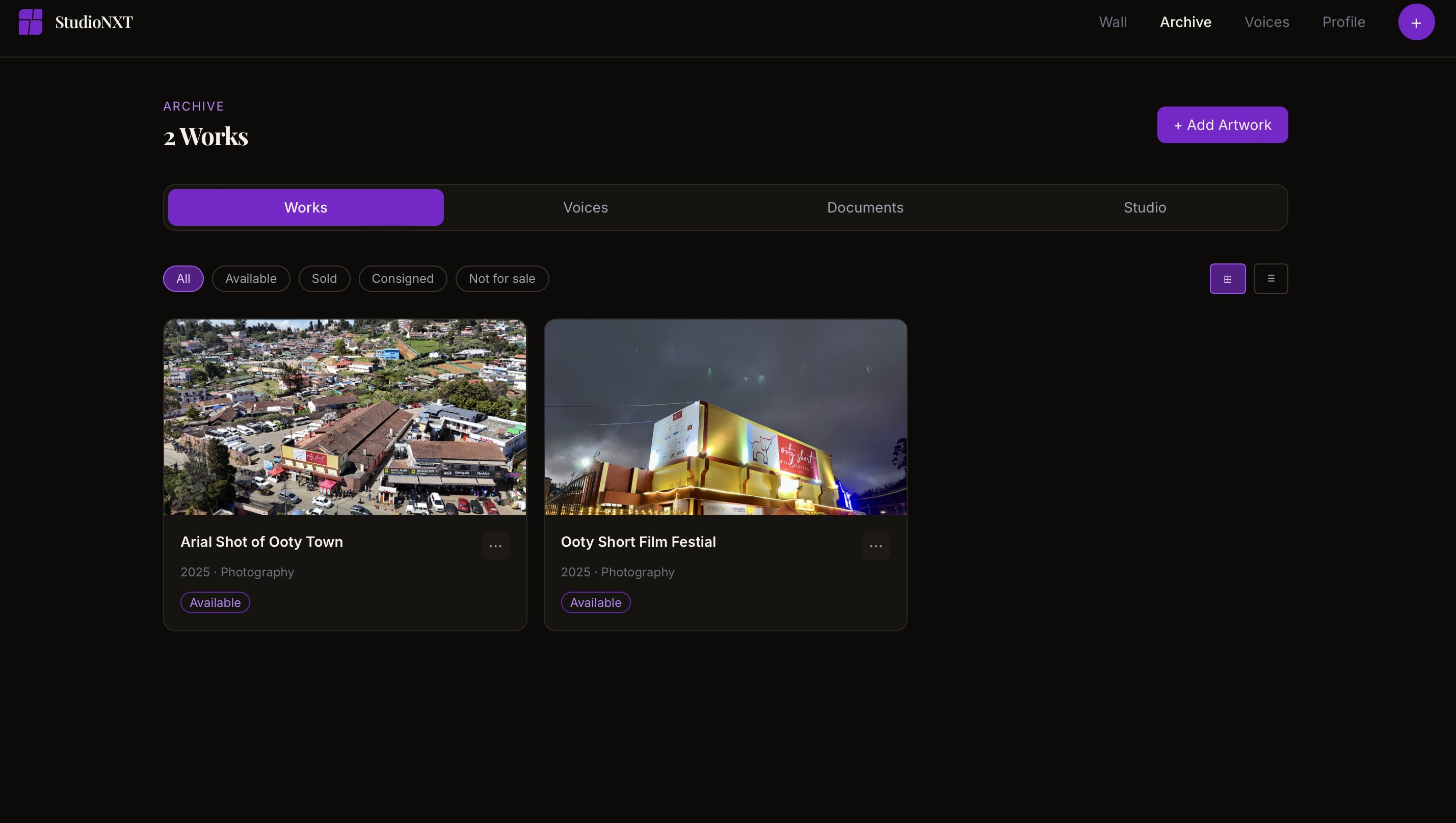
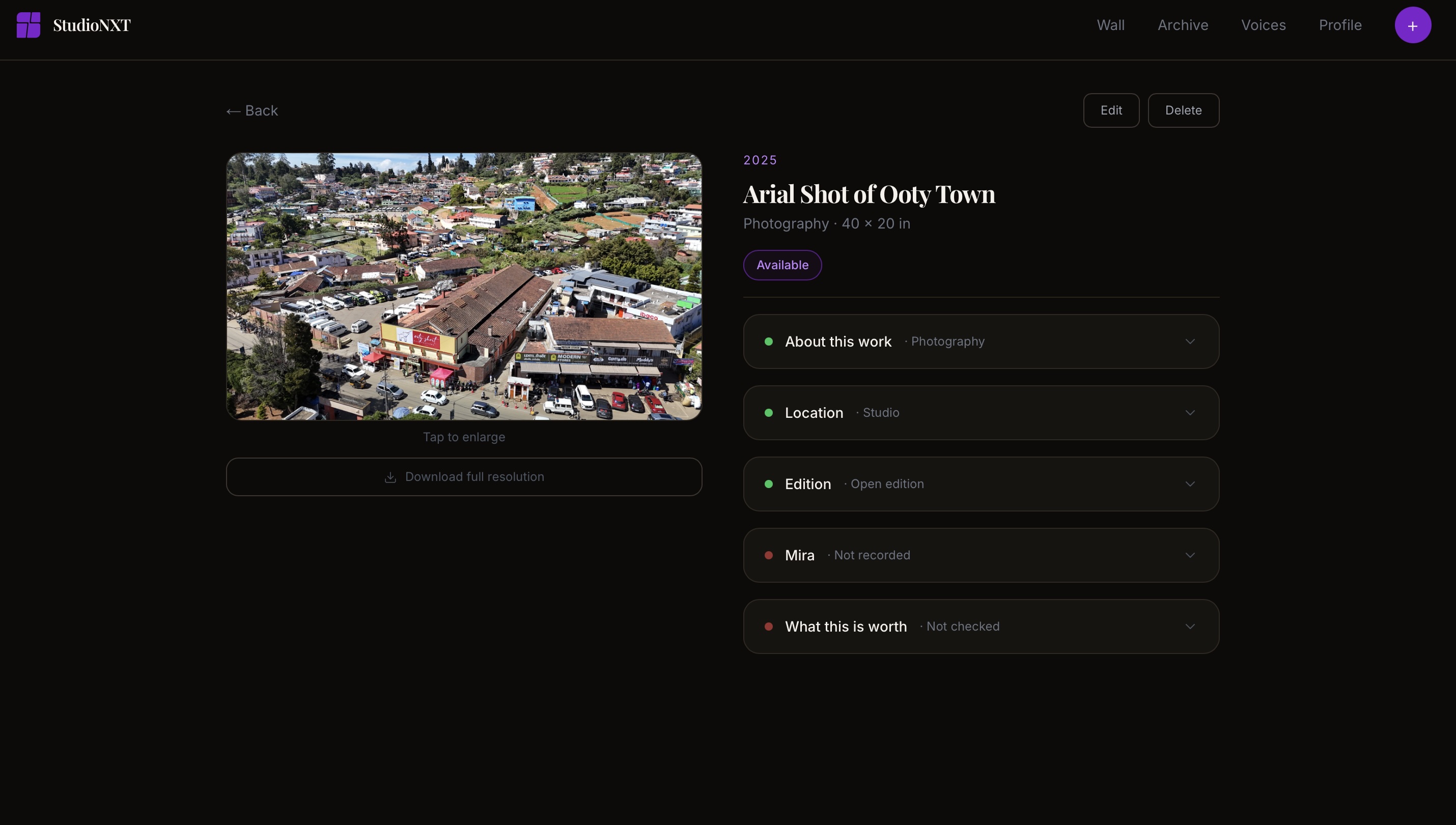
- Track what is sold, consigned, on loan, or in storage across multiple locations
- Narrate the arc of an artist's practice in the artist's own preferred tone and voice
- Flag conflicts in records and surface missing data without inventing information
- Activate Estate Mode: a read-only access layer for families after an artist's death or incapacity, so the archive speaks even when the artist cannot
Mira never guesses. If something is not in the archive, she says so. That anti-hallucination contract is not a technical constraint. It is the foundation of trust between an artist and their institutional memory.
How I built it
I am not a technical founder. I am an art manager who understood the problem deeply enough to architect a solution, and I used every AI-assisted development tool available to bring it to life.
The system is built on four layers:
Data Layer Firebase Firestore holds the structured artist archive: artworks, exhibitions, collectors, editions, documents, and financial records. Every piece of data is typed, validated, and cross-referenced.
Agent Layer Mira is built using the Google Agent Development Kit (ADK), orchestrating tool calls against the Firestore database in response to voice input. The agent follows a strict operating protocol: it only surfaces information present in the session data and never extrapolates.
Voice Layer The Gemini Live API powers real-time, interruptible conversation. Mira can be interrupted mid-sentence, redirected, and corrected, the way you would speak to a real studio assistant.
Preservation Layer Cloud Run hosts the backend. Google Cloud Storage holds artwork image assets. The architecture is designed to survive not just a session, but decades.
Challenges I ran into
The hardest challenge was not technical. It was philosophical.
Most AI assistants are built to be helpful in the broadest possible sense. They fill gaps, make inferences, and generate plausible answers. That is exactly the wrong behaviour for an artist's archive. If Mira invents an exhibition that did not happen, or guesses a price that was never set, she destroys the trust that makes the entire system valuable.
Designing an agent that is genuinely useful but structurally incapable of hallucinating required rethinking how the agent prompt, the tool routing, and the data layer all interact. Every response has to be traceable to a source record.
The second challenge was voice persona. Mira needed to feel institutional and precise, not warm, not casual, and not overly friendly, while still being natural enough to speak with comfortably. Finding that register took many iterations.
As a non-technical founder, the third challenge was bridging the gap between a very clear product vision and the engineering complexity required to realise it. AI-assisted development tools made this possible in ways that simply would not have existed two years ago.
Accomplishments that I'm proud of
I am proud that Mira has a genuine philosophy, not just a feature set.
The anti-hallucination contract, the hard rule that Mira only speaks from verified archive data, is something I believe no other tool in this space has committed to at the product design level. Most AI tools in the art world are general assistants with an art-world label attached. Mira is purpose-built for one function: being the most reliable institutional memory an individual artist has ever had.
I am also proud of the Estate Mode concept. Nobody in art technology is building for the moment after an artist dies. I am. That is a long-term cultural commitment, not a product feature.
What I learned
I learned that the best AI products are not the ones that do the most. They are the ones that refuse to do the wrong thing.
Every time I was tempted to let Mira be more helpful by making an inference or filling a gap, I pulled back. That restraint is what makes her trustworthy. An artist will only rely on a system they believe completely. One invented fact destroys that forever.
I also learned that being non-technical is not a disadvantage when the problem understanding is deep enough. The architecture of Mira, the data model, the agent protocol, the voice persona rules, came entirely from years of working inside studios, not from engineering textbooks.
What's next for Mira
The immediate next step is completing the live voice integration: connecting the Gemini Live API to the Firestore archive so an artist can have a real, unscripted conversation with their own data for the first time.
Beyond that, the roadmap has three stages:
Stage 1: The Living Archive Full voice query, document generation, and inventory management for individual artists. Launching in Stuttgart with a founding cohort of working artists.
Stage 2: The Permanent Archive A preservation layer built like an endowment. A ring-fenced reserve fund, annual physical Archive Books printed and posted to each artist, and a dark backup held by an institutional partner, designed to outlast any software company including this one.
Stage 3: The Art Economy Layer Pricing intelligence, collector relationship management, gallery portals, and anonymised market data that turns StudioNXT into infrastructure for the entire independent art economy.
Mira is not a product feature. She is the beginning of a new kind of institution: one that exists to make sure no artist's life work disappears quietly into an unlabelled hard drive ever again.
Built With
- 1.5
- claude
- cloud
- firebase
- flash
- gemini
- next.js
- typescript

Log in or sign up for Devpost to join the conversation.