About Mintality: Financial Wellness Companion
Inspiration
Mintality was born from a simple observation: traditional financial apps focus on what we spend, but rarely address why we spend. As a team, we noticed that our own spending patterns fluctuated with our emotional states—stress-induced takeout orders, anxiety-driven online shopping, and celebratory splurges after good news. We realized that understanding the emotional triggers behind spending decisions could be the missing piece in achieving financial wellness.
The statistics reinforced our insight: studies show that Americans spend an estimated $143 billion annually on "emotional purchases." Yet most financial tools treat money management as a purely rational activity, ignoring the powerful emotional factors that drive our financial decisions.
What We Learned
Building Mintality taught us valuable lessons about both technology and human behavior:
- The power of multi-modal AI: Combining emotion detection with financial pattern recognition created insights neither could provide alone.
- The emotional dimension of finance: Money decisions are deeply intertwined with our emotional states, creating predictable patterns.
- The importance of empathy in financial tools: Users respond better to supportive guidance than to judgment.
- The technical complexity of state management: Building a conversational AI interface with multiple interaction flows requires careful state handling.
We also gained practical experience with AI APIs, data visualization techniques, and designing intuitive user experiences for sensitive topics like personal finance.
How We Built It
Mintality leverages several technologies to create a seamless experience:
- Streamlit for the web application framework, enabling rapid development
- Gemini Pro API for generating personalized advice and affirmations
- Emotion Analysis to detect and classify emotions from user text
- Pattern Recognition Algorithms to correlate emotional states with spending categories
- Plotly for interactive data visualizations
- Session State Management for maintaining conversation context
Application Flow:
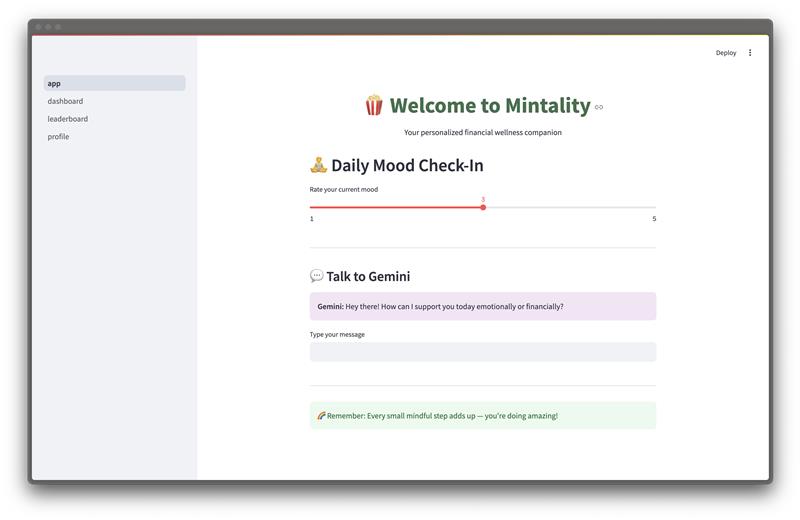
- Users share their feelings about finances through a chat interface.
- Our AI analyzes the text to detect emotional states and intensity.
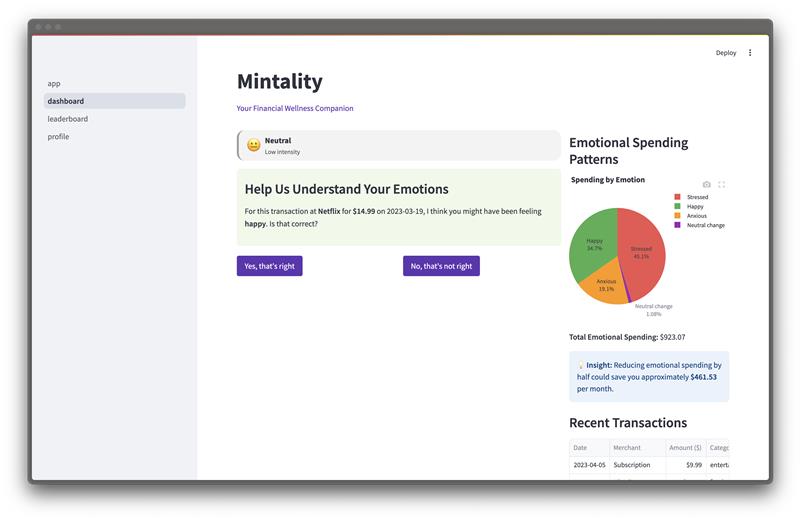
- The system correlates these emotions with historical spending patterns.
- Visualizations show users how emotions affect their spending behavior.
- Personalized insights and gentle interventions are provided.
- Daily affirmations reinforce positive financial mindsets.
Challenges We Faced
Building Mintality wasn't without obstacles:
- Emotion Detection Accuracy: Accurately classifying nuanced emotional states from text required careful prompt engineering and fallback mechanisms.
- State Management: Maintaining complex conversation flows while avoiding infinite loops in Streamlit proved challenging.
- Pattern Recognition with Limited Data: Creating meaningful insights from small transaction datasets required creative approaches to pattern detection.
- UI/UX for Sensitive Topics: Designing an interface that feels supportive rather than judgmental when discussing emotional spending.
- API Integration: Handling API rate limits and ensuring graceful degradation when services were unavailable.
Perhaps our biggest challenge was finding the right balance between technological sophistication and human empathy. We wanted Mintality to feel like a supportive companion rather than a cold financial tool, which required careful attention to language, design, and interaction patterns.
What's Next for Mintality
This hackathon version of Mintality demonstrates the concept, but we see significant potential for expansion:
- Integration with banking APIs for real-time transaction analysis
- More sophisticated emotion detection using multiple signals
- Machine learning models that improve personalization over time
- Expanded emotional categories to capture more nuanced financial behaviors
- Mobile app with notification capabilities for in-the-moment interventions
Built With
- geminiapi
- python
- streamlit

Log in or sign up for Devpost to join the conversation.