-
-
Community Health Service Center
-
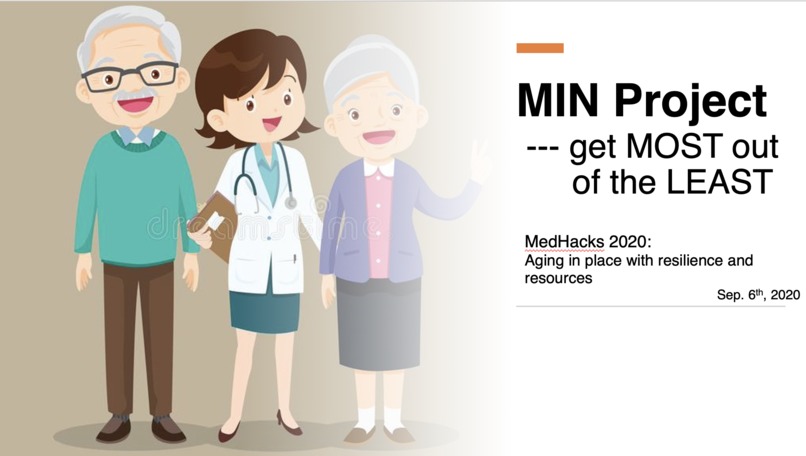
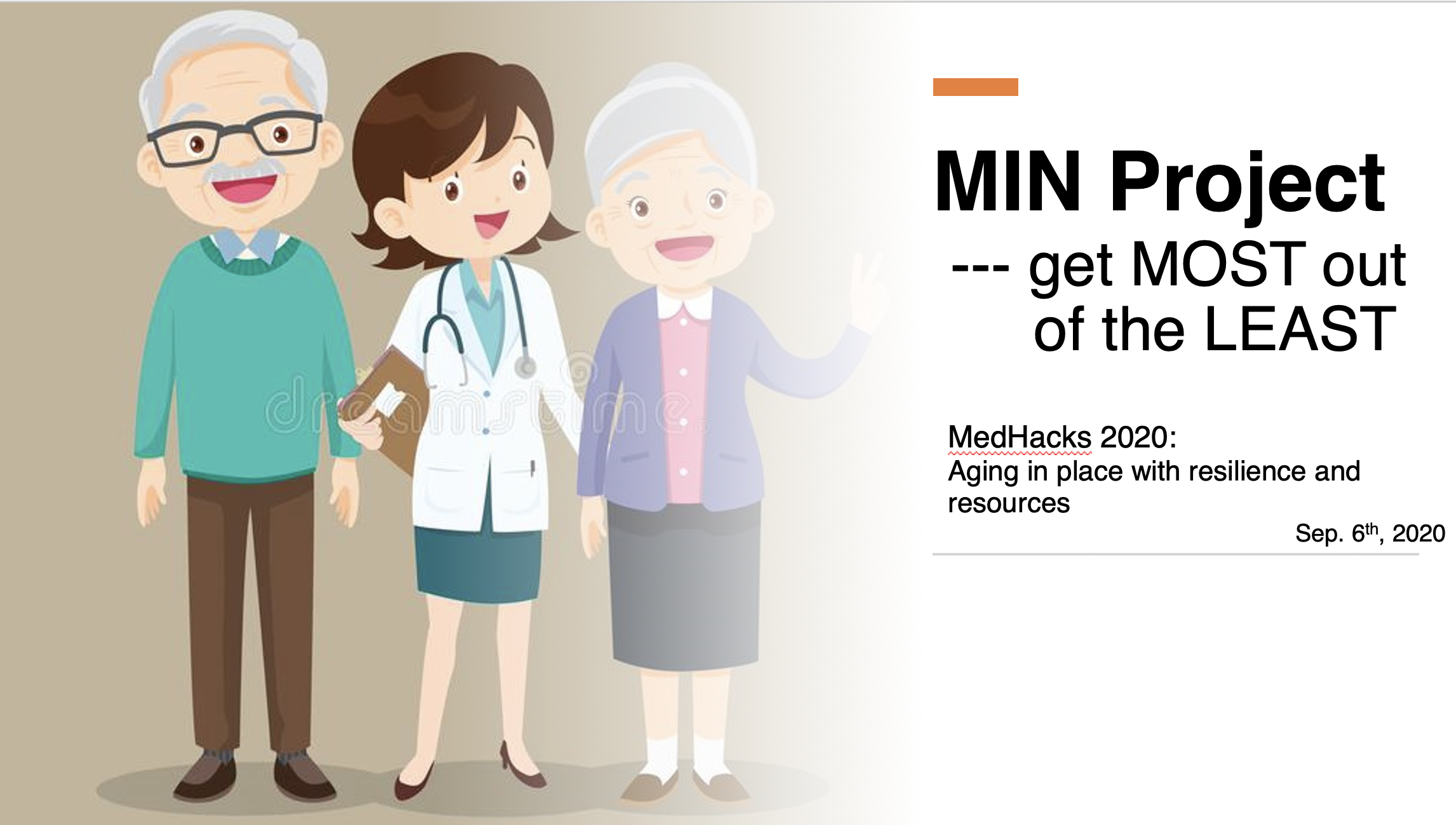
Get the MOST out of the LEAST
Inspiration
Based on the global health and aging report published by WHO, there are already 524 million people aged 65 or above worldwide in 2010, and the number is expected to reach 1.5 billion by 2050, representing16 percent of the world’s population.1 A large part of them may experience one or more chronic illnesses, disabilities, and even difficulties in living independently. These patients require long-term home monitoring of various health parameters, such as blood pressure and glucose level.2 Unfortunately, many of these tedious monitoring processes are likely to be forgotten. They may also pose significant intrusions to the elders’ normal lives. More importantly, most elder people are not able to effectively interpret these data until they meet their care providers, and due to sensory degradation, they are often unlikely to aware of subtle changes in health conditions, which is especially dangerous during events that may jeopardize their health and lives.
Inspired by challenges addressed above, we would like to design a series of non-invasive and multi-functional devices that can measure patients’ health-related parameters in real-time and transmit the data into databases that can be accessed by both patients and their community health centers through our website, which is called Community-based Health Centers (CHC). There will also be algorithms evaluating patients’ health conditions based on their medical profiles. We hope that this concept would greatly improve the life quality for elder people, as well as ensuring their safety and welfare.
What it does
Our project is mainly divided into two components, the non-interruptive and multi-functional hardware and the website (database and connection system). For the hardware portion, we design a series of none-invasive equipment that can take people’s health related parameters in their daily life without them doing anything considerably different from their daily life. These devices will be embedded in people’s living environments, such as living rooms and bedrooms. Here are some examples:
- Spoon style glucose detector: Blood sugar level monitoring is important for diabetics, but it can be difficult to remember doing the measurement regularly. Thus, we design a special spoon embedded with a detector. When the patient put food in the mouth, the spoon can automatically sample patient’s saliva and perform subsequent analysis to obtain the blood sugar level. Thus, whenever and wherever the patients are eating with our spoon, their blood glucose level can be monitored.
- Multi-functional recliner chair: Monitoring blood pressure level and pulse is important for a variety of aging-related diseases, such as hypertension. We think it optimal to implant these functions within a comfortable recliner chair, where patient could sit in to watch television, read books, while their health-related parameters are collected even without their conscious awareness. This would minimize the need for the patient to THINK ABOUT taking the measurements and allow their data to be collected when they live their normal life.
Another major part of our project is building a website named Community/Intermediate Health service Center (CHC/IHC), which is connected to the database. Collected data can be transmitted to our database through the Internet. Both the patients’ health providers and community based medical professors can log in their account to view and manage the real time health data of the patients.
Functions of Senior (patient) interface include:
- Login
- Visualized change in key measures (eg. blood pressure, heart rate) Functions of Caregiver interface:
- Login
- Table of patients' conditions
- Algorithm to alert unusual patients' conditions to caretakers
- Patient record & contact details
We will also develop algorithms that can learn to decide whether the data of a specific person looks normal based on his or her personal medical record and give suggesting diagnosis to doctors if abnormality or even potential emergencies occurs. Then the doctor will be alarmed by the website about the data fluctuation as well as suggestions, and then doctors can decide whether the situation is serious enough to intervene (probably call their patients to check their situation). Additionally, if the patients have any minor medical-related questions regarding their health, they can simply open the chatting feature (both text message and voice form) on our website to directly communicate with a community health profession. We hope that these features would significantly alleviate the pressure on elder people’s caring system by utilizing the valuable nursing resources to the maximum efficiency, as well as allowing the elder people to be notified of any abnormality in time to avoid any further complications.
How I built it
Hardware:
Spoon style glucose detector: we will embed an integrated circuit at the first half side of a spoon, which includes a button cell battery as the energy source, saliva collector, analog/digital signal transformer, and a Wi-Fi transmitter module. There would be a rubber-like material covered on the circuit and seal the chip and battery from outside environment. There’s a small valve on the coverage, right in front of the saliva collector. The valve will open only when the user’s tongue touches it and provides enough pressure. Then saliva can flow through the collector, which has glucose oxidase embedded inside. Glucose in saliva will react chemically with the enzyme and change the current in at different levels, depending on the glucose concentration. Then current, an analog signal will be transformed into a standard digital signal through A/D transformer and finally packed and transmitted through Wi-Fi by the transmitter module.
Multi-functional recliner chair: The chair can measure the user’s pulse, blood pressure and temperature. There is a non-contact infrared digital thermometer buried inside the handle of the chair with only the detector facing out. If an old man is lying his arms out on the handle, the thermometer can then scan him and get the data of body temperature. What's more, the blood pressure monitor that is fixed at the top left part of the chair can also be used to detect the pulse and blood pressure, integrate the data, and then send them to the data transformer that is connected with Wi-Fi (together with the data of body temperature), which can send data to our database.
Website & Database: To present the monitoring data, we designed a website with two user interfaces, one for patients and one for caregivers. Languages: CSS, HTML, JavaScript, MATLAB To build the automatic warning system, we deploy MATLAB Algorithms. The model would identify the problematic heart signal by doing Fourier transformation of heart signals.
Challenges we ran into
Initially, our team had a tough discussion on the devices we are attempting to design. We want to compact as many functionalities within the comfy chair to minimize the equipment the patient needs to buy for measuring their health data. However, as we explore our ideas further, we believe it impractical to pack all the measuring device into the chair – it would take an exorbitant cost. Hence, we conducted some searches and reanalyzed the needs of most of elder people so that we selected a few crucial features to implant into our chair. In addition, our team initially knew little about website construction, which constitutes a major component of our project. After watching several tutorials on basic web design, we were able to figure out the fundaments of website construction and we managed to successfully develop a website that allows us to effectively demonstrate our ideas.
Accomplishments that I'm proud of
We’ve designed two unprecedented multifunctional devices that can be used as a chair or a fork as well as a health monitoring system. They can measure users’ vital signs as well as blood pressure and blood sugar level without doing any measurements intentionally. We intergrade the measurement into people's life.
We have completed the device design, UI design, the proof-of-concept MVP, and the development for a functional web app.
What we learned
We learnt a lot about equipment design, such as how to implant the sensors and signal transmitters with optimal efficiency and practicality. We also learned many fields in website and software development, including Web UX/UI design and mockup, video editing using iMovie, calling APIs, CSS and HTML coding. Furthermore, we have a deeper understanding of how to convert conceptual ideas to real-life applications, as we initiate our design from an entirely intangible notion to equipment that can be used by the older people to help them live a higher-quality life.
What's next for Minimal Intrusion Nursing (MIN) program
To promote our project further, we can improve our current MIN devices and develop new ones. We can also help more senior population via covering more communities through collaborating with local health centers or establishing new CHCs. Furthermore, we want to expand our database such that more chronic diseases can be diagnosed automatically, which may conserve the already limited medical resources. Additionally, we expect to extend the functionalities of our CHCs and the websites so that more services could be provided to people in need.





Log in or sign up for Devpost to join the conversation.