Inspiration
Our inspiration came from listening to NUS Formula SAE talk about how aerodynamics plays a critical role in vehicle performance. Seeing how airflow directly affects speed, stability, and efficiency made us realize that aerodynamic testing doesn’t have to be limited to large, expensive facilities. That sparked the idea — if they can do it at scale, why can’t we build a smaller, accessible version?
What it does
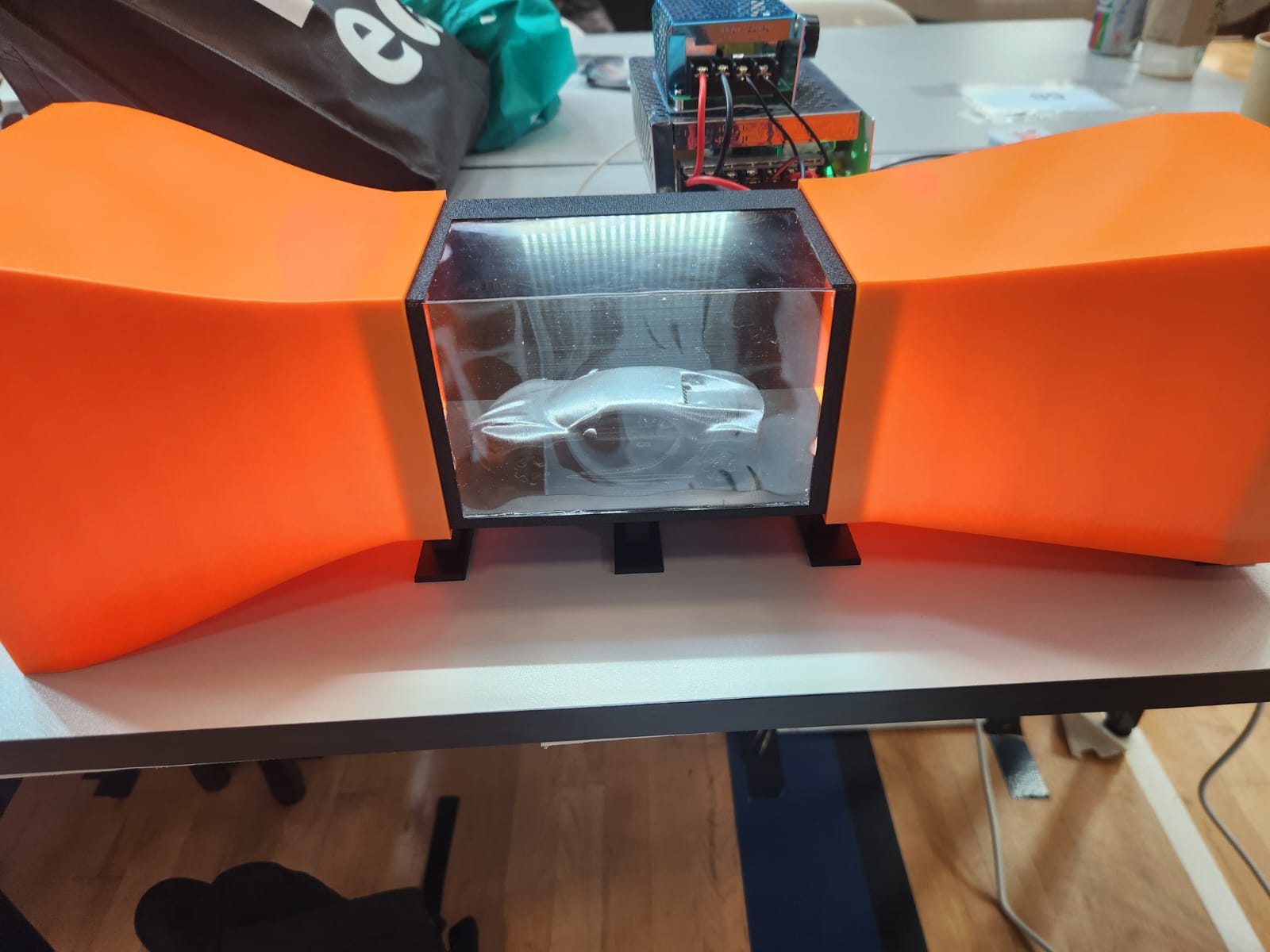
Mini Wind Tunnel is a compact wind tunnel that allows users to visualize and study airflow around small objects. Using smoke visualization, it makes invisible airflow patterns visible, helping users observe streamlines, turbulence, and flow separation in a controlled environment.
How we built it
We designed a closed, enclosed wind tunnel consisting of a contraction section, test section, diffuser, honeycomb flow straightener, and a fan placed at the end to pull air through the system.
To visualize airflow, we used a piezoelectric atomizer to generate fine water droplets and injected the smoke into the tunnel through a nozzle. Most structural components were 3D printed, allowing us to rapidly prototype and iterate within the limited time frame.
Challenges we ran into
One major challenge was smoke visualization — producing consistent, fine smoke that clearly followed the airflow was harder than expected.
Another challenge was time constraint. Since many parts required 3D printing, print time quickly became a bottleneck. We addressed this by redesigning the smoke nozzle and increasing the print layer height to significantly speed up printing while maintaining functionality.
Accomplishments that we're proud of
We’re proud that we were able to design, build, and demonstrate a functional mini wind tunnel within just 24 hours.
We also successfully took inspiration from past projects and integrated multiple concepts — airflow straightening, smoke visualization, and enclosure design — into a single working system under hackathon pressure.
What we learned
We learned that airflow is highly turbulent and unpredictable, and achieving clean, uniform flow requires careful design at every stage. Even small changes in geometry or placement can significantly affect airflow behavior.
What's next for Mini Wind Tunnel
Next, we plan to make the design more modular, allowing individual sections to be easily swapped or modified. We also want to design a proper enclosure for the piezoelectric atomizer, improving safety, reliability, and ease of use.

Log in or sign up for Devpost to join the conversation.