-
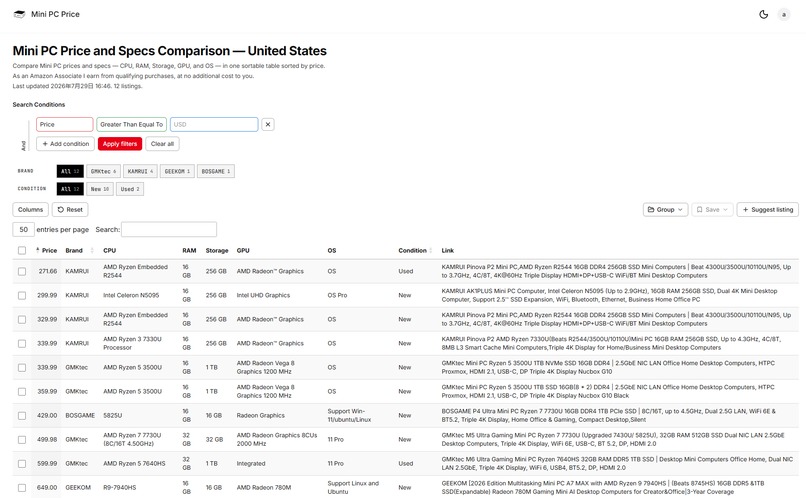
Mini PC Price Preview 2
-
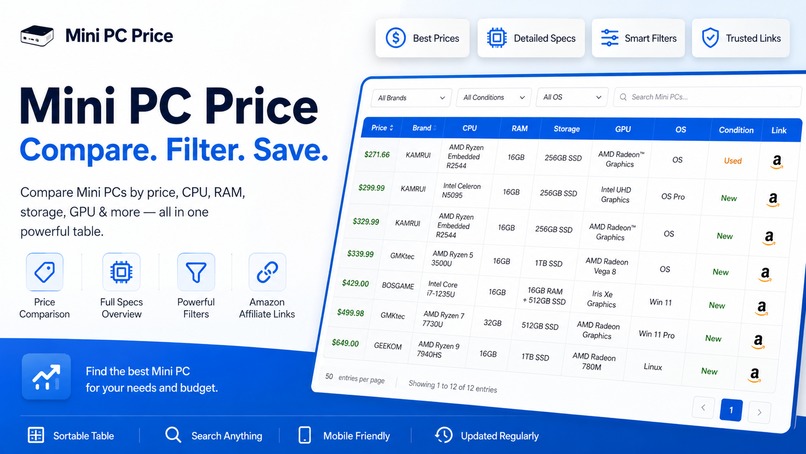
Mini PC Price Preview 1
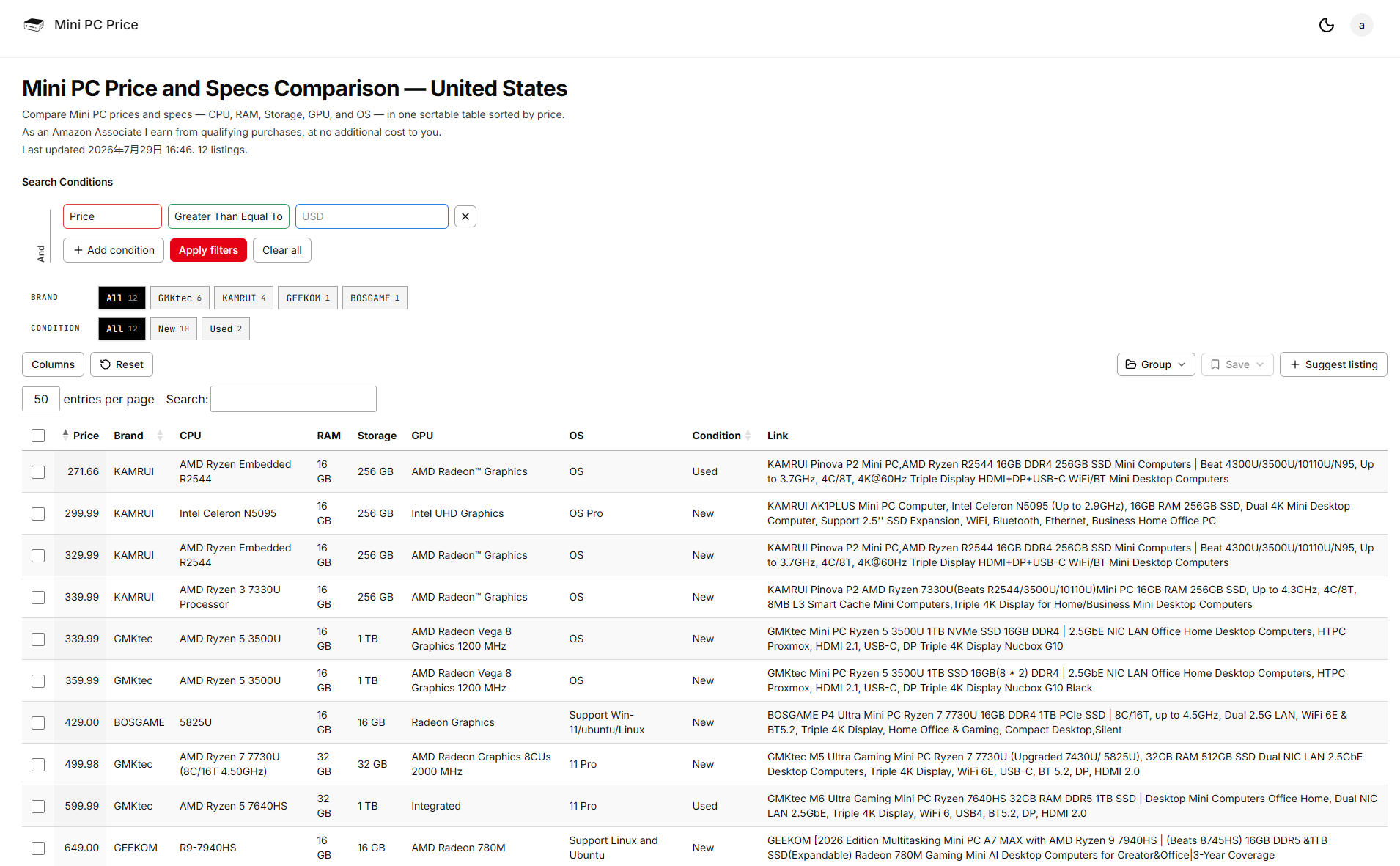
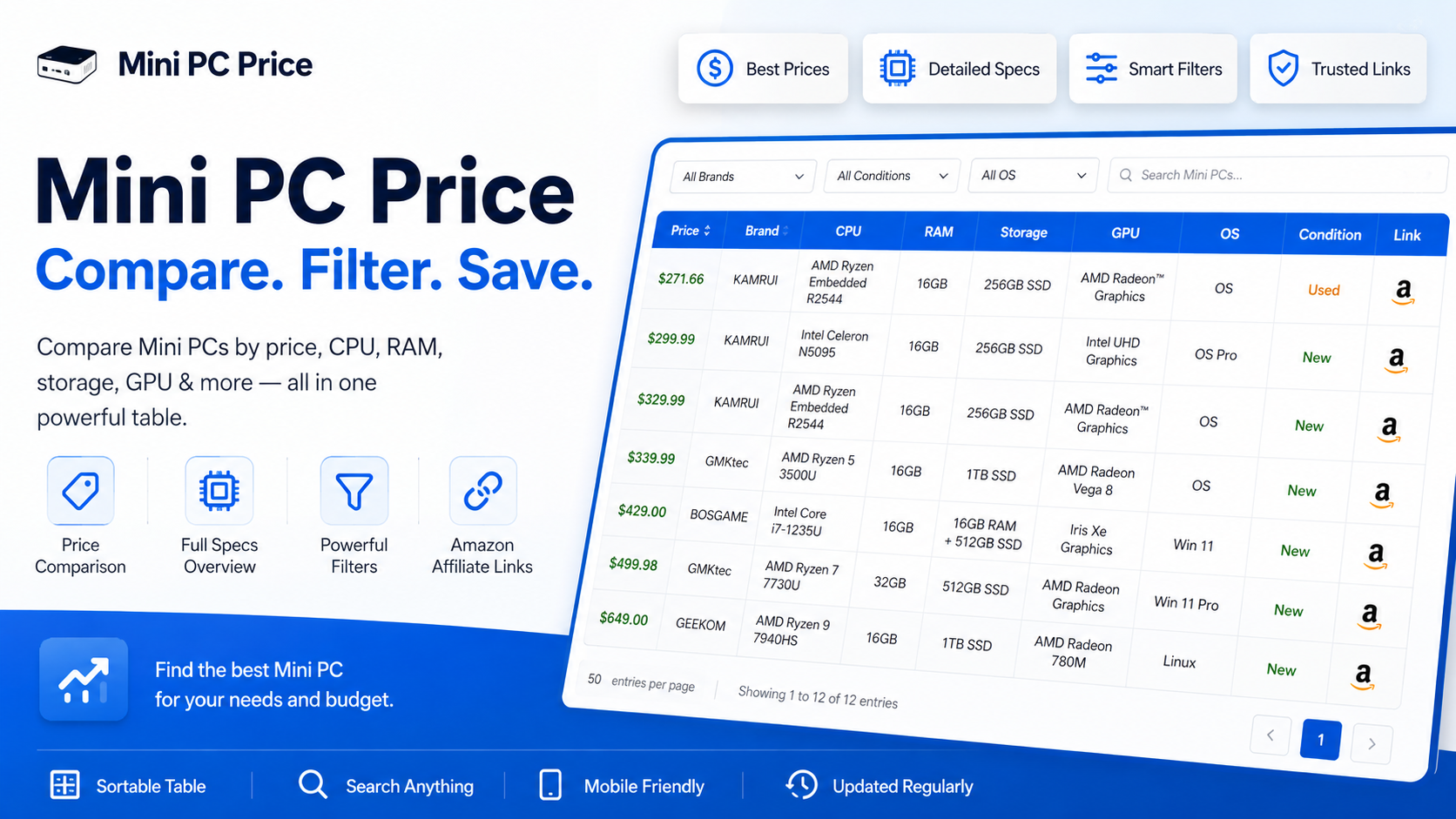
Inspiration
The idea for Mini PC Price came from personal frustration. I was shopping for a mini PC to set up a home server and found myself drowning in open tabs — Amazon, Newegg, AliExpress, brand websites — copying specs into a messy spreadsheet just to compare a handful of models. Every listing presented information differently: one showed RAM type, another didn't; some mentioned upgrade paths, others buried them in fine print. I realized that if I was spending hours on this, thousands of other buyers were too. The mini PC market was growing fast, but there was no centralized, reliable place to compare listings side by side. So I decided to build one.
What it does
Mini PC Price is a free, sortable comparison table that aggregates real marketplace listings with full specifications — CPU, RAM, storage, GPU, OS, ports, upgrade paths, and more. Users can filter by price, brand, condition, RAM size, storage capacity, GPU type, or operating system. Columns are fully customizable: office buyers can focus on RAM and OS, gamers can add GPU RAM and boost clocks, and homelab enthusiasts can track power draw and cooling. The table defaults to price ascending, making it easy to find budget options under $100 or $150. Users can save shortlists, share them with a single link, and even edit specs directly — approved corrections go live for everyone, making the database a community-maintained resource rather than a static scrape.
How I built it
I built Mini PC Price as a web application with a focus on speed and usability. The front end uses a reactive table component that updates instantly as users type search queries or apply filters. Product data is ingested from e-commerce platforms and official product pages through automated pipelines, with prices refreshing daily. The schema was designed to capture every parameter a buyer might care about — from CPU model and RAM technology to USB port count and warranty length. Critical attributes like RAM type (soldered vs upgradeable), GPU class, and OS bundle receive manual verification to catch common mismatches. The community editing feature was implemented with a review queue: user edits apply immediately to their personal view and enter a moderation workflow before going live globally.
Challenges I ran into
Normalizing data from hundreds of disparate sources was the biggest technical hurdle. Retailers describe the same spec in wildly different ways — "16GB DDR5" vs "16 GB RAM" vs "Memory: 16G" — and extracting structured fields required careful parsing and mapping. Keeping prices fresh across multiple platforms meant building reliable scraping pipelines that could handle changing page structures. On the product side, the biggest challenge was deciding what to track and what to leave out. Too many columns overwhelm users; too few make the tool useless. Finding that balance required constant iteration and user feedback. Community moderation also introduced complexity — how to prevent spam edits while keeping the contribution process frictionless.
Accomplishments that I'm proud of
I'm genuinely proud that Mini PC Price has become a genuinely useful resource for the mini PC community. Seeing users not only browse the table but actively contribute corrections — fixing CPU labels, adding missing RAM max values, updating stale prices — validated the community-driven model I had hoped for. The tool now covers hundreds of listings across brands like Beelink, Minisforum, Intel NUC, ASUS, Lenovo, and HP, with specs that are actually reliable. The save-and-share feature has been used in forum discussions and Reddit threads, which is exactly what I envisioned — replacing vague recommendations with curated, shareable tables. Most of all, I'm proud that the tool saves people real time. I built it to solve my own problem, and it turned out to be a solution for many others.
What I learned
Building Mini PC Price taught me that data quality is everything. A pretty interface means nothing if the underlying specs are wrong or inconsistent. I learned that users value trust and transparency — they want to know which fields are verified vs scraped, and they appreciate being able to fix errors themselves. I also learned that "good enough" is not good enough for a comparison tool. The difference between an 8 GB and 16 GB listing of the same model can be easily missed if the table doesn't make it obvious — so every design decision had to prioritize clarity over aesthetics. On a technical level, I gained a much deeper appreciation for the complexity of e-commerce data and the importance of building resilient ingestion pipelines.
What's next for Mini PC Price
I have several features in the pipeline. Price history charts are coming, so users can see how mini PC prices have trended over time and identify genuine deals. I'm also working on alert notifications — users can set a target price for a specific model and receive emails when it drops. The spec database will continue to expand as new SKUs enter the market, and I plan to improve the verification workflow with a reputation system for frequent contributors. Mobile optimization is also a priority, as many users browse on their phones. Longer term, I'd like to add international pricing and regional availability, so the tool works for buyers outside the US. The goal is to make Mini PC Price the definitive resource for anyone shopping for a mini computer — not just a comparison tool, but a community where buyers help each other make smarter decisions.
Built With
- next.js
- react
- typescript

Log in or sign up for Devpost to join the conversation.