-
-
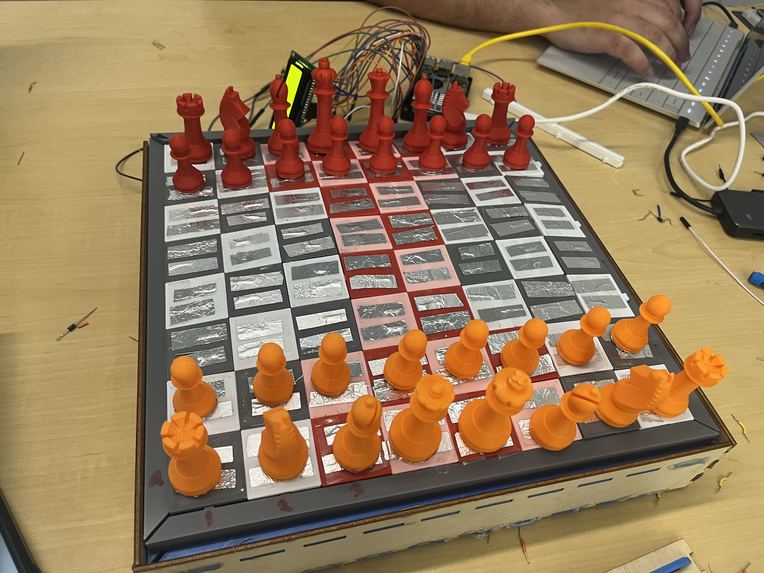
Main Chessboard Picture
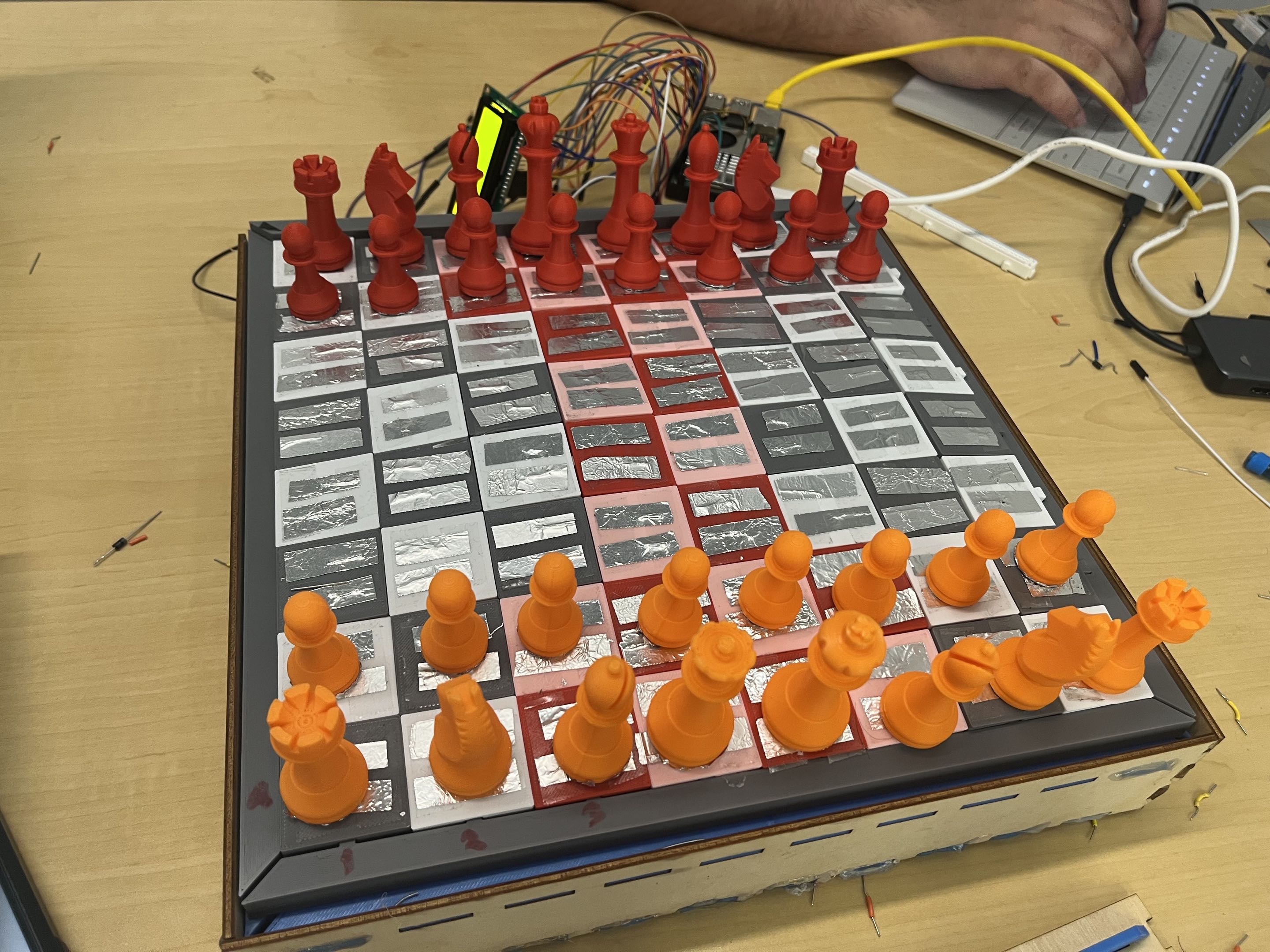
Inspiration
The main inspiration behind this project was our two group members who are highly skilled at chess. They are a part of chess club at NJIT and enjoy playing on chess.com and physical on board chess during chess club meets. However due to a lack of post game-analysis and other useful digital chess tools, on-board chess often feels much harder to get learning feedback from. Due to this we conceptualized and build "mini-mittens" a physical board that is able to provide both real-time and post-game analysis of your moves.
What it does
Mini-mittens is able to detect the moves that you make on board allowing it to give you real-time analysis of your moves and give you the best possible move to make in that situation. Furthermore, at the end of the game the board gives you a in-depth analysis of your play and shows you your ELO allowing you to compare where you stand against players around the world.
How we built it
The board consists of 64 tiles with two pieces of conductors on top. One conductor is connected to a row channel and a column channel. Pieces also have a piece of conductor attached to their base making it so that whenever the 3 conductor strips touch the circuit is completed and picking up a piece and putting down a piece is registered. That data is then sent to raspberry-pi which processes the data and turns it into a readable format for the on-board stock fish model. The model then processes that move data to find the most optimal move based on the position of all pieces at the time.
Challenges we ran into
The major challenges we ran into were limitations of GPIO port as our original idea required 64 GPIO which was not possible to physically implement. Another issue we had was poor cable management which lead to confusion regarding what row/column corresponded to what GPIO pin. Lastly, during the start some confusion regarding the circuitry caused some issues with the rapid prototyping.
Accomplishments that we're proud of
The biggest accomplishment that we are proud of are that we were able to solve the GPIO issues by using a 8x8 matrix and multiplexing to obtain and update the position of each piece with microsecond level precision. Another accomplishment that we are proud of is that even though our circuit broke down multiple times, we as a team were not demotivated and we were able to find the issues rebuild it and submit a project to the best of our abilities.
What we learned
This hackathon was the biggest learning experience that we had as team was rapid prototyping as this was the first hackathon where we 3-D printed. In this hackathon we learned a lot about CAD designing processes and 3D printing and making cut routes for CO2 Laser Printing. We also learned a lot about matrices in coding logic.
Built With
- ai
- autodesk-fusion-360
- digital-design
- python
- raspberry-pi
- stockfish

Log in or sign up for Devpost to join the conversation.