Code: https://github.com/rogemega/mini-ecu Codelab (step-by-step tutorial): https://github.com/rogemega/mini-ecu/blob/main/docs/codelab.md Video: https://youtu.be/x3yPOG4rW8Y
Inspiration
Automotive software runs on QNX because of a few properties that are easy to state and hard to see: synchronous message passing, priority inheritance, resource managers, fault recovery, and — since QNX 8.0 — security policies. I wanted a sample small enough to read in an evening that lets you watch each of them happen, on a laptop, without a board.
What it does
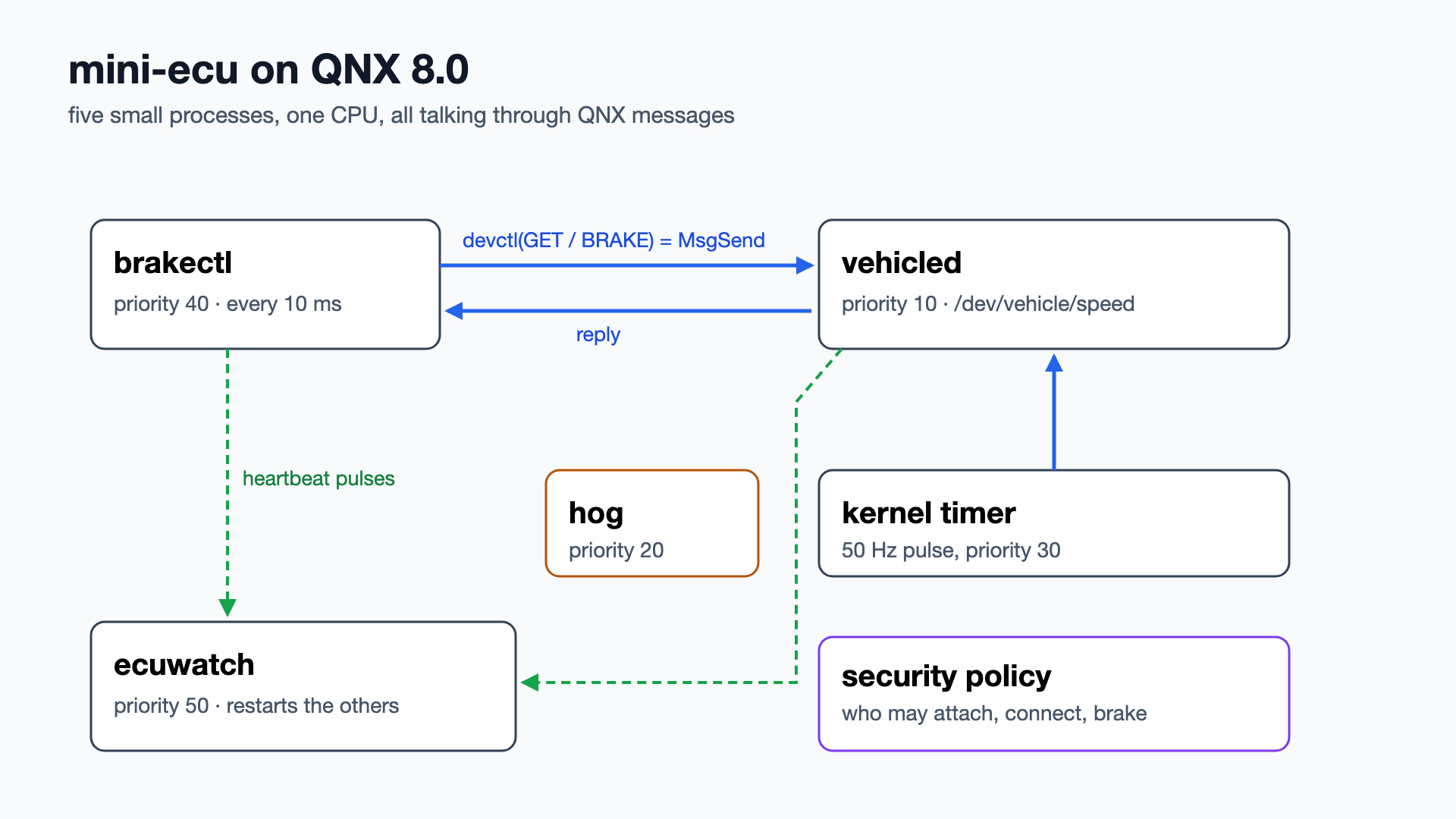
Five small C programs boot on QNX SDP 8.0 inside QEMU:
- vehicled — a resource manager that owns the vehicle state at
/dev/vehicle/speed.catit, or send typeddevctl()commands. A 50 Hz timer pulse drives a toy vehicle model. - brakectl — a priority-40 control loop that asks for the speed every 10 ms, brakes above 80 km/h and measures the latency of every request.
- hog — a priority-20 CPU load on the same core.
- ecuwatch — a watchdog that starts the others, receives heartbeat pulses, and restarts processes that crash or hang.
- vctl — a command-line client.
Two experiments are built in:
- Priority inheritance. With
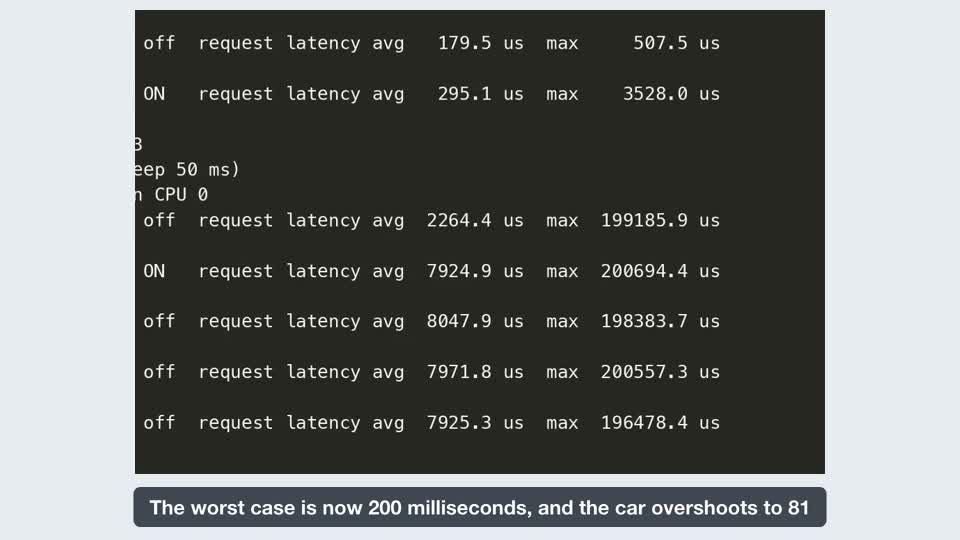
hogrunning, the brake controller's worst request latency is 0.7 ms. Start the server with_NTO_CHF_FIXED_PRIORITY(inheritance off) and it becomes 201 ms, and the car overshoots the speed limit. Same code, one channel flag. - Security policy. Every process runs with its own type. Even as root, an
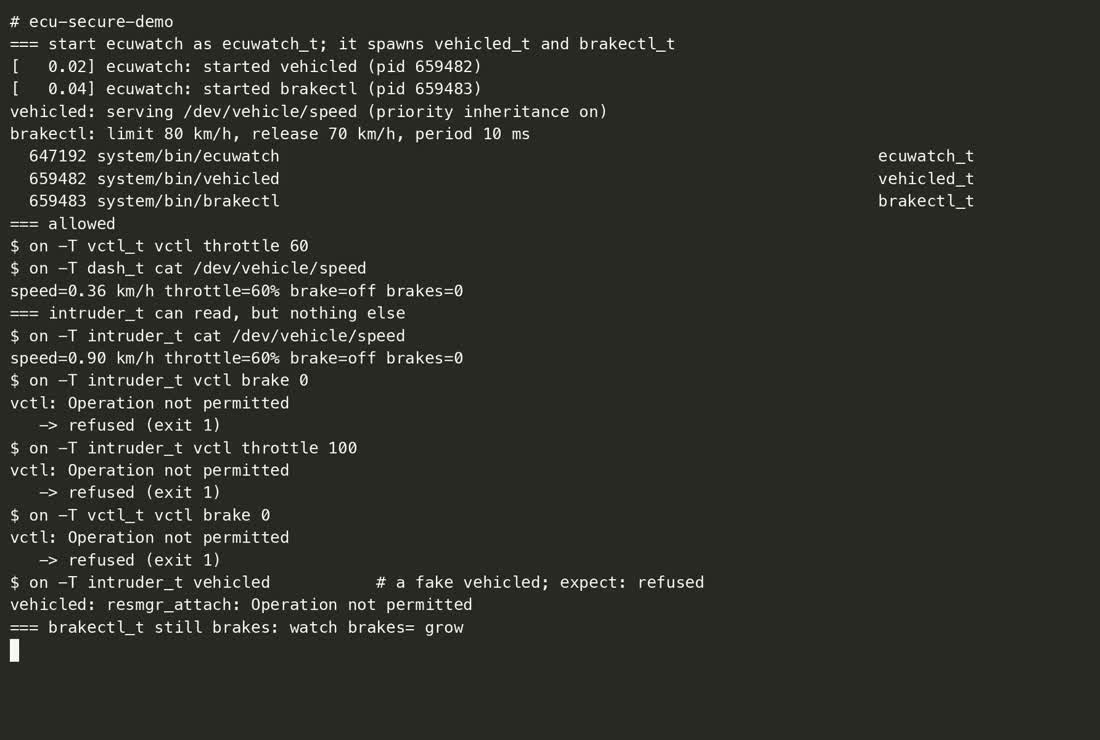
intruder_tprocess can read the speed but cannot brake, cannot move the throttle, and cannot register a fake/dev/vehicle/speed; the operator tool may only move the throttle. The brake/throttle rules are custom permissions (class vehicle { brake throttle }) thatvehicledchecks per request withsecpol_check_permission().
How I built it
- C with
qccfrom QNX SDP 8.0 (free non-commercial license), x86_64 for QEMU (also builds for aarch64le). mkqnximagebuilds the images; a small script adds the programs and boots QEMU with user-mode networking, so no bridge or sudo is needed.- The system part of the policy was recorded with
secpolgenerateon a--secpol=openimage, then combined with a short hand-written policy for the sample and compiled withsecpolcompileinto a--secpol=secureimage. - Every number in the README and the video comes from running it in QEMU.
Challenges
- Getting a security policy that boots: the recorded rules referenced an
undeclared
defaulttype, policy statements are order-sensitive, and the default recording configuration marks the console as unrestricted, so nothing the shell does is recorded. The codelab lists each pitfall and the fix. - Making priority inversion visible: all processes are pinned to one CPU with
ThreadCtl(_NTO_TCTL_RUNMASK), and the vehicle model integrates over measured time so late ticks do not hide the effect.
Accomplishments
- One channel flag turns a 0.7 ms worst case into 201 ms — a clear, measurable demonstration of why QNX servers inherit client priority.
- Per-request authorization that works for root processes, written in ten lines of policy and a few lines of C.
- A codelab that goes from installing the SDK to an enforced security policy in eight steps.
What I learned
How the resource-manager framework, pulses and channels fit together; that
secpolgenerate also records custom-permission use; and how much the default
priority inheritance quietly protects a system.
What's next
Run each process as a non-root user as well, replace the toy model with a CAN
resource manager, and run it on a Raspberry Pi 4 (make ARCH=aarch64le already
builds it).
Built With
- c
- mkqnximage
- qemu
- qnx
- secpol
