-
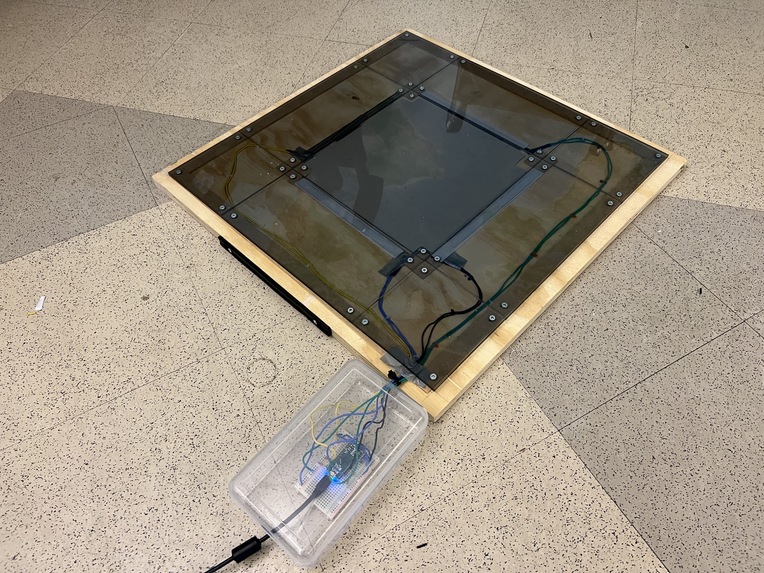
Our Pad!
-
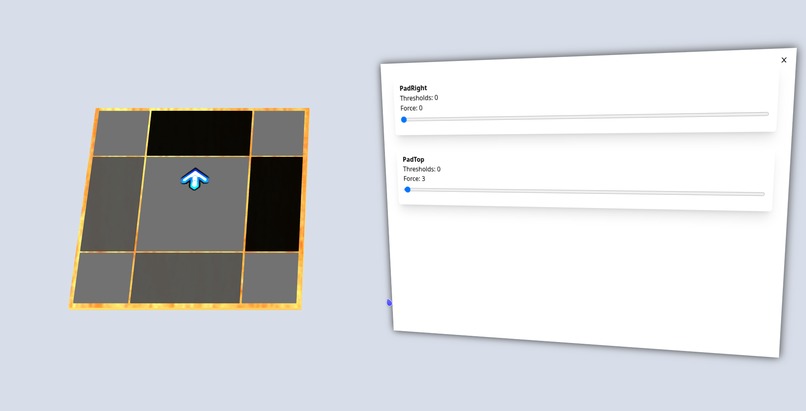
Our GUI for adjusting sensitivity!

Inspiration
We're huge fans of arcade dance games like Dance Dance Revolution and In The Groove and we wanted to challenge ourselves to build a portable pad within 24 hours!
What it does
The pad basically functions as a controller for any dance games that use four panels. Using FSRs (Force Sensitive Resistors), footsteps made on any of the four panels (Up, Down, Left, Right) register just like a keyboard input in the game and mimics just like how dance pads function at the arcade!
How we built it
Construction of the pad was relatively simple! We used 2x2 Plywood found in any home improvement store as the base of the pad. On top of it, we glued down MDF to position and place our polycarbonate acrylic panels at a reasonable distance from our FSR sensors. Lastly, we connected the sensors to a breadboard powered by an Arduino Micro in order to flash our custom firmware to register sensor activation as keyboard inputs.
Here's the list of materials we used if you're curious!
- 2x2 Plywood
- MDF (used to raise panels from sensors)
- Arduino Micro
- Breadboard / Breadboard Wires
- Polycarbonate Panels
- 1x 11"x11"
- 4x 11"x5-1/2"
- 4x 5-1/2"x5-1/2"
- 4x FSR Model 408 (300mm length)
- Soldering Iron
Challenges we ran into
For the hardware side we ran into problems with the sensitivity of the FSR sensors. There were many factors to this which included improper drilling, conductivity issues with wiring, and distance between the base and panel. Lastly, we were planning to move away from our breadboard to a perfboard for a more solid wiring job, but we ran into issues with the Arduino and fitting it into the perfboard which we weren't able to resolve in time.
For the software side, the front-end faced difficulties connecting our custom firmware to our GUI which is used to modify the sensitivity of the FSR sensors. In terms of firmware development, we ran into issues regarding calculating the Weighted Moving Average and Hull Moving Average, which was need to stabilize and capture input from the sensors. Eventually, we were able to work around these issues and succeeded in making one of our most in-depth and comprehensive projects yet.
Accomplishments that we're proud of
We're incredibly proud of the fact that we were able to successfully finish building our dance pad and get it to an arcade level of hardware performance. We were also incredibly satisfied with the fact that we were able to reach one of our stretch goals of making a fully interactable 3D GUI and custom firmware.
What we learned
We're all Cybersecurity / Computer Science majors, so doing a hardware hack was something completely new and incredibly rewarding for us. We learned a lot of things across many different aspects. For hardware, our project required quite a bit of soldering, so this definitely increased our confidence in soldering. Additionally, we improved our skills in "debugging" hardware issues through practices like continuity testing. For software we learned to use libraries like three.js for rendering and enhancing GUI development. Lastly, for firmware we learned about
What's next for Mini Dance Game Pad
Upgrade to perfboard and continue development of firmware to possibly transition into Rust.


Log in or sign up for Devpost to join the conversation.