Inspiration
The inspiration behind Mingo AI came from a real-world moment of frustration and realization. During a late-night research session, our co-founder struggled to transform a pile of scattered voice notes, half-written paragraphs, and fleeting thoughts into a coherent script for a keynote speech. Despite having great ideas, the process of typing, organizing, and refining them into something polished felt mentally draining and creatively limiting. The tools available weren’t conversational, they weren’t adaptive, and they certainly didn’t listen. That moment sparked a simple but powerful idea: what if you could just talk, and an AI would help you think, write, and refine like a co-creator who actually understands your tone and context? At the same time, global teammates on video calls often miscommunicated due to cultural idioms, accents, or robotic translations that missed the emotional nuance. It became clear that voice wasn't just an input method it was the most human interface we had, and no one was truly building an AI platform around it. Thus, Mingo AI was born to empower thinkers, speakers, and learners to turn voice into structured output, to understand cultural tone, and to transform how we write, translate, and learn naturally, through conversation.
What it does
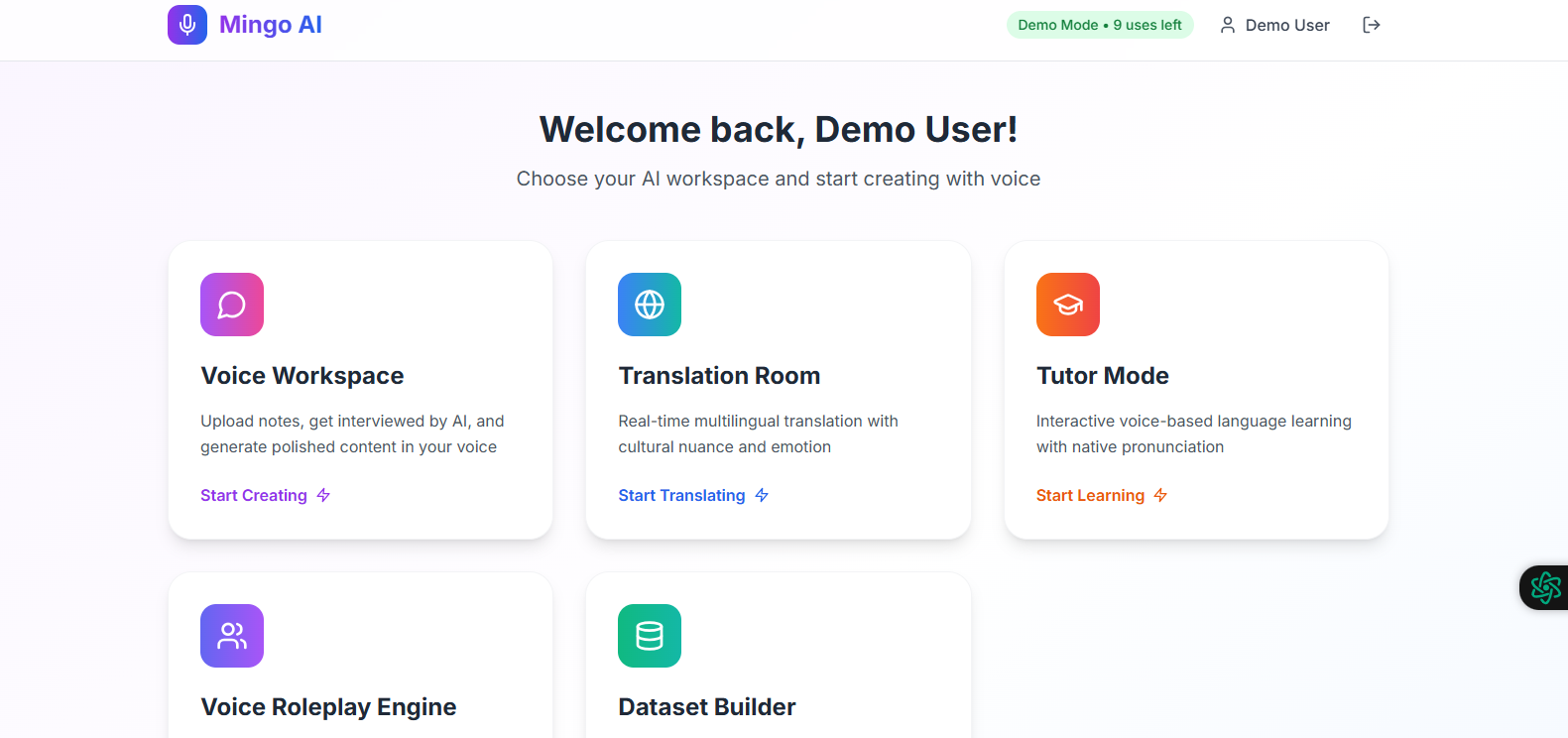
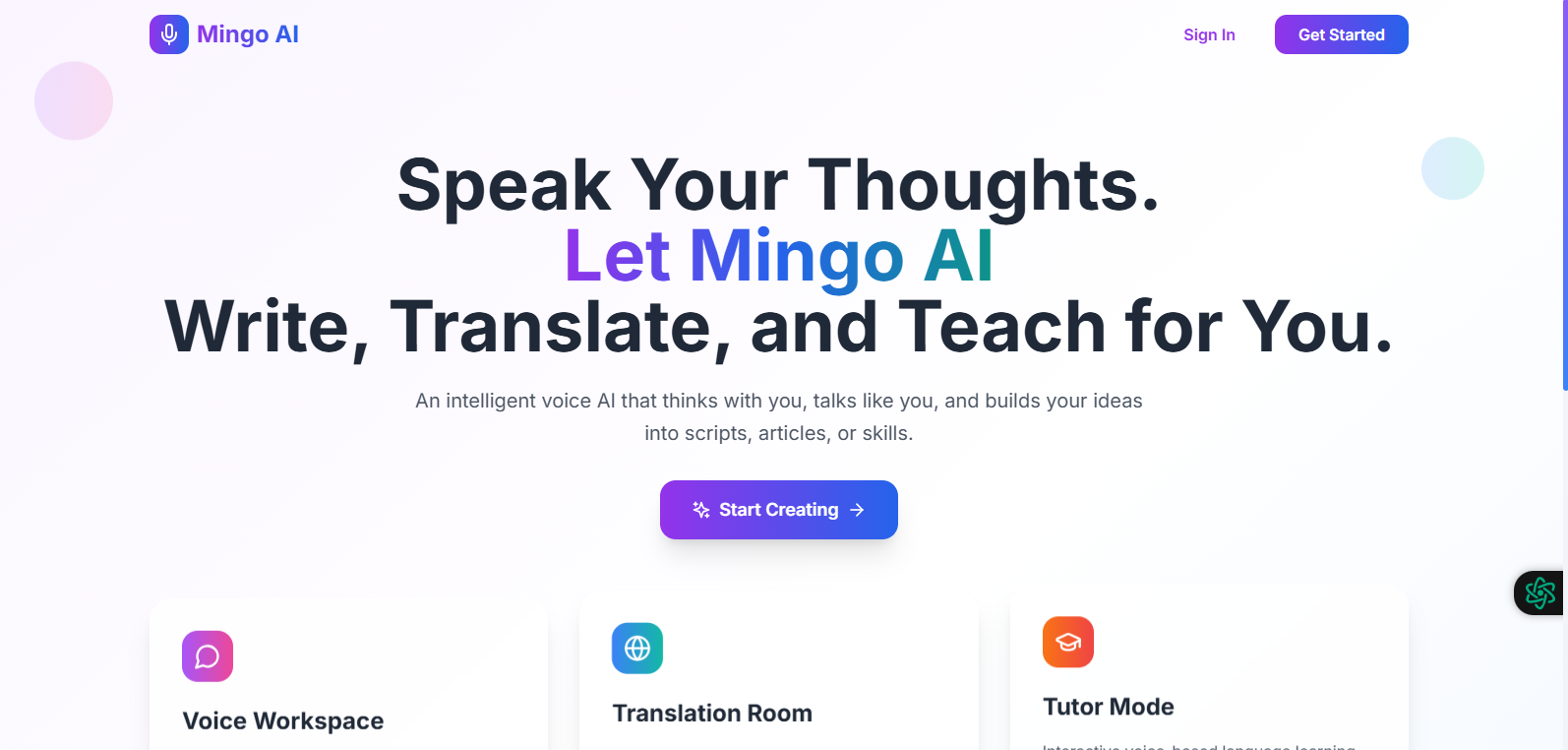
Mingo AI is a conversational, multilingual AI assistant that transforms your spoken thoughts into high-quality articles, scripts, translations, or language lessons. It listens, interviews you, understands your intent and tone, then delivers structured, publishable content all through natural voice interaction. The Problem People often have brilliant ideas but struggle to turn them into polished, organized content. Writing can be time-consuming, especially when thoughts are scattered across voice notes, mental fragments, or multiple languages. Existing AI tools are too text-based, too rigid, and fail to understand human nuance, cultural context, or emotional tone. The Solution Mingo AI lets users speak freely it listens, extracts meaning, and co-creates with them. Whether you’re a creator, a diplomat, or a language learner, Mingo acts as a real-time thinking partner. It understands idioms, adjusts to fluency levels, mimics native accents, and even reconstructs cultural nuance. Our Goals To make creation, communication, and learning as natural as speaking globally and inclusively. Vision To become the world’s most human-like AI communicator, empowering people to speak ideas into action. Mission To build a voice-first platform where anyone can write, translate, and learn through meaningful, intelligent conversation.
How we built it
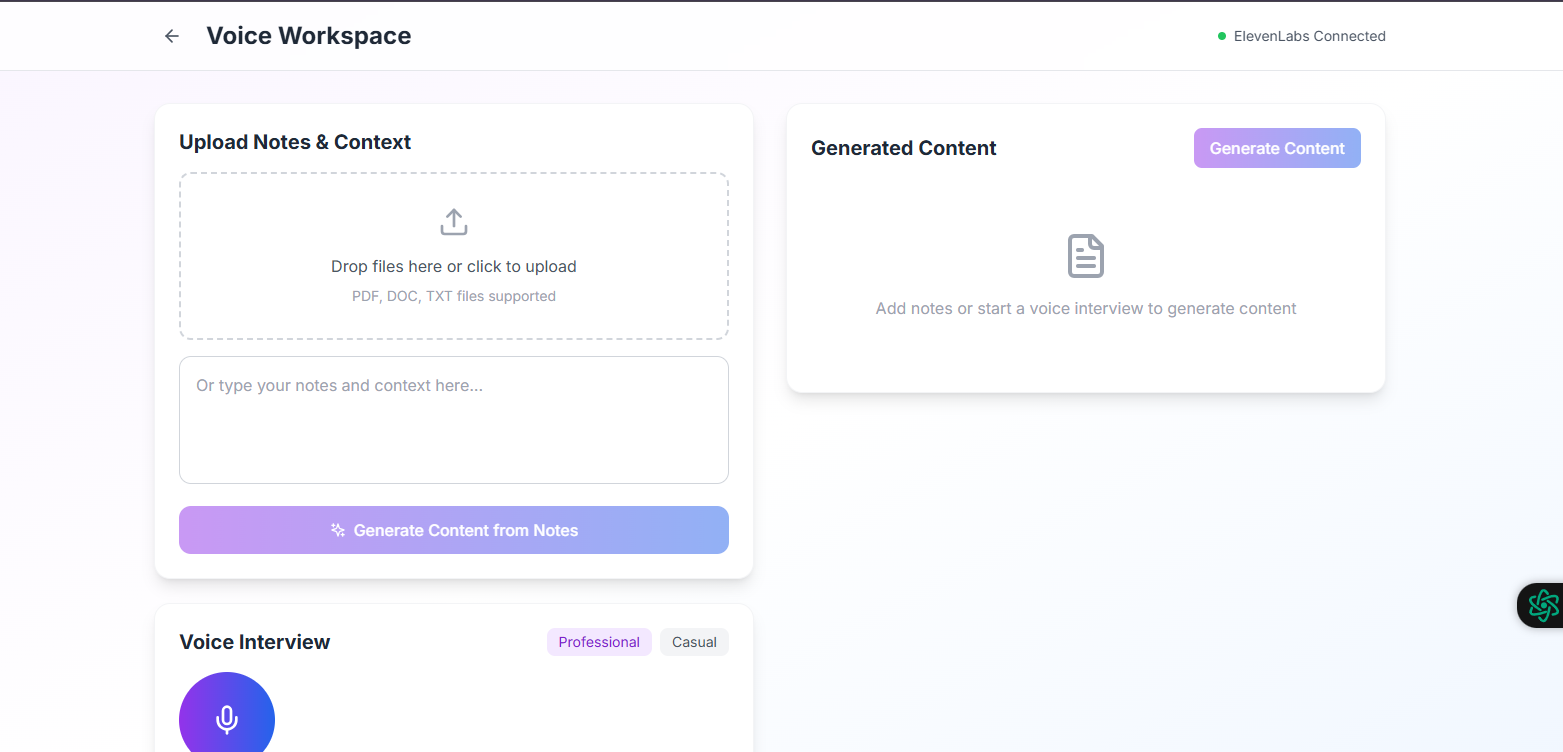
Conversational Writer (Voice-to-Article or Script) Function: User speaks → Mingo interviews back → GPT processes ideas → Generates written content ElevenLabs: Speaks AI-generated follow-up questions and reads back the final script using natural voices or user-cloned voice Supabase: Stores the uploaded voice note or audio input, generated text output, and user preferences (voice, tone, content type)
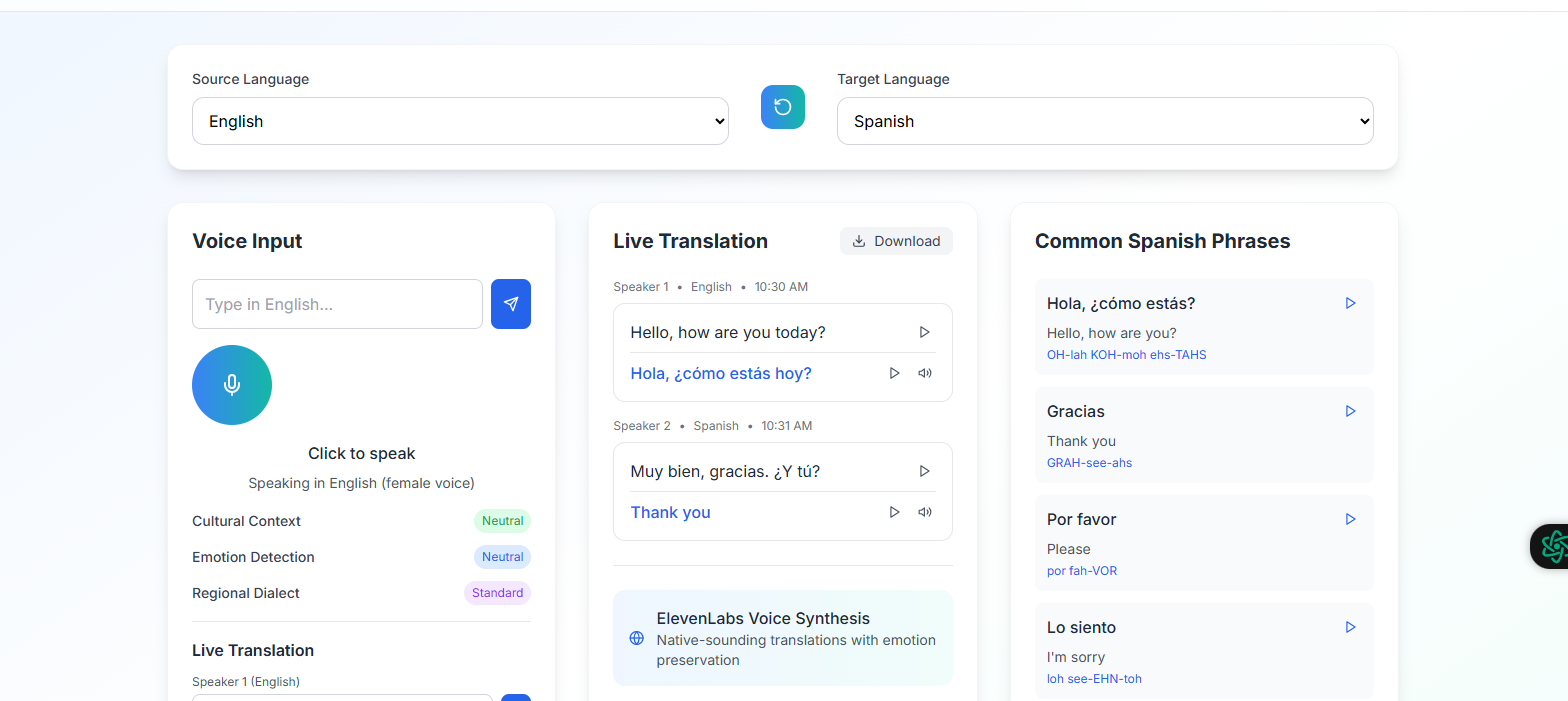
Real-Time Cultural Translator Function: User speaks in one language → AI translates with idioms, tone, and intent intact ElevenLabs: Speaks translations with regional accents, tone-emotion matching, and language switching in real time Supabase: Logs translation history, stores original + translated transcripts, user-selected language pairs
Voice-Based Language Tutor Function: Mingo engages in fluent dialogue, quizzes the user, and corrects pronunciation based on level ElevenLabs: Speaks in native-accented voices for immersion; dynamically adjusts pace and tone for learner level Supabase: Stores user fluency data, XP progress, quiz results, and voice preferences
Voice-to-AI Model Trainer (Advanced Feature) Function: Users “teach” Mingo by feeding voice data or structured instructions; creates mini AI models for personal use ElevenLabs: Reads prompts or confirms data points in voice; optionally uses user’s cloned voice for personalization Supabase: Manages voice-collected datasets, stores training instructions, and model metadata
AI Voice Playback & Export Function: Every piece of content Mingo creates can be played back or exported as MP3 using a selected voice ElevenLabs: Converts text to speech with user-selected or cloned voices Supabase: Manages audio file links, permissions, and download history
Custom AI Persona Builder Function: Users build custom “Mingos” by feeding conversational examples via voice ElevenLabs: Allows voice previews of the AI persona Supabase: Stores personality templates, AI memory logs, training audio
Daily Fluency Challenge (Gamified Tutor) Function: AI challenges users with a daily voice-based task to practice idioms or cultural responses ElevenLabs: Reads out challenges in native tones Supabase: Tracks user streaks, scores, and awards badges or levels
Voice Prompt Library & Templates Function: Users save and reuse their own voice-based prompts for creative writing, business emails, or script generation ElevenLabs: Replays saved prompts or final outputs Supabase: Stores reusable prompt templates and voice settings per user
Challenges we ran into
Challenges We Ran Into Real-Time Voice Sync Complexity Integrating real-time voice interaction with ElevenLabs and ensuring the audio playback syncs smoothly with user input and GPT responses was technically demanding. Handling latency, stream buffering, and audio rendering for natural-feeling conversations required deep optimization.
Cultural and Idiomatic Translation Accuracy Translating not just words, but intent, tone, and cultural nuance across multiple languages using GPT was far more difficult than expected. In many cases, literal translations made users sound robotic or offensive. Fine-tuning prompts and reinforcement feedback became necessary.
Voice Data Management at Scale Handling, storing, and organizing large volumes of voice input and AI-generated audio using Supabase required designing an efficient and scalable database schema. We had to build safeguards for user privacy, quota limits, and optimized retrieval.
Training AI via Voice Allowing users to “train” AI by speaking introduced unexpected complexities. Converting spoken data into structured, meaningful training signals required building an entire speech-to-structure layer.
Maintaining Natural Conversation Flow Designing voice-first interactions that don’t feel like command-line tools was hard. We had to iterate several times to make the AI feel like it’s conversing, not just responding.
Accomplishments that we're proud of
Built a Fully Voice-Driven AI Platform We successfully created a seamless voice-first interface that allows users to speak their ideas, get interviewed by AI, and receive fully-formed scripts, articles, or lessons — all without touching a keyboard.
Integrated ElevenLabs for Human-Like Multilingual Voices Our integration with ElevenLabs brought lifelike, emotionally responsive voice output in multiple languages, enabling Mingo to feel less like a bot and more like a true thinking partner.
Real-Time Cultural Translation Engine We developed a system that doesn’t just translate languages, but understands tone, idioms, and cultural nuances. This makes Mingo uniquely effective in sensitive diplomatic or global business contexts.
Voice-Based Language Tutoring System with Fluency Scoring We launched a gamified tutor mode where Mingo dynamically adjusts conversation difficulty, teaches idiomatic phrases, and rewards real fluency not just vocabulary memorization.
Voice-to-AI Training Prototype We built the first version of a feature that allows users to train mini AI models using only their voice — opening doors to personalized AI agents and voice-driven dataset creation.
Deployed a Scalable Full-Stack App Using Bolt AI, Supabase, and Netlify From front-end UI to real-time database, secure auth, and cloud audio processing, we delivered a production-ready platform with cutting-edge technology and solid infrastructure.
What we learned
Voice Is the Most Natural Interface, But the Hardest to Perfect Building for voice-first interaction taught us that natural conversation is more than speech — it requires emotion, timing, nuance, and cultural awareness. Getting an AI to feel human isn’t about just converting text to speech — it's about shaping experience.
Users Think in Chaos, Not Structure — and That’s Okay We learned that users rarely speak in perfectly formed ideas. Mingo had to become more than a transcription tool — it had to become a co-thinker, capable of asking the right follow-up questions and organizing scattered thoughts into meaning.
Multilingual AI Needs More Than Translation Literal translations fail in high-context conversations. We discovered the need for real-time understanding of tone, culture, and idioms, pushing us to rethink how GPT prompts and voice synthesis should be shaped across languages.
Personal AI Requires Emotional Intelligence People don’t just want productivity — they want resonance. Our users responded best when Mingo felt emotionally aware, curious, and adaptive. Designing AI behavior with empathetic logic made a major difference.
What's next for Mingo ai
Custom AI Personas – Train Your Own Mingo We're building a system that allows users to create personal AI agents trained entirely by voice. Whether it’s a content strategist, dialect coach, or legal advisor, users will soon be able to clone their expertise into a personalized Mingo.
Voice Prompt Marketplace A decentralized, community-driven library where users can share, sell, and remix voice-based prompt templates for writing, language learning, storytelling, and automation.
Offline Mode & Whisper Integration To make Mingo accessible in low-connectivity regions, we’re integrating local voice-to-text and translation capabilities using Whisper + local language models.
Voice-Driven Analytics Dashboard Users will soon get AI-powered summaries and insights from their own speech patterns including tone tracking, emotional trends, and creative progress over time.
Cross-Platform Voice SDK We plan to launch the Mingo Voice SDK so creators and devs can embed Mingo’s voice assistant into their own apps, websites, or AR/VR environments.
Collaboration Mode (Co-Creation in Voice) Teams will be able to brainstorm, speak, and build together with Mingo acting as a real-time scribe, idea organizer, and multilingual translator during meetings.
Built With
- boit
- elevenlabs
- supabase

Log in or sign up for Devpost to join the conversation.