MineOps: Turning Mining Data Into Actionable Decisions
Inspiration
Mining operations generate enormous amounts of data every day, but having data is not the same as being able to act on it quickly.
While working with mining-related data, we became interested in a simple question:
What if we could detect operational problems before they become expensive bottlenecks?
That question inspired MineOps — an intelligent operations assistant designed to help mining teams understand what is happening in their processing operations, identify potential bottlenecks, and turn raw operational data into actionable insights.
Instead of forcing an operator to manually search through spreadsheets, dashboards, and reports, MineOps aims to make the data easier to understand and interact with.
What We Built
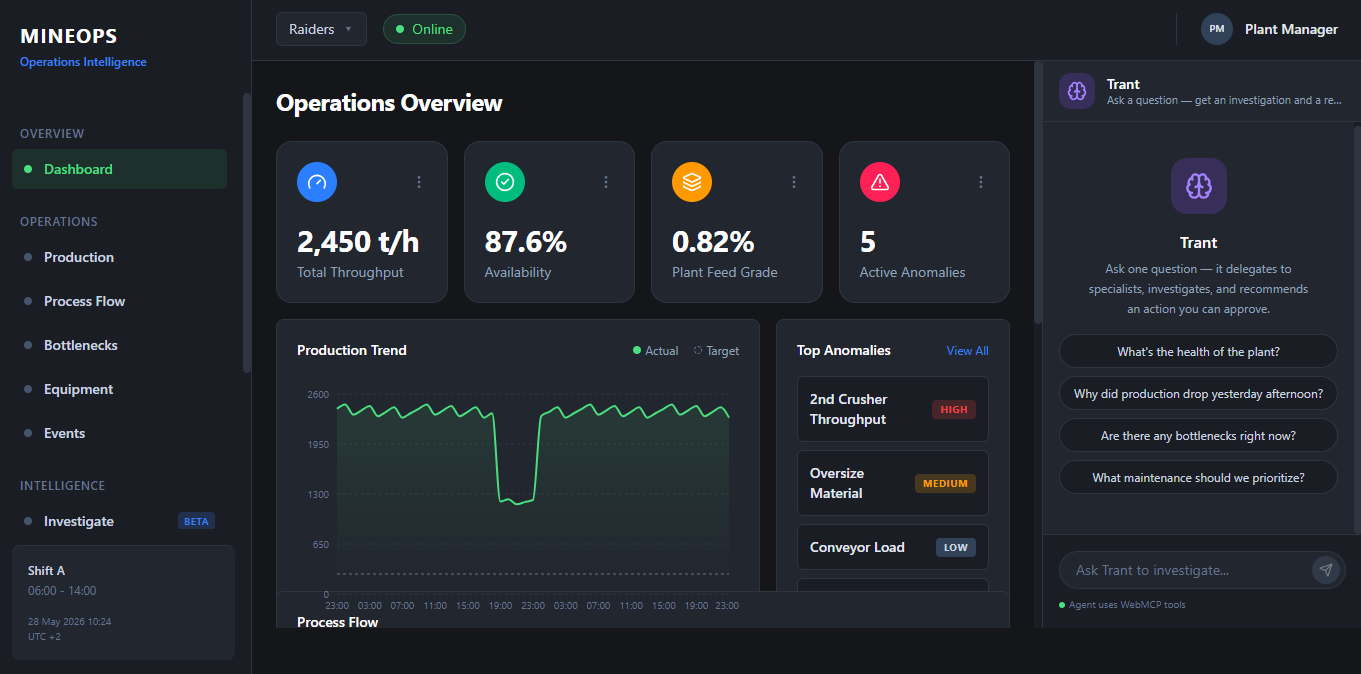
MineOps is an AI-powered mining operations platform that combines operational data, anomaly detection, visualization, and AI interaction into one workflow.
The core idea is to move from:
Raw data → Manual analysis → Delayed decision
to:
Operational data → Automated detection → AI-assisted insight → Faster decision
The system can analyze processing data and identify unusual patterns that may indicate potential bottlenecks or abnormal operating conditions.
The project was also designed around WebMCP, allowing the AI layer to interact with application capabilities through defined tools rather than simply generating text.
This makes the AI more useful because it can work with the application's actual data and functionality.
How We Built It
We approached MineOps as a combination of three layers:
1. Data Layer
The system uses structured mining-processing data containing operational measurements collected over time.
We focused on transforming the raw data into information that could be used for:
- Bottleneck detection
- Anomaly identification
- Operational monitoring
- Trend analysis
- AI-assisted investigation
Data preprocessing was particularly important because real operational datasets are rarely perfectly clean.
2. Intelligence Layer
For anomaly detection, we explored machine-learning techniques that could identify unusual operational behavior without requiring every possible failure condition to be manually labelled.
The goal wasn't simply to predict a number.
It was to answer a more operationally useful question:
"Does something look abnormal, and where should an operator investigate?"
The intelligence layer then feeds those findings into the rest of the application.
3. AI + WebMCP Layer
The final layer connects the operational intelligence with an AI interface.
Rather than building a chatbot that only talks about mining, we wanted the AI to be able to interact with the application.
WebMCP tools provide structured capabilities that allow the AI to retrieve information and perform relevant actions within the MineOps environment.
This creates a more natural workflow:
Operator asks a question → AI uses the appropriate tool → application retrieves the relevant information → AI explains the result.
The interface was intentionally kept simple so that the technology would not get in the way of the operational information.
What We Learned
One of the biggest things we learned was that building an AI application is not just about choosing a model.
The difficult part is connecting the model to a useful workflow.
We learned that:
- Good data matters as much as the model.
- Anomaly detection is only useful when the result can be interpreted.
- AI becomes significantly more useful when it can interact with real application functionality.
- Tool design is important when building AI agents.
- A technically impressive system still needs a simple user experience.
- Building under a hackathon deadline forces you to prioritize the features that actually demonstrate the idea.
We also learned to think more about AI as an interface to systems, rather than simply a system that generates responses.
Challenges
One of the biggest challenges was working with operational data that wasn't originally designed specifically for machine learning.
Cleaning the data, understanding the variables, handling inconsistencies, and deciding which signals were actually meaningful required considerably more work than I initially expected.
Another challenge was determining what should be automated and what should remain under human control.
Mining operations are high-stakes environments. MineOps therefore isn't intended to replace an engineer or operator. Instead, it is designed to help them notice potential issues faster and investigate them more efficiently.
Building the WebMCP interaction layer was another challenge because it required thinking carefully about what capabilities the AI should actually have and how those capabilities should be exposed as tools.
Finally, we had to balance ambition with the reality of a hackathon.
There were many features we wanted to build, but we had to focus on creating a working end-to-end experience that clearly demonstrated the core idea.
Why MineOps Matters
The ultimate goal of MineOps is not to replace existing mining systems.
It is to make the information inside those systems more accessible and actionable.
A bottleneck hidden inside thousands of operational records is not very useful.
A bottleneck that is automatically detected, explained, visualized, and brought to an operator's attention is much more valuable.
That is the problem MineOps is trying to solve.
What's Next
MineOps is only a starting point.
The next stage would be to connect it to more real-time operational data, expand the range of detectable bottlenecks, improve the intelligence behind root-cause analysis, and allow the system to learn from feedback provided by mining professionals.
Ultimately, we want MineOps to become an intelligent operational layer that sits on top of existing mining data and helps teams move from reacting to problems to identifying them earlier.
Built with
- Machine Learning
- Python
- Data Analytics
- WebMCP
- AI Agents
- Data Visualization
- Web Technologies
MineOps is our attempt to bridge the gap between mining data and real operational decisions — one bottleneck at a time.

Log in or sign up for Devpost to join the conversation.