Inspiration
What it does
How we built it
Challenges we ran into## Inspiration
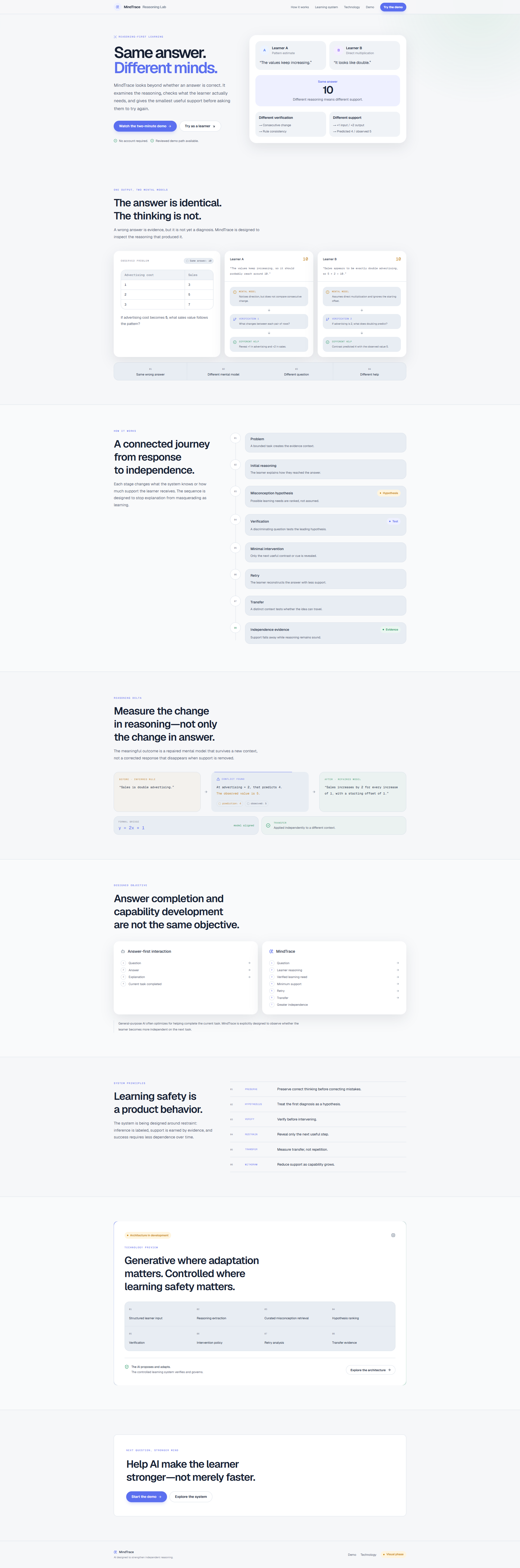
MindTrace Reasoning Lab was inspired by a common learning problem: two learners can give the same wrong answer while misunderstanding the concept in completely different ways. Most learning products detect correctness, but they do not always diagnose the reasoning behind the response. MindTrace asks: what if support began with the learner's mental model, not just the final answer?
What it does
MindTrace is an AI learning prototype that investigates the thinking behind an answer. It creates misconception hypotheses, verifies them with targeted questions, gives the smallest useful intervention, and checks whether the learner can transfer the concept independently.
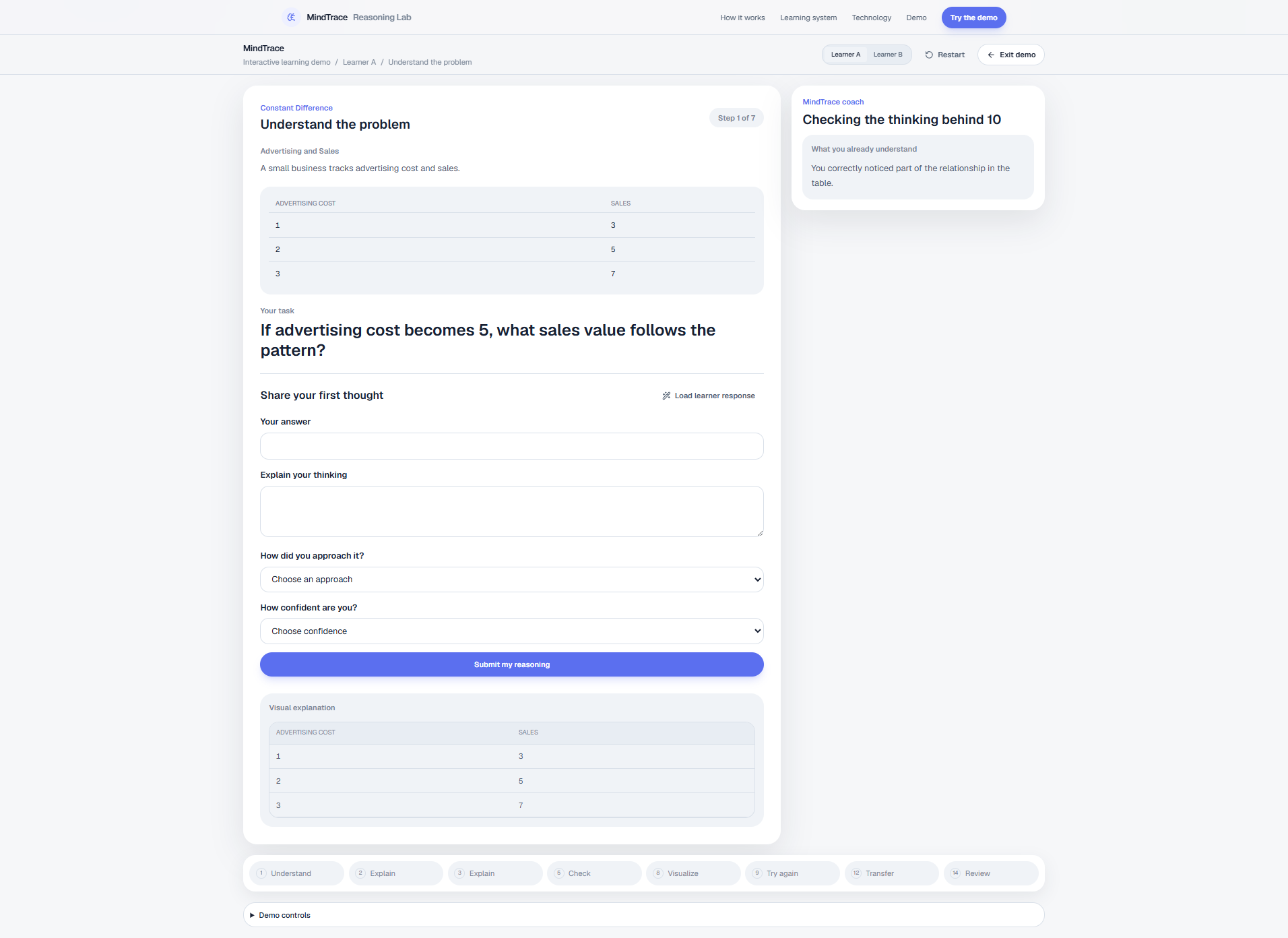
The recommended judge path is /demo/judge, which shows two learners giving the same wrong answer while needing different support. The learner workspace demonstrates the broader journey from initial response to reasoning evidence, verification, intervention, retry, transfer, and review.
How it works
The system is designed around a controlled learning sequence:
- Collect learner answer, reasoning, approach, and confidence.
- Extract reasoning evidence.
- Retrieve possible misconception hypotheses.
- Rank hypotheses without treating them as final truth.
- Verify the hypothesis with targeted questions.
- Select a bounded intervention.
- Ask the learner to retry.
- Compare reasoning before and after support.
- Check independent transfer in a new context.
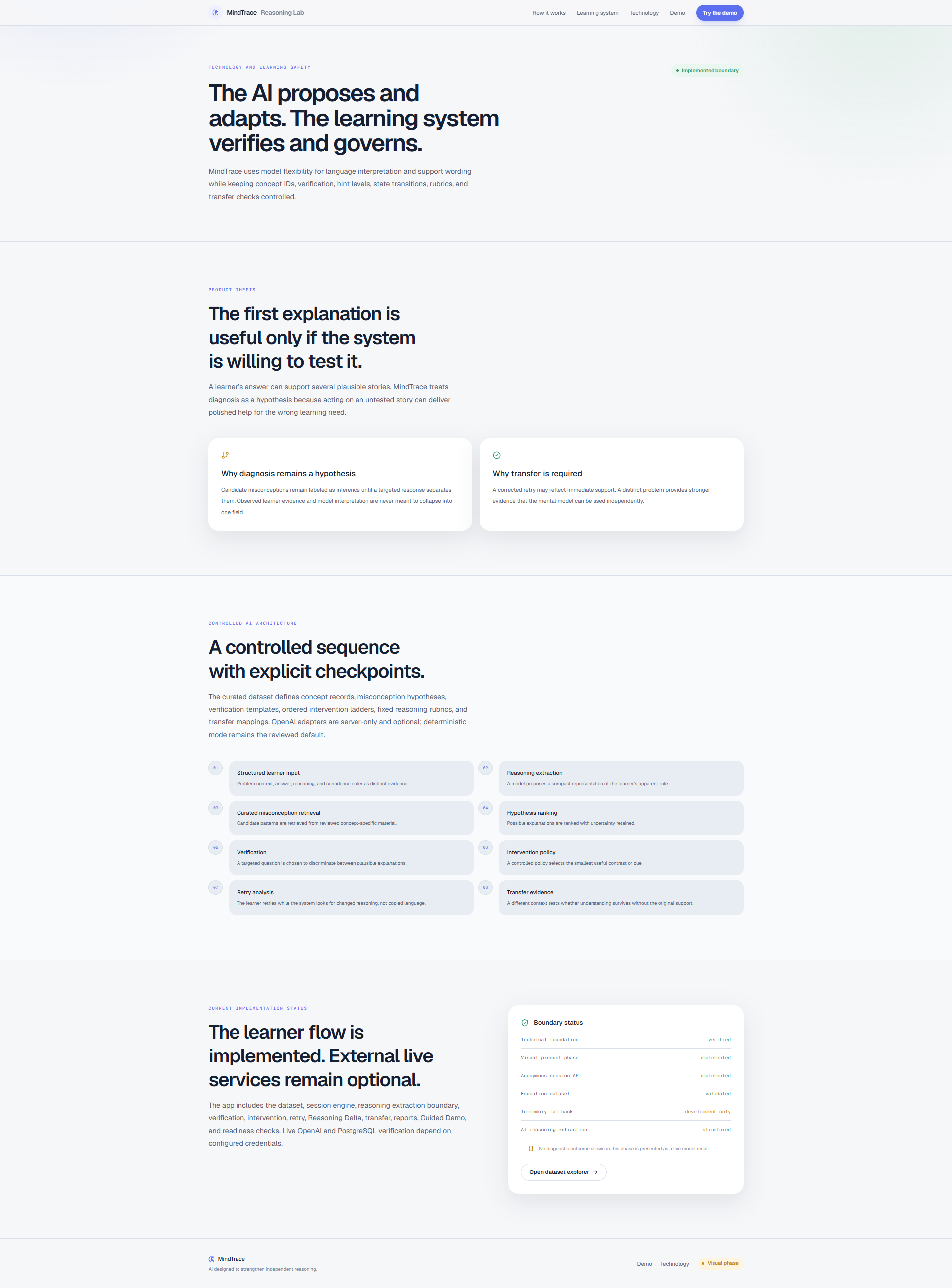
For review reliability, the current demo uses deterministic fallback paths and curated educational data, so judges can test the product without OpenAI or database credentials.
How Codex and GPT-5.6 were used
Codex with GPT-5.6 was my main engineering collaborator. It accelerated the project by helping scaffold the Next.js foundation, design the product architecture, implement the judge demo, build the learner workflow, structure educational data, add Vitest and Playwright coverage, fix hydration and deployment issues, and prepare the README and submission package.
Key decisions made with Codex included keeping OpenAI usage server-only and lazy, avoiding database requirements for public pages, using deterministic fallbacks for judge reliability, and treating AI output as a proposal that must be verified by the learning system.
Built with
The project uses Next.js App Router, React, strict TypeScript, Tailwind CSS, shadcn/ui foundations, Framer Motion, Zustand, React Hook Form, Zod, Prisma, PostgreSQL-compatible persistence, OpenAI SDK server boundaries, Lucide icons, Vitest, Playwright, ESLint, Prettier, and pnpm.
Current status
MindTrace is incomplete by design, but it is a working foundation. Implemented pieces include the public landing page, Judge Mode, learner workspace, curated dataset, session API foundation, reasoning/misconception/intervention boundaries, transfer checks, final report route, testing, and deployment. Authentication, payments, teacher dashboards, production analytics, and full live AI workflow are intentionally not implemented yet.
Challenges
The biggest challenge was balancing ambition with reviewability. The product needed to show a full reasoning-to-transfer loop, but judges also needed to run it without private secrets. I solved this with deterministic fallbacks, server-only AI boundaries, and a polished judge path. Another challenge was making the app honest about being incomplete while still demonstrating strong technical and educational value.
What I learned
I learned how important it is to separate AI flexibility from product responsibility. For an educational product, model output should not be treated as truth by default. It should be proposed, checked, bounded, and measured through learner evidence.
What's next
The next phase is the visual product phase: improving the learner experience, strengthening reasoning visualizations, adding more concepts, and selectively connecting live OpenAI-backed reasoning where it adds value without weakening safety or reviewability.
Accomplishments that we're proud of
What we learned
What's next for MindTrace Reasoning Lab
Built With
- css
- drei
- eslint
- fiber
- form
- framer
- hook
- lucide
- motion
- next.js
- openai
- playwright
- postgresql
- prettier
- prisma
- react
- shadcn/ui
- tailwind
- three
- typescript
- vercel
- vitest
- zod
- zustand

Log in or sign up for Devpost to join the conversation.