-
-
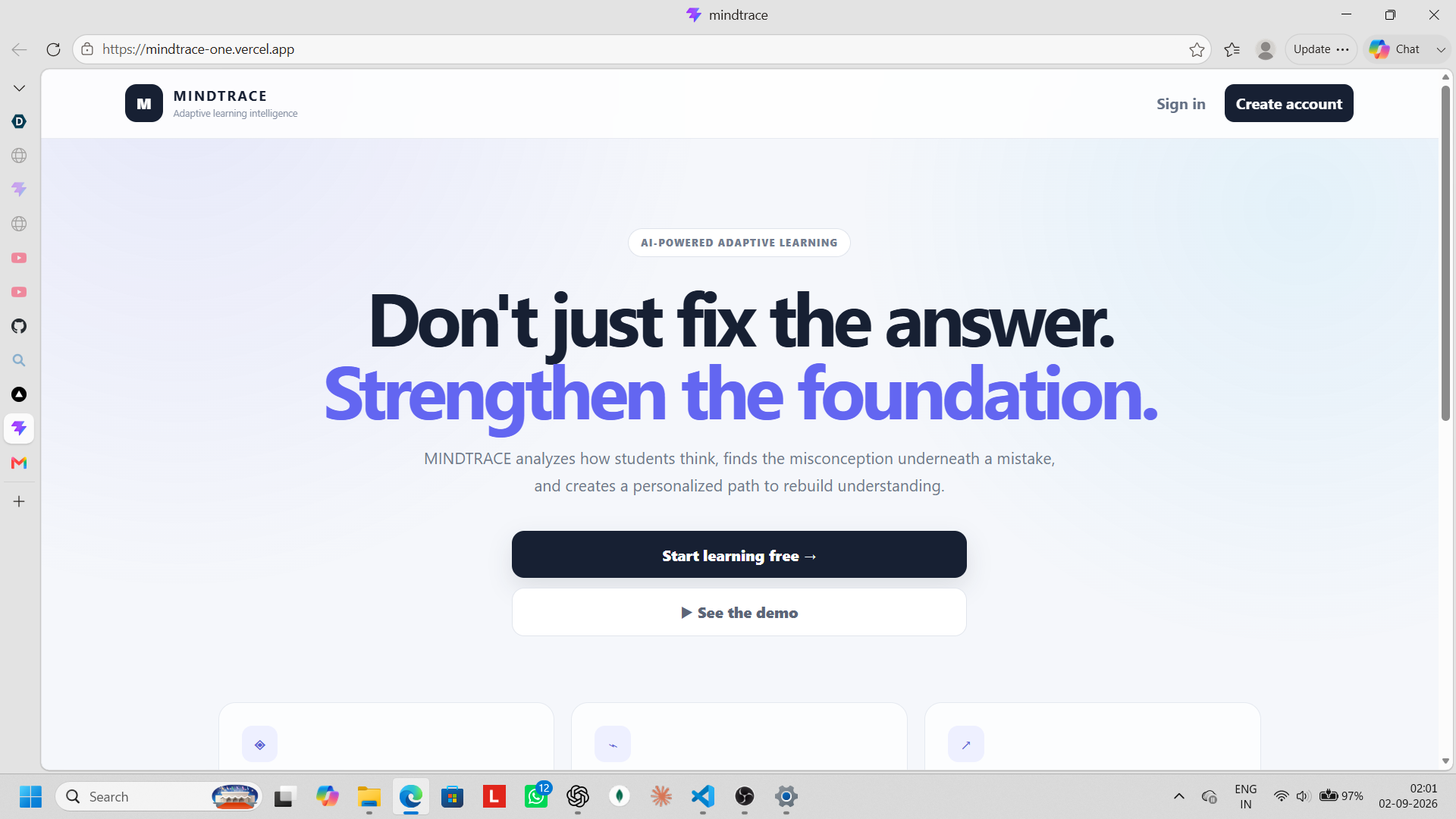
landing
-
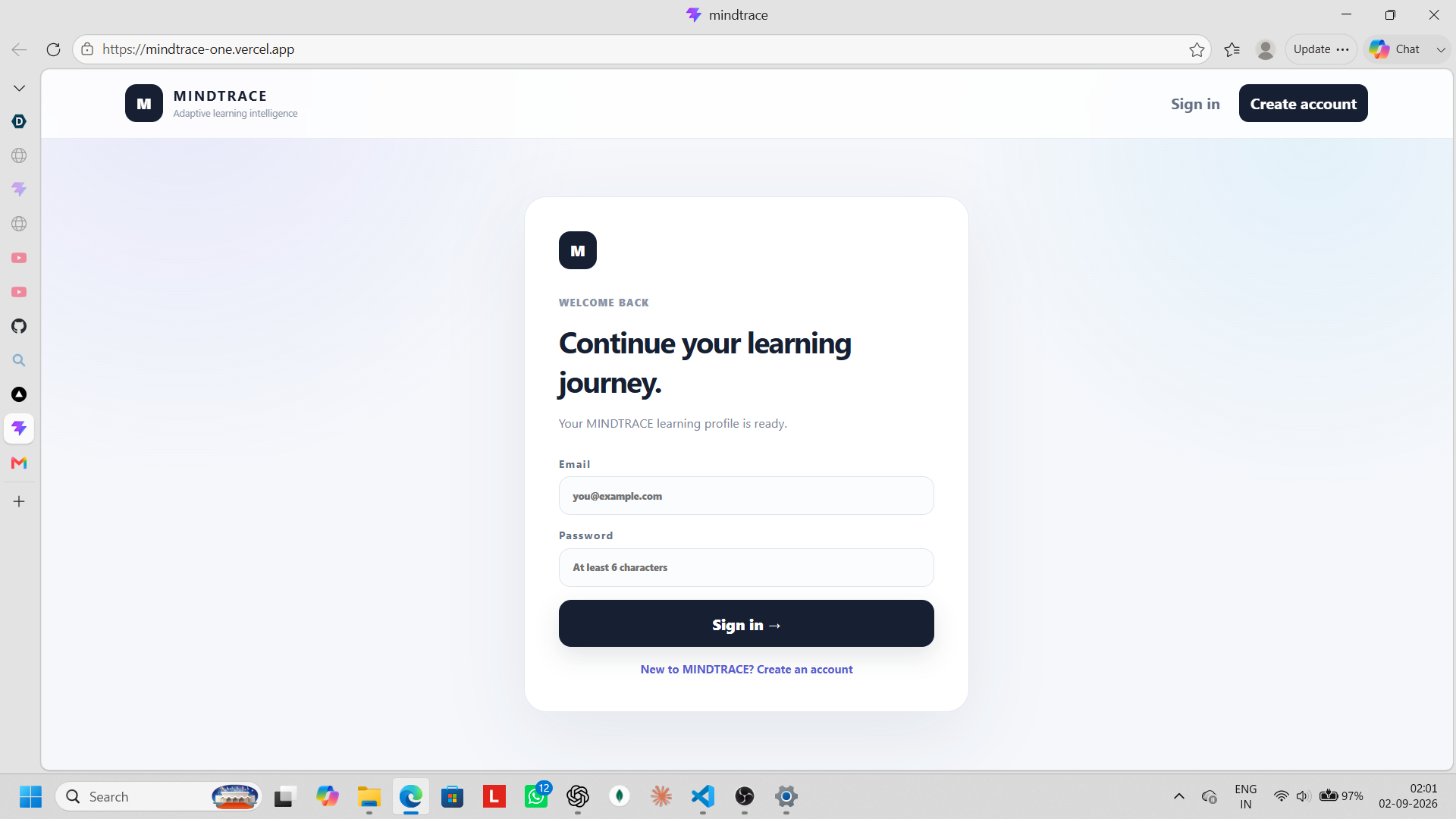
login
-
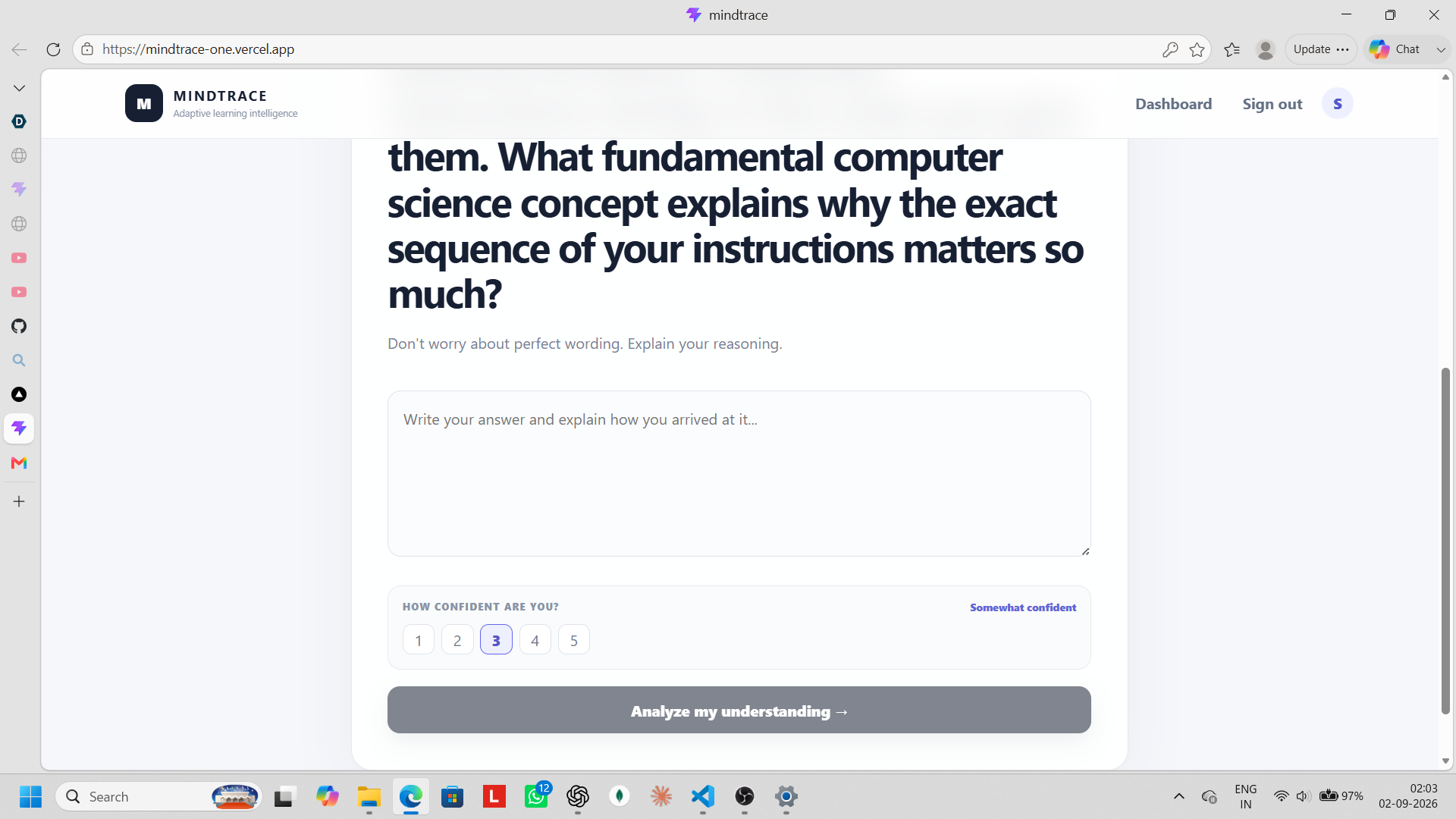
learning
-
dashboard
-
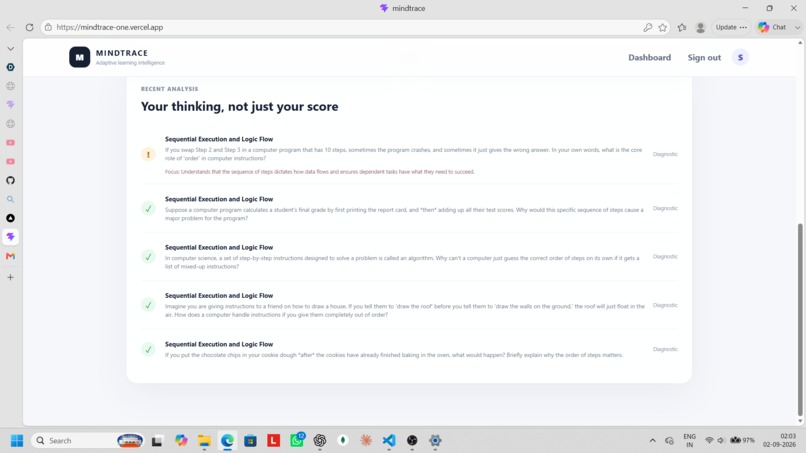
analysis
Inspiration
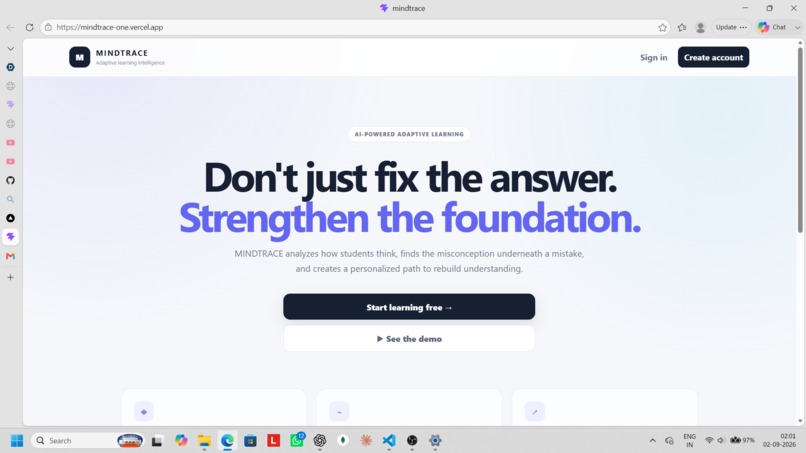
We noticed that most educational platforms focus on one question: “Did the student get the answer right?” But a wrong answer can come from many different misunderstandings, and a correct answer can sometimes be a guess. We wanted to build something that looks deeper—at how a student thinks. This inspired MINDTRACE, an AI-powered learning system designed to identify the foundation behind a student's mistake and use that insight to personalize what they learn next.
What it does
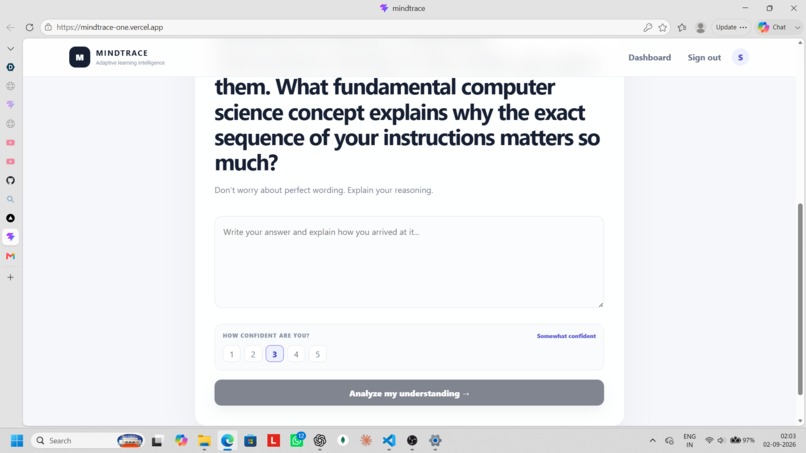
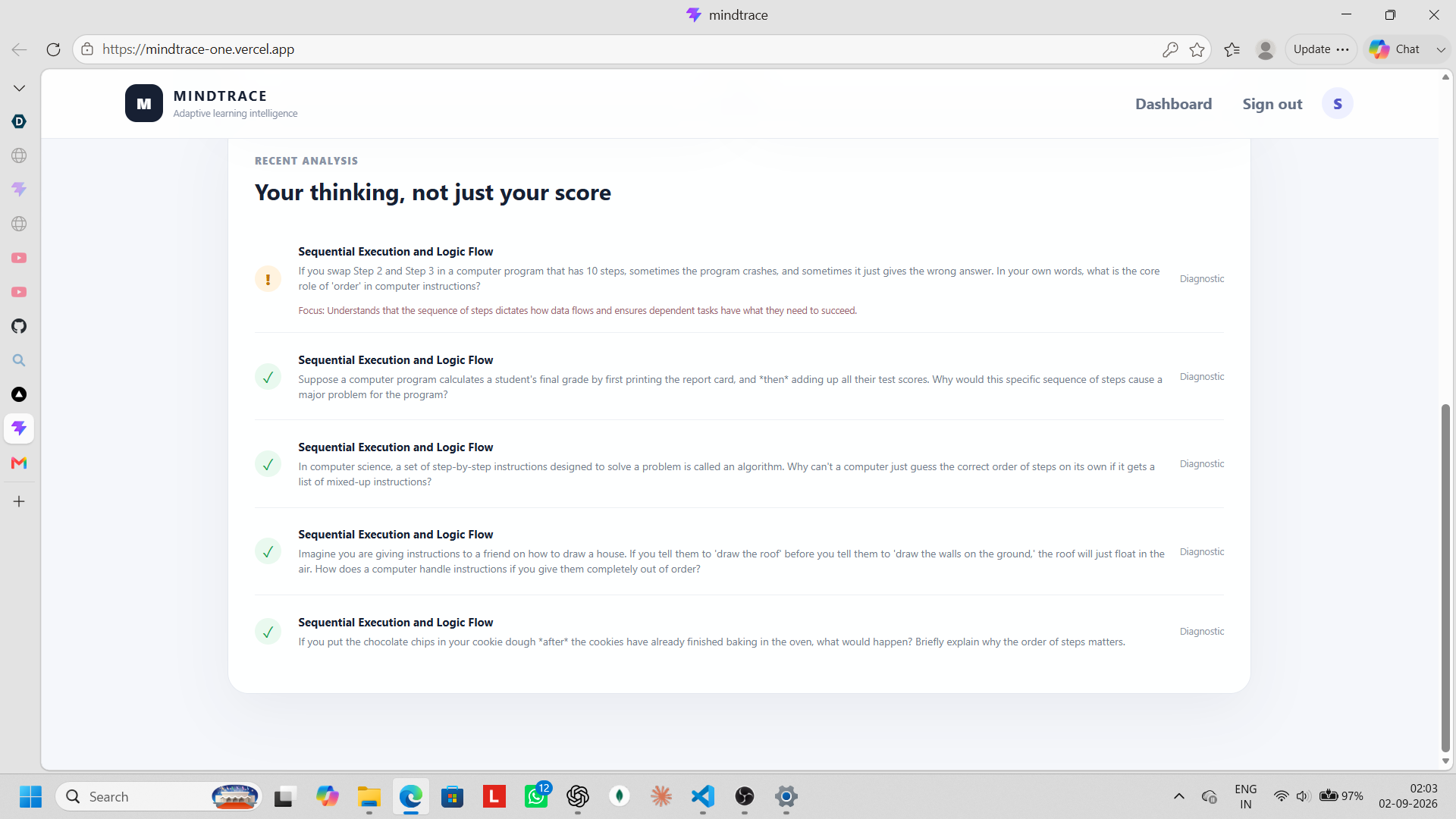
MINDTRACE analyzes a student's answer and reasoning using AI to identify whether they genuinely understand the concept, detect misconceptions or foundation gaps, and explain what went wrong.
When a weakness is detected, MINDTRACE generates a 5-question targeted diagnostic focused on that specific foundation. If the student scores below 3/5, the system creates an adaptive Round 2 based on the concepts they actually missed. The student needs to reach 7/10 overall to demonstrate sufficient foundation mastery.
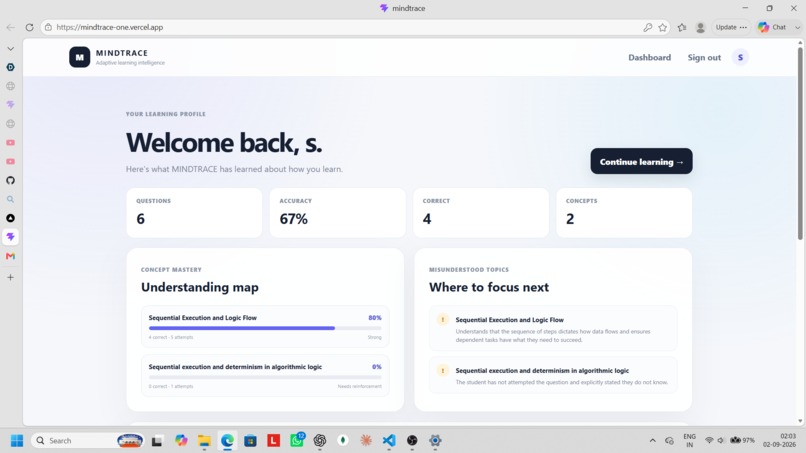
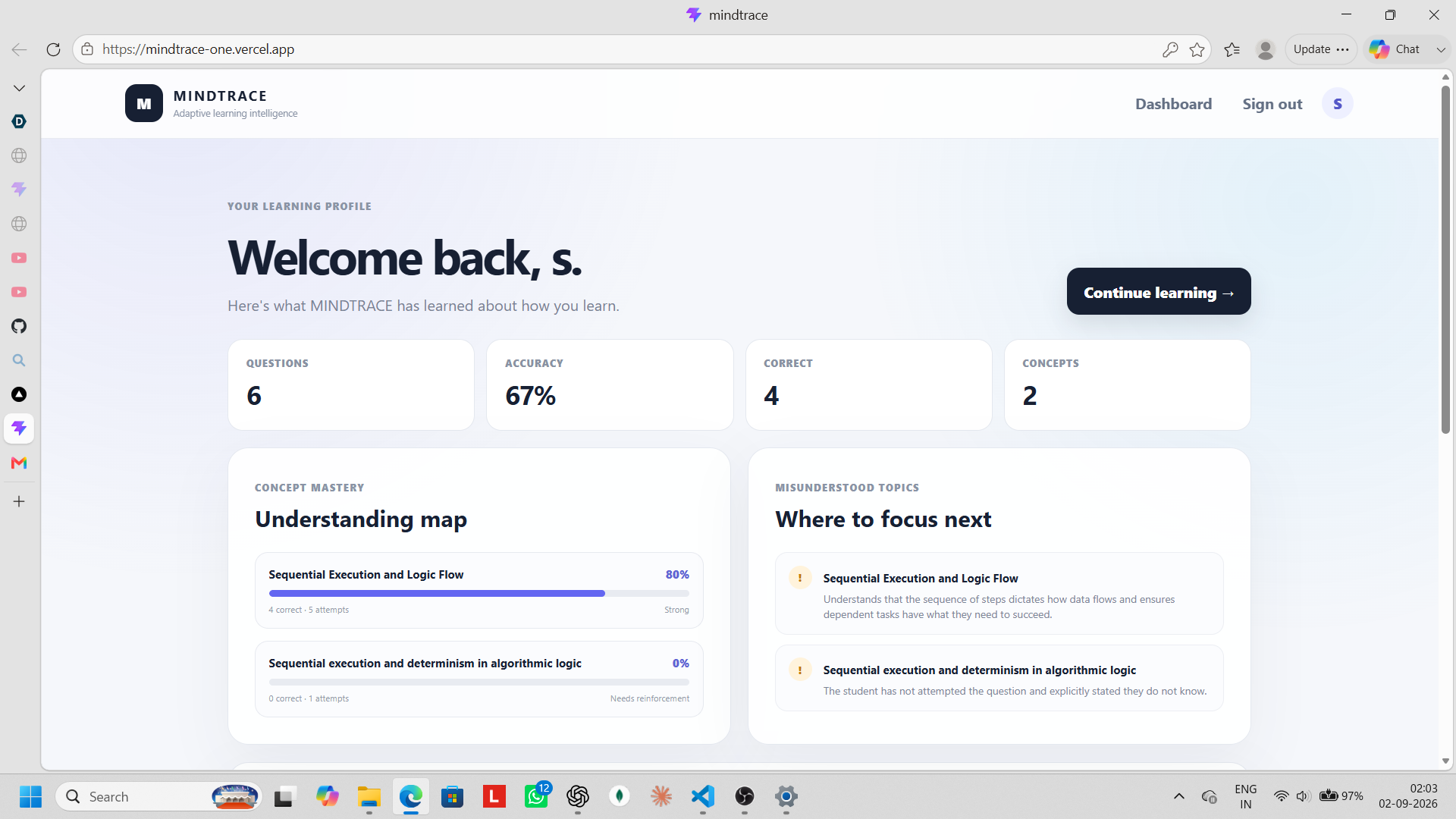
MINDTRACE also maintains a persistent learning profile showing:
Questions answered and accuracy Concept mastery Misunderstood topics Diagnostic results Recent reasoning analyses Personalized recommendations for what to learn next
Instead of simply saying “incorrect,” MINDTRACE tries to answer “why?” and then turns that insight into the student's next learning step.
How we built it
MINDTRACE is a full-stack application built with React, JavaScript, Node.js, Express, and Google Gemini.
The frontend provides the interactive learning experience, authentication flow, diagnostic rounds, and mastery dashboard. The Express backend handles authentication, learning sessions, AI analysis, adaptive question generation, diagnostic evaluation, and recommendations.
Gemini is central to the system. We use it to:
Analyze student reasoning. Identify underlying concepts and misconceptions. Generate targeted diagnostic questions. Evaluate diagnostic responses. Adapt Round 2 using previous mistakes. Recommend the student's next learning focus.
For the hackathon prototype, we implemented persistent JSON-based storage for users, sessions, analyses, diagnostics, and mastery. Passwords are securely hashed with bcrypt, and authentication uses JWT.
We also added concept normalization so that closely related AI-generated labels such as logical ordering, execution sequence, and procedural dependency can be recognized as parts of the same broader learning foundation.
Challenges we ran into
One of our biggest challenges was turning flexible AI output into reliable application logic.
AI can describe the same concept in different ways. Without normalization, a student's dashboard could incorrectly show several separate concepts when they were really struggling with one underlying foundation.
Another major challenge was making the second diagnostic round genuinely adaptive. Simply generating another five questions would not be enough. We designed the system so Round 2 receives the student's Round 1 results and focuses specifically on the areas they missed.
We also had to carefully separate answer correctness, reasoning quality, misconceptions, concept mastery, and historical learning data so that one mistake would not permanently define a student's learning profile.
Accomplishments that we're proud of
We're proud that MINDTRACE goes beyond a conventional AI tutor.
The complete learning loop works as:
Student reasoning → AI analysis → misconception diagnosis → targeted practice → adaptive reinforcement → mastery tracking
We're especially proud of the persistent concept-mastery system. Instead of treating every question as an isolated event, MINDTRACE builds an evolving picture of what a student understands.
We're also proud of the adaptive Round 2 system, because the questions are generated from the student's actual mistakes, making the experience personalized rather than simply randomized practice.
Most importantly, we built a working end-to-end educational product rather than just an AI demo.
What we learned
We learned that using AI effectively in education requires much more than generating questions or explanations.
The valuable part is connecting AI reasoning to structured learning data and then using that information to make the next learning action better.
We also learned how important it is to distinguish between a wrong answer and the reason behind that wrong answer. Two students can give the same incorrect answer while having completely different misconceptions.
Building MINDTRACE taught us to think of learning as a continuous feedback loop rather than a sequence of independent questions.
What's next for MINDTRACE
Our next goal is to make MINDTRACE's understanding of students even more sophisticated.
We want to add:
Concept dependency graphs to show how foundational concepts connect. Teacher dashboards for identifying class-wide misconceptions. Confidence vs. accuracy analysis to detect overconfidence and uncertainty. More advanced mastery models that give greater weight to recent performance. More subjects and broader learning domains. Longer-term learning paths that adapt across weeks and months. Stronger production-grade database and privacy infrastructure. More detailed explanations of why MINDTRACE made a particular diagnosis.
Our ultimate goal is to move education from:
“What did you score?”
to:
“What do you understand, what are you missing, and what should you learn next?”
MINDTRACE turns mistakes into learning signals.
Built With
- api
- artificial-inteligence
- bcrypt
- css
- education
- express.js
- gemini
- genai
- javascript
- json
- jwt
- node.js
- react
- rest


Log in or sign up for Devpost to join the conversation.