Inspiration
In the U.S., over 49 million people lack access to service dogs due to their high training and maintenance costs. We’ve seen firsthand how life changing these animals can be for individuals with disabilities and how devastating the lack of access can be. That’s why we created K9 Assist: to promote inclusion and accessibility by democratizing service dog training.
What it does
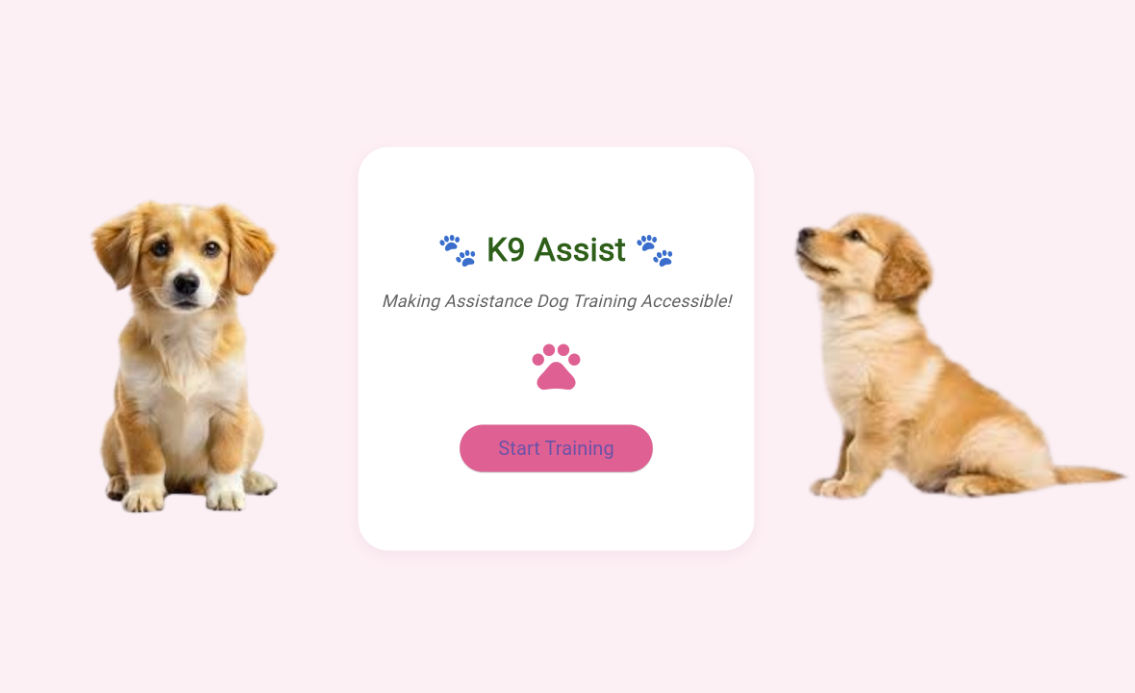
K9 Assist is a Flutter-based mobile app that guides users through basic service dog training commands: sit, stay, down, come, and stand. Each module includes a “checkpoint” where users record their dog’s performance, and our AI model (powered by Ultralytics) analyzes the pose to verify if the command was executed correctly. The app gives real-time feedback, providing confidence without the need for expensive trainers.
How we built it
We built the frontend using Flutter for a smooth, interactive user experience. For the AI-powered checkpoints, we used Ultralytics' machine learning model YOLOv11, trained on the DogPose dataset, to detect and classify dog behaviors. The app architecture is modular, making it easy to expand and iterate. We used GitHub for version control and collaborated through VS Code and GitHub Desktop.
Challenges we ran into
- Pose Detection Precision: Training the AI to recognize subtle dog pose differences (like between “sit” and “down”) was tricky and required fine-tuning thresholds and confidence levels. Additionally, it had a hard time detecting from far away.
- Dataset Limitations: The open-source datasets we started with didn’t include every breed or body type, so we had to work creatively with augmentation and edge cases.
- Lighting & Background Noise: The model struggled with varied environments. Dim lighting, cluttered rooms, or non-uniform flooring made detection inconsistent, so we had to account for that in our testing and design.
- Bias & Accessibility: We spent time making sure the app doesn’t assume high-end tech or ideal conditions like expensive phones or perfect internet because we’re building for equity.
Accomplishments that we're proud of
- Successfully integrated a real AI model into a mobile app.
- Created a working UI/UX that’s both accessible and beginner-friendly.
- Designed a project with real-world impact and clear alignment with UN Sustainable Development Goals (10.2 and 11b).
What we learned
- Building an ML model that interacts with real-life behavior (like dog poses) taught us that tech must adapt to users
- We learned to constantly think from the perspective of someone with limited resources or accessibility needs.
- Clear Communication in Teamwork: With AI, frontend, and research all happening at once, we learned the importance of version control, documentation, and checking in often
- Making something truly accessible takes extra time, testing, and intentional design, but it’s worth it for the communities we hope to reach.
What's next for K9 Assist
- Add more advanced training modules and trick recognition.
- Integrate user accounts to track progress.
- Partner with volunteer orgs and vet clinics to reach more communities.
- Explore grant funding and nonprofit avenues to launch this app at scale.


Log in or sign up for Devpost to join the conversation.