-
-
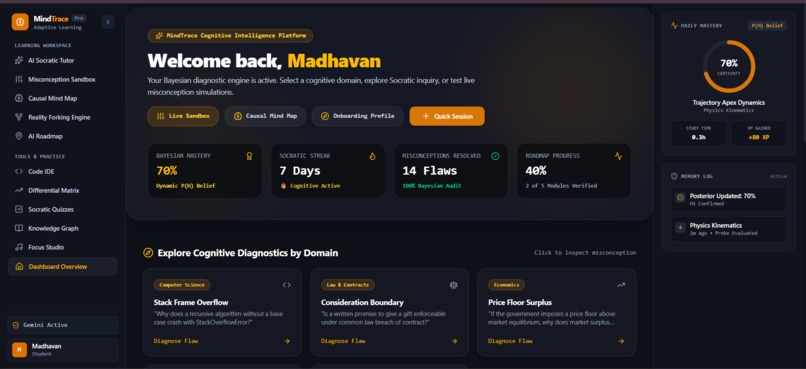
Main Dashboard
-
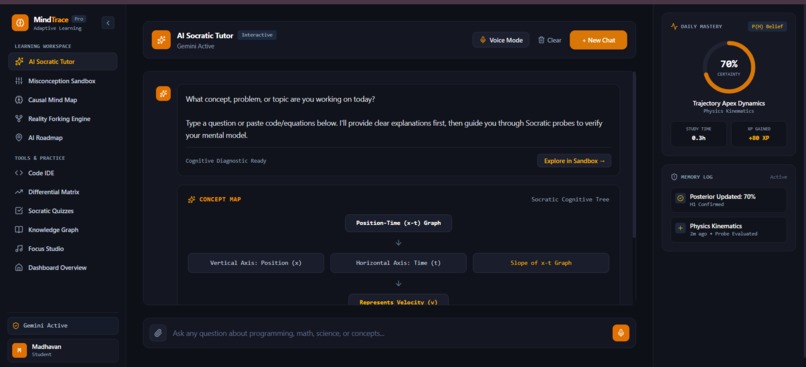
AI
-
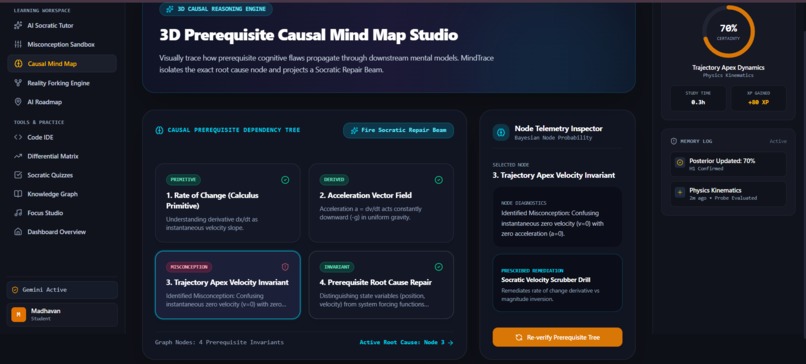
Mind Map
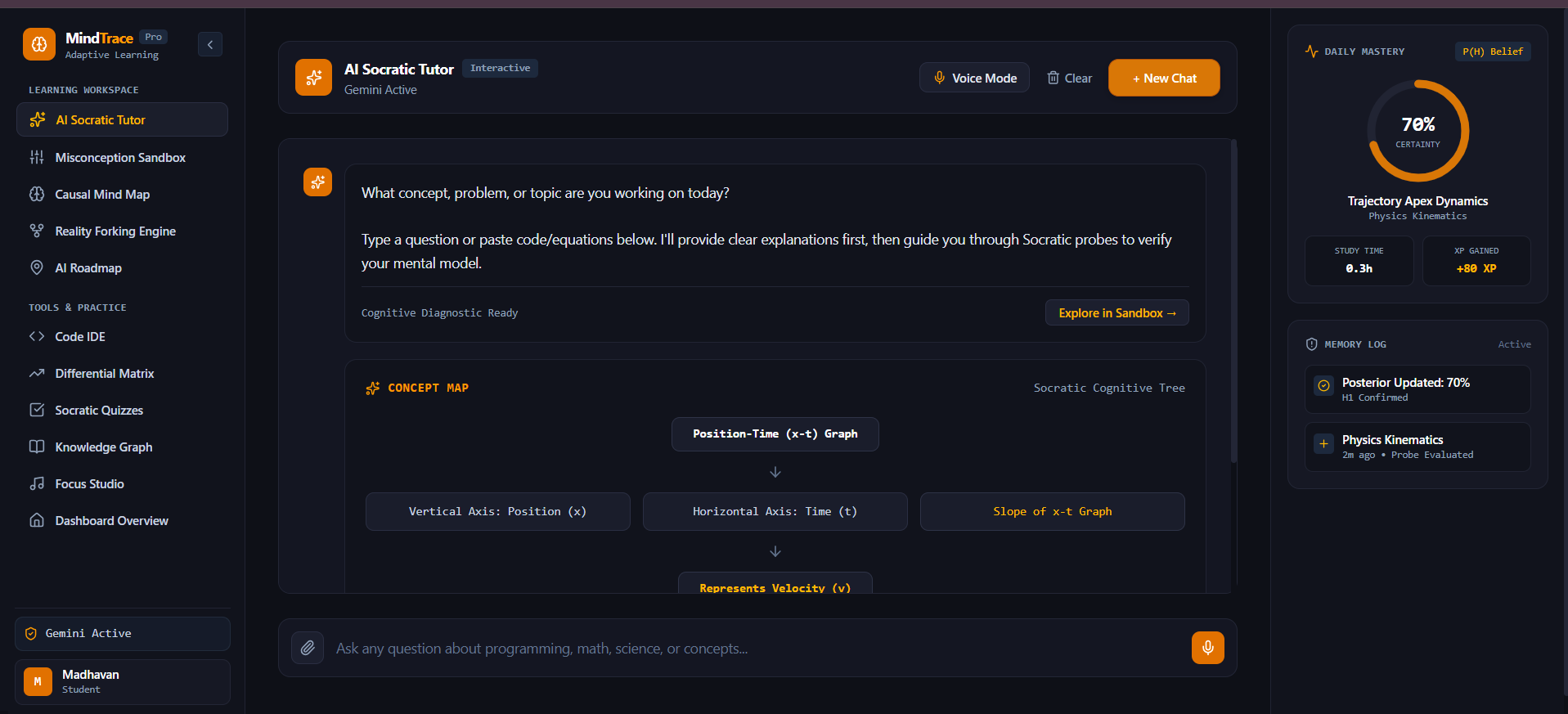
Most educational AI systems focus on one question: Did the student get the answer right?
But a correct answer does not necessarily mean correct understanding, and a wrong answer does not always reveal why the student is wrong. Two students can receive the same score while having completely different mental models.
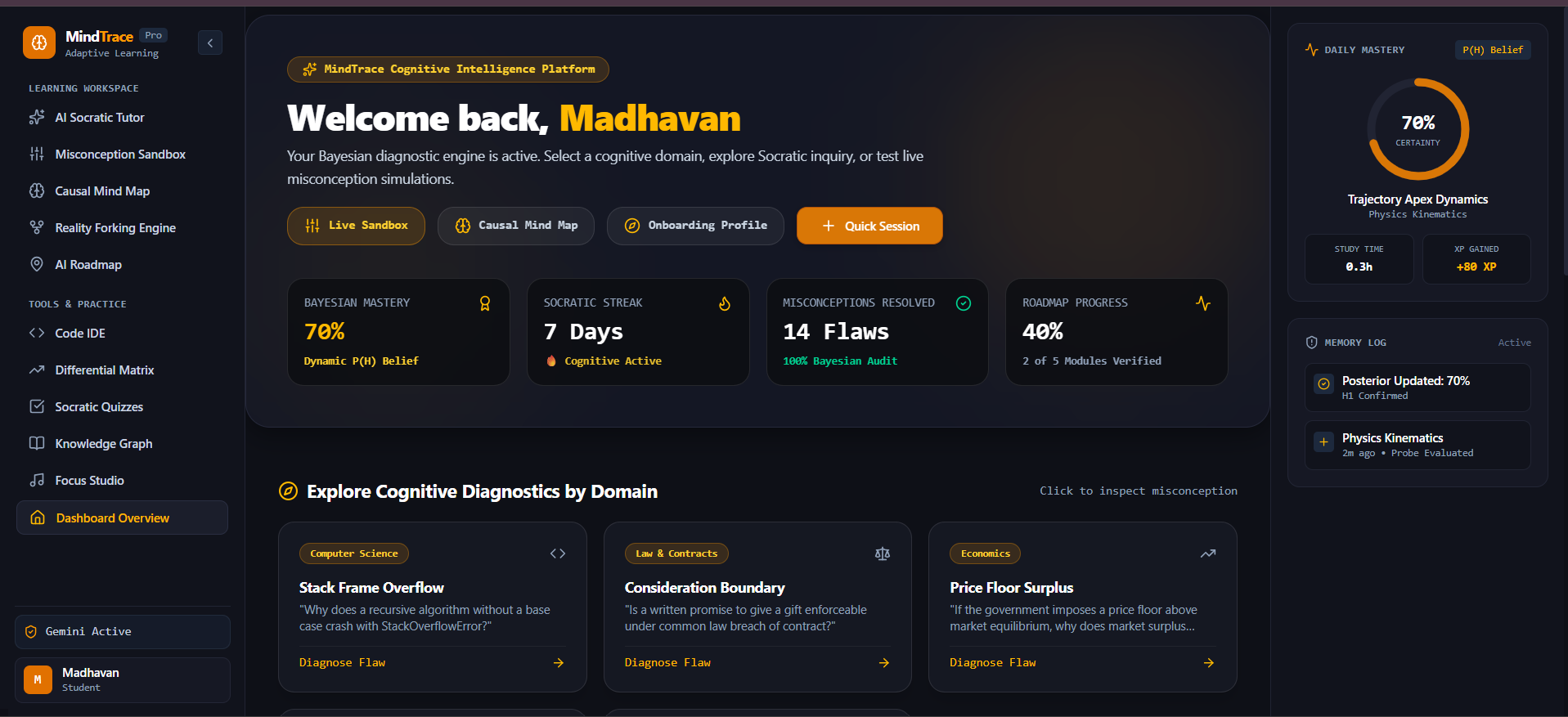
This inspired us to build MindTrace — an AI cognitive diagnostic system that tries to understand how a learner thinks. Instead of simply grading an answer, MindTrace analyzes the learner's reasoning, identifies potential misconceptions, maps them into a misconception graph, and uses interactive simulations and Socratic questioning to test whether the suspected misconception is actually present.
Our goal was to move from answer evaluation to reasoning investigation.
What it does
MindTrace follows a continuous diagnostic loop:
Student reasoning → AI analysis → Misconception detection → Interactive simulation → Socratic intervention → Updated mastery
A learner first explains how they arrived at an answer. The AI analyzes the reasoning and looks for conceptual inconsistencies rather than relying only on the final answer.
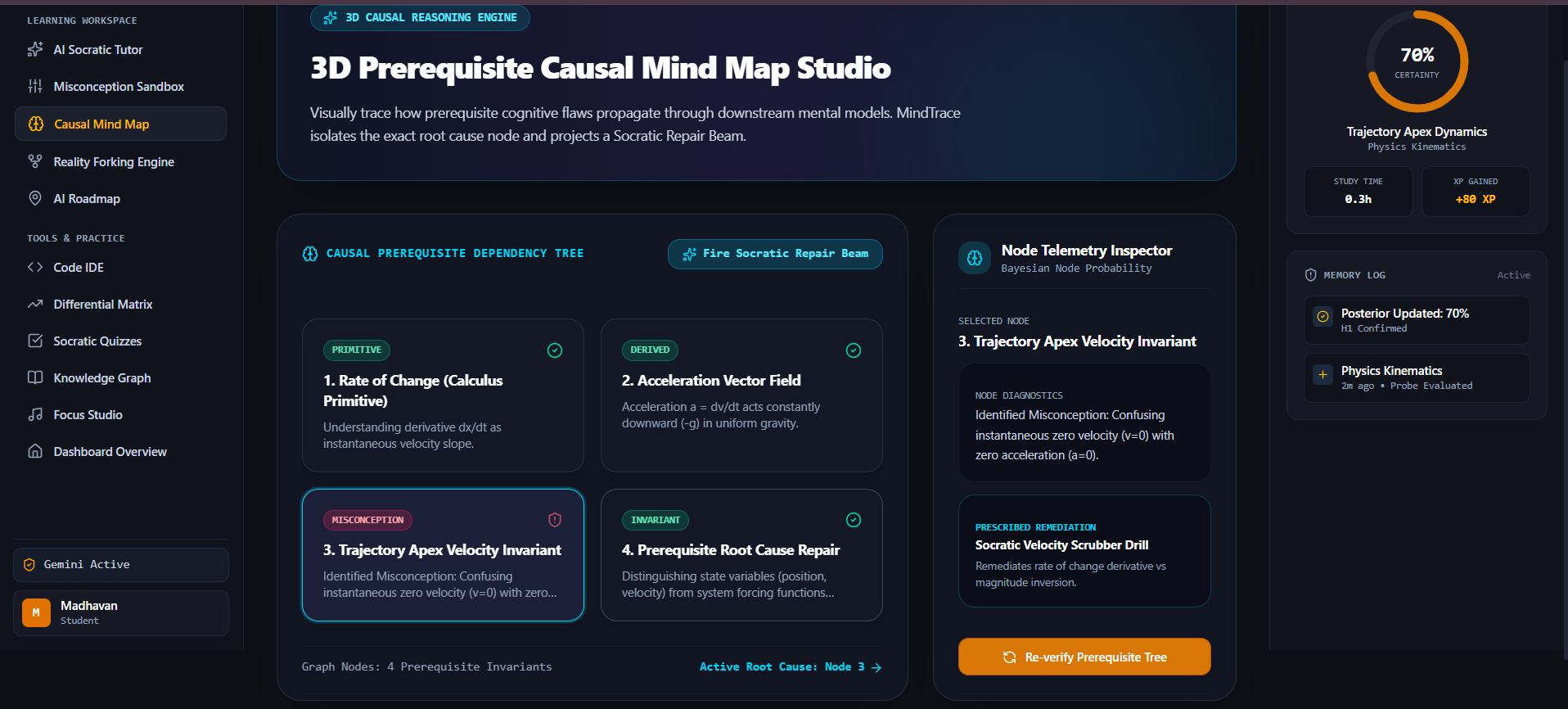
When a potential misconception is detected, MindTrace creates a structured representation of the learner's conceptual state. It can then generate an interactive scenario designed to probe that specific misunderstanding.
For example, in physics, a student may believe that an object with zero velocity must also have zero acceleration. Instead of simply marking the response wrong, MindTrace can use an interactive motion scenario to test the student's mental model and then ask targeted Socratic questions.
This makes the system capable of distinguishing between students who may have the same score but fundamentally different understanding.
How we built it
MindTrace was built as an interactive web application with a React-based interface and an AI reasoning layer powered by Gemini.
The system combines AI analysis with a misconception graph and interactive visual simulations. React, SVG/Canvas-based visualizations, animations, and browser capabilities are used to make the diagnostic process interactive rather than presenting the learner with a conventional chatbot interface.
The architecture is designed around a feedback loop: the learner's reasoning becomes evidence for the AI, the AI forms hypotheses about misconceptions, targeted interactions collect additional evidence, and the resulting evidence is used to reassess the learner's conceptual understanding.
We also designed the system to work across multiple domains, including Physics, Mathematics, Computer Science, and Biology.
Challenges we faced
The biggest challenge was making the AI do more than generate explanations.
A convincing educational system needs to distinguish between a genuine misconception, a careless mistake, an incomplete explanation, and a correct answer supported by weak reasoning. We therefore had to design the interaction around evidence gathering and hypothesis testing, rather than simply asking an LLM to provide feedback.
Another challenge was turning abstract cognitive states into something that could be represented and visualized. The misconception graph helped us create a structured representation of relationships between concepts and suspected misunderstandings.
We also had to balance AI reasoning with an interactive experience. The diagnostic process needed to feel understandable and engaging to a student while still exposing enough reasoning and evidence to make the AI's conclusions meaningful.
What we learned
Building MindTrace taught us that using AI effectively in education is not simply about generating better answers. The more interesting problem is determining what the learner actually understands and why.
We learned to treat AI outputs as hypotheses that should be tested through additional evidence rather than blindly accepted. This led us to design MindTrace around a diagnostic loop instead of a traditional question-and-answer experience.
The result is our vision of an AI learning system that doesn't just tell students what the answer is, but investigates how they arrived there and helps uncover the mental models behind their mistakes.

Log in or sign up for Devpost to join the conversation.