Inspiration
The inspiration for MindSync AI came from recognizing a critical gap in modern wellness technology: most health and mental wellness systems are fundamentally reactive. They wait for users to recognize problems and seek help, but by then, issues have often escalated significantly.
We envisioned a system that could proactively detect wellness risks through natural conversation, much like how a trusted healthcare professional might notice subtle signs of distress. The "aha" moment occurred when we realized AI agents could collaborate like a multidisciplinary healthcare team—combining psychological assessment, physical health analysis, behavioral pattern recognition, and personalized intervention planning—all through conversational interaction.
What it does
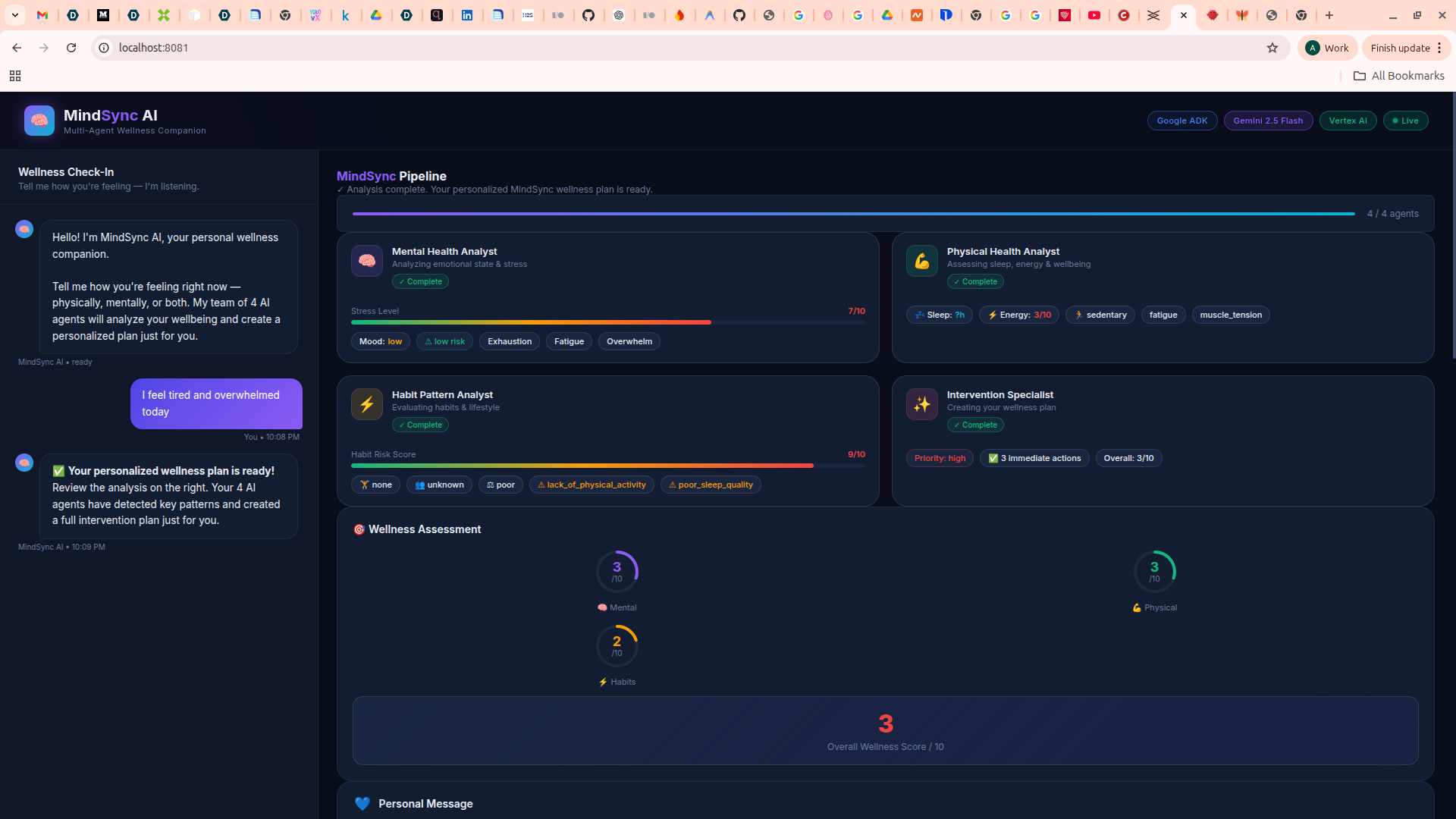
MindSync AI is a multi-agent wellness companion that analyzes user conversations to provide comprehensive health and mental wellness insights. When users share how they're feeling, the system orchestrates four specialized AI agents that work sequentially:
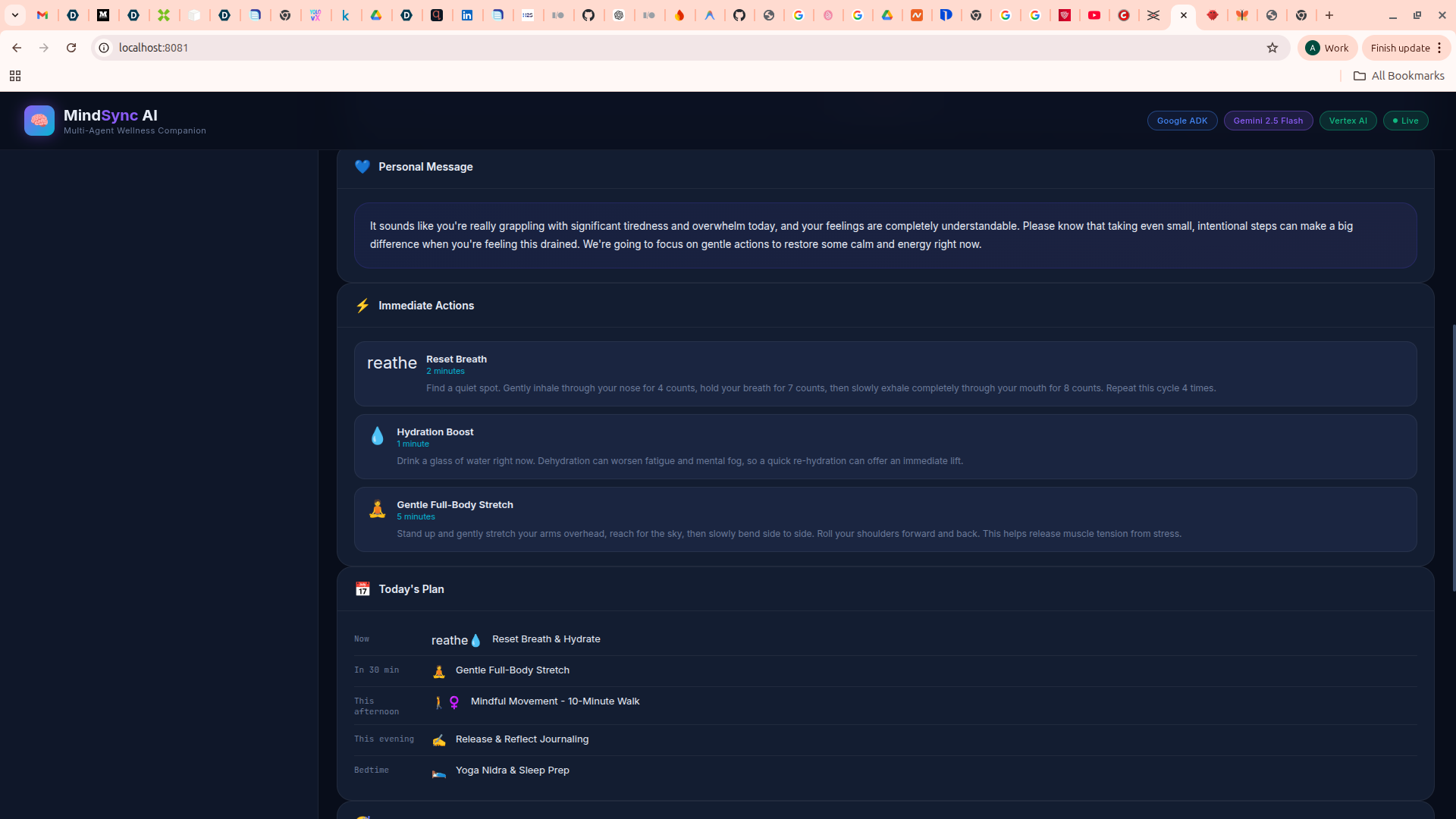
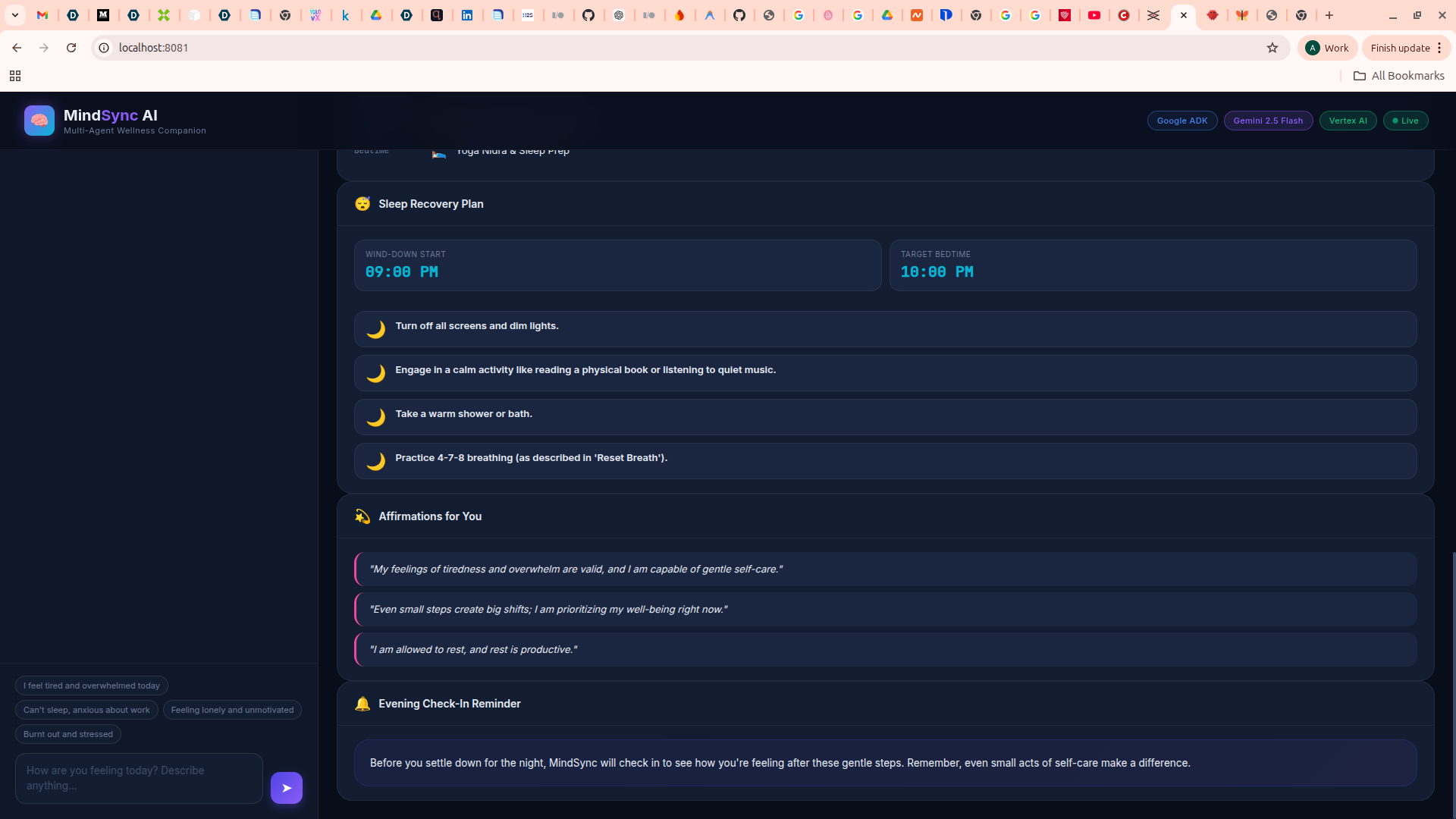
Mental Health Analyst: Detects stress levels, mood states, emotional indicators, and cognitive patterns Physical Health Analyst: Assesses sleep quality, energy levels, and physical wellbeing signals Habit Pattern Analyst: Evaluates daily routines, lifestyle behaviors, and habit formation Intervention Specialist: Synthesizes all analyses to create personalized wellness action plans The system delivers real-time, streaming responses through a modern web interface, providing immediate feedback and actionable recommendations. Users receive structured insights about their wellness state along with empathetic, conversational guidance.
How we built it
MindSync AI was built using Google's Agent Development Kit (ADK) as the core framework, combined with modern web technologies:
Backend Architecture: FastAPI server, MCP server with async Server-Sent Events (SSE) for real-time streaming Google Gemini AI for natural language processing and agent intelligence SequentialAgent orchestration pattern to coordinate the 4-agent pipeline In-memory session management for conversation continuity
Agent Design: Each agent follows specialized expertise models with structured JSON outputs Mental Health Agent uses clinical psychology frameworks Physical Health Agent evaluates biometric and lifestyle indicators Habit Agent analyzes behavioral patterns and routines Intervention Agent synthesizes insights into actionable plans
Frontend: Modern HTML/CSS/JavaScript interface with responsive design Real-time progress indicators during multi-agent processing Clean, accessible UI focused on user experience and trust
Development Approach: Modular agent architecture allowing easy extension Structured data exchange between agents for consistency Emphasis on clinical accuracy balanced with conversational tone
Challenges we ran into
Agent Context Management: The biggest technical challenge was managing context window limitations in large language models. Each agent needed sufficient user context for analysis while leaving room for generating responses, requiring careful prompt engineering and context summarization.
Sequential Processing Latency: The sequential agent pipeline created inherent delays—each agent must complete before the next begins. We solved this through progressive UI disclosure, showing partial results as they become available and implementing engaging loading states.
Clinical Accuracy vs. Accessibility: Balancing professional clinical assessment capabilities with approachable, empathetic communication proved challenging. The Mental Health Agent needed to maintain clinical rigor while feeling like a supportive conversation partner.
Real-time Streaming Complexity: Implementing SSE streaming introduced connection state management and error handling challenges. We developed robust connection recovery mechanisms and graceful degradation for varying network conditions.
Cross-Agent Data Consistency: Ensuring consistent data formats across all four agents required careful schema design and unified data models to enable effective synthesis by the final intervention agent.
Accomplishments that we're proud of
Innovative Multi-Agent Orchestration: Successfully implemented a sequential agent pipeline that mimics real-world healthcare collaboration, where specialists build upon each other's insights for comprehensive care.
Real-Time User Experience: Created a streaming interface that provides immediate feedback during multi-second processing, making AI analysis feel conversational and responsive rather than batch-processed.
Clinical Framework Integration: Developed structured analysis frameworks for each agent that balance clinical accuracy with user-friendly presentation, covering stress assessment, mood analysis, habit patterns, and intervention planning.
Technical Architecture: Built a scalable system using modern AI frameworks (Google ADK + Gemini) combined with robust web technologies, demonstrating how to create production-ready AI applications.
User-Centered Design: Designed an interface that makes complex AI analysis accessible and trustworthy, focusing on user wellbeing rather than technical complexity.
What we learned
Agent Orchestration Patterns: We discovered that effective multi-agent systems require sophisticated orchestration beyond individual agent capabilities. Sequential processing ensures contextual coherence, where each agent's analysis builds upon previous insights.
Structured AI Communication: Agents communicate more effectively through structured data formats (JSON) rather than natural language, enabling programmatic synthesis of insights across the pipeline.
Progressive Disclosure UX: Real-time streaming requires careful UX design to manage user expectations during processing delays, teaching us the importance of loading states and partial result presentation.
Clinical AI Balance: Successfully balancing clinical accuracy with empathetic communication requires domain expertise in both healthcare and conversational AI design.
Context Window Economics: Managing AI context windows taught us efficient prompt engineering and information prioritization to maximize analysis quality within computational constraints.
What's next for MindSync AI
Longitudinal Wellness Tracking: Expand the system to track wellness patterns across multiple conversations, providing trend analysis and early warning systems for emerging issues.
Wearable Data Integration: Incorporate data from fitness trackers and health devices to combine conversational insights with biometric measurements for more comprehensive assessments.
Multi-Language Support: Extend the system to support multiple languages, making proactive wellness AI accessible to global users regardless of language barriers.
Healthcare Provider Integration: Develop APIs for integration with electronic health records and healthcare provider systems, enabling MindSync AI to complement professional medical care.
Advanced Intervention Personalization: Implement machine learning models that adapt intervention recommendations based on user response patterns and effectiveness over time.
Mobile Application: Create native mobile apps that can provide wellness check-ins throughout the day and integrate with phone sensors for additional context.
Research Partnerships: Collaborate with healthcare institutions to validate the system's effectiveness and expand the clinical frameworks used by the agents.
Built With
- css
- fastapi
- google-adk
- google-cloud
- google-gemini/vertex-ai
- html
- javascript
- mcp-server
- python

Log in or sign up for Devpost to join the conversation.