-
-
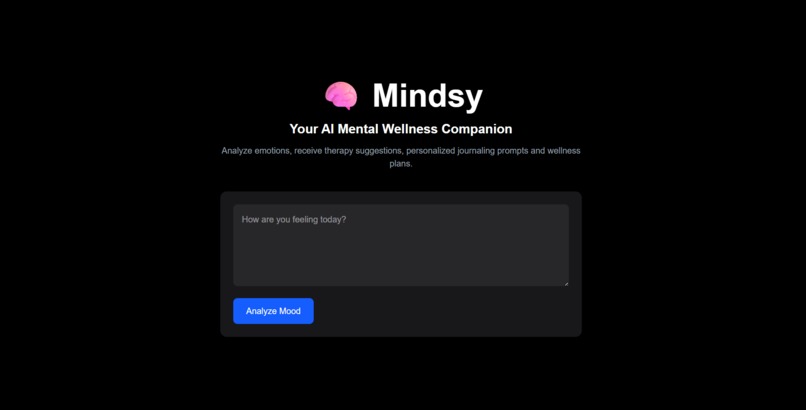
mindsy-home.png
🧠 About the Project — Mindsy
✨ Inspiration
Mental health support is often either too generic or too passive. Most applications only track mood but fail to take meaningful action in real time. I wanted to build something that behaves less like a chatbot and more like a support system that actually responds, adapts, and acts like a team of specialists.
That idea led to Mindsy — an AI-powered multi-agent mental wellness system designed to understand emotions and provide immediate, personalized support.
💡 What I Built
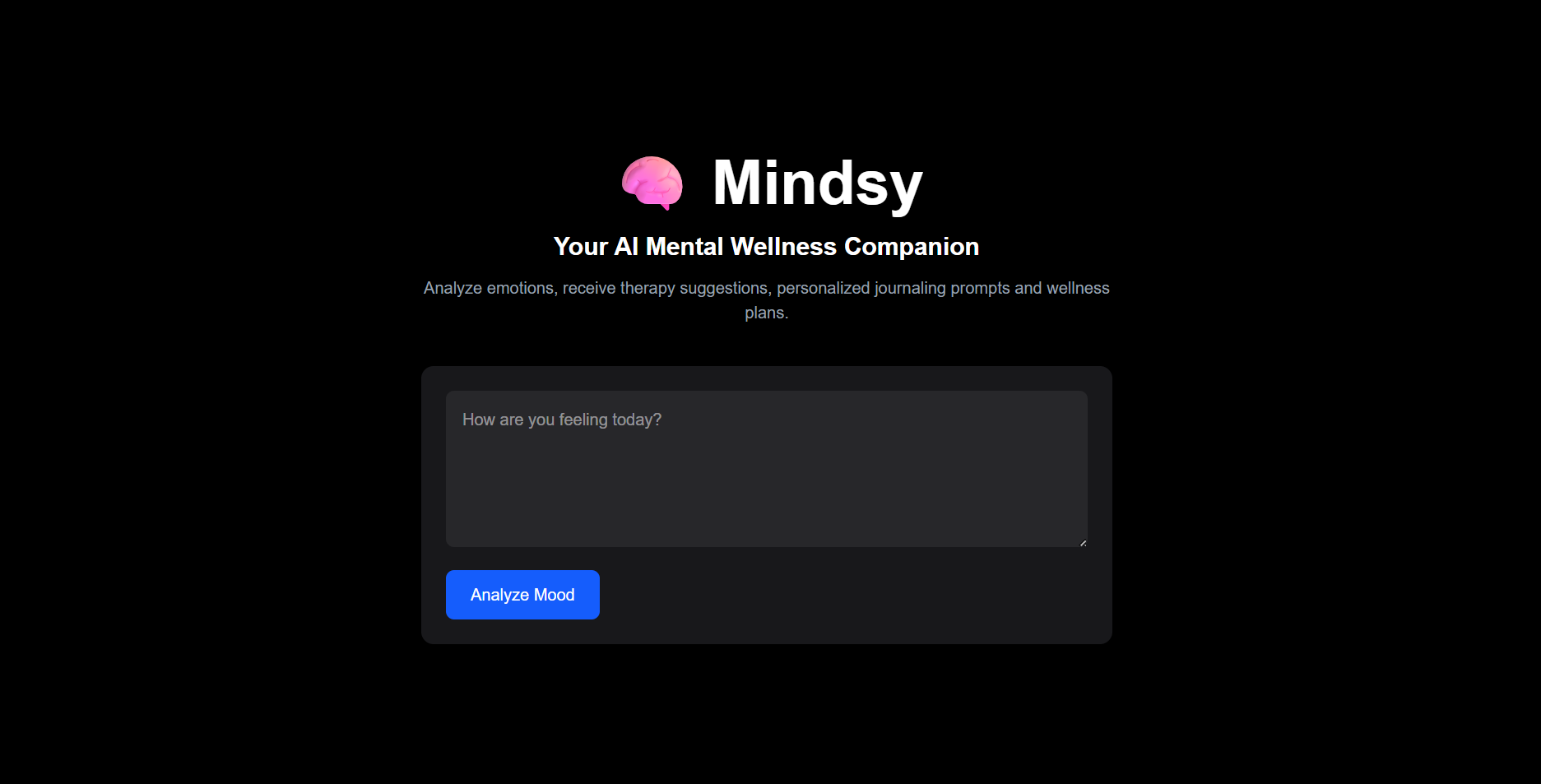
Mindsy is a multi-agent AI system that analyzes a user’s emotional state and generates actionable mental wellness support in real time.
When a user enters their thoughts, the system:
Detects mood and emotional patterns using an AI model Generates a personalized response Activates specialized agents such as: 🎵 Music Therapy Agent 📔 Journal Prompt Agent 🌱 Wellness Recommendation Agent
Instead of giving a single static response, Mindsy orchestrates multiple AI “agents” that collaborate to support the user.
⚙️ How I Built It
I built Mindsy using:
Next.js for frontend and API routes TypeScript for type-safe development Tailwind CSS for UI styling LLM API (Gemini/OpenAI style model) for emotional analysis Vercel for deployment
The architecture follows a simple pipeline:
User Input → Mood Analysis → AI Response Generation → Agent-based Recommendations
Each “agent” is logically separated in the system to simulate specialized intelligence.
🧠 What I Learned
This project taught me how to:
Design agent-based AI systems instead of single-response chatbots Structure full-stack applications using Next.js Integrate AI APIs into real-world user flows Think in terms of system design rather than just UI logic
Most importantly, I learned how to translate an abstract idea (mental wellness support) into a working technical product.
⚠️ Challenges I Faced
One of the biggest challenges was designing a system that feels like multiple intelligent agents working together rather than just one model responding.
I also faced issues with:
Git/GitHub setup and deployment workflow Structuring API routes properly in Next.js Creating a clean and intuitive UI under time constraints
Another challenge was making the responses feel empathetic and supportive rather than robotic, which required careful prompt design.
🚀 Final Outcome
The final result is Mindsy, a lightweight but powerful AI system that simulates a mental wellness support team. It demonstrates how multi-agent AI systems can be applied to real-world emotional health use cases.
Mindsy is not just a chatbot — it is an AI-driven emotional support ecosystem.
Built With
- api
- apis
- cloud-services
- databases
- frameworks
- gemeni
- github
- html
- javascript
- next.js
- platforms
- tailwind
- typescript
- vercel

Log in or sign up for Devpost to join the conversation.