🛡️ MindSteady
The Real-Time Runtime Shield for Children's Video Safety
Parental controls today only block explicit words and themes. They do nothing about the hyper-stimulating video pacing that overwhelms a developing brain.
MindSteady is a real-time, AI-powered runtime shield. It intercepts video as it plays and gently throttles hyper-fast scene cuts, dampens harsh contrast, and stabilizes playback — before sensory overload happens.











🚨 MindSteady doesn't just flag content. It intervenes — live, on the page, while the child is watching.
📖 Table of Contents
-⚡ TL;DR
- 💡 Inspiration
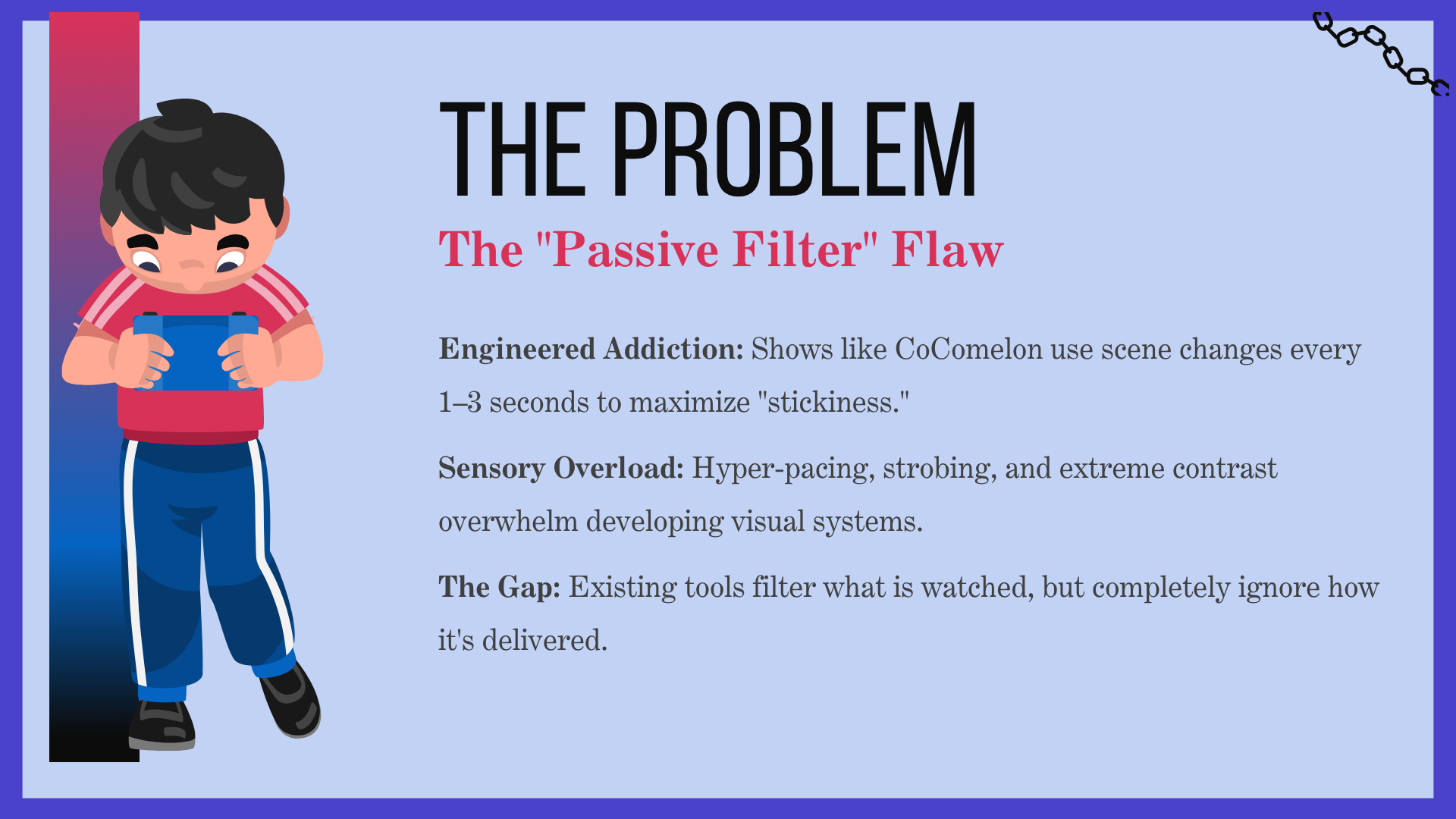
- 🔥 The Problem: The "Passive Filter" Flaw
- 💡 The Solution: An Active Runtime Shield
- 🎯 Target Users
- 🧩 Key Pillars
- 🏗️ System Architecture
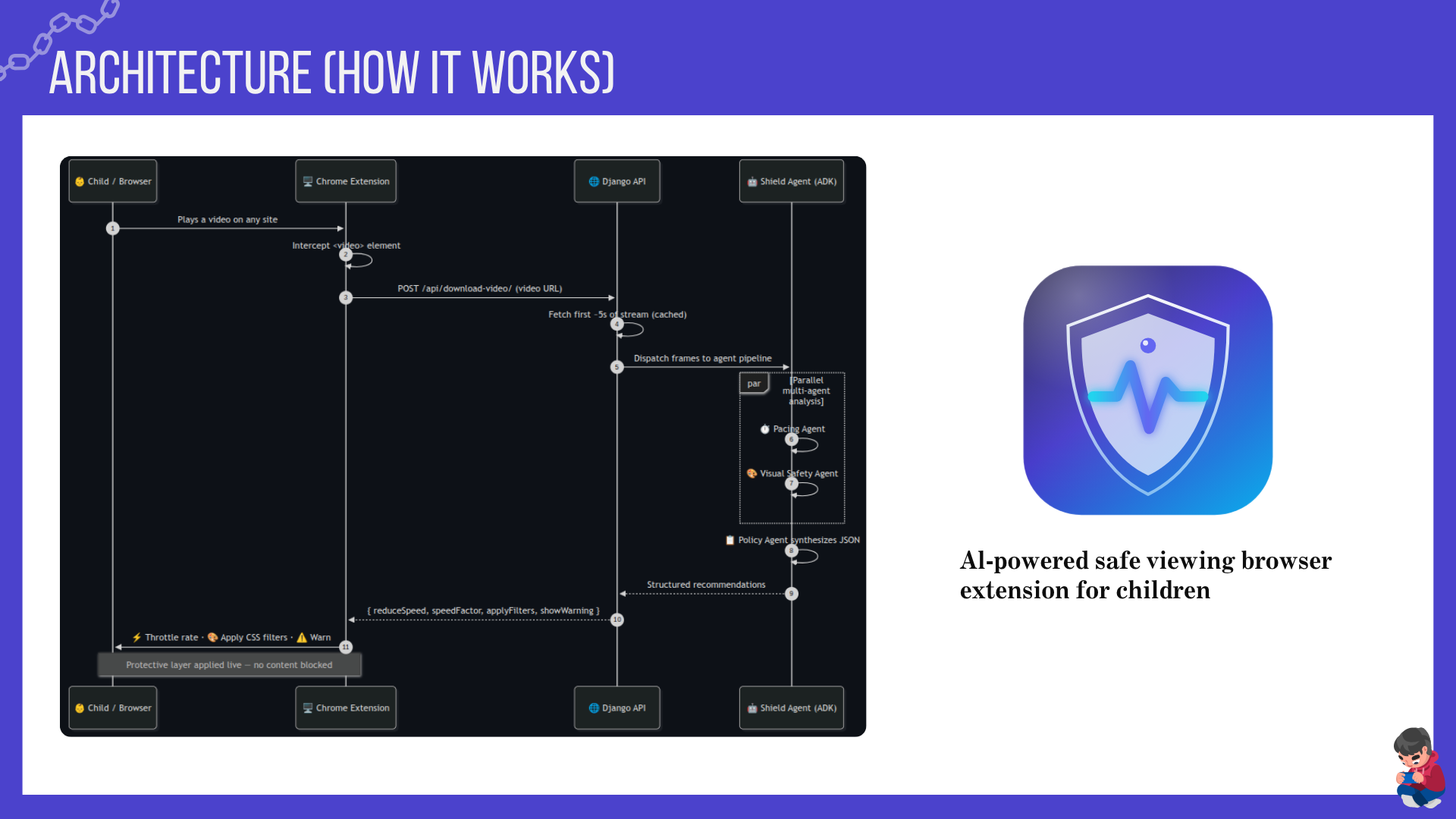
- 🔄 How It Works: The Closed-Loop Pipeline
- 🤖 The Shield Agent: Multi-Agent AI
- 🧠 Grounded in Research & Evidence
- 📚 What We Learned
- 🧗 Challenges
- 📊 Impact Model
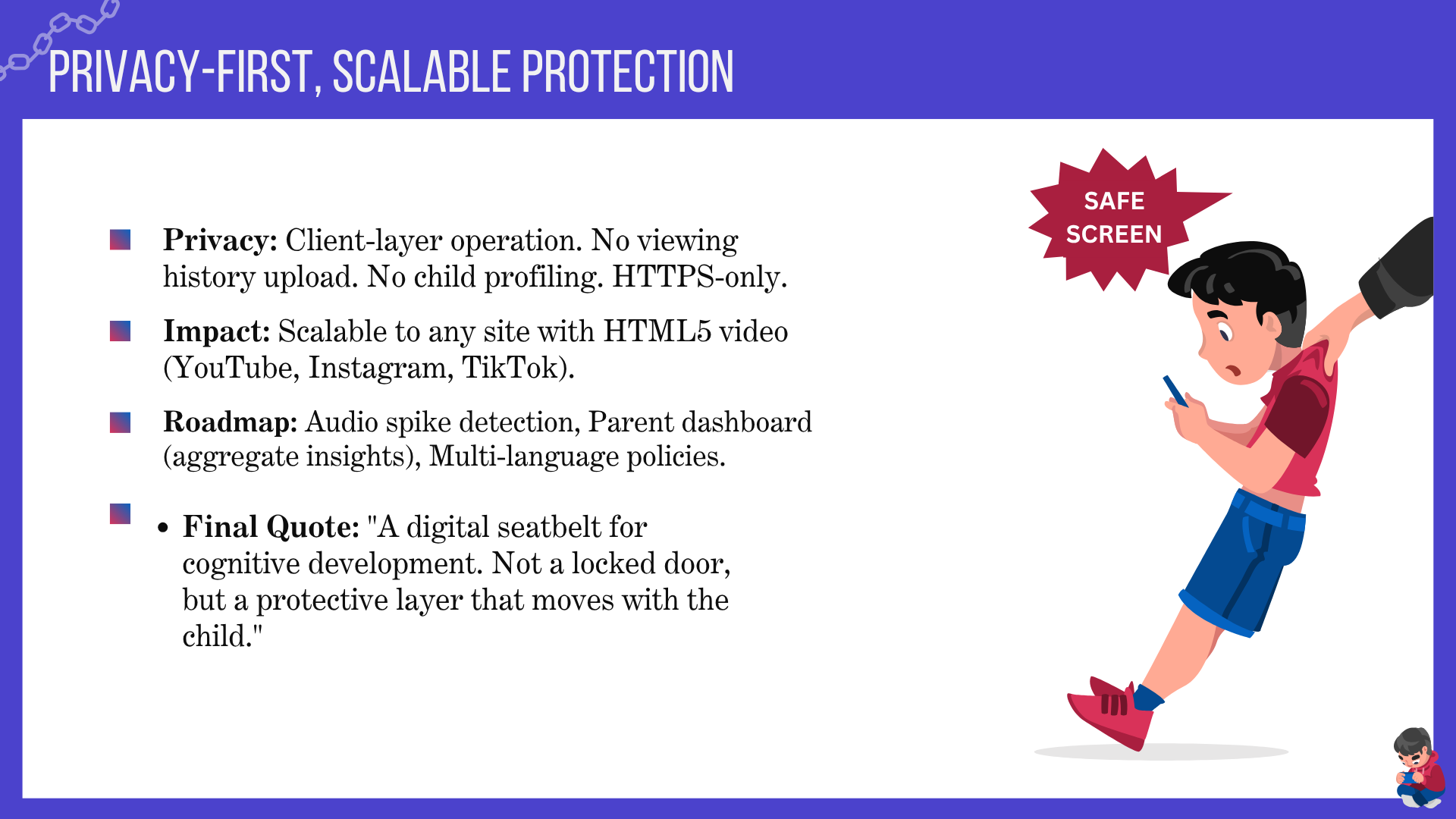
- 🔐 Privacy by Design
- 📈 Results
- 🗺️ Roadmap & Future Scope
- 🏆 Why MindSteady
- 👤 Author
⚡ TL;DR
One line: MindSteady is a Chrome extension + AI backend that intervenes in hyper-stimulating video in real time — slowing playback, calming visuals, and warning parents — instead of merely blocking content after the damage is done . 🗓️ Build window: October 13–14, 2026
| Question | Answer |
|---|---|
| What is it? | A real-time runtime shield that modulates video playback to protect developing brains. |
| Who is it for? | Parents, caregivers, and educators of children aged 0–8. |
| What's the AI? | A Google ADK multi-agent pipeline (3 parallel specialists + a synthesis agent) that scores video pacing, visual intensity, and content safety from sampled frames. |
| Why is it different? | Everyone else filters. MindSteady modulates — the intervention happens live, not in a blocklist. |
| Is it built? | Yes — a working MVP across three integrated components (extension, API, agents). |
💡 Inspiration
It started with a small, familiar family struggle — and ended with a public-health concern.
One of us came across an Instagram video explaining how children's content is deliberately engineered to capture attention and create dependency — to the point where many kids cannot perform routine tasks, like eating a meal, without being handed a phone. That resonated immediately with our own observations of younger children in our families, who insist on screen time whenever food is involved.
What felt like a minor parenting annoyance suddenly connected to something much larger: if this pattern continues unchecked, it could have serious long-term effects on children's development.
| 🔍 What We Found | 📌 The Implication |
|---|---|
| Popular shows are reportedly engineered using child testing to maximize "stickiness" rather than educational value. | Developing brains are exposed to engineered addiction, not enrichment. |
| Modern children's content often relies on sensory overload — scene changes every 1–3 seconds, extreme color saturation, and rapid stimuli beyond natural human processing capacity. | The harm is in the delivery, not the topic — invisible to every text-based filter. |
| A single flagship channel generates 7.8 billion monthly views and 134 million subscribers, reaching millions of infants during critical brain-development stages. | The exposure is massive and systemic, not a fringe case. |
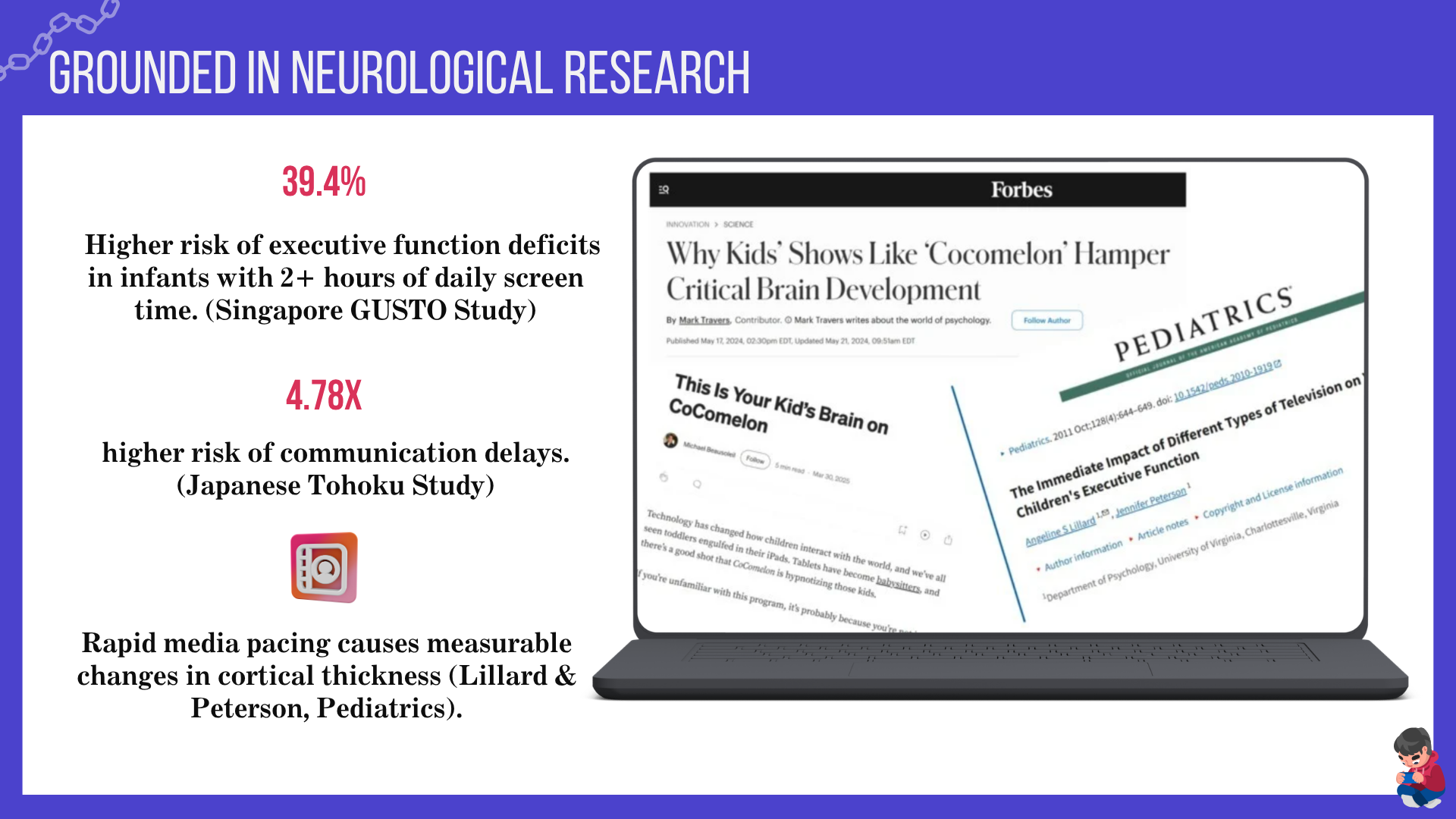
| Studies link high screen exposure to structural brain changes, altered EEG patterns, elevated stress hormones, and persistent executive-function deficits that can last into school age. | The effects are measurable — this is a real, defensible problem. |
And yet there is a regulatory gap. No existing technology automatically detects and moderates the visual characteristics — pace, contrast, content safety — that research has proven harmful.
Motivated by both personal experience and this growing body of evidence, we built MindSteady: a protective technology layer designed to safeguard the developing brains of infants and toddlers.
🔥 The Problem: The "Passive Filter" Flaw
Traditional parental controls are a locked door on a house that is already on fire.
Every major parental-control tool today runs on the same outdated model: block or allow. They scan titles, transcripts, tags, and known keywords, then decide whether a video is permitted. This leaves a massive, unaddressed gap.
| ❌ What Existing Tools Catch | 🚨 What They Completely Miss |
|---|---|
| Explicit language in metadata | Hyper-fast scene cuts that fragment attention |
| Known banned keywords | Strobing & flashing that overwhelm visual processing |
| Category-based age ratings | Extreme saturation & contrast spikes |
| Static allow/deny lists | Sudden volume spikes that startle infants |
| Nothing about delivery | Rhythm & pacing that dysregulates developing brains |
The result: a video that is correctly labeled, correctly rated, and correctly filtered can still be a sensory assault on a toddler's nervous system. Existing tools have zero runtime awareness of how content is delivered — only what it contains.
📉 The Scale of the Gap
| Signal | Reality |
|---|---|
| Content moderation focus | Almost entirely on text and themes |
| Pacing / edit-rhythm detection | Effectively non-existent in consumer parental tools |
| Intervention timing | Post-hoc blocking — after exposure begins |
| Child-facing feedback | Surveillance dashboards, not protective modulation |
💡 The Solution: An Active Runtime Shield
MindSteady does not just tell parents a video is fast — it steps in.
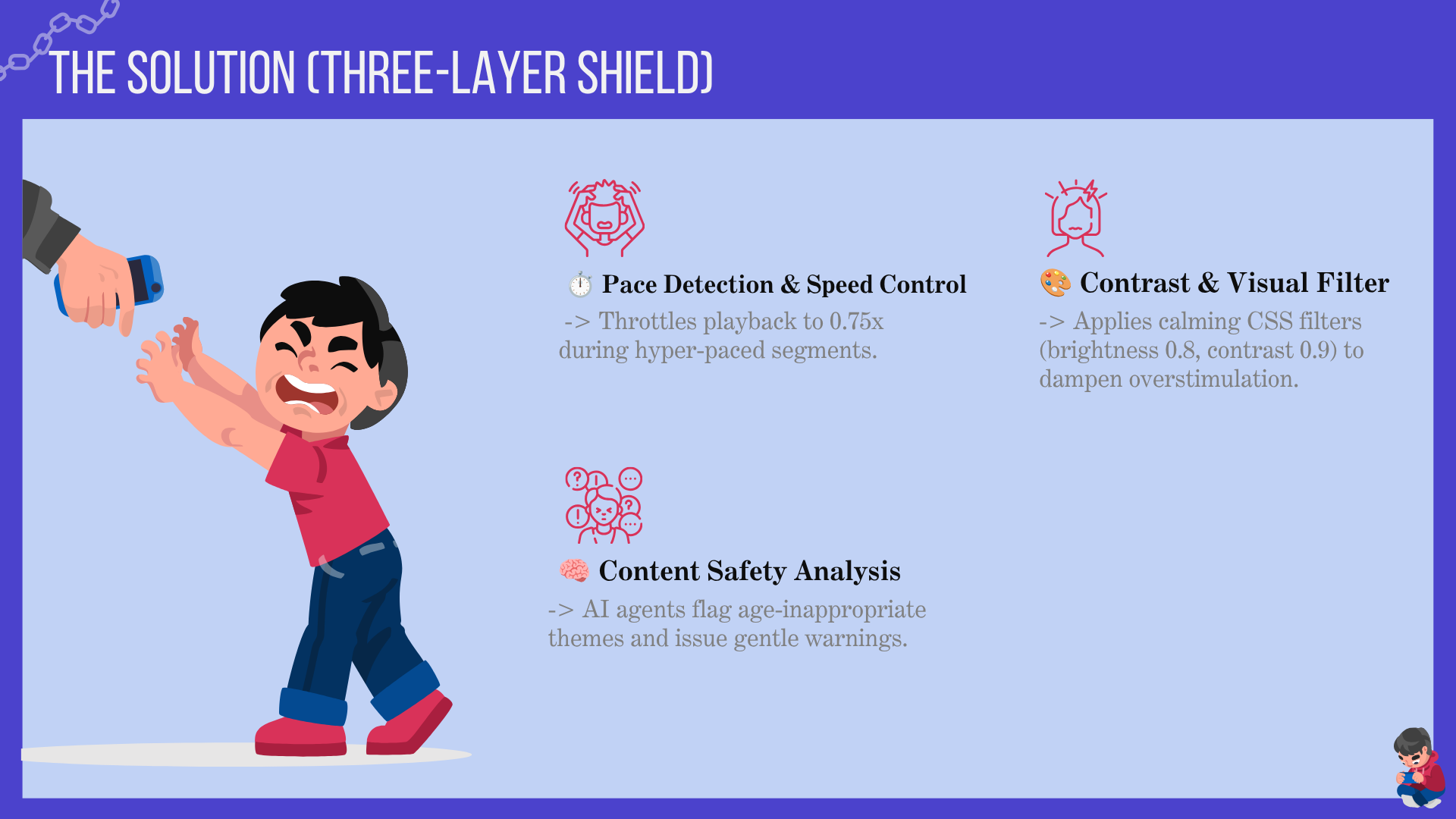
It intercepts HTML5 <video> elements in real time and dynamically applies protective measures during playback, without blocking the child's experience outright.
| 🎯 Intervention | ⚙️ Mechanism | 🧠 Why It Matters |
|---|---|---|
| ⏱️ Playback Throttling | Dynamically reduces playback rate to 0.85x / 0.75x during detected hyper-pacing |
Gives the developing brain time to process each frame |
| 🎨 Visual Dampening | Applies calming CSS filters — brightness(0.8) contrast(0.9) saturate(0.7) |
Reduces overstimulation from harsh contrast & saturation |
| 🔇 Volume Stabilization | Lowers sudden volume spikes during intense segments | Prevents startle responses in infants |
| ⚠️ Gentle Warnings | Non-blocking notice with a continue / skip choice | Keeps parents informed without surveillance |
🎯 Target Users
| User | Pain Point | How MindSteady Helps |
|---|---|---|
| 👨👩👧 Parents & caregivers | Can't vet every second of every video | Automatic, live protection with no manual setup |
| 🧑🏫 Early-years educators | Show "safe" clips that still overstimulate | Playback modulated for the classroom age band |
| 👶 The child | Experiences overload they can't articulate | Sensory load is reduced transparently and gently |
| 🩺 Pediatric / OT professionals | No tool to demonstrate pacing risk | Concrete, measurable runtime intervention |
Design stance: protect the child without surveilling the child. MindSteady never builds a profile, never logs viewing history, and never tracks identity.
🧩 Key Pillars
1️⃣ ⚡ Active Intervention
Solving the "Passive Filter" Flaw
MindSteady does not stop at flagging. It intercepts HTML5 video elements in real time to dynamically reduce playback speed, apply calming visual CSS overlays, and lower volume spikes during detected hyper-pacing segments. Real-world impact beyond simple content flagging.2️⃣ 🤖 Google ADK Multi-Agent AI
Sophisticated, meaningful AI
Rather than a single monolithic script, MindSteady runs a parallel multi-agent pipeline built on the Google Agent Development Kit — each agent specializing in a distinct dimension of safety. Pacing · Visual Safety · Content Safety → Policy Synthesis.3️⃣ 🧠 Research-Grounded
Real necessity, not a gimmick
Grounded in developmental research on rapid media pacing and executive-function deficits in early childhood, MindSteady targets the actual mechanism of harm. A protective layer for cognitive development.4️⃣ 🔐 Privacy-Respecting
Protection without surveillance
MindSteady operates locally on the client layer via the browser extension. It intercepts playback without logging private viewing history, profiling the child, or tracking identity. Safety that supports independence.
🏗️ System Architecture
MindSteady is a monorepo built as a continuous, closed-loop feedback system across three specialized components.
┌─────────────────────────┐       ┌─────────────────────────┐       ┌─────────────────────────┐
│    Chrome Extension     │       │       Django API        │       │  Shield Agent (ADK)     │
│   (DOM Interception)    │ ────► │  (Analysis & Routing)   │ ────► │  (Multi-Agent Scoring)  │
│                         │       │                         │       │                         │
│ • Intercepts <video>    │       │ • Ingests frame data    │       │ • Pacing Agent          │
│ • Executes CSS filters  │ ◄──── │ • Dispatches policy     │ ◄──── │ • Visual Safety Agent   │
│ • Controls rate (0.75x) │       │ • Caches safety results │       │ • Content Safety Agent  │
│ • Non-blocking warning  │       │ • yt-dlp 5s sampling    │       │ • JSON Policy Synthesis │
└─────────────────────────┘       └─────────────────────────┘       └─────────────────────────┘
🔧 Component Matrix
| Layer | Component | Stack | Responsibility | Status |
|---|---|---|---|---|
| 🖥️ Client | extension/ |
JS · HTML · CSS · Manifest V3 | Intercepts <video>, executes CSS filters, controls playback rate |
✅ Working |
| 🌐 Service | backend/ |
Python · Django · DRF · yt-dlp · OpenCV | Downloads a 5s sample, extracts frames, dispatches analysis, caches results | ✅ MVP |
| 🧠 Intelligence | shieldagent/ |
Python · Google ADK · LiteLLM | Parallel multi-agent scoring & JSON policy synthesis | ✅ MVP |
| 🎨 Brand | docs/ |
SVG | Logo & identity assets | ✅ Complete |
🔄 How It Works: The Closed-Loop Pipeline
[ 👶 Child / Browser ]  -- (1. Plays video) -->  [ 🖥️ Chrome Extension ]
                                                            │
                                                     (2. Intercepts <video>)
                                                            │
                                                     (3. POST video URL)
                                                            ▼
                                                     [ 🌐 Django API ]
                                                            │
                                                     (4. Fetches ~5s stream)
                                                            │
                                                     (5. Dispatches frames)
                                                            ▼
                                              [ 🤖 Shield Agent (ADK) ]
                                                            │
                                              ┌─────────────┴─────────────┐
                                              ▼                           ▼
                                      [ ⏱️ Pacing ]               [ 🎨 Visual Safety ]
                                              │                           │
                                              └─────────────┬─────────────┘
                                                            ▼
                                                   [ 🚸 Content Safety ]
                                                            │
                                                 (6. Synthesizes policy)
                                                            ▼
                                                   [ 📋 Policy Agent ]
                                                            │
                                                (7. Returns JSON layout)
                                                            ▼
                                                     [ 🌐 Django API ]
                                                            │
                                               (8. Sends action parameters)
                                                            ▼
                                              [ 🖥️ Chrome Extension ]
                                                            │
                                              (9. Throttles rate, CSS, warnings)
                                                            ▼
                                        [ Live Protective Layer Applied ]
                                        *No content blocked or blacked out*
🪜 Three-Stage Execution
| Stage | What Happens |
|---|---|
| 1️⃣ Interception | The Chrome Extension intercepts video elements on web pages and extracts live metadata + the page URL. |
| 2️⃣ Analysis | The Django backend downloads a short sample (yt-dlp), extracts representative frames (OpenCV), and dispatches them to the Shield Agent pipeline. |
| 3️⃣ Execution | The agents synthesize a structured JSON policy; the Extension applies live playback-rate throttling and visual-dampening CSS in real time. |
🤖 The Shield Agent: Multi-Agent AI
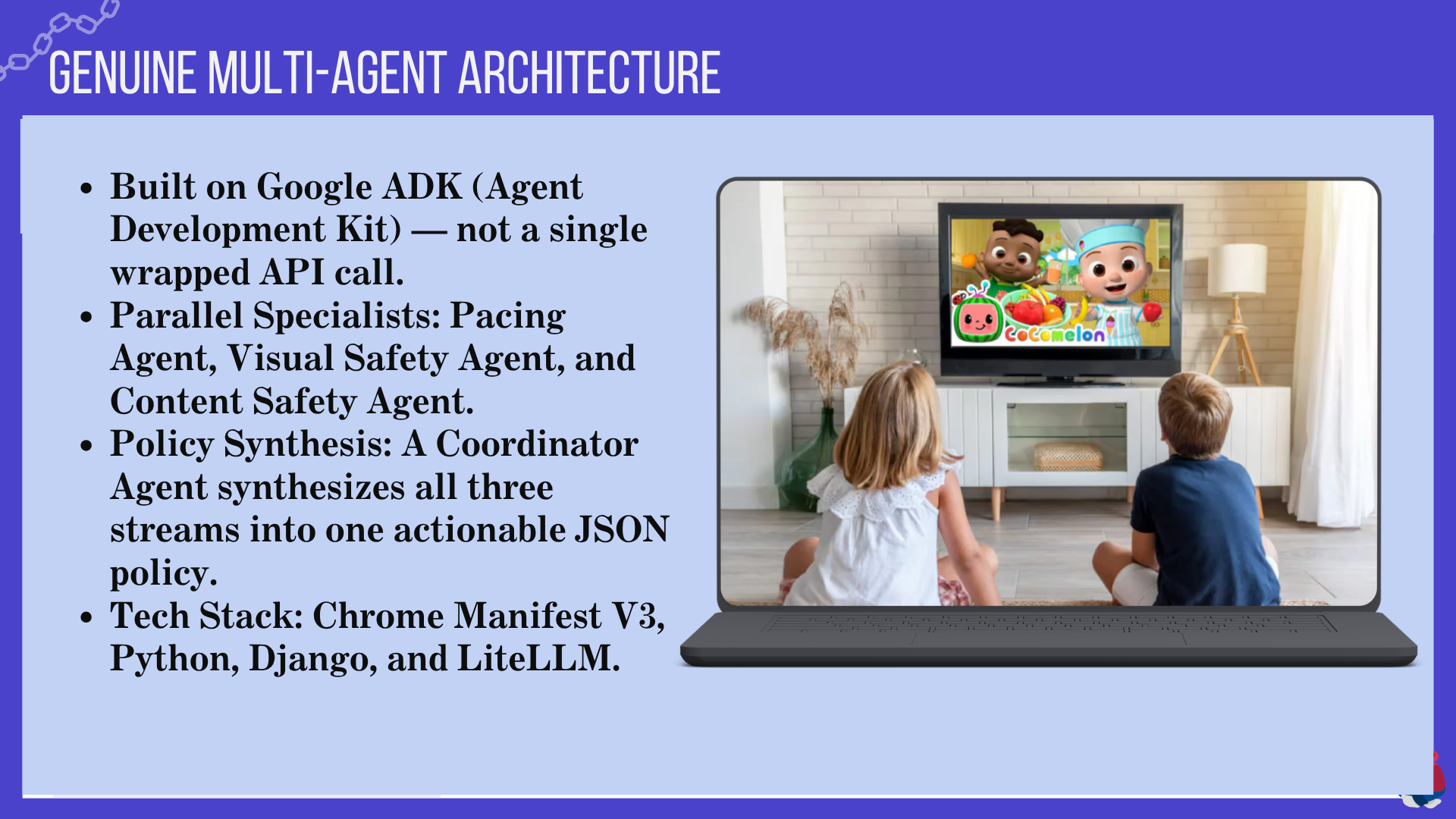
The intelligence core is a SequentialAgent pipeline built on Google ADK: a parallel research phase feeds a synthesis phase.
               ┌───────────────────────┐
               │   🎞️ Video Frames      │
               └───────────┬───────────┘
                           │
                           ▼
               ┌───────────────────────┐
               │    ParallelAgent      │
               │    InfoGatherer       │
               └─────┬─────┬─────┬─────┘
                     │     │     │
         ┌───────────┘     │     └───────────┐
         ▼                 ▼                 ▼
 ┌───────────────┐ ┌───────────────┐ ┌───────────────┐
 │  ⏱️ Pacing     │ │ 🎨 Visual     │ │ 🚸 Content    │
 │  Agent        │ │  Safety Agent │ │  Safety Agent │
 └───────────┬───┘ └───────┬───────┘ └───────────┬───┘
             │             │                     │
             └───────────┐ │ ┌───────────────────┘
                         ▼ ▼ ▼
               ┌───────────────────────┐
               │    📋 Policy Agent    │
               │ MindSteadyCoordinator │
               └───────────┬───────────┘
                           │
                           ▼
               ┌───────────────────────┐
               │ 📦 Structured JSON    │
               │    Policy Payload     │
               └───────────────────────┘
| Agent | Model | Evaluates | Output Key |
|---|---|---|---|
⏱️ Pacing Agentplayback_speed_agent |
gpt-4.1-mini |
Fast movements, quick cuts, rapid scene changes, information density, motion patterns that overwhelm developing visual systems | needs_slower_playbackrecommended_factor |
🎨 Visual Safety Agentcolor_contrast_agent |
gpt-4.1 |
High-contrast elements, bright / saturated colors, rapid color changes, flashing effects | needs_reduced_contrast |
🚸 Content Safety Agentcontent_appropriation_agent |
gpt-4.1-mini |
Violence, frightening imagery, adult themes, scary visuals, age-inappropriate concepts | contains_inappropriate_contentsafety_message |
📋 Policy AgentMindSteadyCoordinator |
gemini-2.0-flash |
Synthesizes all three telemetry streams into a single actionable recommendation | overall_recommendation |
💡 Why multi-agent? Different dimensions of harm need different reasoning. Splitting pacing, visuals, and content into specialized agents yields sharper judgments than one generalist model — and the parallel architecture keeps latency low enough for real-time use.
🧬 Engineering Highlights
| Technique | Where | Why It Matters |
|---|---|---|
ParallelAgent fan-out |
shieldagent/agent.py |
Three specialists run concurrently, not in series |
SequentialAgent pipeline |
shieldagent/agent.py |
Research phase → synthesis phase, deterministically ordered |
| Scene-change frame sampling | backend/ai.py |
Samples every ~2s instead of every frame — cheap, representative |
| Multi-provider models | LiteLLM + OpenAI + Gemini | Best model per task, not one model for everything |
| Result caching | views.py (Django cache) |
Repeat views are instant and cost-free |
| Graceful degradation | background.js |
On API failure, fails safe rather than failing open |
🧠 Grounded in Research & Evidence
MindSteady is not built on vibes — it targets a documented developmental mechanism. The evidence base spans neuroscience, developmental psychology, and platform-scale exposure data.
| 🔬 Finding | 🎯 Design Response |
|---|---|
| Rapid media pacing is associated with measurable executive-function deficits in early childhood. | ⏱️ The Pacing Agent actively throttles playback speed during hyper-paced segments. |
| Scene changes every 1–3 seconds exceed natural human processing capacity and drive sensory overload. | ⏱️ Scene-change frequency is monitored and playback is slowed above a safe threshold. |
| Strobing, flashing, and extreme contrast overwhelm the developing visual system. | 🎨 The Visual Safety Agent triggers real-time CSS dampening filters. |
| High screen exposure is linked to structural brain changes, altered EEG patterns, and elevated stress hormones. | 🧩 The intervention targets net sensory load, not just isolated features. |
| Sudden volume spikes trigger startle responses in infants. | 🔇 Volume stabilization lowers abrupt intensity. |
| Cognitive load from dense, fast-cut content degrades attention and self-regulation. | 🧩 Combined interventions reduce net sensory load in real time. |
Why this matters for the "regulatory gap": no existing technology automatically detects and moderates the visual characteristics (pace, contrast, content safety) that research has proven harmful. MindSteady closes that gap.
📚 What We Learned
| Domain | Takeaway |
|---|---|
| 🧠 Neuroscience foundations | How screen exposure — especially today's high-contrast, fast-paced content — shapes early cognitive development by altering brain-wave patterns, attention mechanisms, and executive function. |
| 🎛️ Applied multimodal AI | How multimodal AI can analyze multiple video features simultaneously (in parallel) to address a real-world social problem. |
| 🤖 AI orchestration with ADK | The practical challenges of deploying agents with the Google Agent Development Kit — including coordinating multiple agents for real-time, low-latency analysis and decision-making. |
| ⚖️ Product judgment | How to balance protective intervention against usability, so content stays watchable rather than frustrating. |
🧗 Challenges
| Challenge | How We Approached It |
|---|---|
| ⚡ Real-time performance — achieving reliable analysis without playback lag was the single biggest technical challenge. | Sample a short window (≈5s) instead of the whole video, extract a small set of representative frames, and fan out analysis to parallel agents; cache results so repeat views are instant. |
| 📚 New toolkit learning curve — mastering Google ADK during the hackathon required rapid experimentation and adaptation. | Built the pipeline incrementally: single agent → ParallelAgent fan-out → SequentialAgent synthesis. |
| 🎚️ Balancing intervention and usability — designing filters and playback adjustments that protect children without making content unwatchable. | Conservative, reversible interventions: gentle speed factors (0.75x–0.85x), modest CSS dampening, and a non-blocking warning with a continue/skip choice. |
| 🌐 Cross-platform testing — ensuring consistency across video formats and platforms like YouTube and Instagram. | Target the standard HTML5 <video> element and re-scan dynamically loaded players every 5 seconds. |
📊 Impact Model
MindSteady is designed to scale to every site with an HTML5 <video> element — that is the entire modern web.
| Dimension | Today (MVP) | With Adoption |
|---|---|---|
| Coverage | Any page with <video> (YouTube, news, social) |
Universal via browser extension |
| Cost per view | Near-zero (cached, short sample) | Constant, cache-amortized |
| Latency | Sub-second sample + parallel agents | Further reduced via edge caching |
| Child data collected | None | None — by design |
| Measurable outcome | Sensory-load reduction per session | Aggregate (non-identifying) pacing stats |
🎯 Measurable Success Metrics
- Sensory-load reduction — average pacing/contrast delta applied per flagged video.
- Intervention precision — % of interventions judged appropriate by caregivers.
- Time-to-protection — latency from
playevent to applied modulation. - False-positive rate — videos modulated that did not need it.
🔐 Privacy by Design
MindSteady is built to protect children without surveilling them.
| ✅ What We Do | 🚫 What We Never Do |
|---|---|
| Analyze a short sample of the video on your own backend | Upload or store the child's viewing history |
| Keep user settings in browser-local storage | Build a profile of the child |
| Operate on the client layer for intervention | Track identity, location, or personal data |
| Communicate over HTTPS-only endpoints | Sell or share any data |
"Parental tools that support safety without excessive surveillance." — aligned with the hackathon's own guidance.
🧪 Demo & Testing
| Scenario | Expected Behavior |
|---|---|
| ▶️ Safe content | Normal playback — no intervention |
| ⚠️ Moderate content | Reduced speed + calming visual filters |
| 🛑 Risky content | Warning dialog + pause, with continue / skip choice |
# 1. Load the extension (see Quick Start)
# 2. Visit any site with video (YouTube, news, social)
# 3. Open the popup → watch live detection stats
# 4. Press F12 → follow the "MindSteady:" console trace
📈 Results
We tested MindSteady on a set of popular children's videos. The extension:
| ✅ Observed Outcome | Mechanism |
|---|---|
| Successfully adjusted playback speed when content had rapid scene changes | ⏱️ Pacing Agent → runtime playbackRate control |
| Reduced overstimulating visual intensity through adaptive filtering | 🎨 Visual Safety Agent → CSS dampening |
| Triggered warnings for videos flagged as developmentally inappropriate | 🚸 Content Safety Agent → non-blocking continue/skip notice |
These outcomes demonstrated the feasibility of real-time AI protection for infants and toddlers during digital content consumption.
| Technology | Role |
|---|---|
| 🧠 Google ADK | Multi-agent orchestration (ParallelAgent → SequentialAgent) |
| 🎛️ Multimodal AI Agents | Parallel frame-level reasoning across pacing, visuals, and content |
| 🐍 Python | Backend, frame extraction, and agent logic |
| 🟢 JavaScript | Chrome extension — interception and live intervention |
| 🌐 Django | Analysis & routing API |
| ☁️ GCP | Hosting the agent service |
| 💎 Gemini | Policy-synthesis agent |
| 🤖 OpenAI | Pacing, visual-safety, and content-safety specialist agents |
| ✍️ Prompt Engineering | Task-specific instructions and strict JSON contracts |
🗺️ Roadmap & Future Scope
With a working application in place, MindSteady can be extended in several ways to maximize its utility and impact.
✅ Delivered
- [x] 🖥️ Chrome Extension with real-time video interception
- [x] ⚡ Live playback throttling & CSS dampening
- [x] 🤖 Google ADK multi-agent pipeline
- [x] 🌐 Django analysis & routing API
- [x] 🎨 Premium brand identity
🔭 Next
- [ ] 🎛️ Customizable Moderation — parents personalize filtering per child. If a child has a phobia (e.g. dogs), the parent specifies it and the AI flags or blocks videos containing that trigger to prevent unnecessary stress.
- [ ] 📱 Mobile Integration — extend beyond the browser into mobile environments using a "display over other apps" service, monitoring video across popular mobile apps with the same real-time protections.
- [ ] 📊 Real-time frame-level pacing telemetry
- [ ] 🔇 Audio spike detection & stabilization
- [ ] 👨👩👧 Parent dashboard with aggregate (non-identifying) insights
- [ ] 🌍 Multi-language safety policies
- [ ] 🧩 SDK for third-party platforms
By iteratively building on this foundation, MindSteady can grow into a comprehensive AI-powered safety layer for children's digital media consumption — bridging the regulatory gap with scalable, customizable protection.
🏆 Why MindSteady Wins
🎯 Judging Criteria — Mapped
| Judging Criterion | Weight | How MindSteady Delivers |
|---|---|---|
| ⚙️ Technical Execution | 25% | A working monorepo: real DOM interception, live playback control, a Django API, and a functioning ADK multi-agent pipeline with caching and graceful degradation. |
| 🤖 AI Relevance | 20% | A genuine multi-agent architecture — parallel specialist agents plus policy synthesis — not a single wrapped API call. |
| 🎯 Usefulness | 15% | Solves the concrete "passive filter" gap: intervention, not just flagging. |
| 🌍 Impact | 15% | Research-grounded and scalable across every site with HTML5 video. |
| ✨ Creativity | 15% | The runtime-intervention model plus a closed-loop feedback architecture is genuinely differentiated. |
| 🎤 Presentation | 10% | Clear problem framing, architecture diagrams, and a live demo of real interventions. |
🥇 The Differentiators
| # | Differentiator | Why It Matters to Judges |
|---|---|---|
| 1 | Intervention, not blocking | Addresses the exact gap the brief calls out |
| 2 | True multi-agent design | Earns the AI-relevance weight honestly |
| 3 | Privacy-first | Matches the brief's "no excessive surveillance" stance |
| 4 | Research-grounded | Impact is defensible, not speculative |
| 5 | Working end-to-end MVP | Technical execution is demonstrable, not aspirational |
| 6 | Closes a documented regulatory gap | No existing tool moderates the visual characteristics research proves harmful |
📅 Hackathon Timeline
Event: Child Safety in AI — hosted by STEMSisterz on Devpost Theme: Create apps that address the sociotechnical challenges of protecting children in the age of AI. Format: Online · Public · Students only · Beginner friendly
👤 Author
Muhammad Mujtaba Built for the Child Safety in AI hackathon — because a "safe" video should also be a gentle one.🛡️👶 MindSteady
Protecting developing minds — one video at a time.
Built with ❤️ for the Child Safety in AI Hackathon
Built With
- ai
- child-safety
- chrome
- django
- gemini
- google-adk
- gpt-4.1
- javascript
- litellm
- manifest-v3
- multi-agent-systems
- privacy
- python
- real-time
- video

Log in or sign up for Devpost to join the conversation.