Project Story: MindSphere
Inspiration
The inspiration for MindSphere emerged from a critical gap we observed in student mental health support systems. Despite growing awareness of mental health issues on campuses, students face significant barriers when seeking help: long wait times for counseling appointments, limited availability of mental health professionals, stigma around seeking support, and lack of immediate resources during moments of crisis.
We were particularly moved by statistics showing that many students experiencing mental health challenges don't reach out until situations become critical. We asked ourselves: What if there was a platform that could provide immediate, judgment-free support while seamlessly connecting students to professional help when needed?
Our vision was to create an ecosystem that serves three key stakeholders—students needing support, counselors providing care, and administrators managing the system—all working together to make mental health support more accessible, efficient, and effective.
What it does
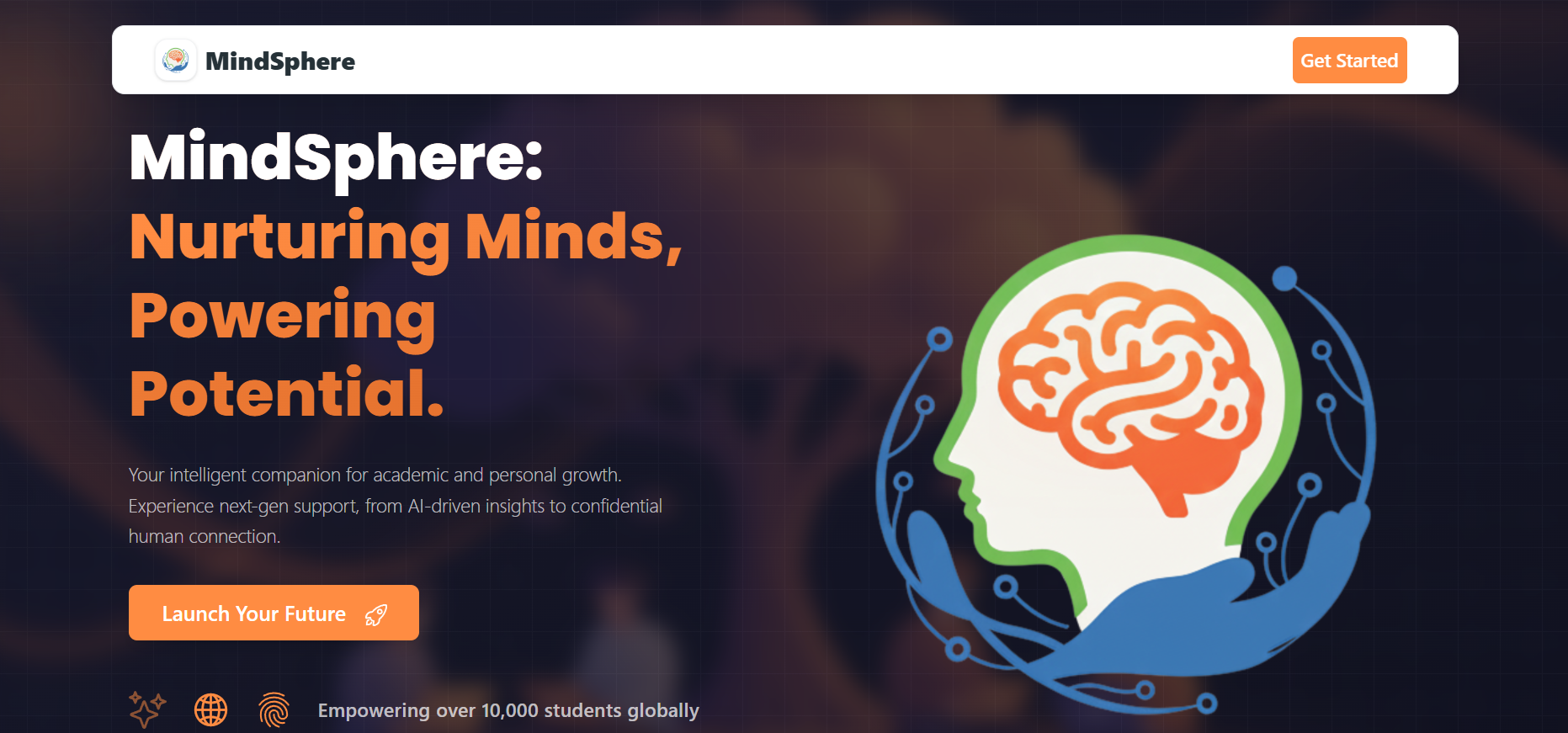
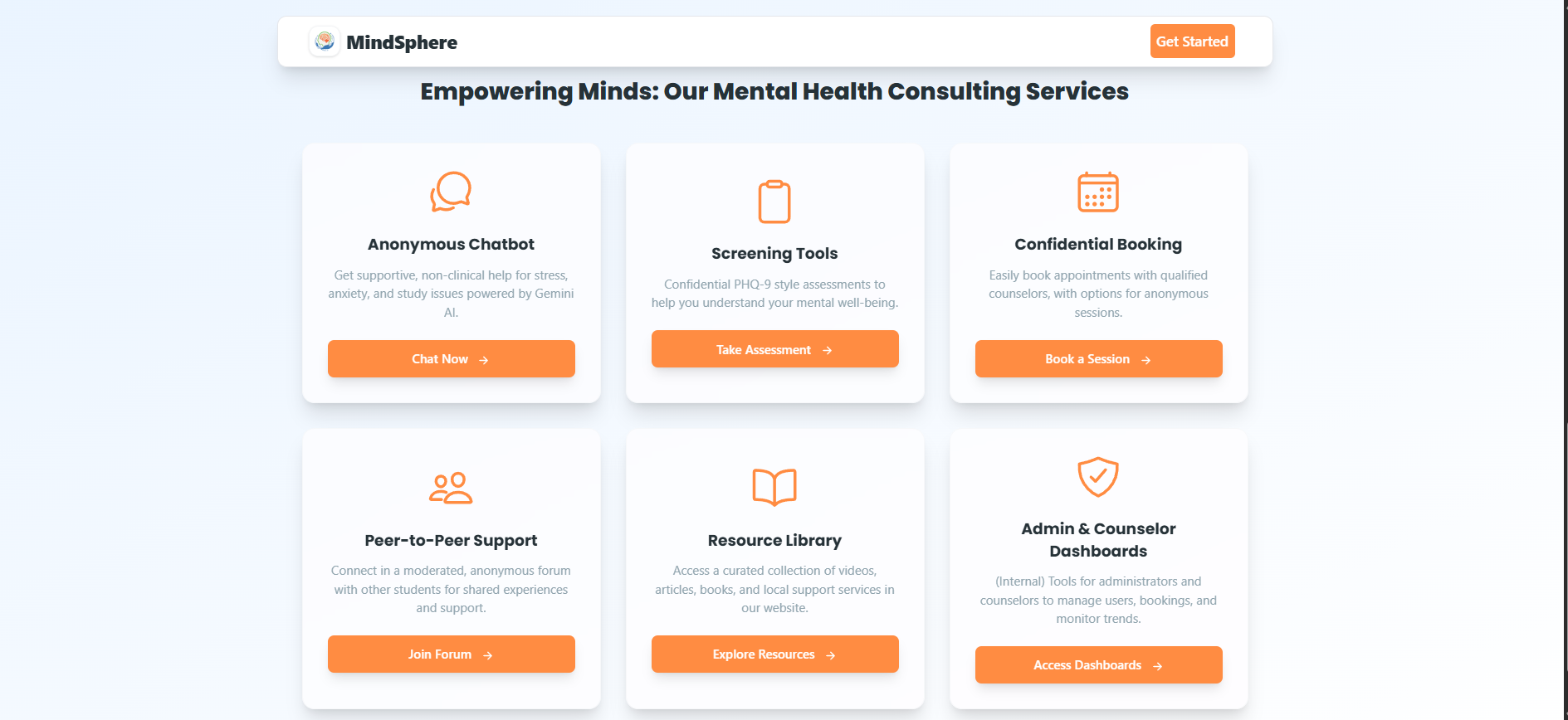
MindSphere is a comprehensive digital mental health support platform designed specifically for educational institutions. It provides a multi-layered approach to student wellness through an integrated suite of features:
For Students:
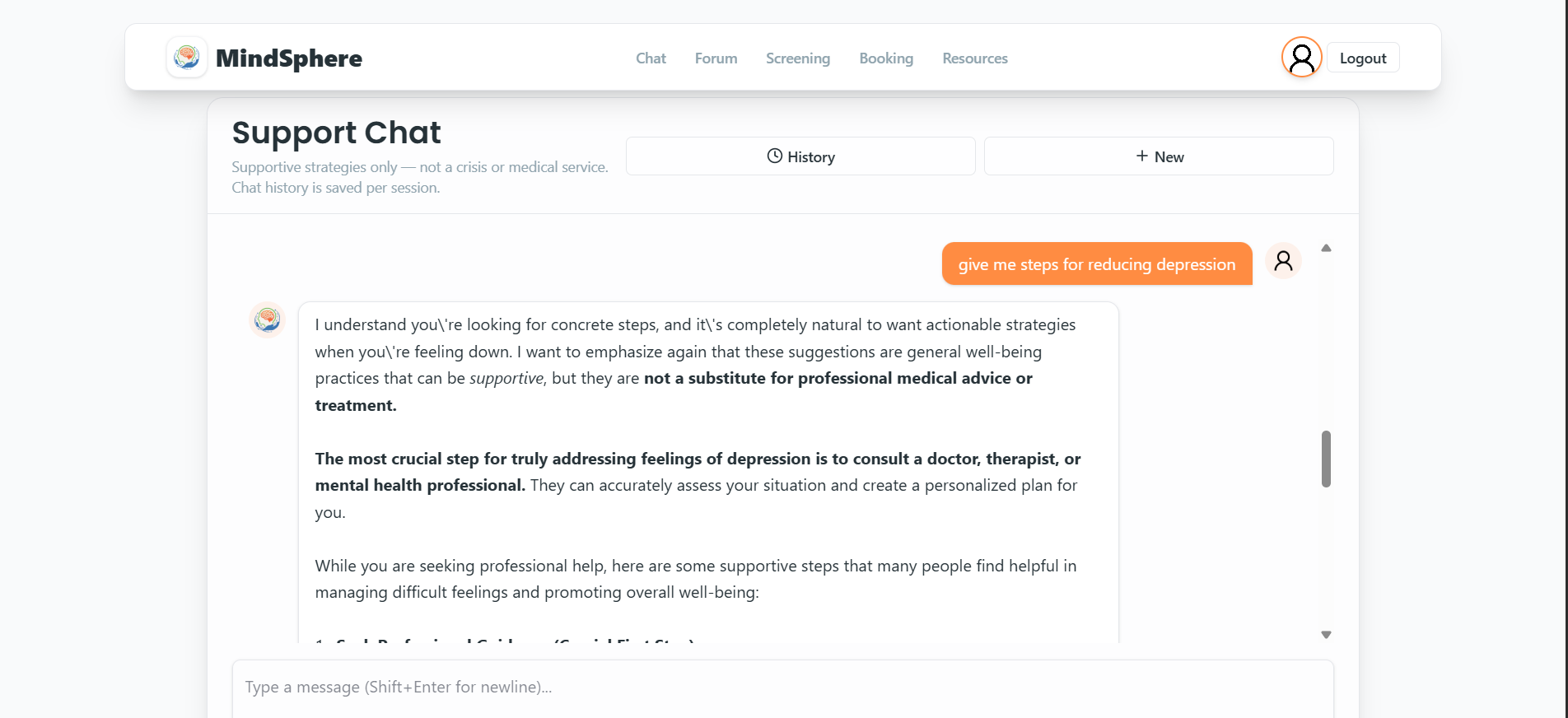
- 24/7 AI-Powered Chatbot: Provides immediate, empathetic support and evidence-based coping strategies when students need help, even outside counseling hours
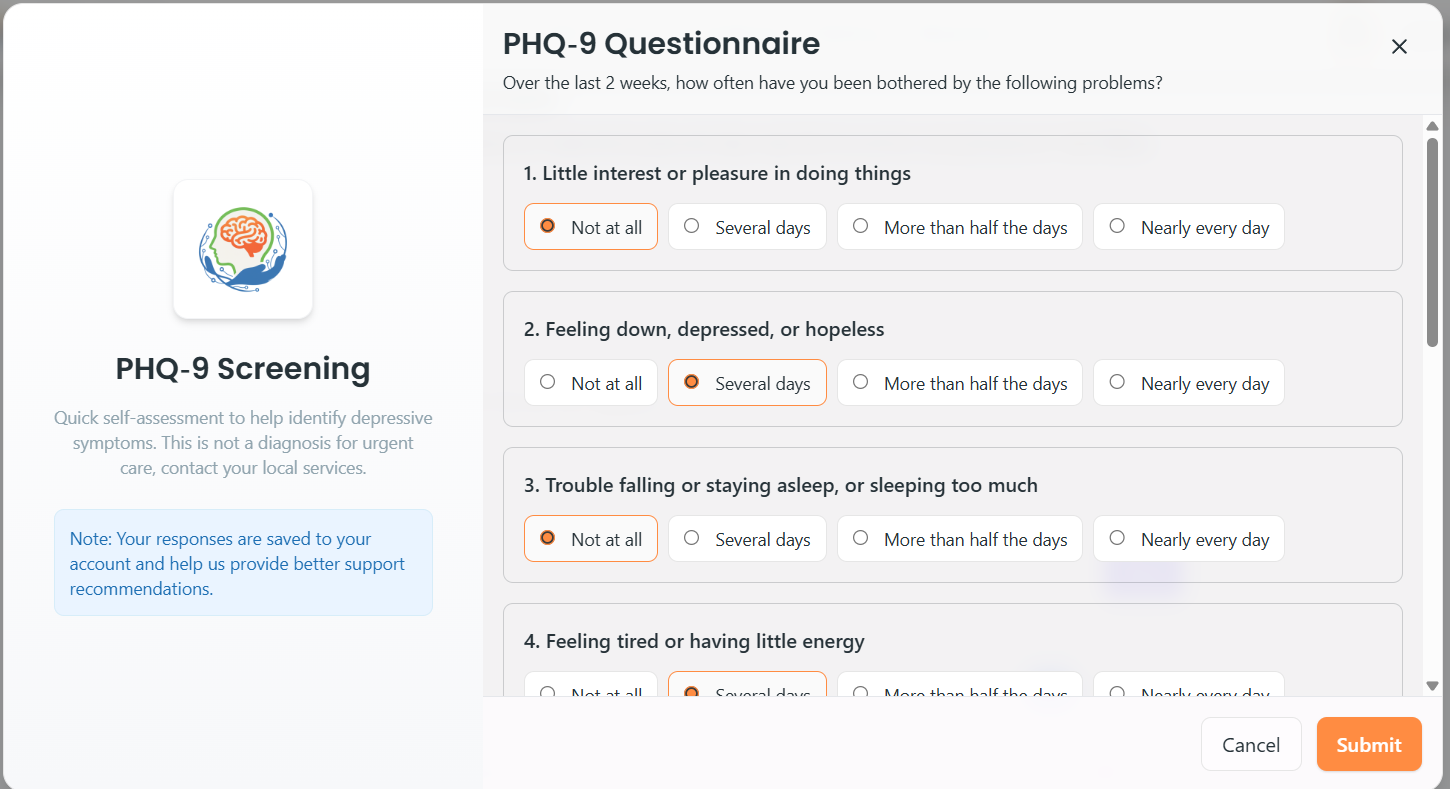
- PHQ-9 Screening Tool: Validated clinical assessment that helps students understand their mental health status and track changes over time
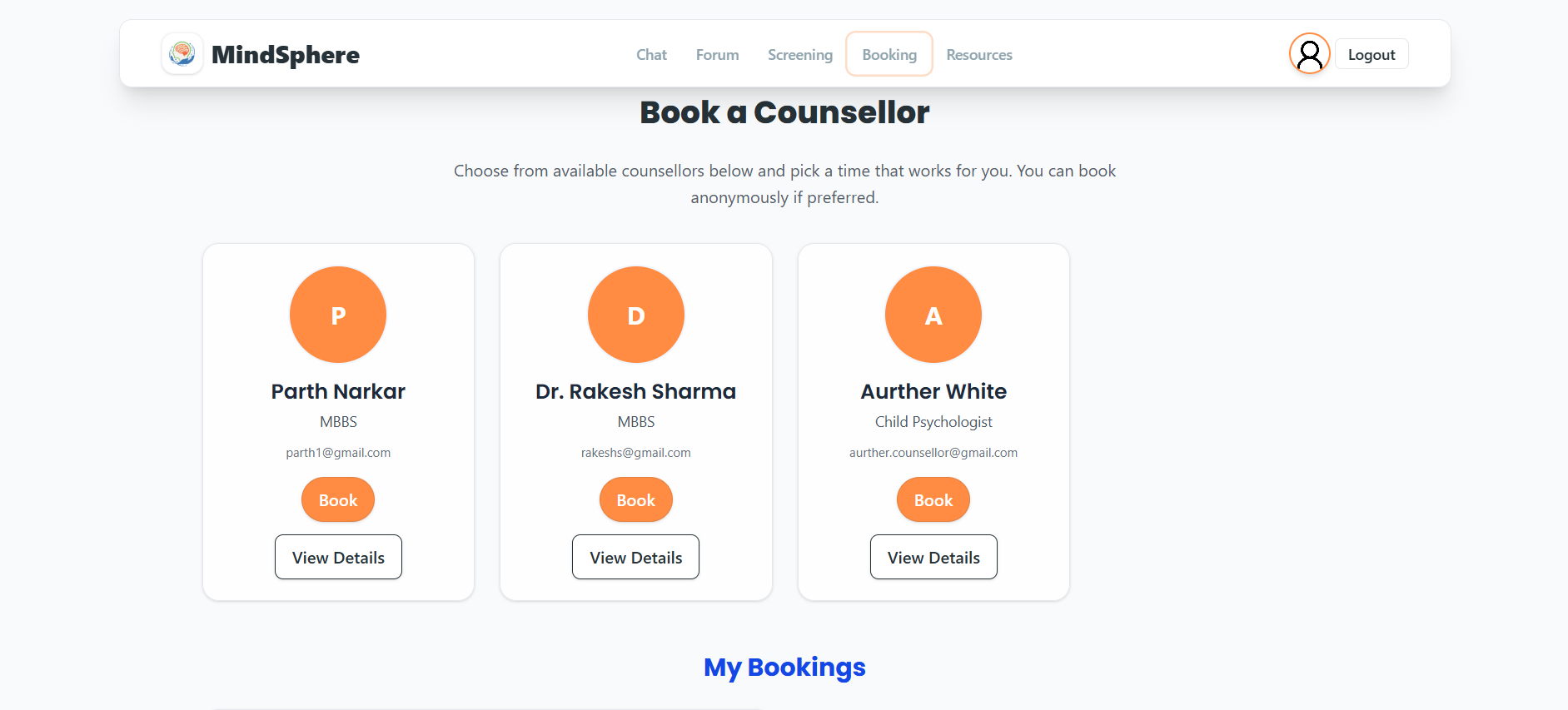
- Appointment Booking System: Streamlined scheduling with licensed counselors, eliminating the friction of traditional booking processes
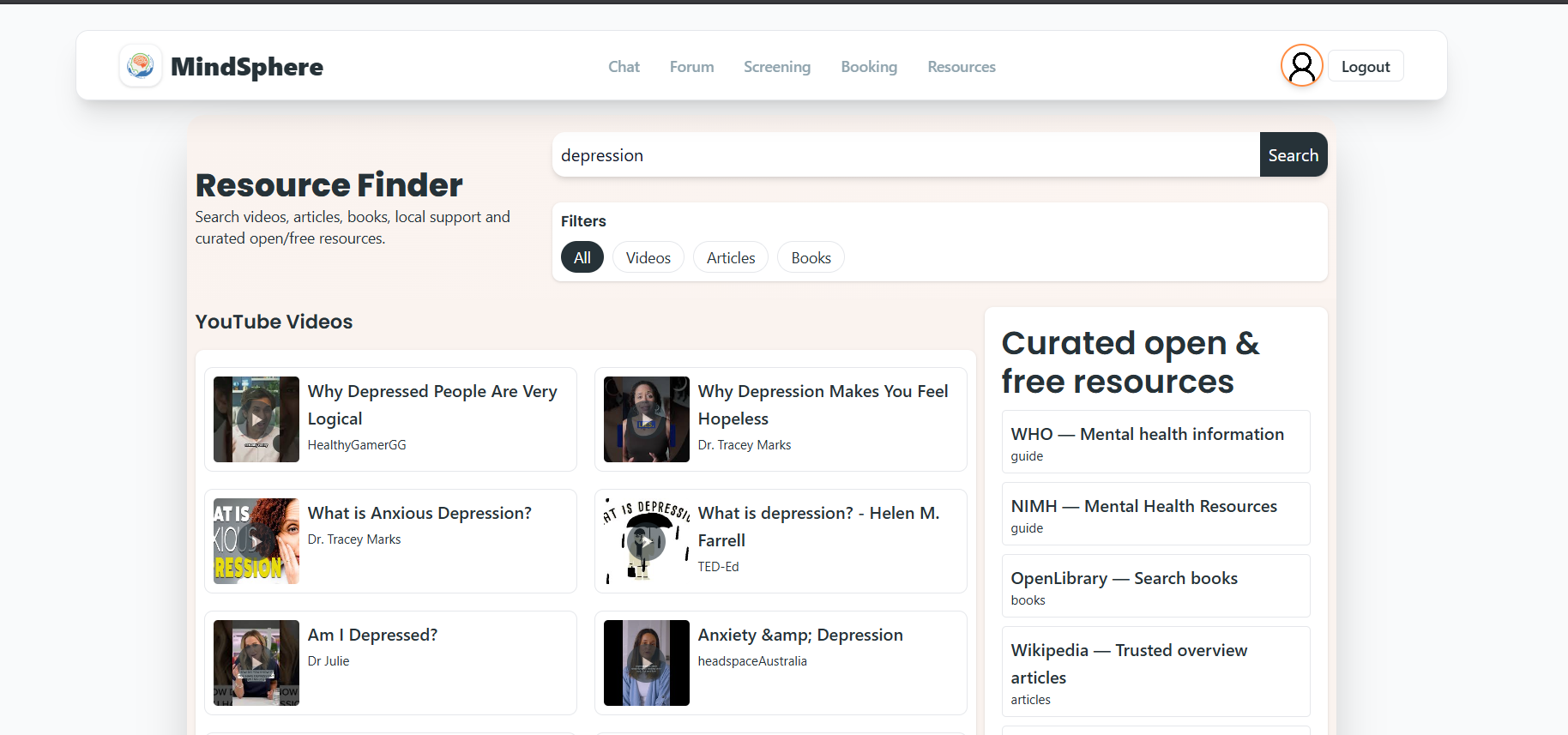
- Resource Library: Curated mental health resources, self-help materials, and educational content tailored to student needs
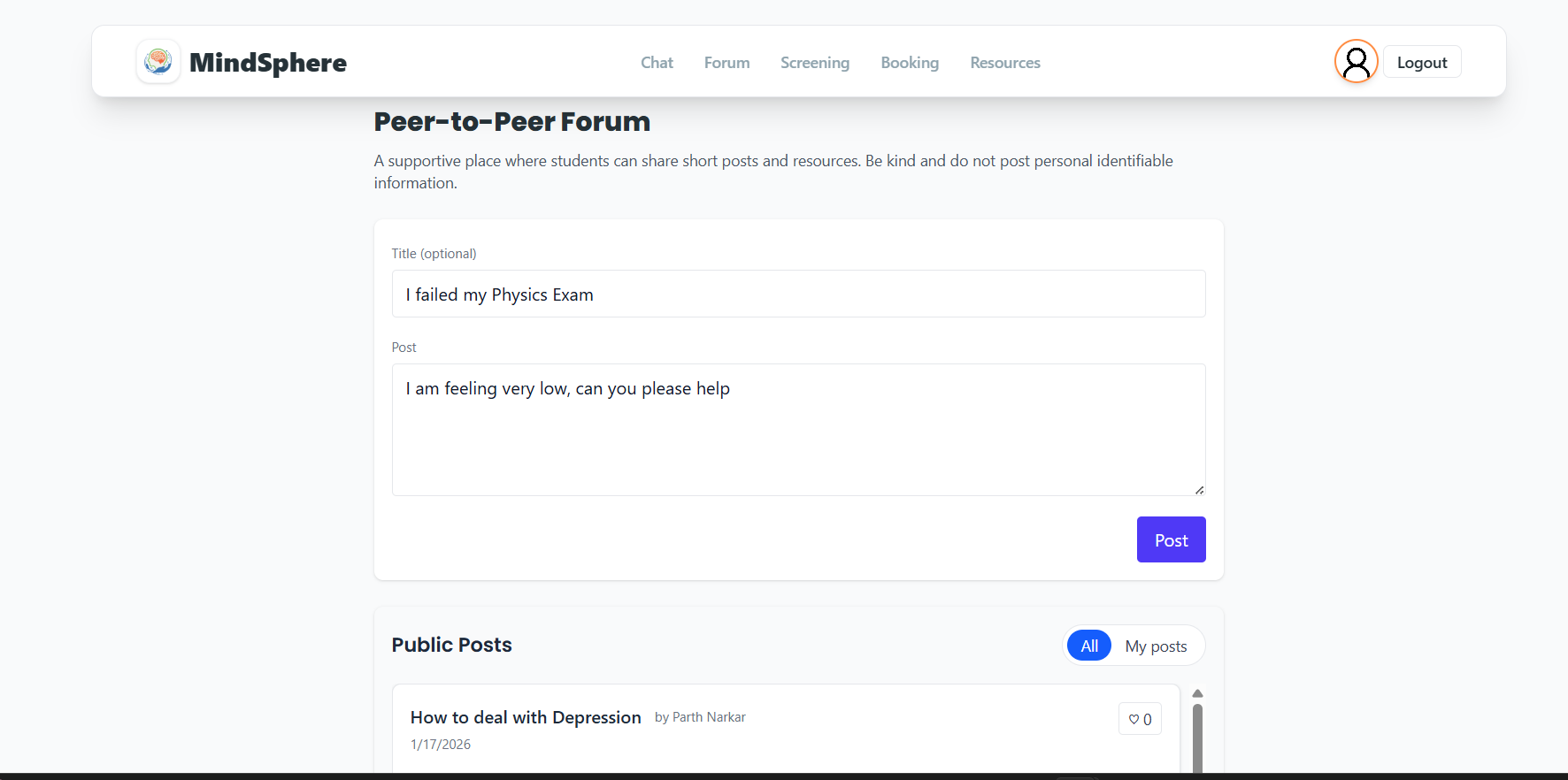
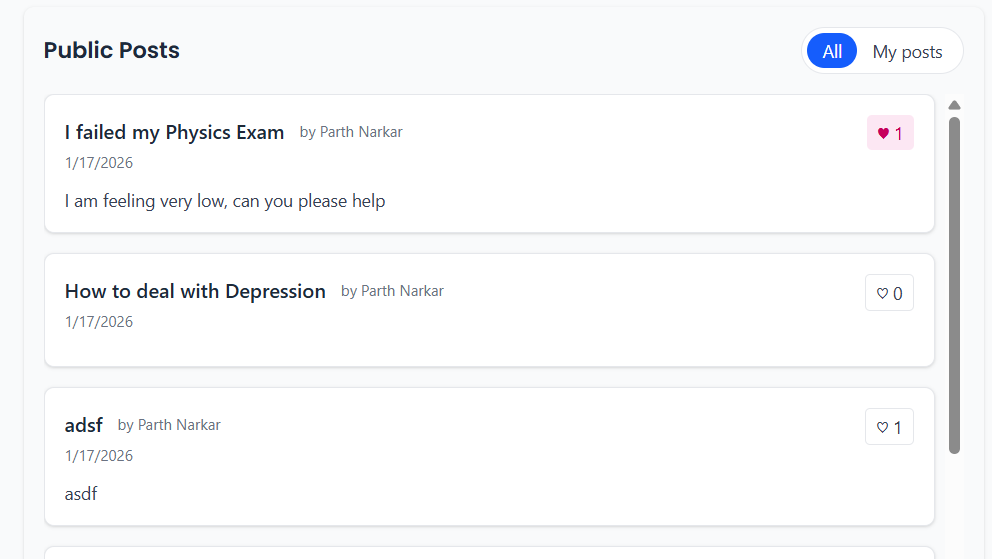
- Peer Support Forum: Safe, moderated community space where students can share experiences, reduce isolation, and find solidarity
For Counselors:
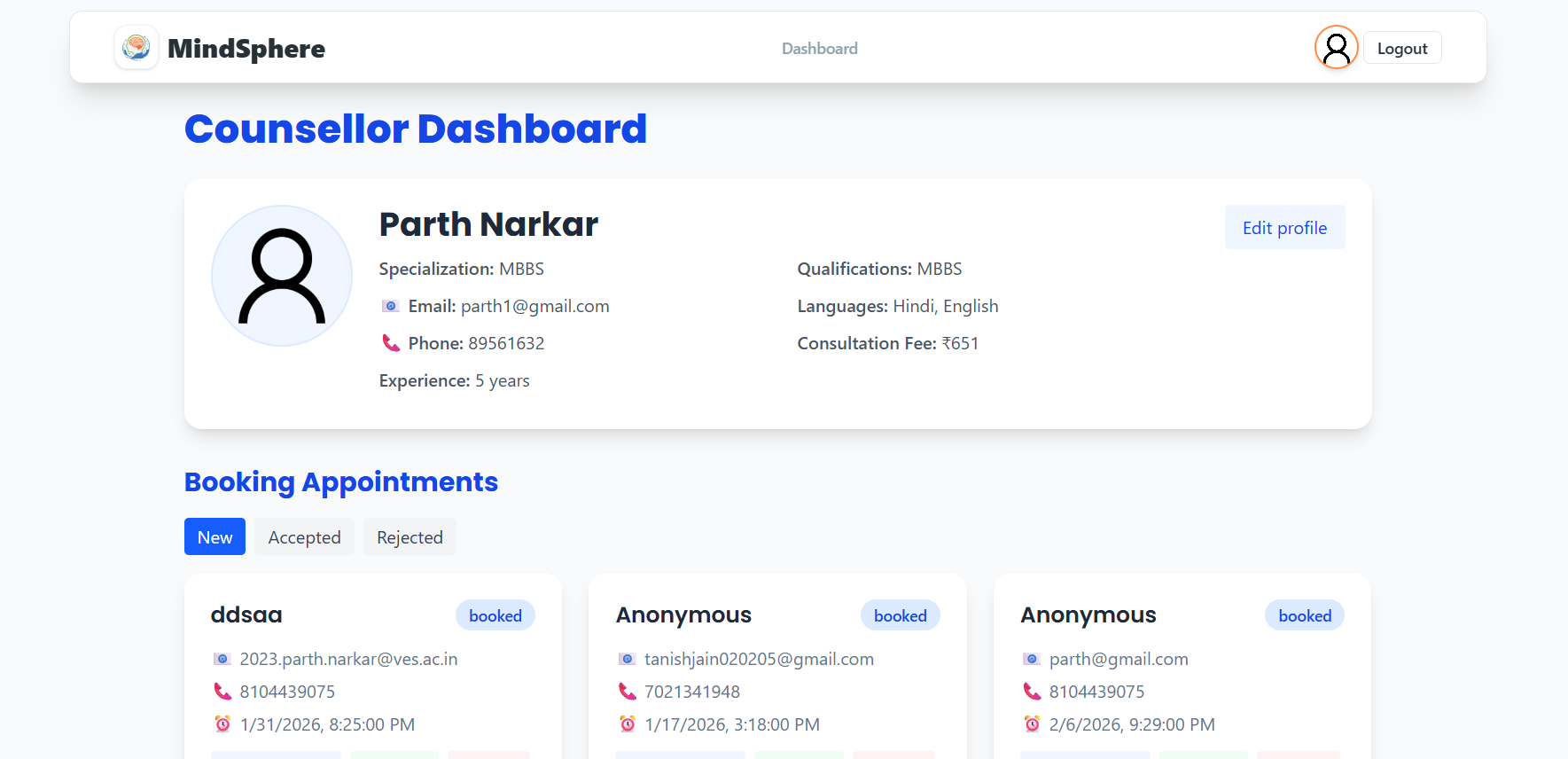
- Client Dashboard: Centralized view of assigned students, upcoming appointments, and client information
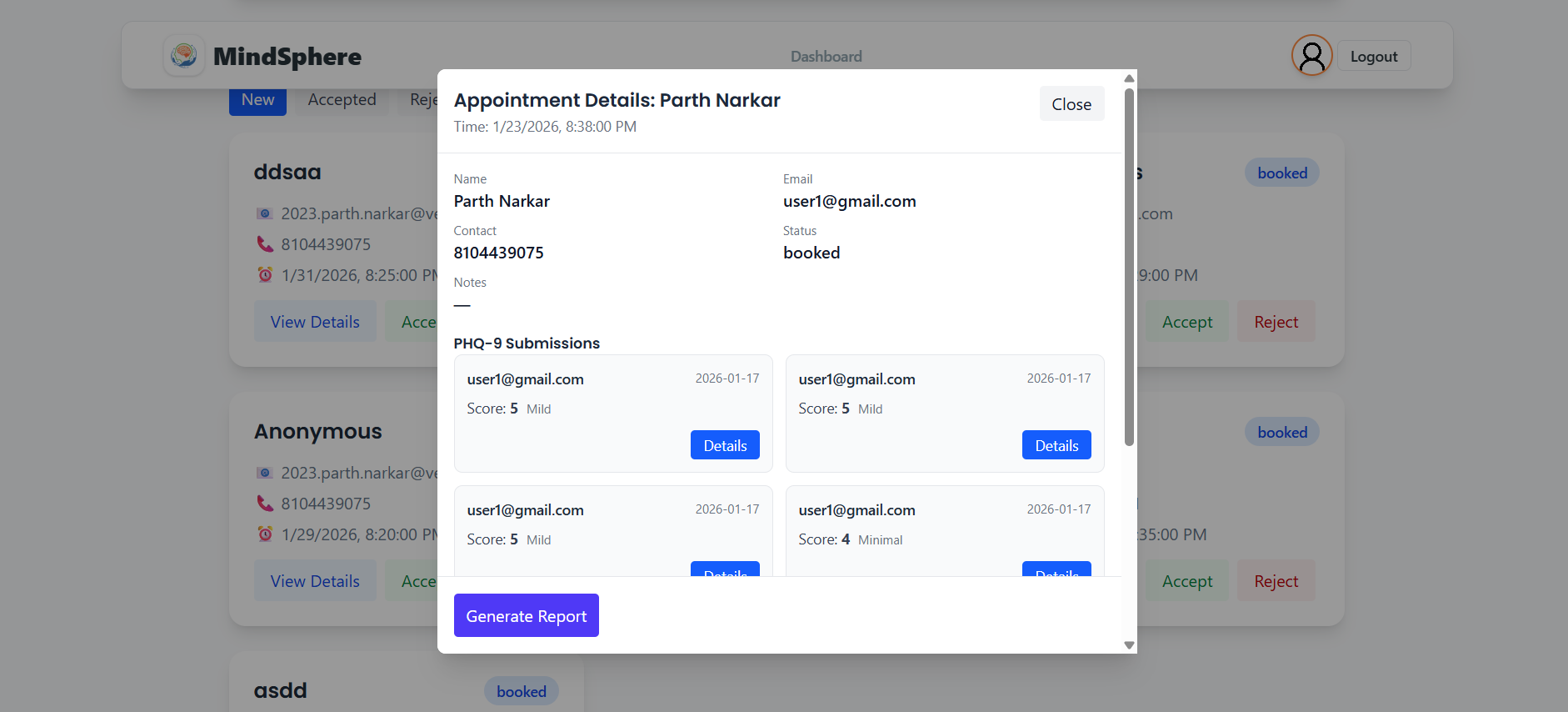
- PHQ-9 Analytics: Track client screening results and progress over time to inform treatment
- Session History Access: Review chat transcripts and resource searches to better understand client needs
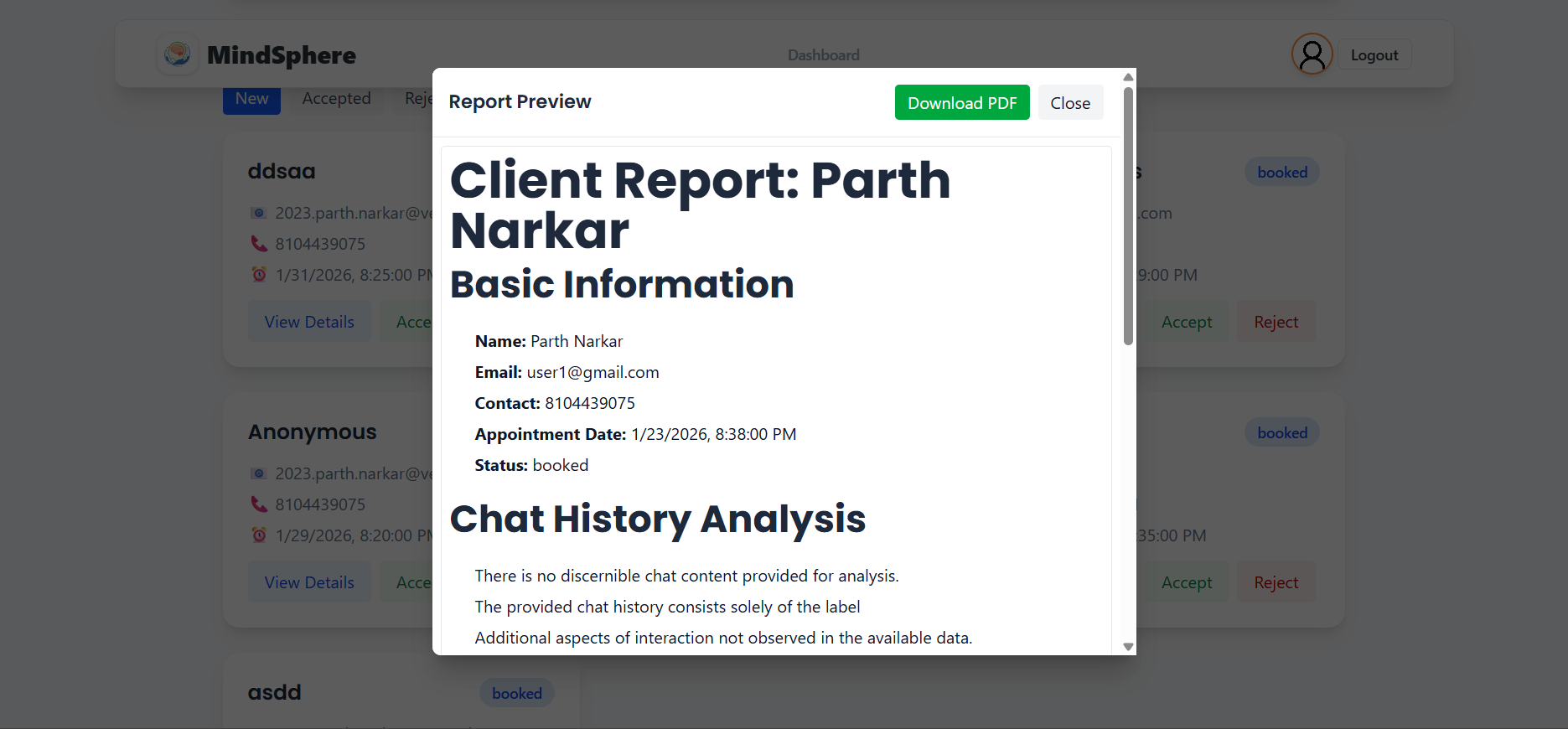
- Report Generation: Create comprehensive reports on client interactions and progress
- Client Management Tools: Monitor and manage counselor-client relationships effectively
For Administrators:
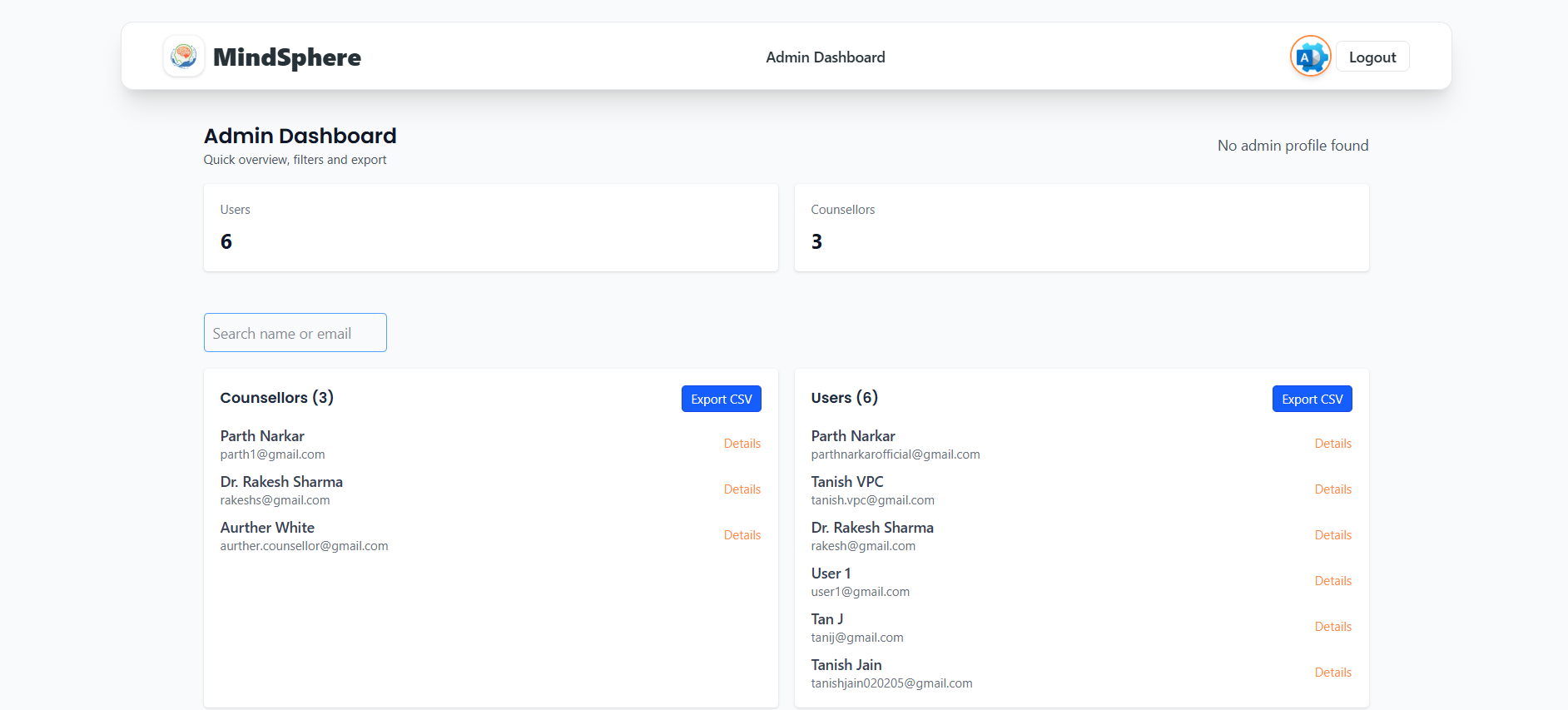
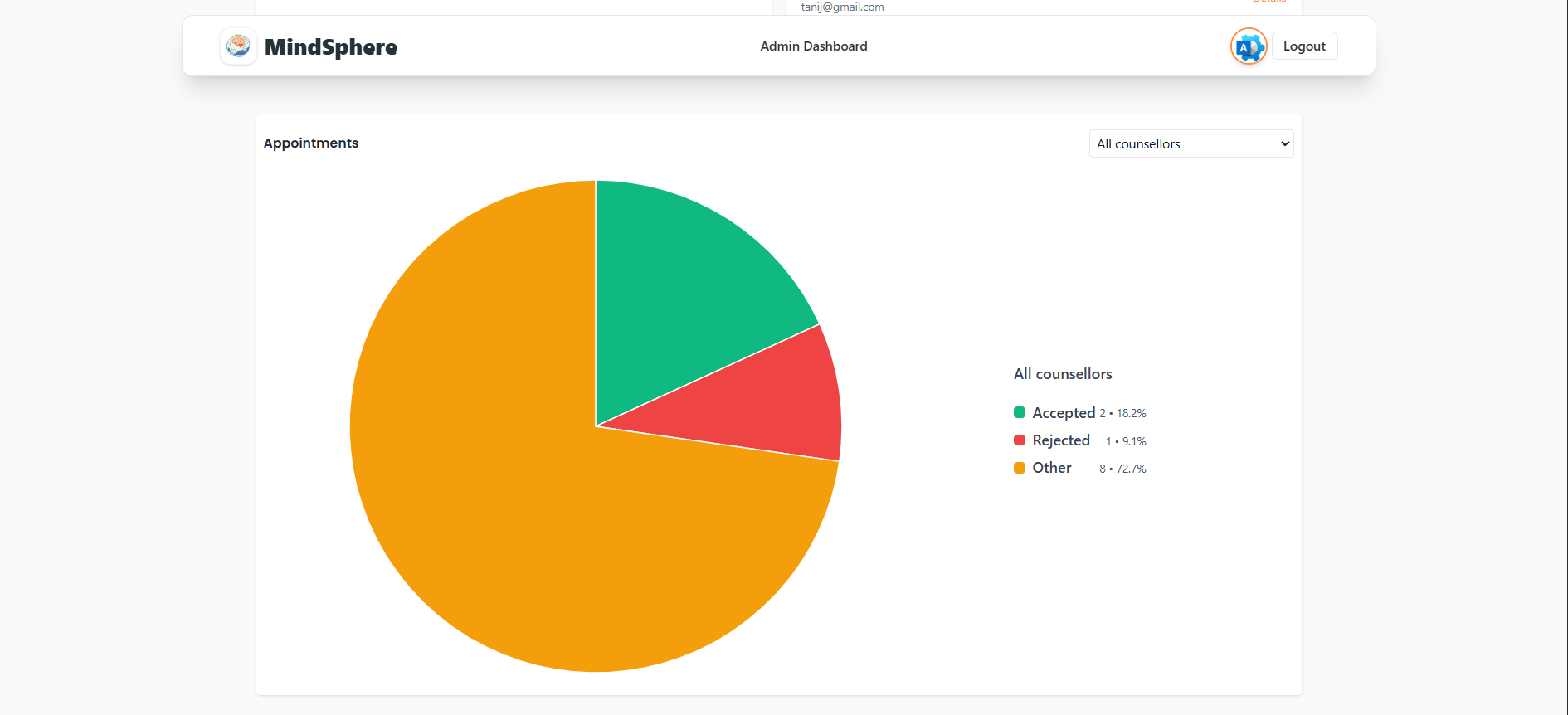
- Real-time Metrics Dashboard: System-wide statistics on active users, screenings completed, appointments scheduled, and resource utilization
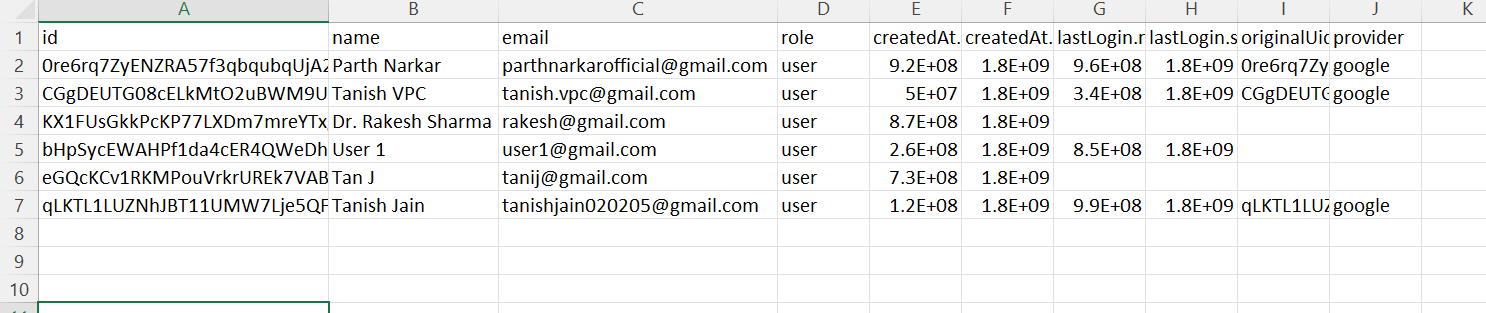
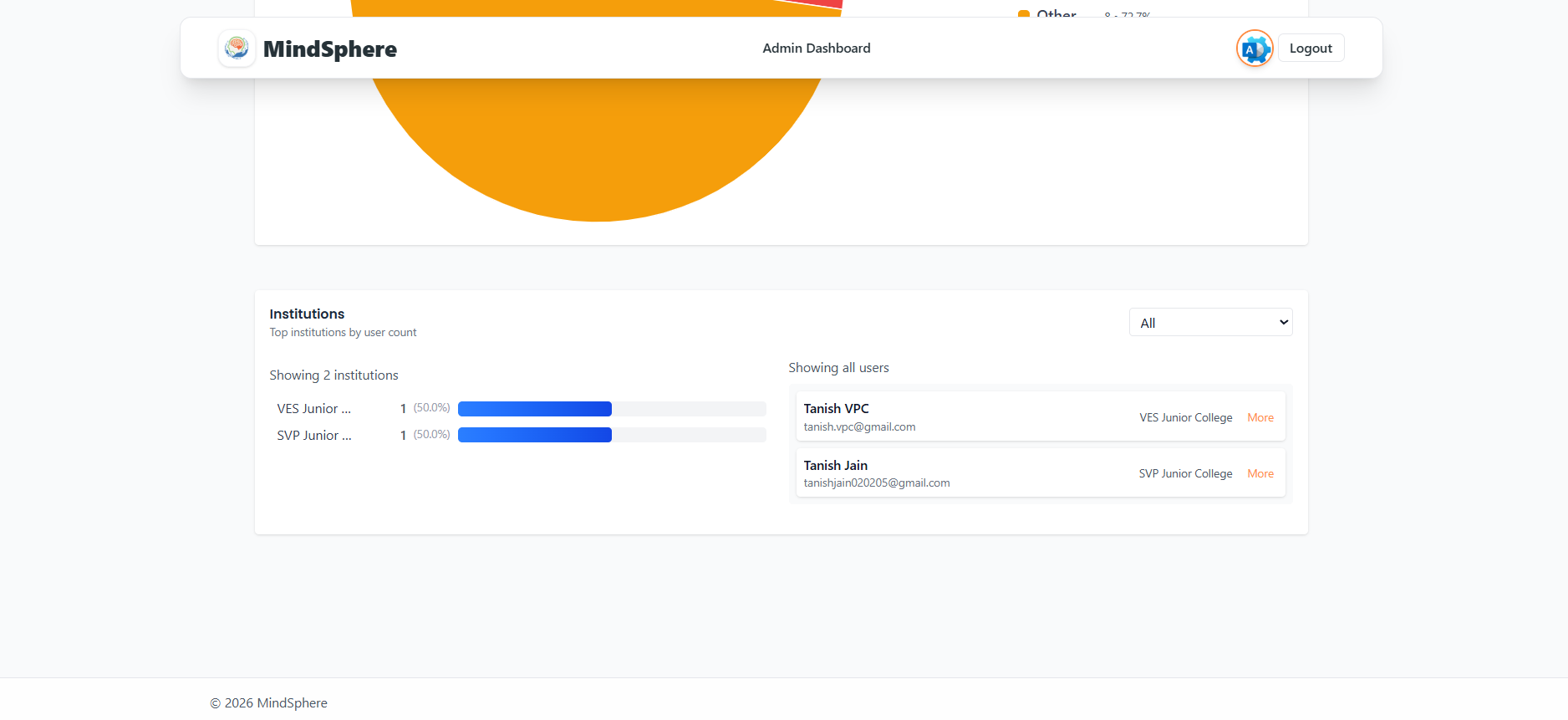
- User Management: Oversee all users, counselors, and administrators across the platform
- Appointment Oversight: Monitor scheduling patterns and counselor availability
- Live Data Subscriptions: Real-time updates from Firestore for dynamic system monitoring
The platform intelligently detects crisis situations through intent classification and escalation detection, automatically notifying appropriate personnel when intervention may be needed.
How we built it
We architected MindSphere as a modern, scalable full-stack application with clear separation of concerns:
Frontend Architecture
- React 19.1.1 + Vite 7.1.7: Leveraged the latest React features with Vite's lightning-fast build tooling for optimal development experience
- Tailwind CSS 4.1.13: Implemented a responsive, accessible design system using utility-first CSS
- React Router: Built role-based routing to ensure users only access appropriate features
- Firebase Authentication: Integrated secure, industry-standard authentication
- Firestore: Used for real-time user metadata, role management, and live data synchronization
Backend Architecture
- Flask 2.3+: Chose a lightweight, flexible Python framework for rapid API development
- MongoDB: Implemented NoSQL database for flexible schema and efficient querying of chat sessions, screenings, forum posts, and resources
- Google Generative AI (Gemini): Integrated state-of-the-art language model for intelligent, context-aware chatbot responses
- Modular Design: Separated concerns across modules:
app.py: Main application routes and endpoint handlersutils/db.py: Database abstraction and helper functionsutils/model.py: AI model initialization and inference wrapperutils/helpers.py: Prompt engineering and business logic
Key Technical Implementation Details
1. Intelligent Chatbot System
# Workflow simplified
user_message → build_context_aware_prompt(message, history)
            → generate_coping_text(prompt)
            → analyze_response(intent_classification, escalation_detection)
            → return {response, escalate, intent, confidence}
We engineered carefully crafted system prompts that:
- Establish empathetic, supportive tone while maintaining appropriate boundaries
- Include safety guidelines to avoid providing clinical diagnoses or medical advice
- Implement crisis detection through pattern recognition
- Maintain conversation context across multi-turn interactions
2. PHQ-9 Integration We implemented the clinically validated Patient Health Questionnaire-9, which measures depression severity on a scale from 0-27:
$$\text{PHQ-9 Score} = \sum_{i=1}^{9} q_i \text{ where } q_i \in {0, 1, 2, 3}$$
Score interpretation:
- 0-4: Minimal depression
- 5-9: Mild depression
- 10-14: Moderate depression
- 15-19: Moderately severe depression
- 20-27: Severe depression
3. Role-Based Access Control (RBAC) Implemented three-tier permission system:
User Authentication (Firebase)
    ↓
Role Determination (Firestore user.role)
    ↓
Protected Routes (React Router + Guards)
    ↓
Backend Authorization (Token verification)
4. Real-time Data Synchronization
Used Firestore's onSnapshot listeners for live updates:
// Admin dashboard subscribes to live metrics
onSnapshot(collection(db, 'appointments'), (snapshot) => {
  updateMetrics(snapshot.docs);
});
Development Workflow
- Architecture Planning: Mapped user journeys, designed database schemas, and created API contracts
- Incremental Development: Built features iteratively with continuous integration
- Testing Strategy: Developed
ultimate_server_test.pyfor endpoint validation - Deployment Flexibility: Designed for both serverless (Vercel) and containerized deployment
Challenges we ran into
1. AI Safety and Responsibility
Challenge: Creating an AI chatbot that provides genuine support without crossing into clinical territory or missing critical warning signs.
The Dilemma: We needed the chatbot to be empathetic and helpful, but not provide medical advice, diagnoses, or treatment recommendations. Additionally, we had to ensure it could detect crisis situations without creating false positives that would overwhelm counselors.
Solution: We implemented a multi-layered safety approach:
- Prompt Engineering: Spent significant time crafting system prompts that establish clear boundaries: "I'm here to listen and suggest coping strategies, but I'm not a replacement for professional help"
- Intent Classification: Built a scoring system that analyzes message content for concerning patterns:
Intent Categories: crisis, anxiety, depression, stress, general_wellness Confidence Threshold: 0.7 triggers escalation review - Escalation Detection: Implemented keyword analysis combined with contextual understanding to flag messages containing self-harm mentions, hopelessness, or crisis language
- Human-in-the-Loop: Ensured all escalated conversations route to licensed counselors for review
This required iterating through dozens of prompt variations and testing against various conversation scenarios.
2. State Management Across Distributed Systems
Challenge: Keeping data synchronized across student, counselor, and admin interfaces when actions occur (appointments booked, screenings completed, forum posts created).
The Complexity: Consider this scenario:
- Student books appointment →
- Counselor dashboard must update immediately →
- Admin metrics must reflect new booking →
- Student's profile must show upcoming appointment →
- Email notifications must be sent
With REST APIs, this could lead to stale data, race conditions, or inconsistent states.
Solution: We implemented a hybrid approach:
- Firestore Real-time Listeners: For time-sensitive data (appointments, user status)
- MongoDB for Historical Data: Chat sessions, PHQ-9 results, forum posts
- Optimistic UI Updates: Frontend updates immediately, then syncs with backend
- Event-Driven Notifications: SMTP emails triggered by state changes
The admin dashboard particularly benefited from Firestore's real-time capabilities, giving administrators live insights without polling.
3. Privacy, Security, and Compliance Architecture
Challenge: Managing highly sensitive mental health data while ensuring appropriate access controls, audit trails, and compliance with privacy regulations.
Considerations:
- Mental health data is among the most sensitive personal information
- Different roles need different access levels (counselors see only their clients)
- Need to support emergency access scenarios
- Must maintain audit logs for accountability
- Cannot log sensitive content inappropriately
Solution:
- Authentication Layer: Firebase handles identity management with industry-standard security
- Authorization Layer: Custom middleware verifies roles before granting access:
python @require_role(['counselor', 'admin']) def view_client_data(client_id): # Only counselors assigned to this client can access - Data Minimization: PII is hashed in logs, only necessary data is transmitted
- Encryption: HTTPS for transport, MongoDB encryption at rest
- Clear Disclaimers: Prominent notices that MindSphere complements but doesn't replace professional care
We also documented that MindSphere is a prototype and requires additional security hardening, HIPAA compliance review, and clinical governance before production use with real patient data.
4. Balancing AI Response Quality with Cost and Latency
Challenge: Generative AI calls can be expensive and slow, especially with long conversation histories.
The Math: Each API call to Gemini costs based on tokens: $$\text{Cost} = (\text{input_tokens} \times \text{price_per_1k_input}) + (\text{output_tokens} \times \text{price_per_1k_output})$$
With conversation history, input tokens grow linearly: $O(n)$ where $n$ is number of messages.
Solution:
- Context Window Management: Truncate history to most recent $k$ messages (we used $k=10$)
- Prompt Optimization: Reduced prompt length while maintaining quality
- Caching Strategy: Considered caching common queries (not implemented in prototype)
- Fallback Mechanisms: Graceful degradation when model is unavailable
5. Development Environment Complexity
Challenge: Coordinating frontend, backend, database, AI service, authentication, and email systems during development.
Initial Setup Pain Points:
- Developers needed MongoDB, Firebase project, Gemini API key, SMTP server
- Environment variables scattered across
.envfiles - Service dependencies caused failed startups
Solution:
- In-Memory Fallbacks: Backend runs without MongoDB for quick demos
- MailHog Integration: Local SMTP server captures emails without external dependencies
- Comprehensive
.env.exampleFiles: Clear documentation of required variables - Docker Consideration: Discussed containerization for easier onboarding (future work)
6. Serverless vs. Traditional Deployment Trade-offs
Challenge: Deciding between serverless (Vercel) and traditional hosting affected our architecture.
Serverless Constraints:
- Cold starts delay first request
- Connection pooling to MongoDB is problematic
- Execution time limits for long-running requests
- Stateless execution environment
Solution: We architected for flexibility:
server/api/index.pyas serverless entrypoint (Vercel)server/app.pyfor traditional WSGI deployment- Connection retry logic for database
- Documented both deployment paths
This allows teams to choose based on scale, budget, and operational preferences.
Accomplishments that we're proud of
1. Complete, Functional Ecosystem: We didn't just build a chatbot—we created an entire support infrastructure that serves students, counselors, and administrators. Each role has a polished, purpose-built interface.
2. Clinical Validation: Implementing the PHQ-9, a clinically validated screening tool, demonstrates our commitment to evidence-based approaches rather than just building "cool tech."
3. AI Safety Design: Our multi-layered approach to chatbot safety—prompt engineering, intent classification, escalation detection—shows responsible AI implementation in a sensitive domain.
4. Real-time Capabilities: The admin dashboard's live metrics and counselor notifications create a responsive system that feels modern and professional.
5. Production-Quality Code: Clean architecture, separation of concerns, comprehensive documentation, and testing infrastructure make this maintainable and extensible.
6. Deployment Flexibility: Supporting both serverless and traditional hosting shows we understand real-world operational requirements.
7. Team Collaboration: Six developers coordinated effectively across frontend, backend, database, and AI integration—a significant accomplishment in itself.
What we learned
Technical Skills
AI Integration & Prompt Engineering: We learned that integrating AI responsibly requires far more than API calls. Prompt engineering is an iterative craft—we went through 20+ prompt variations to achieve the right balance of empathy, helpfulness, and appropriate boundaries.
Real-time Data Architecture: Combining Firestore's real-time listeners with MongoDB's query flexibility taught us when to use each database paradigm. Real-time is powerful but not always necessary.
Role-Based Access Control: Implementing RBAC from scratch gave us deep appreciation for authentication vs. authorization, and the complexity of managing permissions across multiple interfaces.
Serverless Architecture: We learned the constraints and benefits of serverless computing, including cold starts, stateless execution, and connection pooling challenges.
Domain Knowledge
Mental Health Support Systems: We researched how student counseling centers operate, learned about clinical screening tools, and understood the importance of crisis protocols.
Medical Ethics & AI: Building for mental health forced us to think deeply about AI safety, informed consent, appropriate disclaimers, and the limitations of technology in healthcare.
Team & Project Management
Incremental Development: Building features iteratively (chat → screening → booking → forum) allowed us to maintain working software throughout development.
Documentation Importance: Our comprehensive README proved invaluable as team members onboarded to different parts of the codebase.
Trade-off Decision Making: Every architecture choice involved trade-offs (serverless vs. traditional, MongoDB vs. Firestore, real-time vs. polling). We learned to evaluate options systematically.
Personal Growth
Building with Purpose: Creating something that could genuinely help people dealing with mental health challenges gave our work meaning beyond technical achievement.
Responsible Innovation: We learned that in sensitive domains, "move fast and break things" is the wrong approach. Safety, privacy, and ethics must be foundational, not afterthoughts.
What's next for MindSphere
Immediate Next Steps (Technical Maturity)
1. Security Hardening
- Implement server-side token verification for all protected endpoints
- Add rate limiting to prevent abuse
- Conduct security audit and penetration testing
- Implement comprehensive audit logging for compliance
2. Production Database Migration
- Move from prototype in-memory fallbacks to fully persistent MongoDB
- Implement database backup and disaster recovery
- Add database migration system for schema evolution
3. Enhanced Testing
- Expand integration test coverage beyond smoke tests
- Add end-to-end testing for critical user journeys
- Implement load testing for scalability validation
Feature Enhancements
1. Advanced Chatbot Capabilities
- Multi-modal Support: Accept images (e.g., student sharing journal entries) using vision models
- Conversation Summarization: Generate summaries for counselors to review efficiently
- Personalization: Adapt responses based on user history and preferences
- Multi-language Support: Serve diverse student populations
2. Counselor Productivity Tools
- Scheduling Intelligence: AI-suggested appointment times based on urgency and availability
- Progress Tracking: Visual dashboards showing client improvement over time
- Intervention Recommendations: Evidence-based suggestions based on PHQ-9 trends
3. Data Analytics & Insights
- Trend Detection: Identify campus-wide mental health trends (anonymized)
- Early Warning System: Predict high-risk periods (e.g., finals week)
- Outcome Measurement: Track system effectiveness with validated metrics
Integration & Ecosystem
1. University System Integration
- Student Information Systems (SIS): Sync with enrollment data for automatic account creation
- Learning Management Systems: Integrate mental health resources into course platforms
- Campus Safety Systems: Connect with emergency response protocols
2. External Provider Network
- Teletherapy Platform Integration: Connect with external therapists for overflow capacity
- Crisis Hotline Integration: Direct connection to 988 Suicide & Crisis Lifeline
- Insurance Verification: Check student health insurance for coverage details
Research & Clinical Validation
1. Clinical Studies
- Partner with university research departments to study MindSphere's effectiveness
- Measure outcomes: reduction in crisis incidents, improved PHQ-9 scores, satisfaction rates
- Publish findings in peer-reviewed journals
2. Evidence-Based Content
- Collaborate with clinical psychologists to validate chatbot responses
- Implement cognitive-behavioral therapy (CBT) techniques programmatically
- Regular content review by licensed professionals
Compliance & Governance
1. HIPAA Compliance
- Business Associate Agreements (BAAs) with service providers
- Comprehensive privacy impact assessment
- HIPAA security rule implementation
2. Clinical Oversight
- Establish clinical advisory board
- Regular review of escalated conversations
- Continuous quality improvement process
Scalability & Performance
1. Infrastructure
- Implement CDN for static assets
- Database query optimization and indexing
- Implement caching layer (Redis) for frequently accessed data
2. Monitoring & Observability
- Implement structured logging with tools like DataDog or New Relic
- Real-time alerting for system issues
- User experience monitoring and error tracking
Accessibility & Inclusion
1. Universal Design
- WCAG 2.1 AA compliance for accessibility
- Screen reader optimization
- Keyboard navigation support
2. Cultural Competency
- Culturally adapted content for diverse populations
- Support for different mental health frameworks
- Community-specific resources
Long-term Vision
Preventive Mental Health Ecosystem: Transform MindSphere from reactive support to proactive wellness platform:
- Wellness Programs: Guided meditation, stress management courses, resilience building
- Community Building: Group therapy sessions, support groups, wellness challenges
- Holistic Health: Integration with sleep tracking, exercise, nutrition for comprehensive wellness
AI Research Platform: Use anonymized, consented data to advance mental health AI research:
- Better crisis detection algorithms
- More effective coping strategy recommendations
- Personalized intervention timing
Expansion Beyond Universities: Adapt MindSphere for K-12 schools, corporate wellness programs, and community mental health centers.
MindSphere represents our commitment to making mental health support more accessible, immediate, and effective. While we're proud of what we've built during this hackathon, we recognize this is just the beginning. With continued development, clinical validation, and community feedback, MindSphere has the potential to meaningfully impact how educational institutions support student mental health.
Built with ❤️ and hope for better mental health support everywhere.

Log in or sign up for Devpost to join the conversation.