-
-
Exposure Load
-
Recovery Break
-
Exposure Load
-
Dashboard
-
Protected content
-
Moderation
Inspiration
Behind the growth of AI systems are people who label, filter, and moderate the data that makes these systems possible.
Content moderators and data annotators can be exposed to harmful or disturbing content as part of their work. Yet most moderation workflows are designed primarily around productivity and task completion.
We wanted to explore a simple question:
What if the tools used to make content safer could also protect the people doing the work?
This question led us to create MindShield AI, an ethical AI assistant focused on reducing unnecessary exposure to harmful content while allowing moderators to continue doing their job.
What it does
MindShield AI is designed as a protective layer for content moderation and data annotation workflows.
Its core workflow is:
Content → Risk → Protection → Exposure Load → Recovery → Resume
The prototype demonstrates this experience through an interactive moderation workflow.
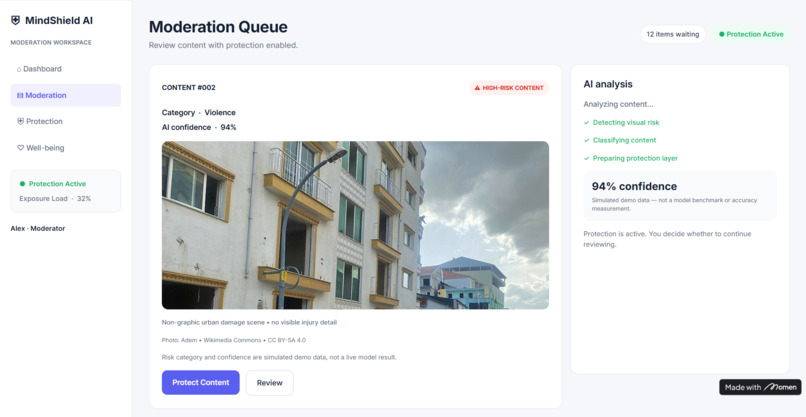
1. Risk identification
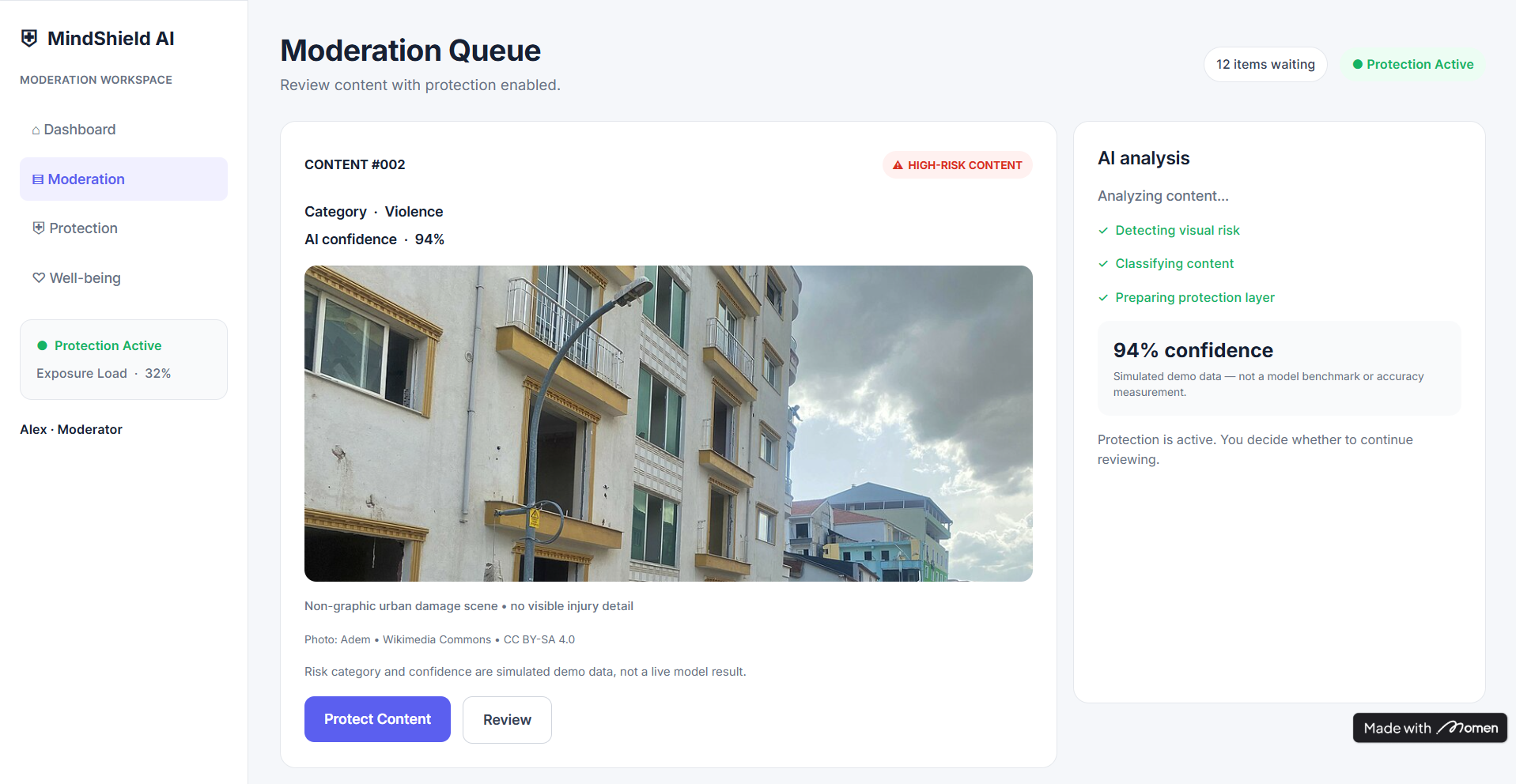
MindShield identifies potentially high-risk content and presents a risk category and confidence indicator.
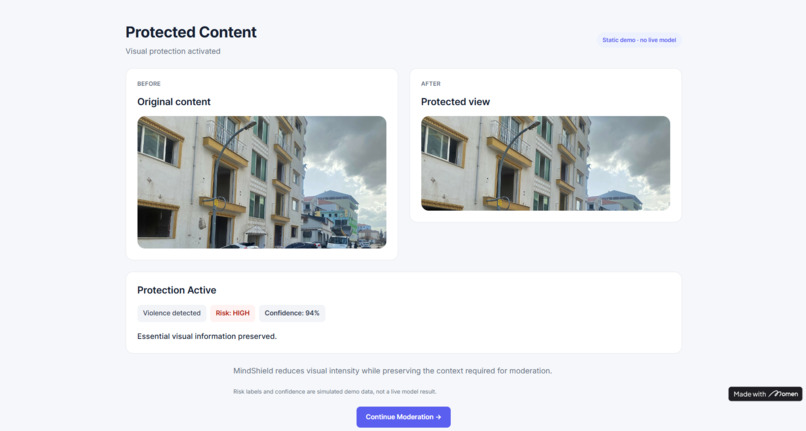
2. Protected content
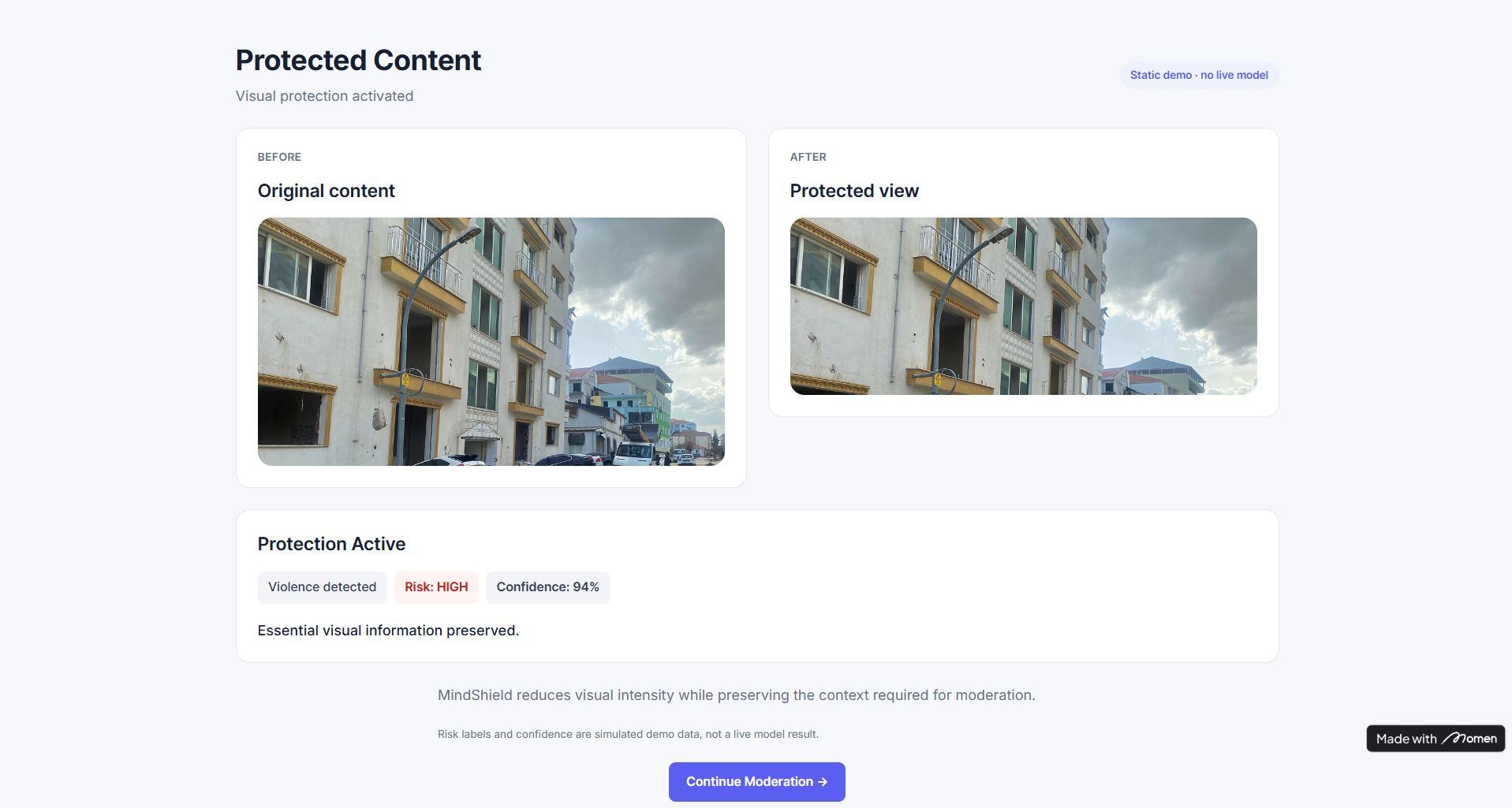
Instead of simply blocking the task, MindShield reduces the visual intensity of potentially harmful content through transformations such as desaturation, reduced detail, and moderate blur.
The goal is to preserve the information needed for moderation while reducing unnecessary visual exposure.
3. Exposure Load
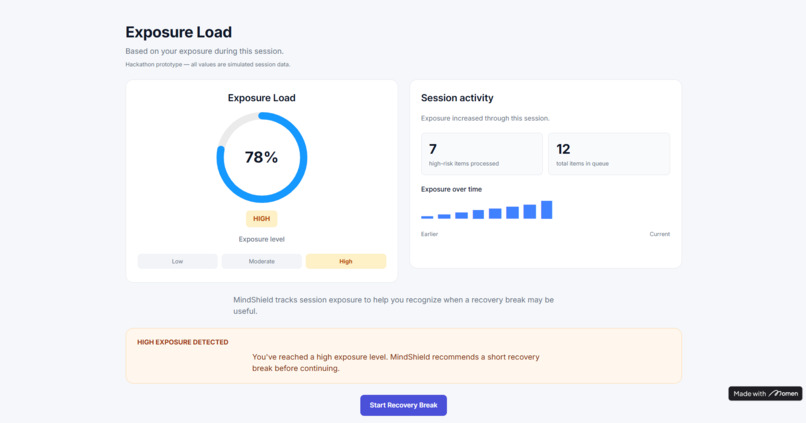
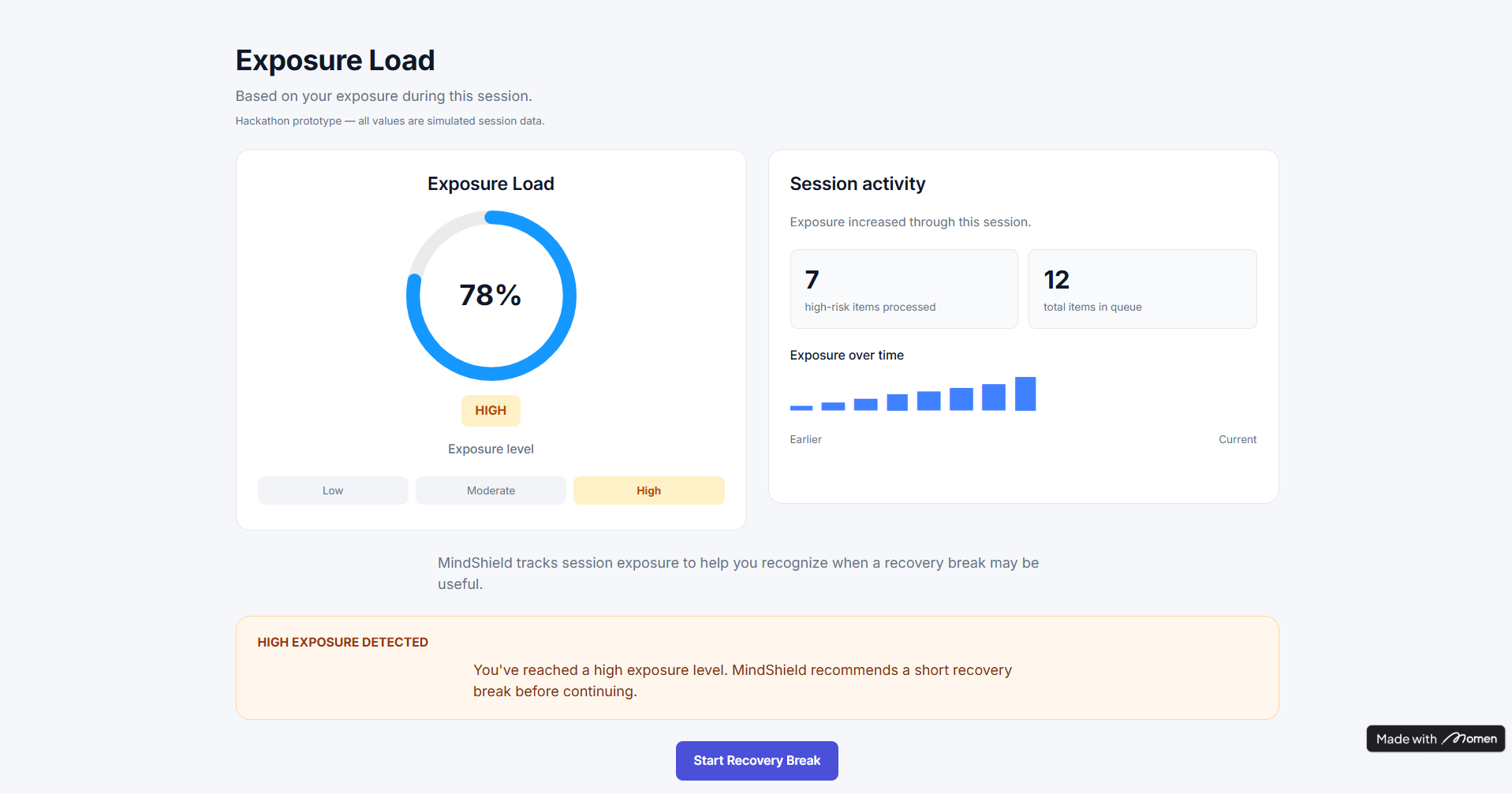
MindShield displays an Exposure Load indicator based on the content encountered during the session.
When the exposure becomes high, the system recommends a recovery break.
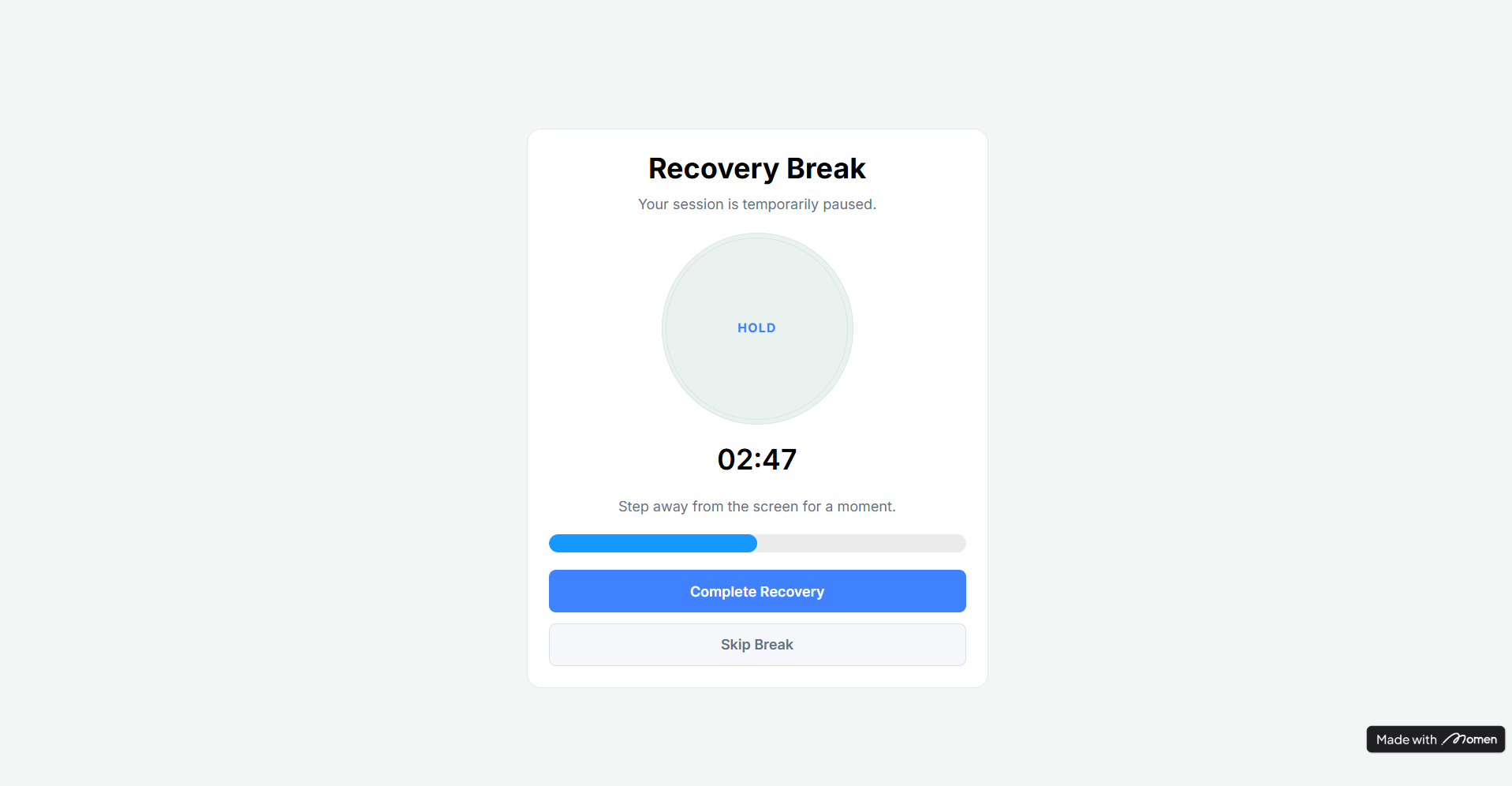
4. Recovery
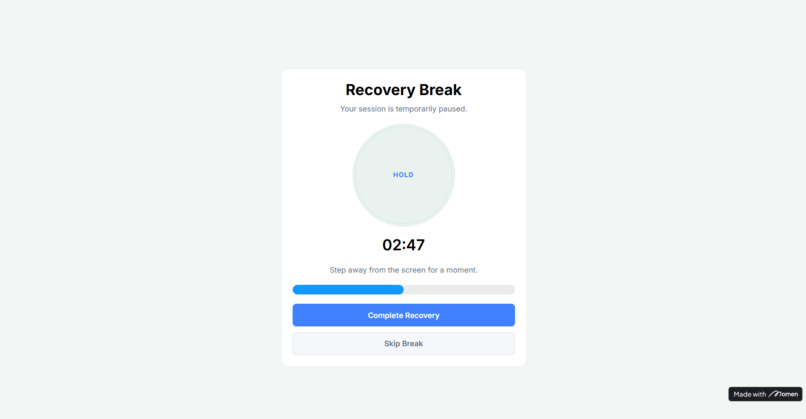
The workflow is temporarily paused and the user is guided through a short visual breathing exercise.
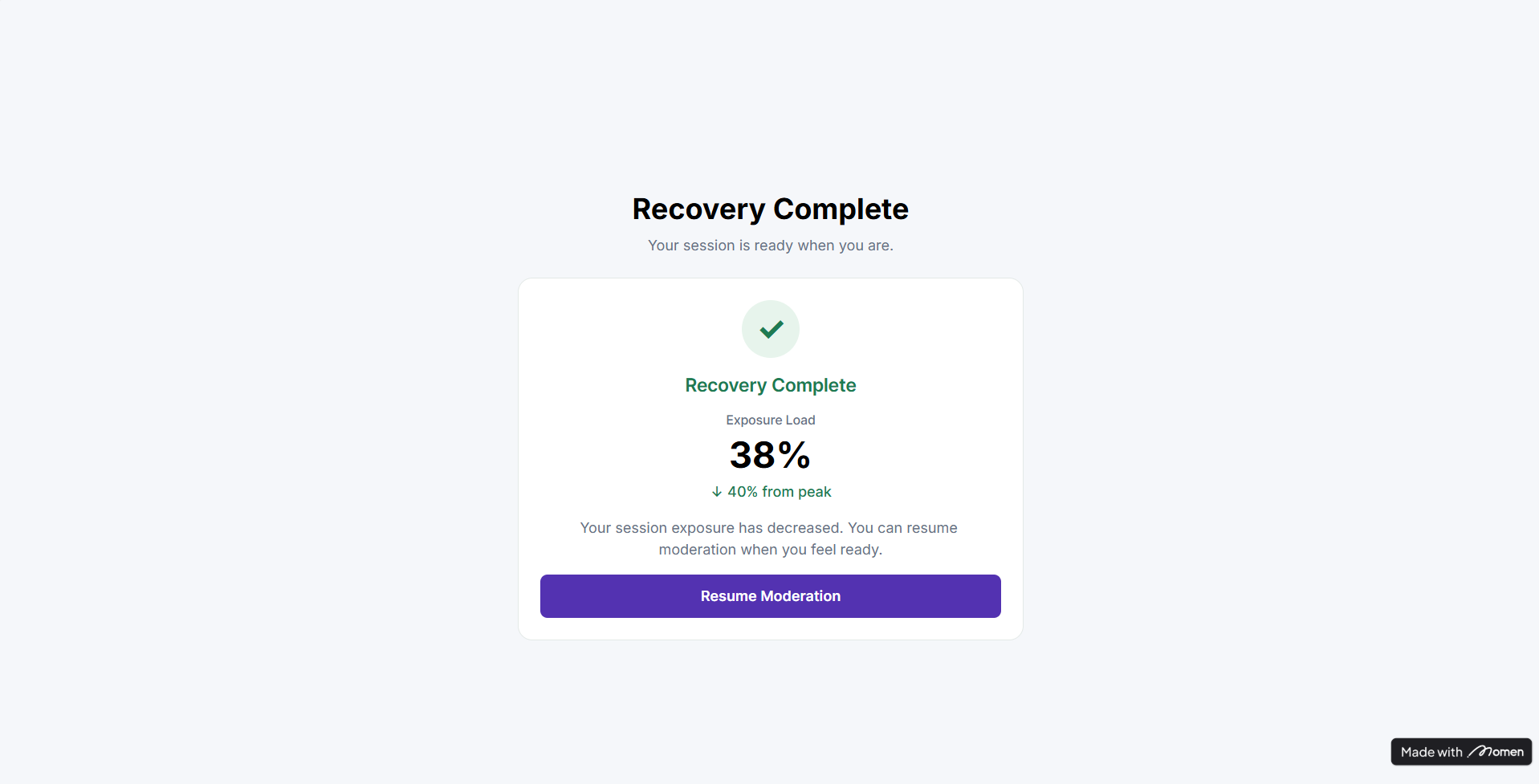
5. Resume
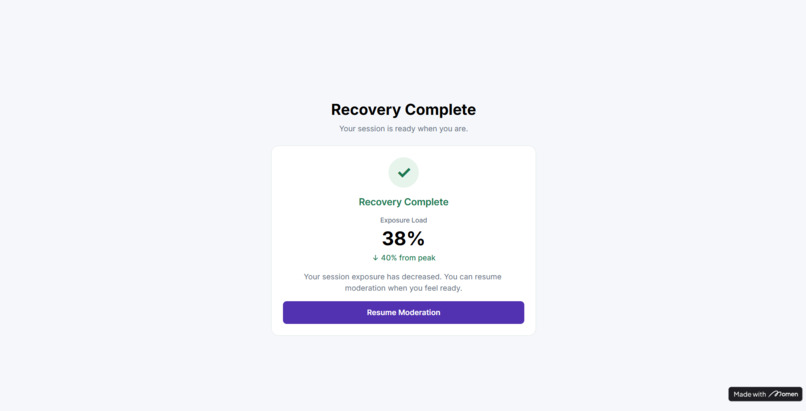
After the recovery moment, the user can return to the moderation workflow.
The current prototype uses simulated AI analysis to demonstrate this workflow. It is not presented as a production AI system.
How we built it
We built an interactive web prototype using Momen, with the interface and user experience designed around a realistic content moderation workflow.
The prototype includes:
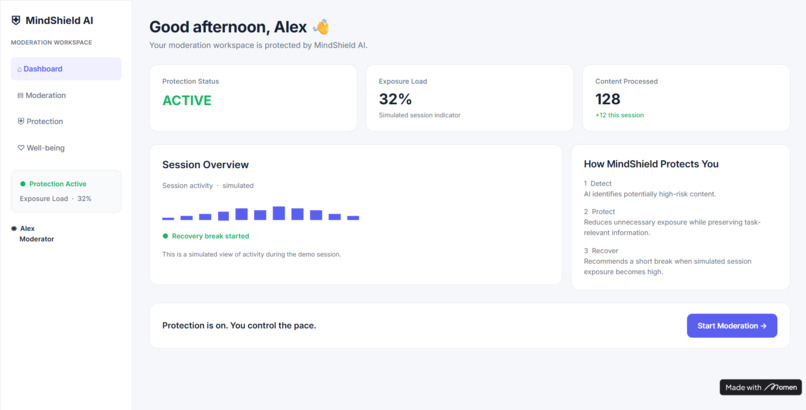
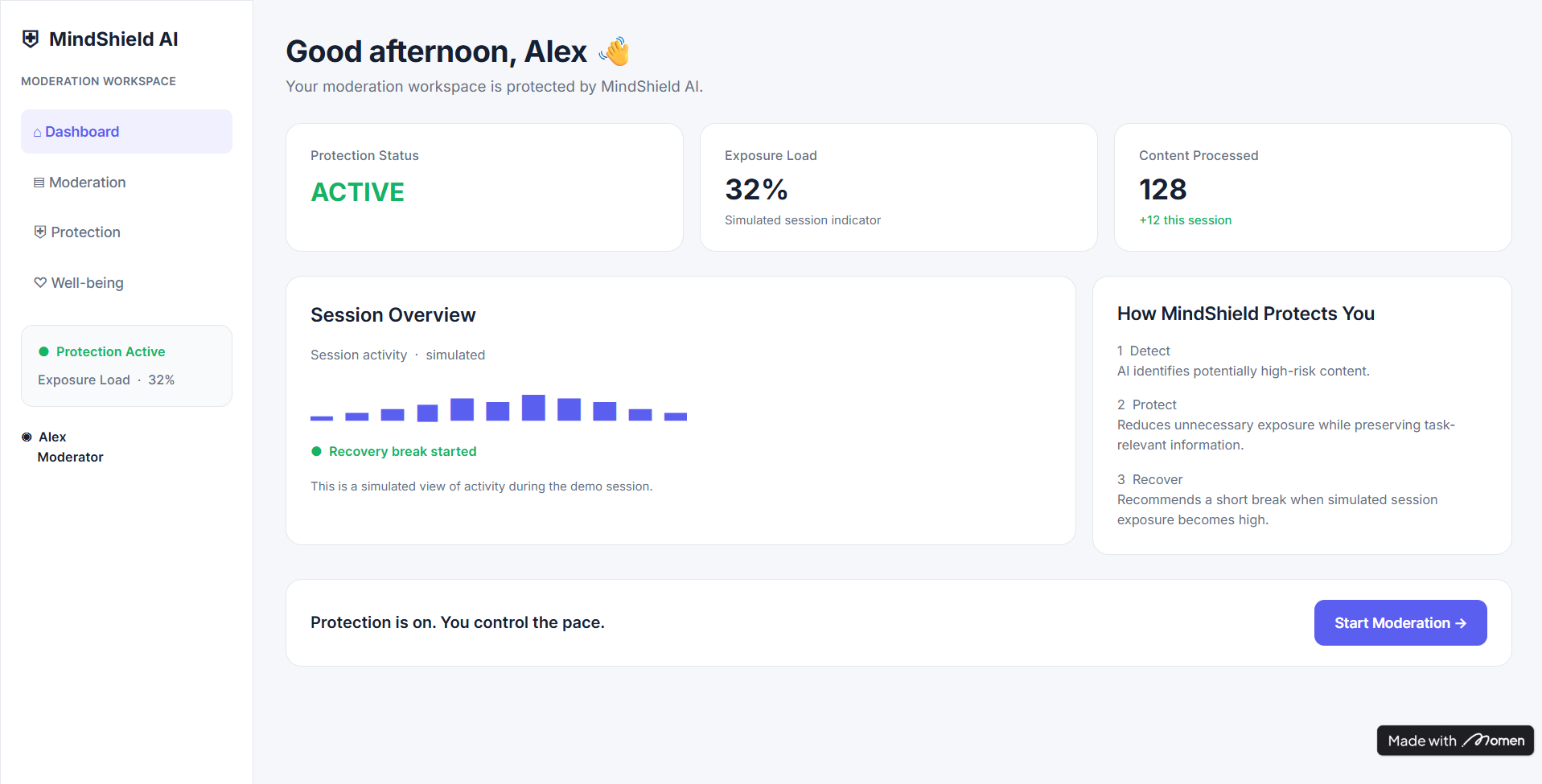
- A moderation dashboard
- Risk analysis
- Protected content visualization
- Exposure Load monitoring
- Recovery recommendations
- A guided breathing exercise
- Recovery completion
- Navigation connecting the complete workflow
We also used Figma during the design process to structure and refine the interface.
For the current hackathon prototype, we focused on demonstrating the product experience rather than building production-grade AI models from scratch.
The intended technical direction includes NLP/text classification for harmful text and computer vision for potentially harmful visual content. These are part of the future technical architecture and are not claimed as fully implemented in the current prototype.
Challenges we ran into
One of our main challenges was finding the right balance between protection and usability.
If harmful content is completely hidden, a moderator may no longer have enough information to complete the task.
If the content is shown without protection, the user may experience unnecessary exposure.
MindShield therefore explores a middle ground:
Reduce unnecessary exposure while preserving the information required to do the job.
Another challenge was building a convincing AI-assisted experience within a hackathon timeframe.
Instead of overclaiming what our prototype could do, we decided to focus on creating a clear and interactive workflow that demonstrates how the system would work and how its technical architecture could evolve.
Accomplishments that we're proud of
We are proud to have transformed an idea about responsible AI and human wellbeing into an interactive prototype.
Our prototype demonstrates a complete workflow:
Moderation → Protection → Exposure Monitoring → Recovery → Resume
We are particularly proud of the protected-content experience because it explores an alternative to simply blocking sensitive content.
We are also proud of the recovery flow, which treats recovery as part of the moderation workflow rather than something completely separate from the work.
Most importantly, we built the prototype around a simple principle:
MindShield AI doesn't replace the moderator. It protects them.
What we learned
Building MindShield AI taught us that responsible AI is not only about the model itself.
It is also about the experience surrounding the model and the people who interact with it.
We learned how important it is to:
- Design AI around real human workflows
- Balance safety with usability
- Communicate AI capabilities honestly
- Distinguish a prototype from a production system
- Think about the human impact of AI-powered workflows
- Use UX to make responsible AI concepts understandable
We also learned that a simple interaction can communicate a complex idea effectively when the workflow is designed carefully.
What's next for MindShield AI
The current prototype is the first step toward a fully functional technical system.
The next stage would be to integrate real AI components for:
- Text classification and toxicity detection
- Computer vision for potentially harmful visual content
- Selective visual transformations
- Audio-to-text filtering
- More advanced exposure modeling
- Integration with existing moderation and annotation platforms
We would also explore privacy-conscious processing and local AI models where appropriate.
Our long-term vision is to make wellbeing a natural part of AI data workflows rather than an afterthought.
AI should not only make data safer. It should also make the work of creating that safer data more humane.
Built With
- chatgpt
- figma
- momen

Log in or sign up for Devpost to join the conversation.