-
-
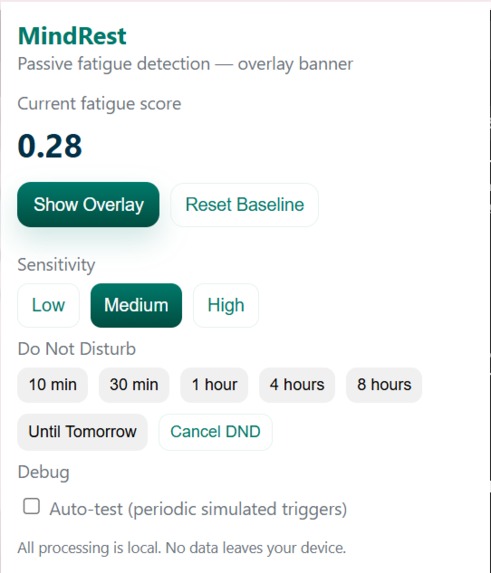
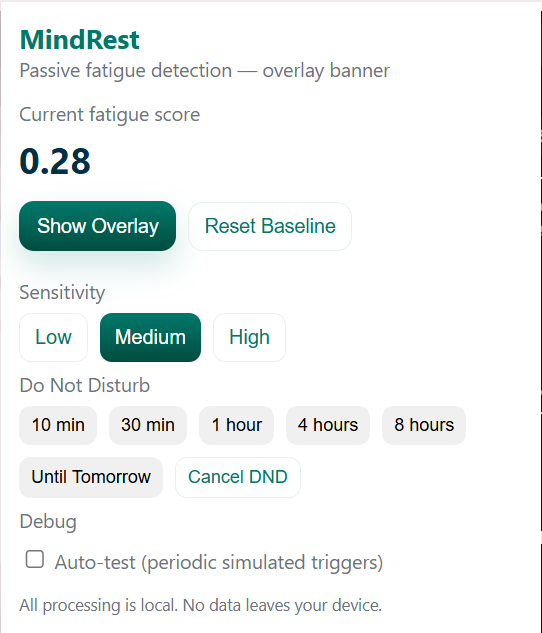
This is the dashboard of the extension
-

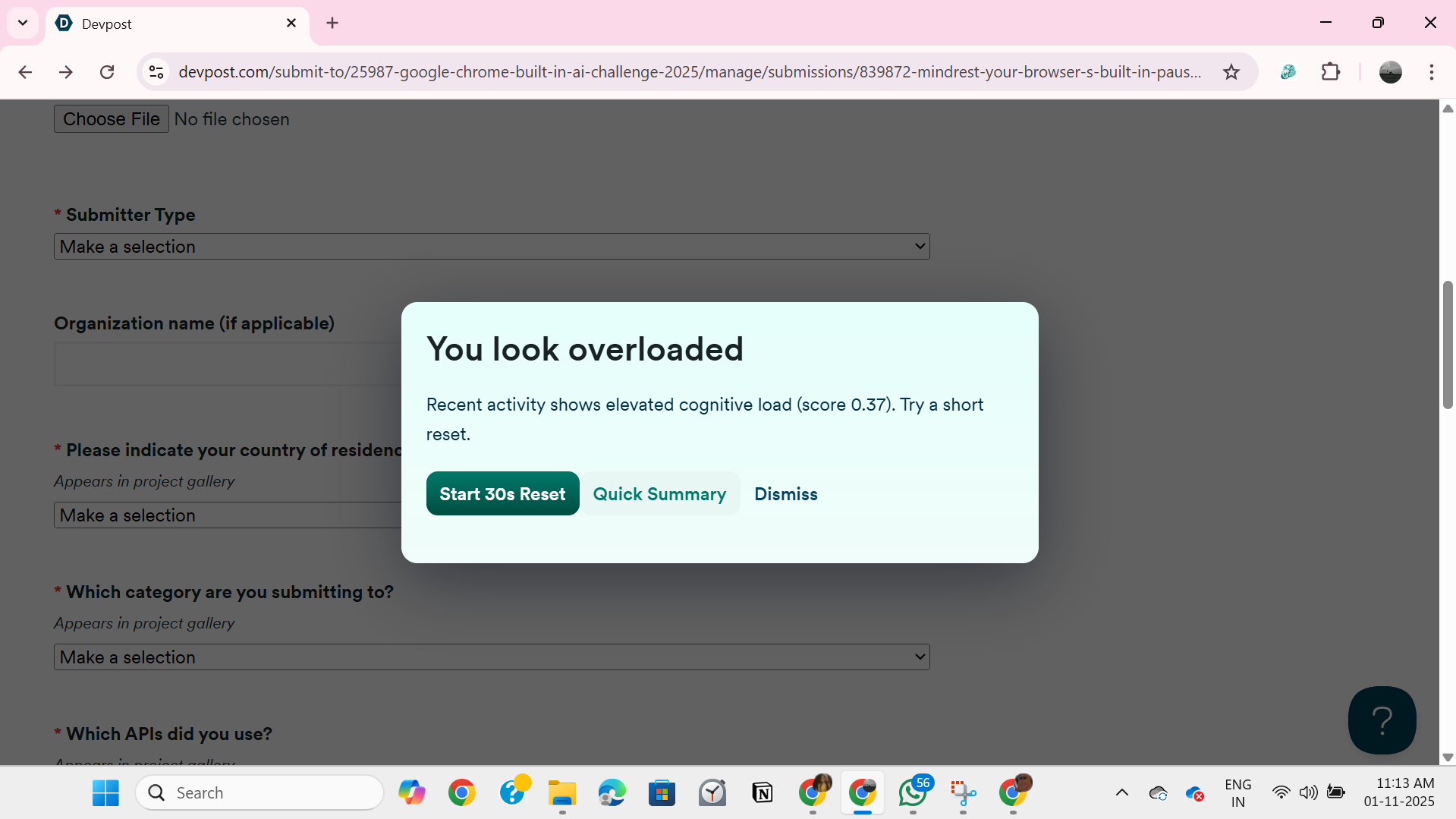
The overlay which pops up as a reminder
MindRest — Your Browser’s Built-In Pause Button Inspiration
Modern browsing habits have blurred the line between productivity and fatigue. We spend hours inside Chrome — researching, studying, and working — yet rarely notice when our cognitive energy quietly declines. I observed how often I switched between multiple tabs, reread the same text, or scrolled endlessly without focus.
This raised a question: What if the browser could sense when users were mentally overloaded — and intervene before burnout set in?
That idea led to MindRest: a Chrome AI feature that recognizes digital fatigue and helps users recover focus through subtle, intelligent interaction.
What it does
MindRest analyzes real-time browsing behavior to identify early signs of cognitive fatigue. It monitors key behavioral signals such as:
Frequency and velocity of tab switching
Scroll depth and repetitive scrolling patterns
Extended idle or reread durations on a single page
When these indicators exceed adaptive thresholds, the AI model classifies the state as potential overload. MindRest then intervenes with context-aware actions — for example:
Suggesting a short focus reset period
Generating a summary of the user’s recent activity to re-establish continuity
Temporarily dimming visual intensity to reduce cognitive strain
The feature aims not to boost productivity metrics but to enhance mental clarity and intentional use of the browser.
How we built it
MindRest was designed around three principles: privacy, adaptivity, and empathy.
Data Collection Layer: Utilized Chrome’s tabs, idle, and webNavigation APIs to gather anonymized activity metrics (tab events, scroll delta, dwell time).
Inference Layer: Implemented a lightweight, on-device AI model to compute a fatigue probability score from behavioral vectors.
Interaction Layer: Developed a responsive Chrome popup interface for interventions, summaries, and user feedback.
The underlying fatigue detection model was formulated as a weighted linear combination of normalized features:
𝐹
𝑤 1 ( Δ 𝑡 𝑎 𝑏 𝑠 ) + 𝑤 2 ( Δ 𝑠 𝑐 𝑟 𝑜 𝑙 𝑙 ) + 𝑤 3 ( 𝑡 𝑖 𝑑 𝑙 𝑒 ) + 𝑤 4 ( 𝑟 𝑟 𝑒 𝑣 𝑖 𝑠 𝑖 𝑡 ) F=w 1
(Δ tabs
)+w 2
(Δ scroll
)+w 3
(t idle
)+w 4
(r revisit
)
A dynamic threshold 𝐹 𝑐 𝑟 𝑖 𝑡 F crit
is continuously updated using exponential smoothing to adapt to each user’s baseline rhythm. When 𝐹
𝐹 𝑐 𝑟 𝑖 𝑡 F>F crit
, a MindRest prompt is triggered.
To model adaptive smoothing, the threshold update rule is defined as:
𝐹 𝑐 𝑟 𝑖 𝑡 ( 𝑡
)
𝛼 𝐹 ( 𝑡 − 1 ) + ( 1 − 𝛼 ) 𝐹 𝑐 𝑟 𝑖 𝑡 ( 𝑡 − 1 ) F crit (t)
=αF (t−1) +(1−α)F crit (t−1)
where 0 < 𝛼 < 1 0<α<1 controls the rate of adaptation to recent user behavior.
Challenges we ran into
Defining “fatigue” computationally: Translating human exhaustion into quantifiable behavior required iterative modeling and data calibration.
Maintaining subtlety: Early prototypes were overly assertive, interrupting users unnecessarily. We refined the logic to make interventions feel natural rather than intrusive.
Ensuring privacy: All inference runs locally; no browsing data leaves the device. Balancing on-device performance with model accuracy was a central technical challenge.
Human-AI interaction tone: Designing prompts that sound empathetic without being condescending required careful language and UX tuning.
Accomplishments that we’re proud of
Designing a technically feasible AI system that prioritizes mental wellbeing over productivity.
Creating an adaptive fatigue model that operates entirely on-device, preserving user privacy.
Building a lightweight, intuitive UX that integrates seamlessly into Chrome without disrupting workflow.
Demonstrating how AI can enhance self-awareness rather than just automate behavior.
What we learned
Through MindRest, we learned that AI’s value in user experience extends beyond efficiency — it can also cultivate digital empathy. We discovered that timing, tone, and subtle interface design significantly influence user trust and comfort. We also confirmed that privacy-preserving, on-device AI can meaningfully contribute to mental wellbeing.
Above all, we realized that true innovation lies in helping technology recognize the limits of human attention — and respond with care.
What’s next for MindRest
Expanding the fatigue model using reinforcement learning to personalize thresholds per user over time.
Integrating physiological cues from device sensors (e.g., ambient light, typing cadence) for multimodal fatigue detection.
Collaborating with cognitive scientists to validate fatigue indicators and refine intervention timing.
Exploring integration with Chrome’s Digital Wellbeing dashboard for educational and enterprise deployment.
MindRest reimagines the browser not as a tool for endless work, but as a partner that understands when it’s time to pause.
Built With
- chrome.storage
- chromeaiapis
- css3
- exponentialsmoothingalgorithm
- figma
- html5
- javascript
- manifestv3
- tensorflow.js


Log in or sign up for Devpost to join the conversation.