-
-
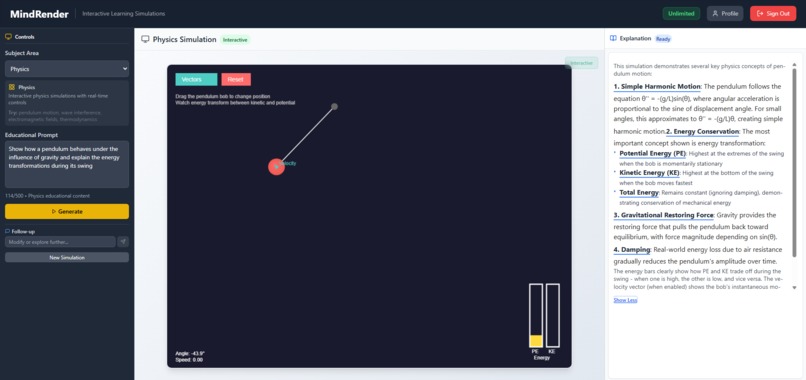
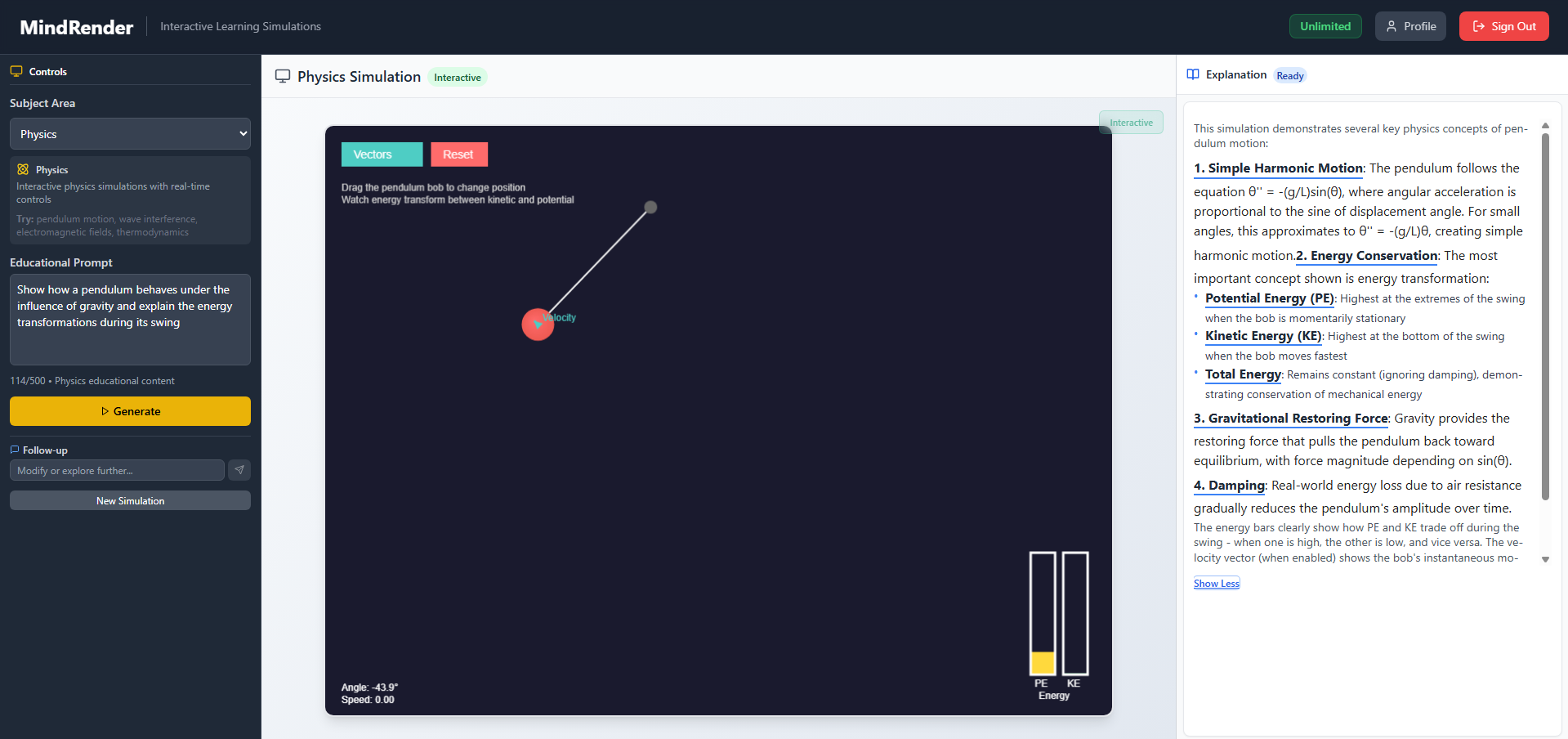
Simulation page
Inspiration
We wanted to change how people learn by making it interactive, intuitive, and AI-driven. Traditional tools like static diagrams or rigid simulations fail to adapt to a learner’s curiosity. With the power of MindRender, we envisioned a platform where anyone could describe a concept in plain language and instantly see it come to life as a dynamic simulation with an explanation.
What it does
MindRender lets users turn natural-language prompts into fully interactive simulations, auto-generated sliders for parameters like gravity or mass, live data graphs, and an AI tutor powered by Claude. It transforms abstract ideas into tangible, explorable models instantly.
How we built it
Claude is the primary LLM powering simulation code generation from user prompts.
We developed a real-time parameter detection engine that scans the generated code and builds UI sliders on the fly.
Plotly.js powers dynamic graphing of variables like velocity, acceleration, and energy.
The full stack is built with Next.js, TypeScript, TailwindCSS, and deployed using Bolt.new.
Supabase manages authentication, user sessions, and simulation storage.
Challenges we ran into
- Claude sometimes produced valid but overly abstract simulations, so we needed to find a balance.
- Extracting editable physical parameters from LLM-generated code required building a robust parser.
Accomplishments that we're proud of
Built a full-stack platform that turns plain English into working simulations with interactivity.
Created a smooth, interactive UI that feels more like a sandbox than a form.
Enabled live analytics and physics charts with zero manual setup from the user.
What we learned
Building AI systems takes more than good prompts. It requires tool orchestration, fallback planning, and UI balance.
Good educational tools should adapt to the user, not the other way around.
What's next for MindRender
We’re building a new feature where users solve guided physics challenges by manipulating simulations. Instead of just observing, they’ll be tasked with goals like “Make the pendulum complete a full loop” or “Optimize for max projectile range,” turning learning into experimentation.
Allow users to share and remix simulations through a public library.
Introduce voice-to-simulation input for even more intuitive exploration.
Expand the AI tutor to support Socratic teaching methods and in-simulation guidance.
Built With
- claude-api
- framer-motion
- next.js
- perplexity-api
- plotly.js
- supabase
- tailwindcss
- typescript

Log in or sign up for Devpost to join the conversation.