-
Mood History
-
Focus Timer
-
Mental Health Journaling App With AI Coach
Beginner Track
Inspiration
Mental health has always been a major aspect of human life, yet until recently, it has been overlooked. Mental health has such wide-ranging effects mentally (of course), physically, and emotionally, which makes it all the more important to address and account for. For me in particular, I realized, first-hand, the value of proper mental health when I found myself constantly getting burned out. I kept pushing myself too hard without processing and reflecting on my mental state and emotions, which ended up taking a huge toll on me. Now, I use technology to help me plan, focus, and reflect on my mental health, which has greatly improved my mental state. However, a major problem I noticed with mental health platforms is that they are often hard to navigate, filled with endless settings and customization that take away from the main goal. This was the main inspiration to create a simplistic yet effective mental health platform to reflect, refine, and refocus.
What it does
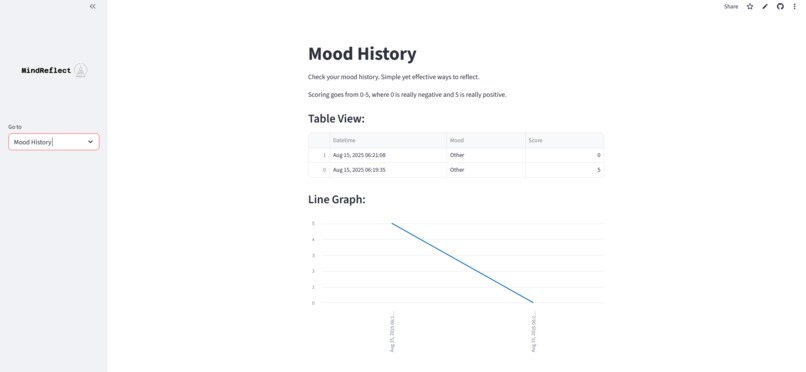
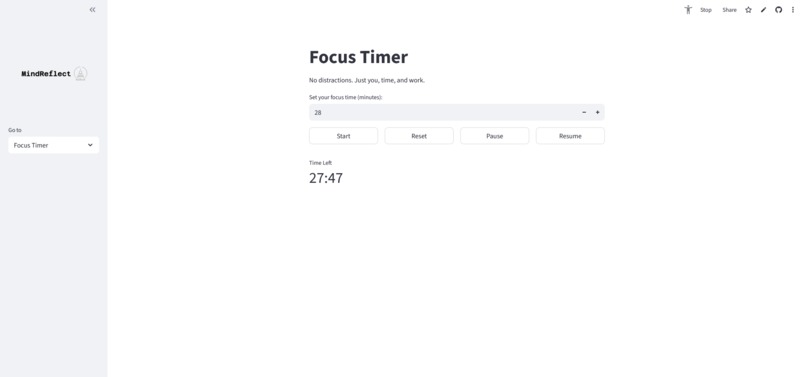
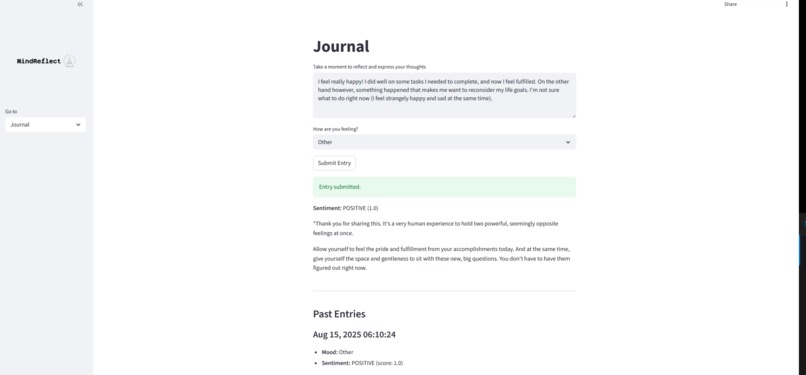
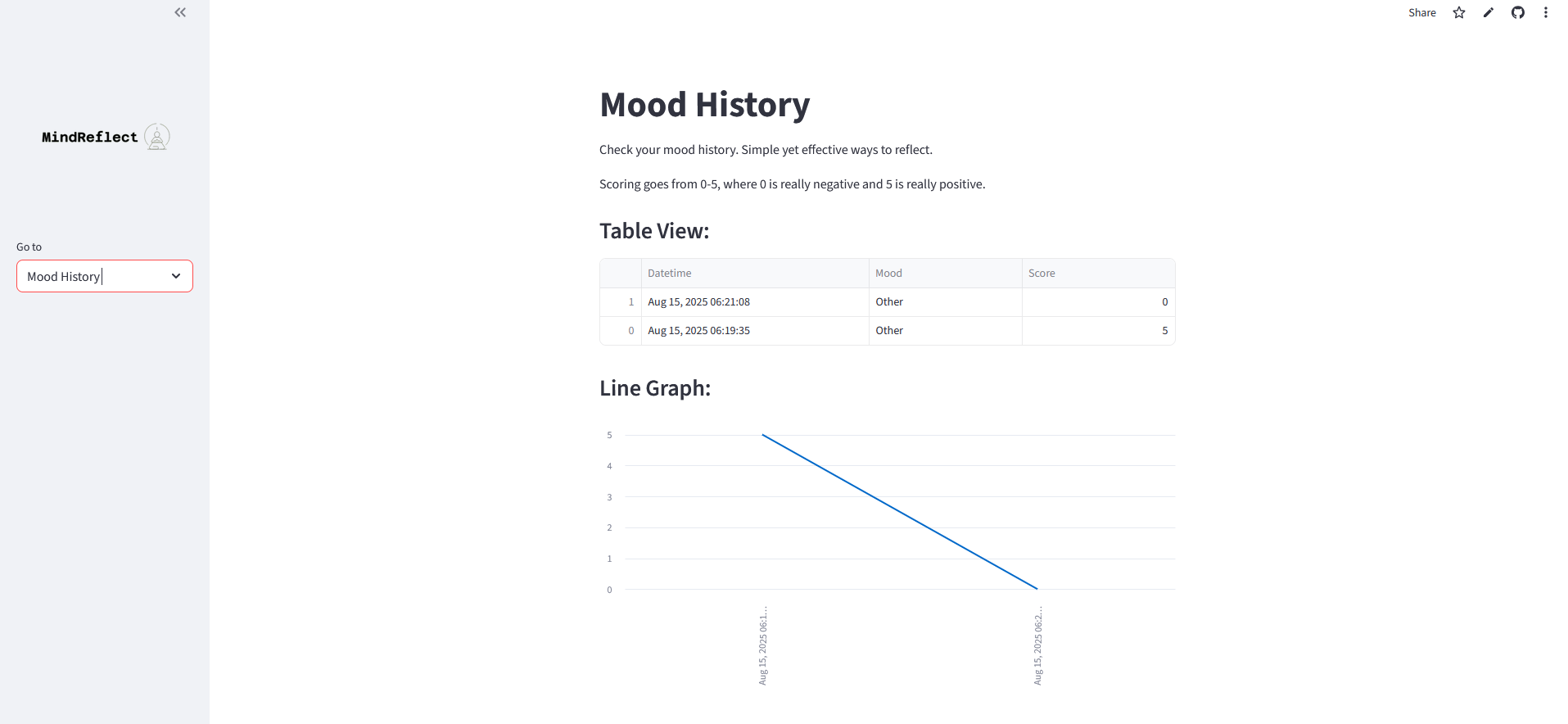
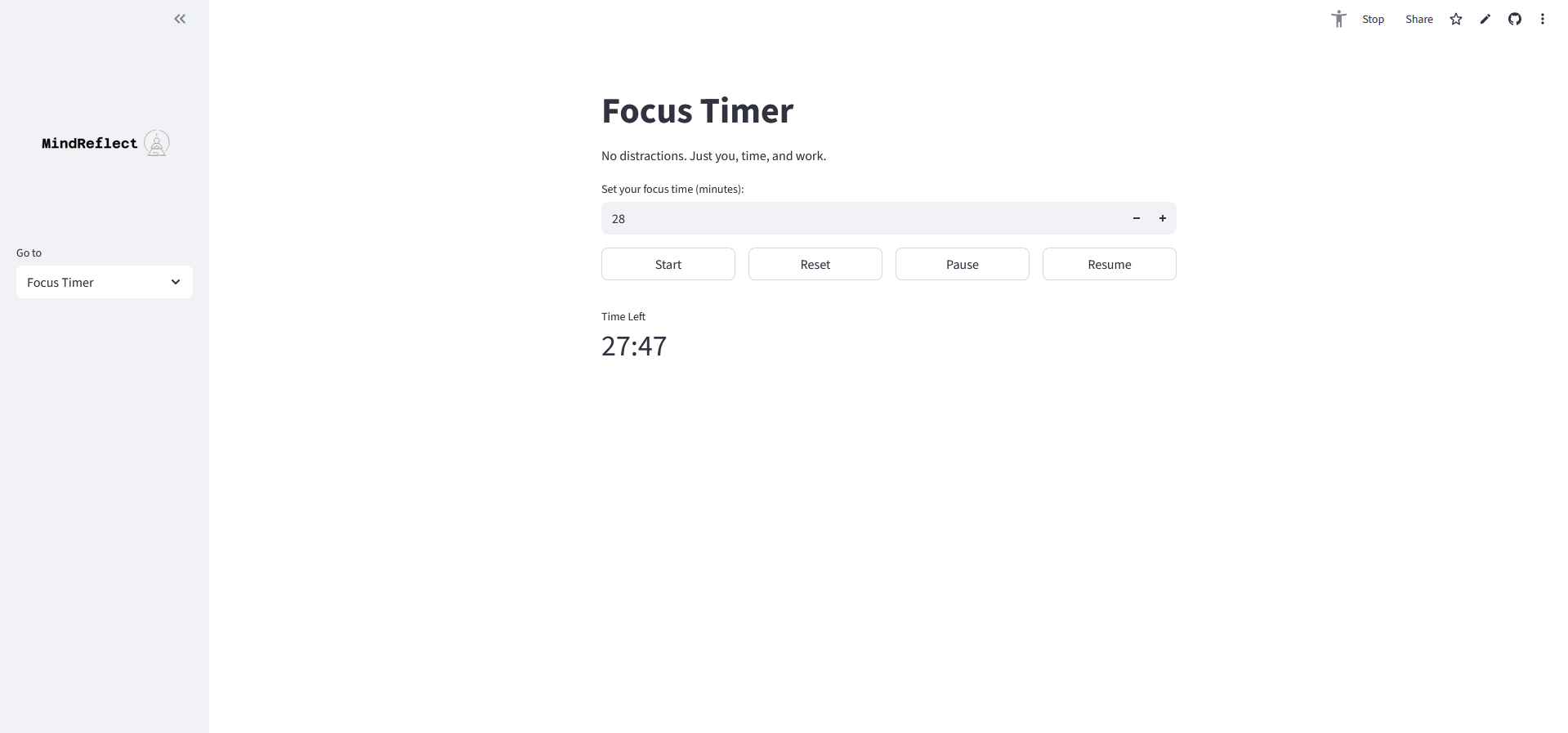
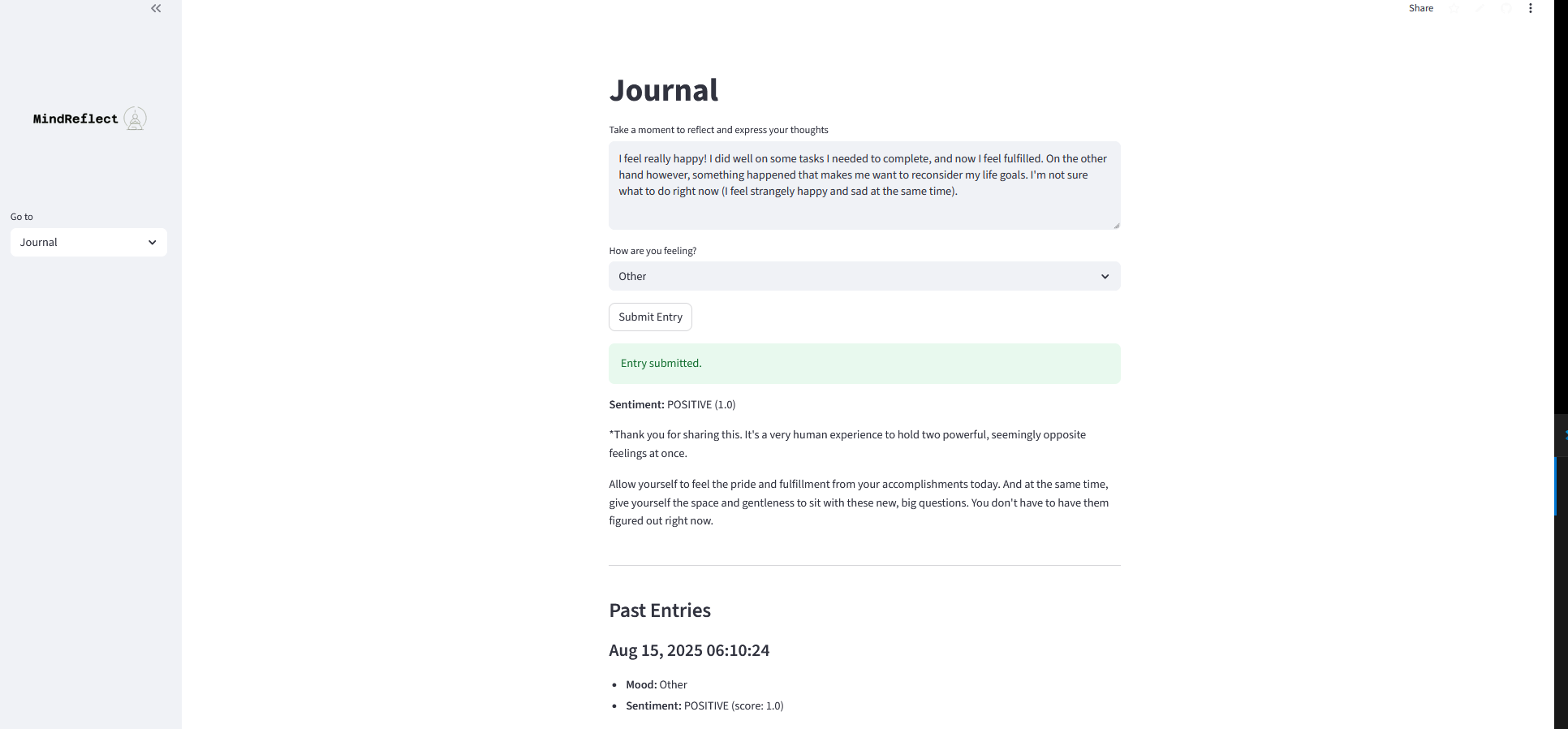
MindReflect is a mental health platform that serves to help one reflect on their life, with an AI coach to help guide them; focus on their work, with a simplistic timer; and examine their mood history, to see their progress and life outlook from a wide lens. The journaling aspect of MindReflect involves the user reflecting (writing) about their day, allowing them to process what happened in the past to help shape their future in a positive light. Then, an AI coach (Gemini) provides personalized advice in the form of a therapist. Additionally, a HuggingFace Sentiment Pipeline is used to assign a label (positive or negative) and a confidence score, which is used to create mood history graphs. Past entries are saved and shown below on the page. The focus timer is a simplistic timer, which allows the user to choose between 25 and 240 minutes to focus on work or anything else they need to. The mood history utilizes the past entries from the journal page to list moods and scores on a table and plot a line graph to visualize mood changes. These tools enable users to focus on their mental health and well-being, without having to worry about complex platforms or tools to utilize.
How we built it
MindReflect was built on Python using the Streamlit framework (used for creating web applications with data), Google Gemini 2.5 Pro for the AI coach, and the HuggingFace Sentiment Model for scoring moods in journaling.
Challenges we ran into
Some challenges we ran into while implementing MindReflect were understanding how Streamlit worked in general, as well as implementing the HuggingFace Sentiment Pipeline and the Gemini API. Although there was documentation on how to implement both of those, it was still a confusing process to implement (for example, some of the language was cryptic). Additionally, I was (and still am) new to AI and implementing it in general, which made this project both a challenge and a learning experience.
Accomplishments that we're proud of
Some accomplishments I'm proud of are that I was able to understand the implementation of a variety of different technologies (Gemini, Streamlit, HuggingFace) and modify it to suit the needs of MindReflect. To be more specific, I am proud that I was able to utilize Streamlit's built-in session functionality to store data in a browser session and utilize it in the mood history, and I am proud that I was able to figure out how the Gemini API and the HuggingFace pipeline work and use them to provide feedback and a mood score, respectively.
What we learned
I learned how Streamlit works (in terms of code implementation) and how to utilize APIs to leverage AI models for specific applications (in this case, scoring and personalized feedback), which were two concepts that I can utilize for many other projects and applications. Moreover, I learned how to host software online through community cloud providers (in this case, Streamlit Community Cloud).
What's next for MindReflect
For MindReflect, I would like to phase out the local browser storage of past entries and move to a SQL database, which supports multiple users using MindReflect without having to keep the browser session open to save past data, as well as allowing for users to access MindReflect on various devices with their data saved. Moreover, I would like to reduce the latency associated with MindReflect presently, which might have to be done by replacing Streamlit with a more faster framework.

Log in or sign up for Devpost to join the conversation.