-
-
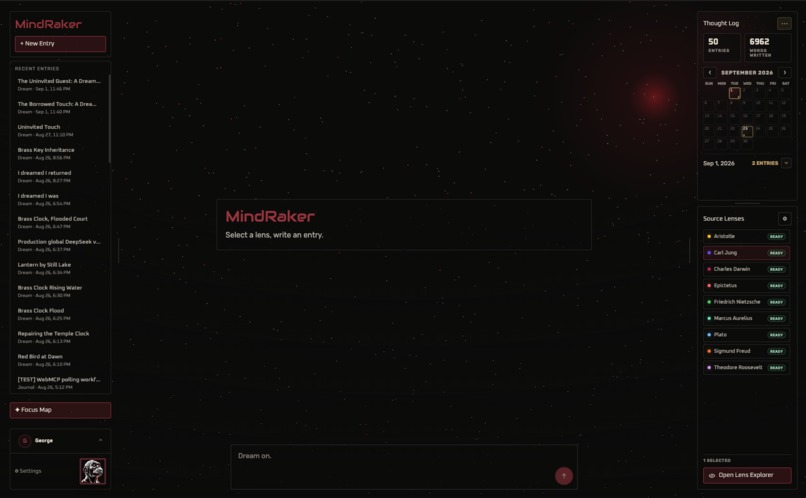
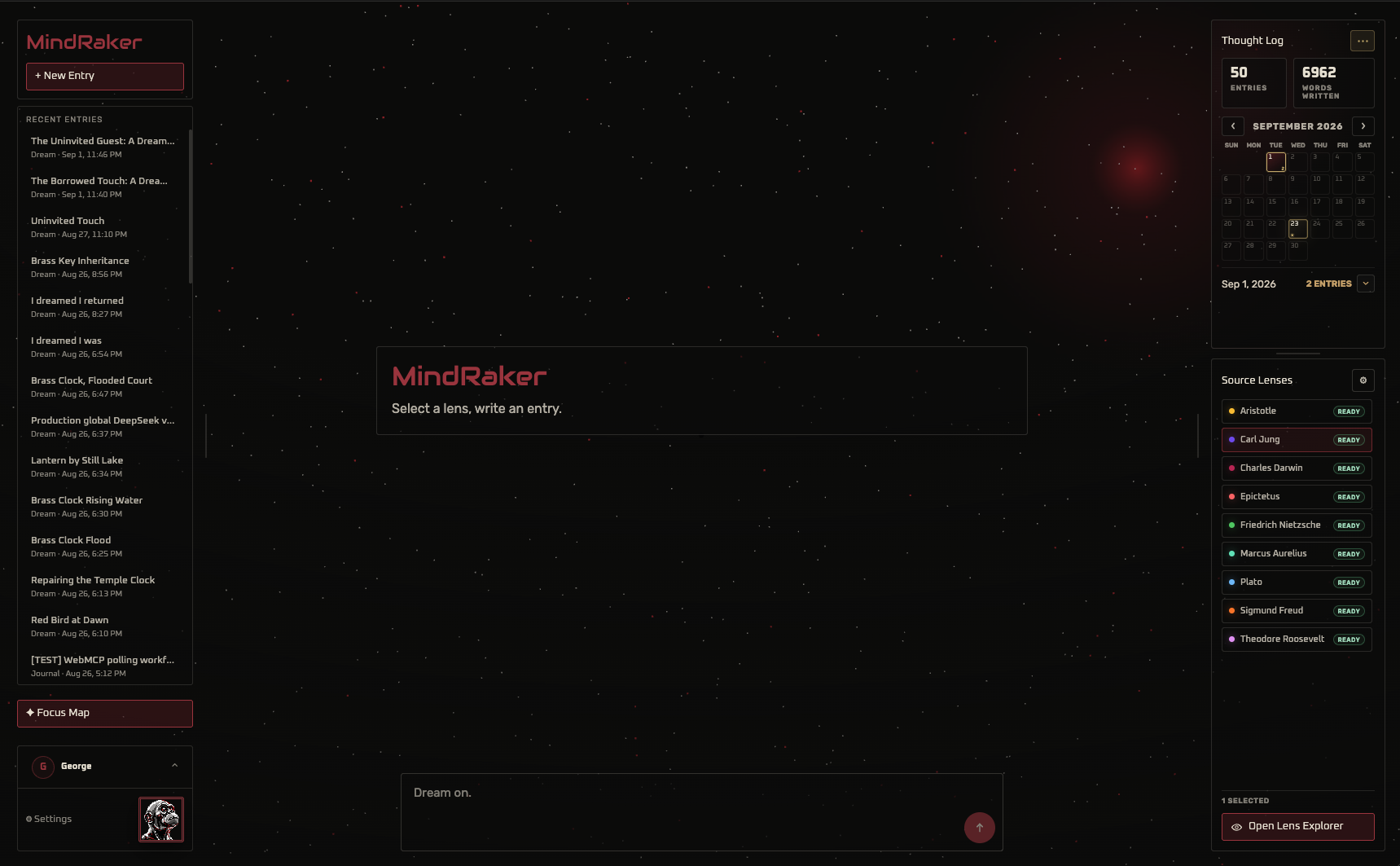
MindRaker Main Screen Interface
-
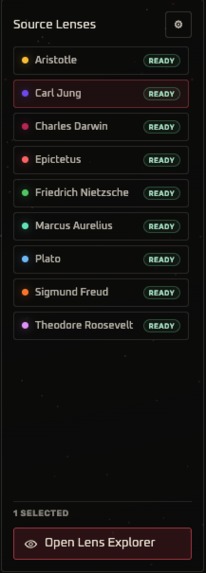
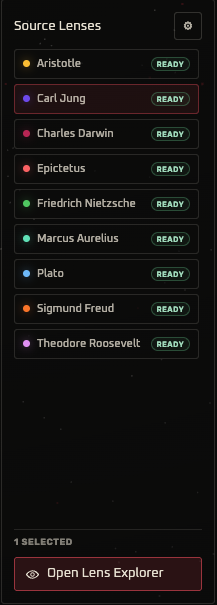
Lenses available for use
-
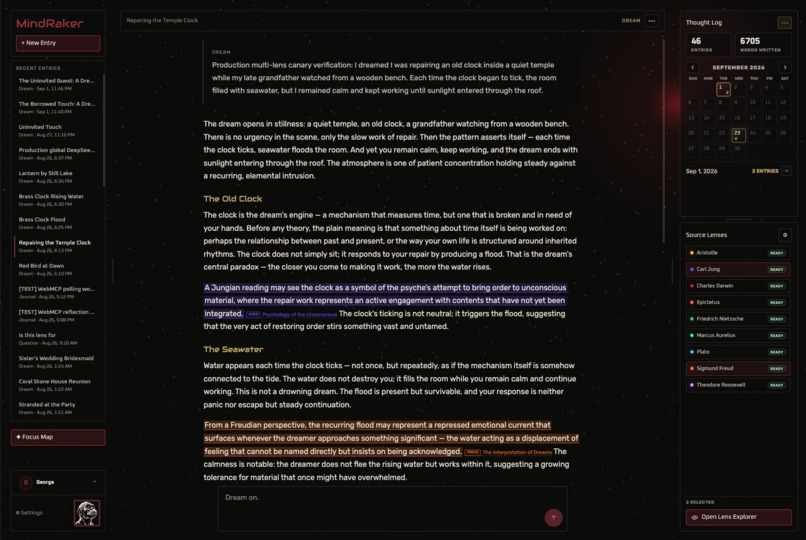
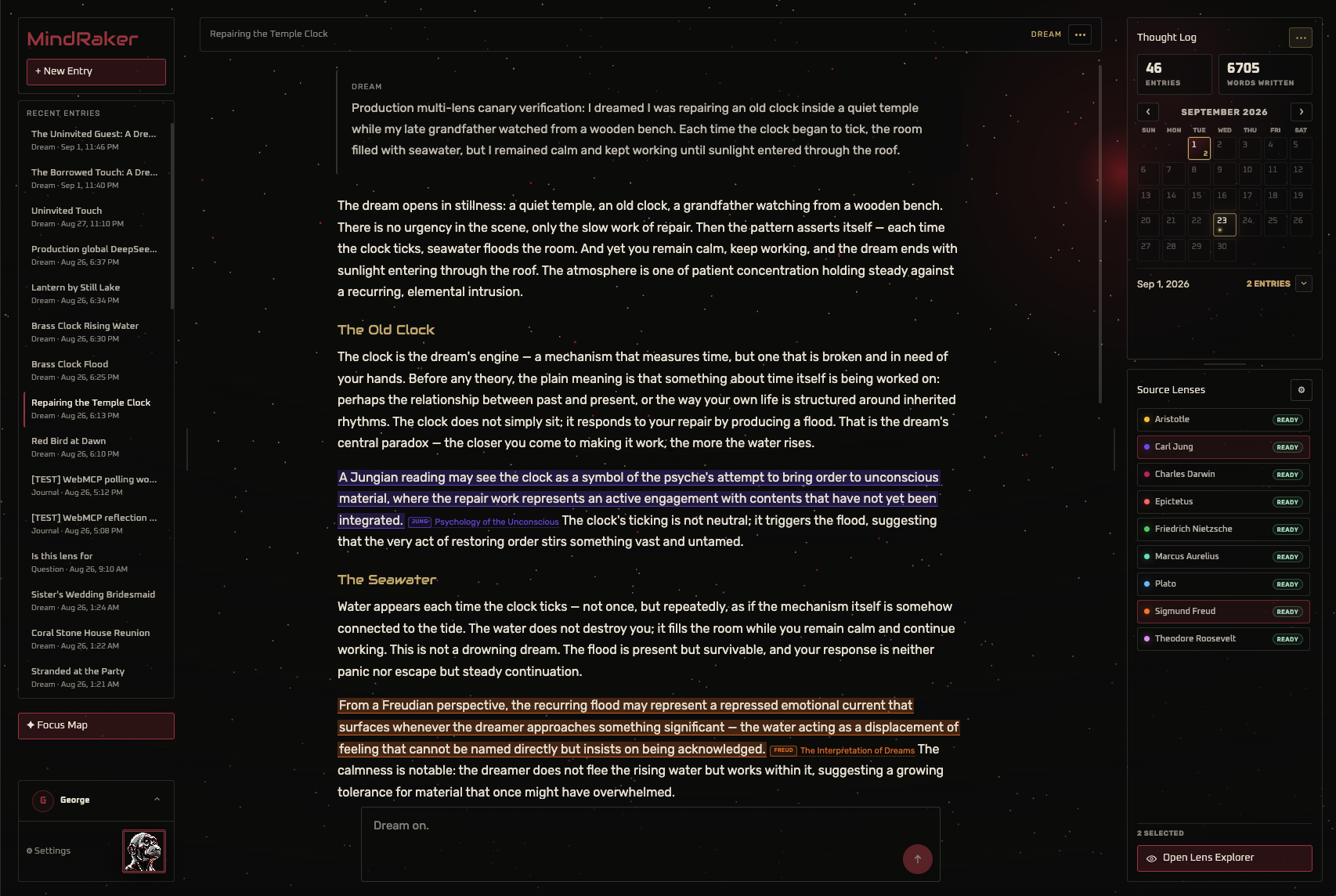
Dream Entry with Analysis from selected Lenses
-
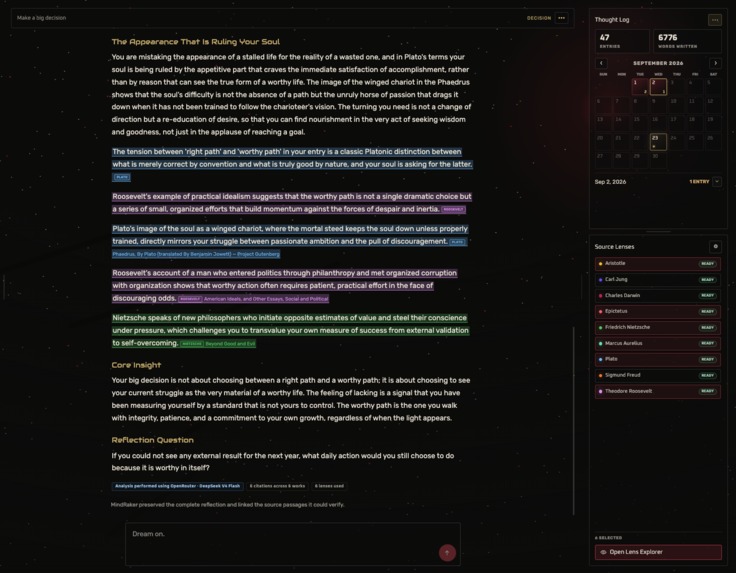
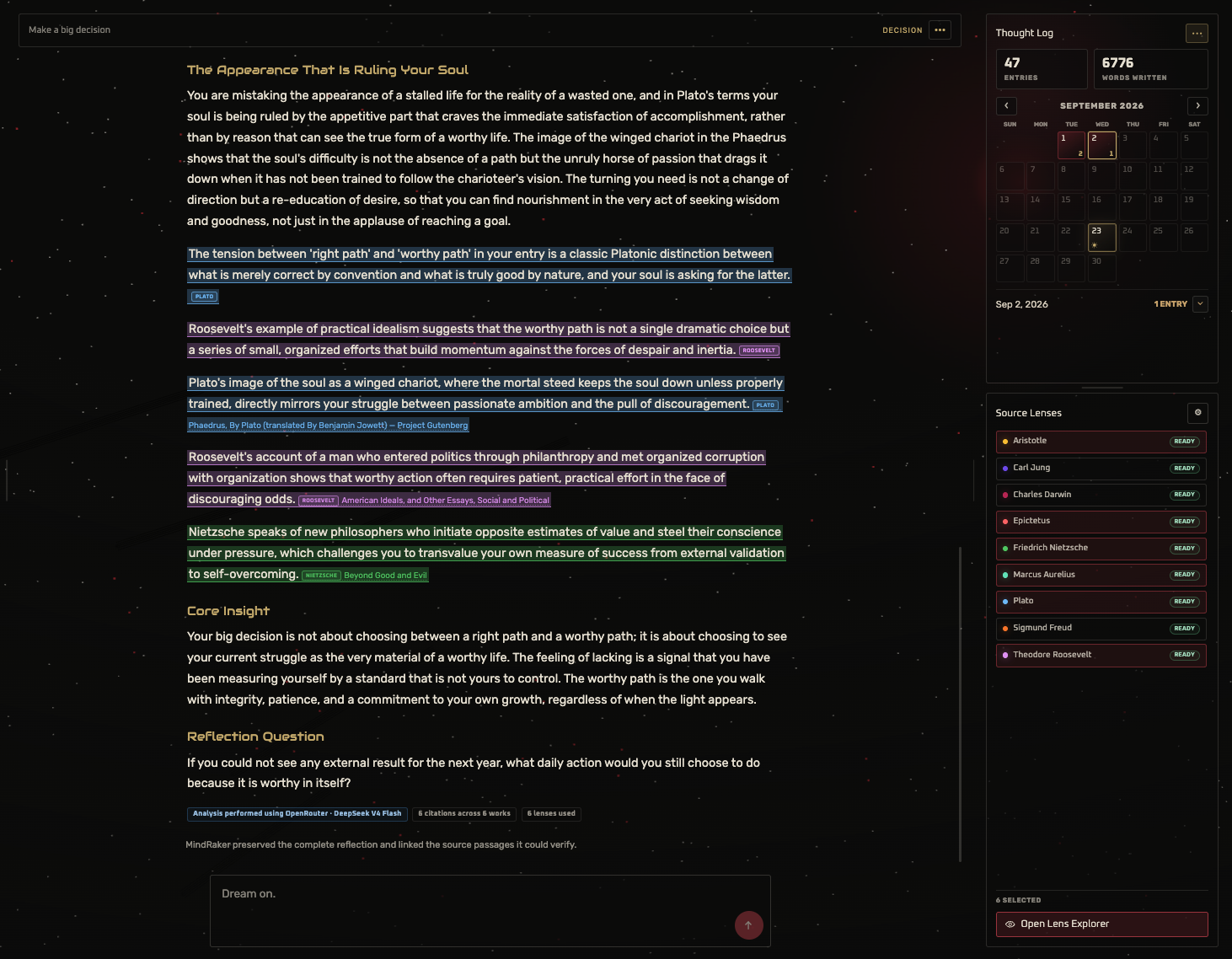
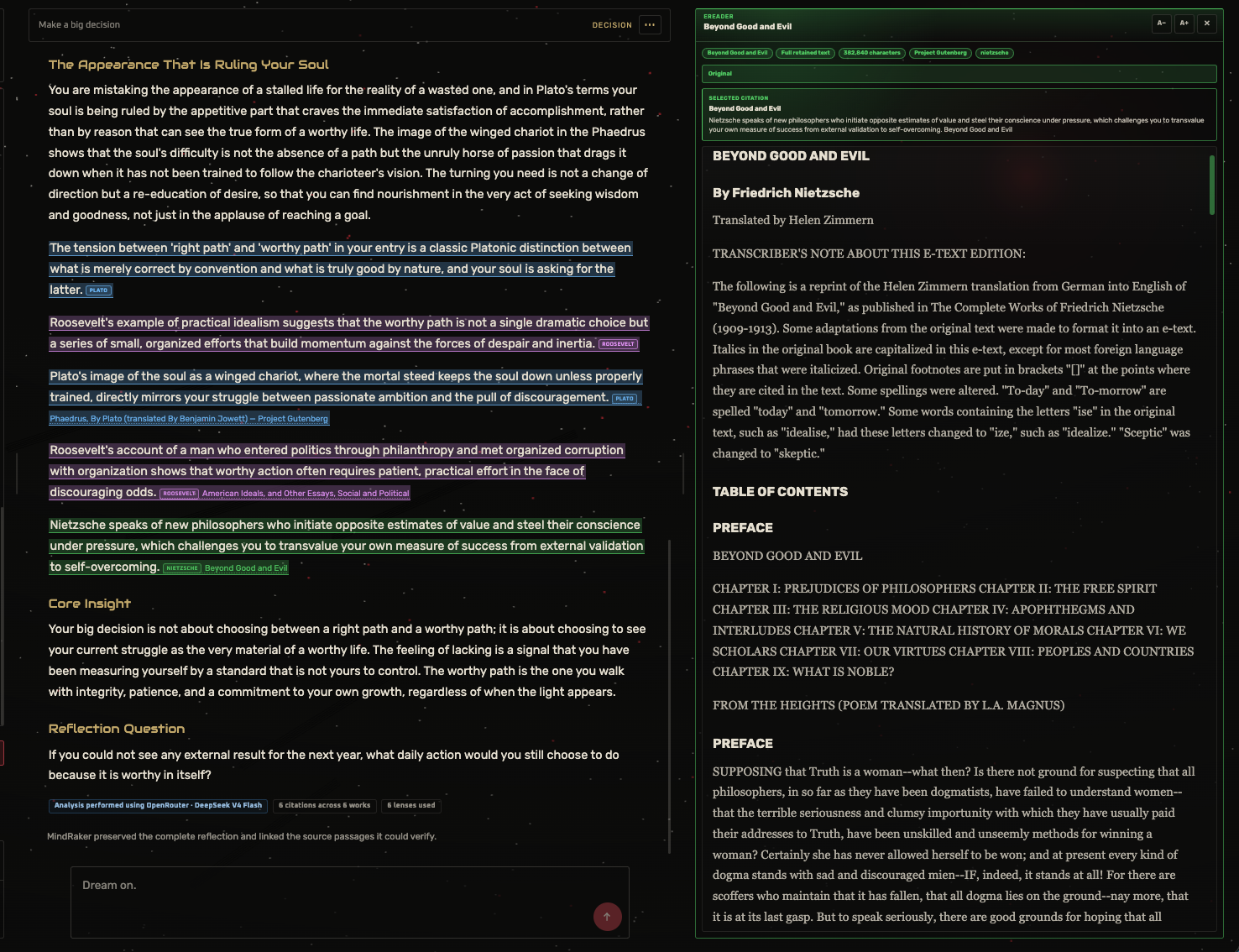
Multi-Lens Reflection
-
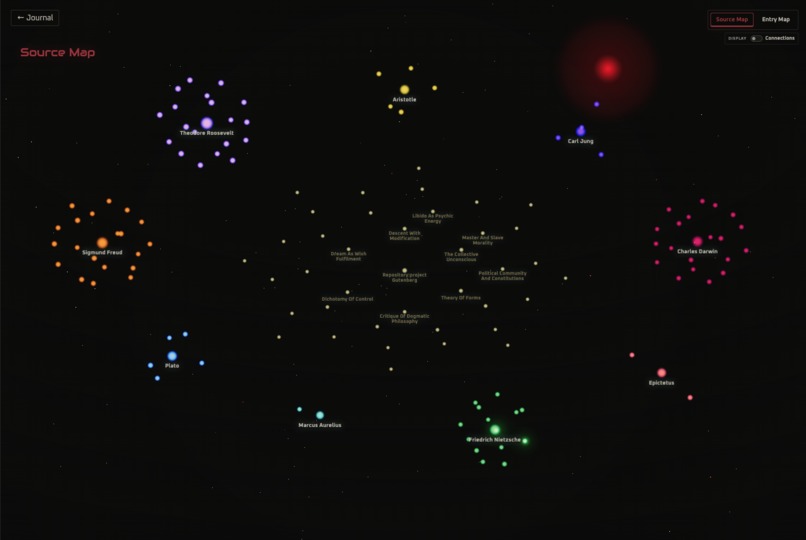
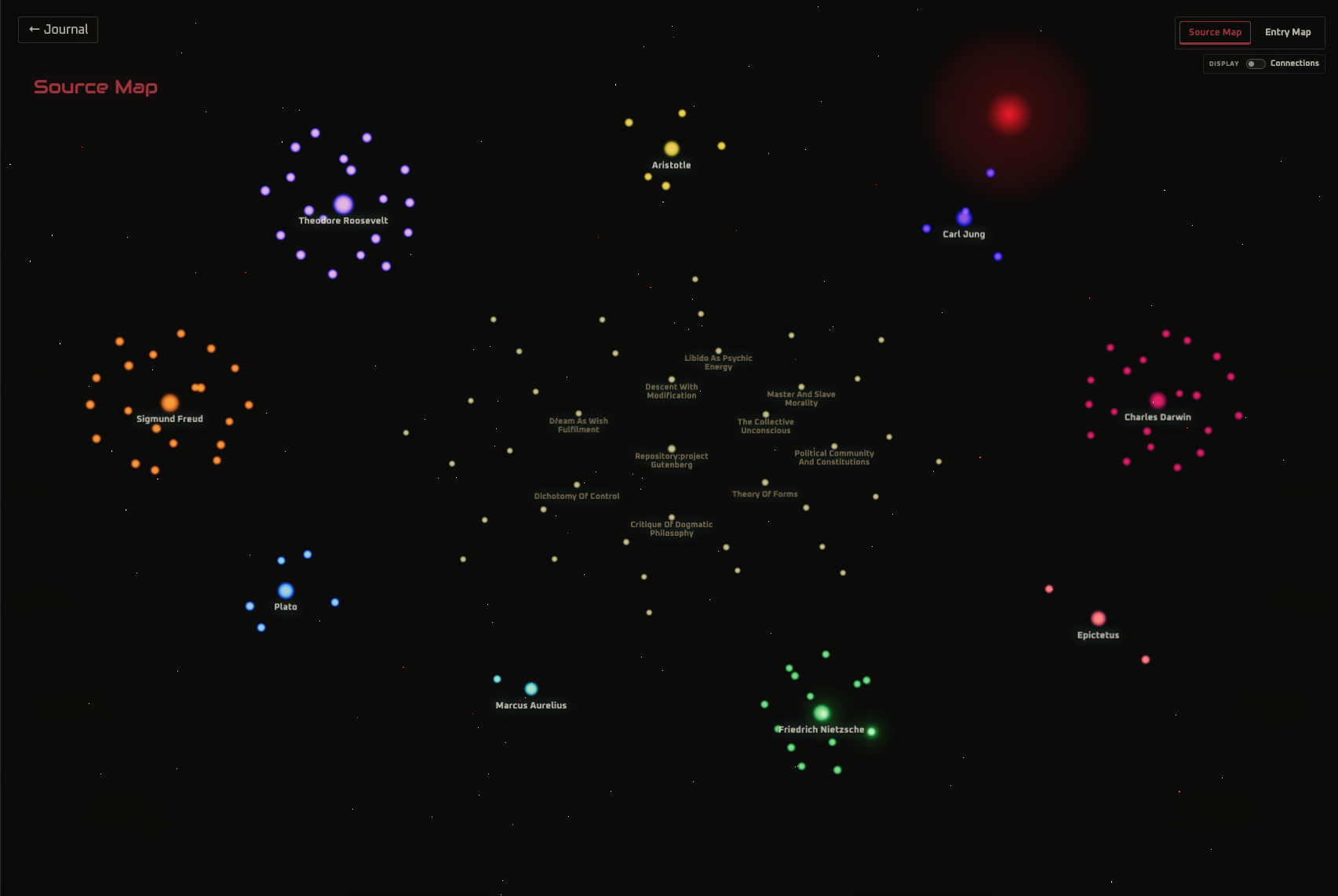
Source Map
-
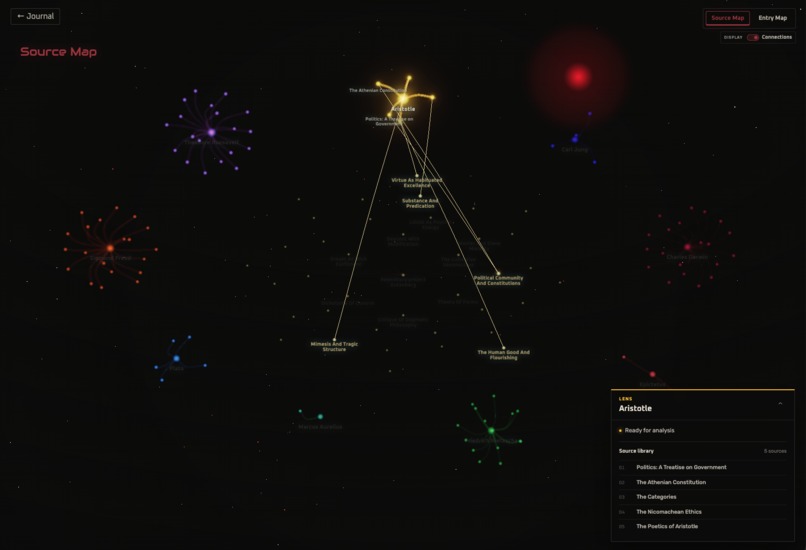
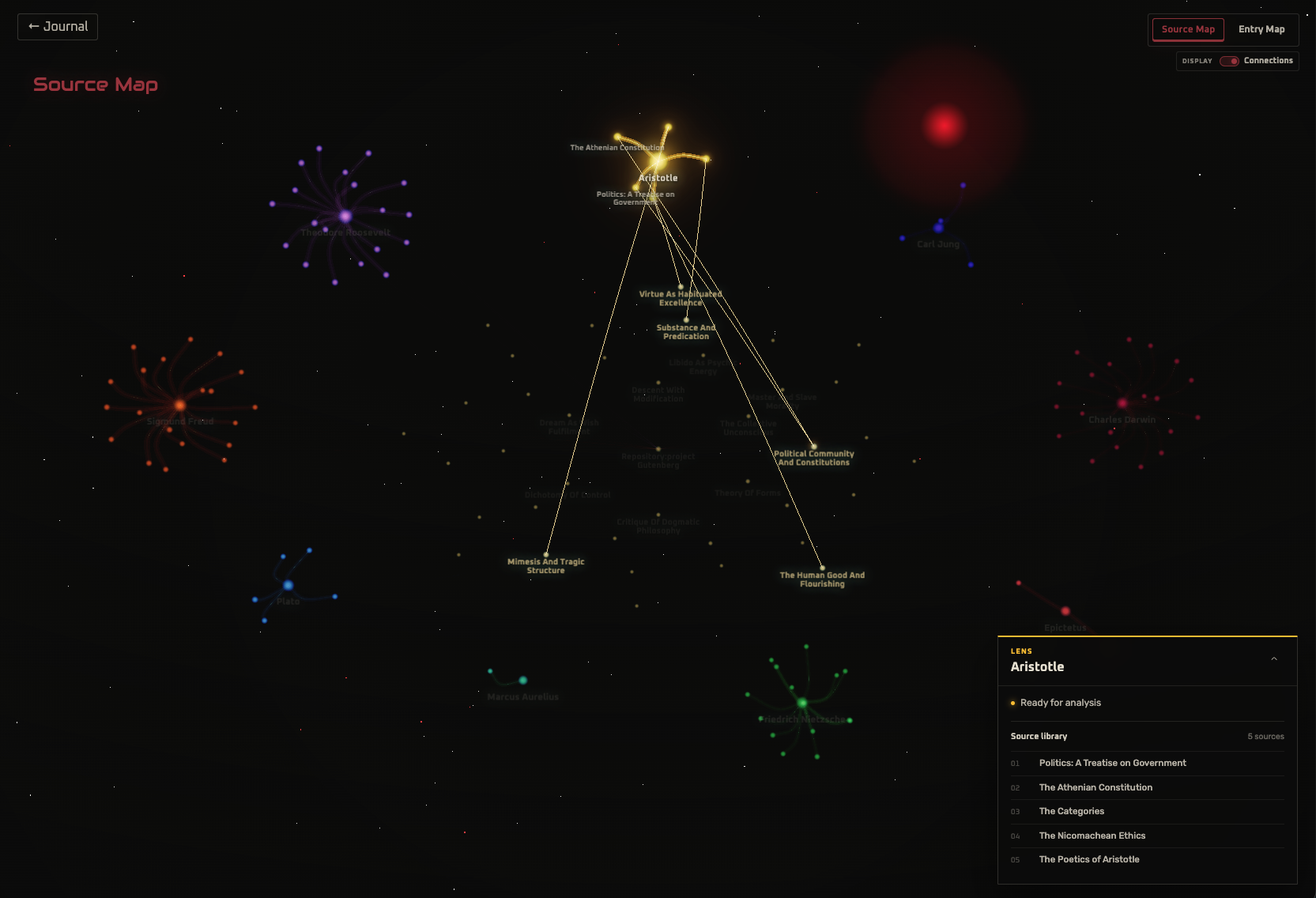
Source Map with Connections displaying
-
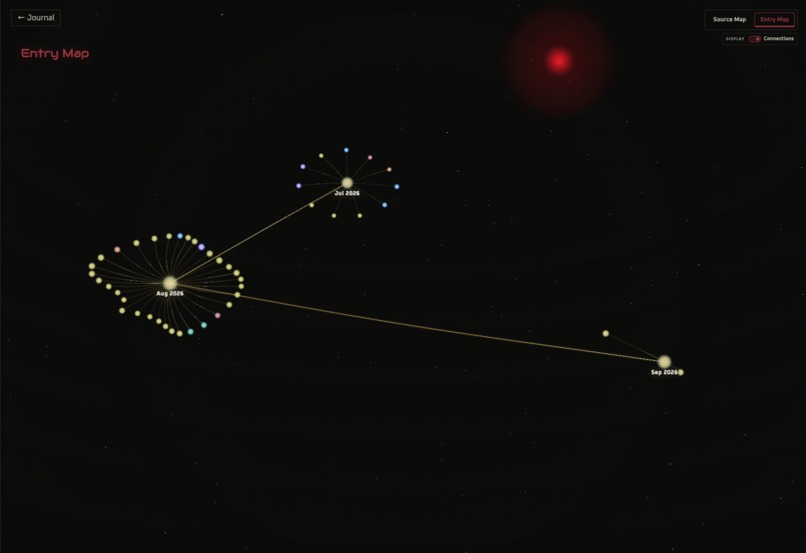
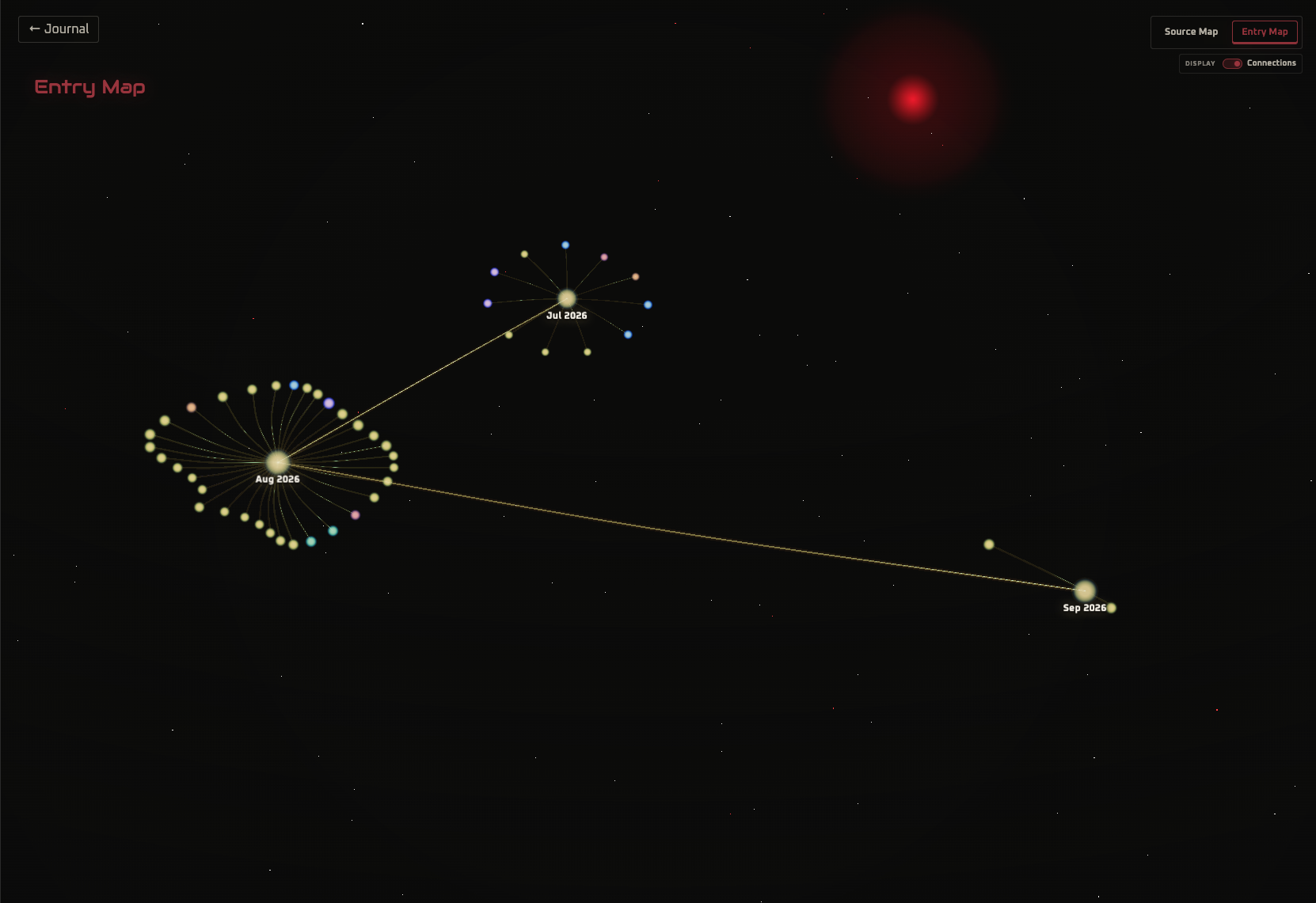
Entry Map
-
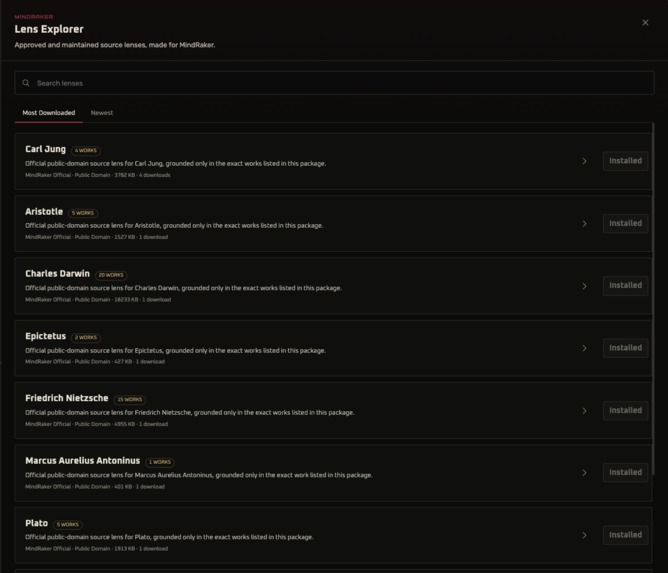
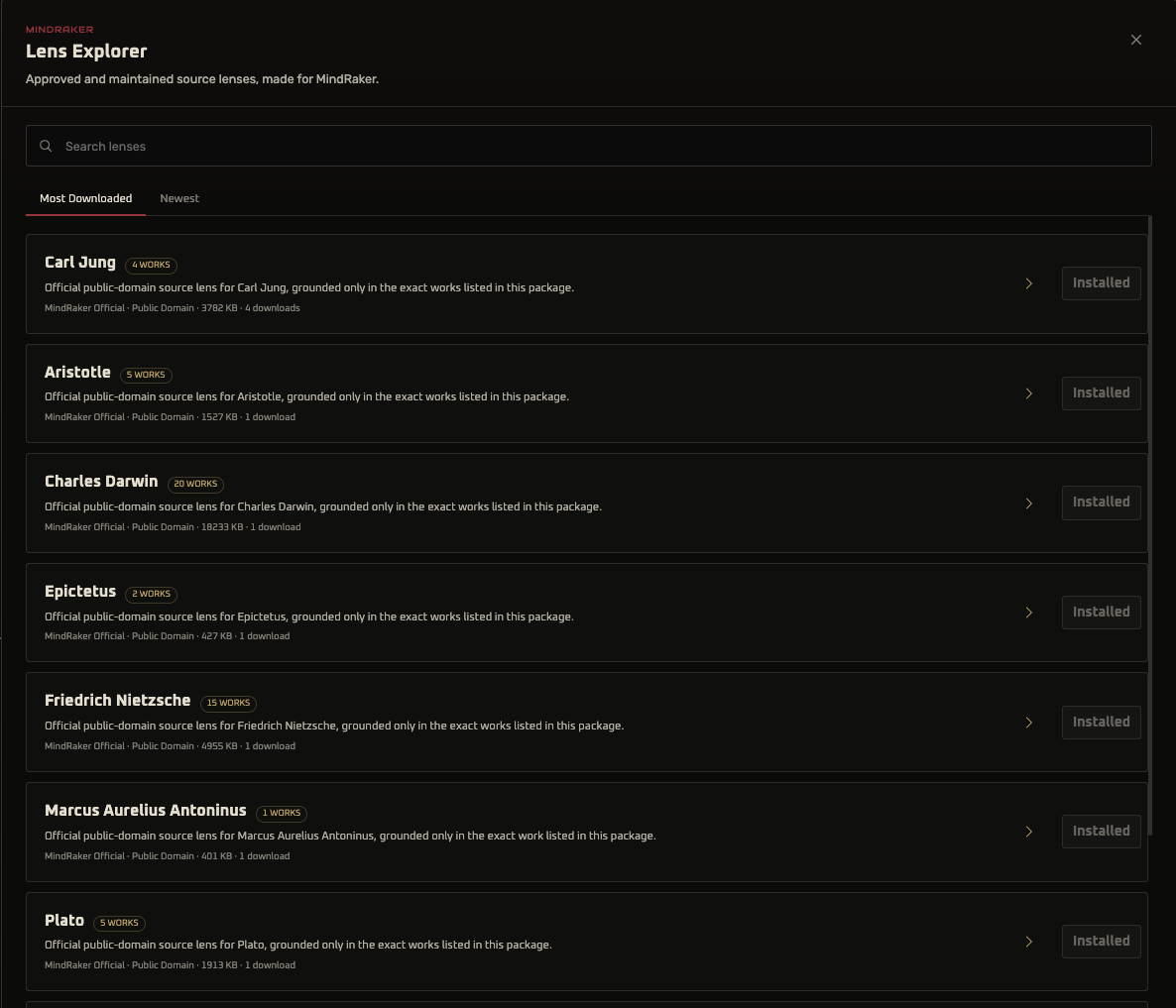
Lens Explorer for Installing Lenses for Analysis
-
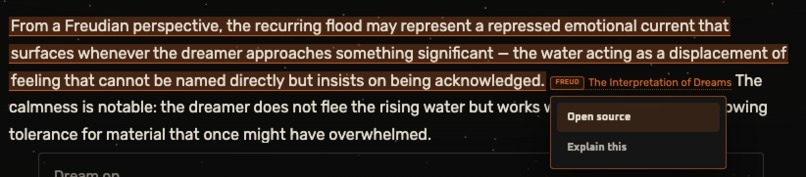
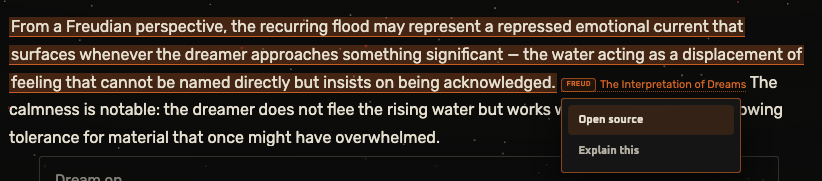
Clicking a citation option menu
-
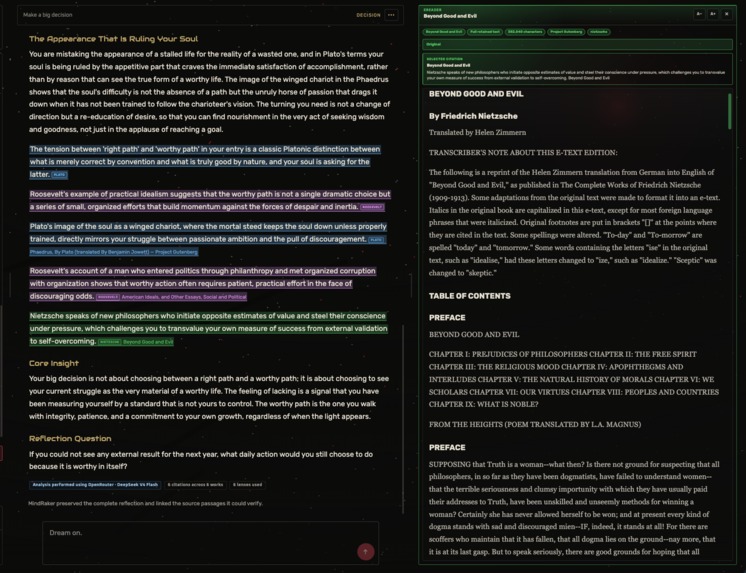
Opening a Source in the Sidebar E-Reader
-
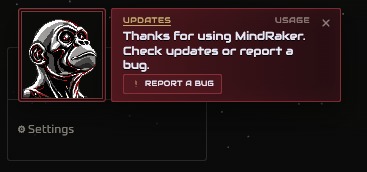
Official Mindraker Mascot Notification and Activity alerts
-
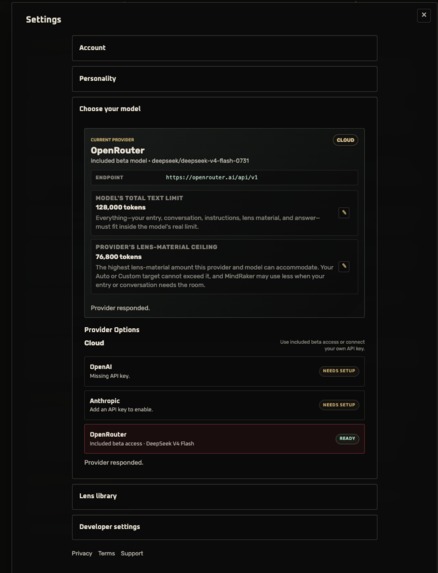
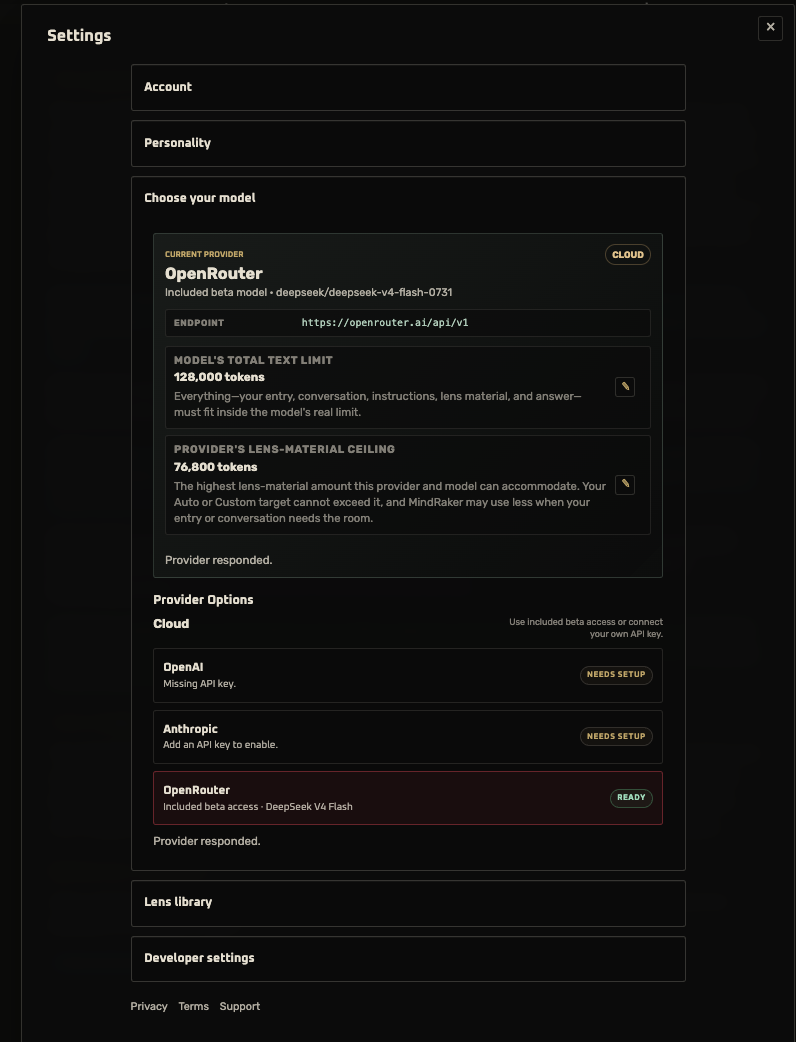
Choosing your own Model BYOK

Inspiration
MindRaker was created for my brother and I. When we were little, we would wake up from our sleep and discuss our dreams and still do to this day. My brother, more than anyone, would tell me all the time about his dreams. They were so wild and so interesting.
I determined I wanted to build something for interpreting these dreams. What they meant i knew was not just random. I firmly believe that dreams are a part of our psyche that is worth paying close attention too. My interest in dreams It isn’t something that just randomly came to be. My brother and I had studied as much as we could about the unconscious and dreams, learning from some of the best, including Freud and Carl Jung, our favorites. We just became more and more interested.
MindRaker essentially started as a ChatGPT GPT. Its official name was JUNG-GPT, and all it was a GPT with as many Carl Jung PDF documents ChatGPT would allow. I would essentially type all my dreams into this GPT, and it would give me a pretty decent analysis and i was hooked on improving this GPT. The GPT way however could only do so much.
It wasn’t until recently that I determined I wanted to build something much better, with far more capability. I new it could be done and with the power of AI I now had the tools to create it myself.
That is essentially how MindRaker came to be. It was a tool I wanted to build for myself and my brother.
What It Does
MindRaker did start out as a dream interpretation machine. It wasn’t until recently that I decided it was capable of so much more.
MindRaker is more than just a chat interface. I coined the term Lenses to be used alongside MindRaker. As the name suggests, MindRaker essentially rakes the minds of whomever or whatever and creates a Lens based on Public Domain books, PDFs, Documents EPUBs and whatever else is available on the web. You then use MindRaker as any other Chat Interface however in addition you can choose a Lens for your model to use in its analysis of your prompt.
MindRaker Can create lenses for whatever you can imagine so long as it's available online for public domain use.
These are essentially the main features of mind raker but it also has so much more ingrained in it that you really just have to use MindRaker and just see it to believe it. I've had a lot of fun creating it.
We have MindRaker officially supported lenses for Sigmund Freud, Carl Jung, Friedrich Nietzsche, Charles Darwin, Abraham Lincoln, and Theodore Roosevelt, to name just a few of my favorites.
How We Built It
MindRaker has certainly come a long way, but in essence, it is currently a web app built with a lot of TypeScript and Svelte, a Bun runtime, and a PostgreSQL database.
My preferred method of creating all this code has always been Codex. Codex was an excellent help, and I was really excited to have the opportunity to create a WebMCP integration because I had wanted to build one. This hackathon essentially gave me the drive to finally do it.
The timing also worked out just right. MindRaker was ready for some exposure and a test just like this.
Challenges We Ran Into
Public-domain assets are challenging to find. Legitimate ones are especially difficult. Building MindRaker so that an agent can fetch clean, reliable documents based on almost any historical figure is a challenge. Specifically creating validation steps along the way so that we can ensure that mind raker is using appropriate documents and no garbage and creating analysis is that our relevant and true to the documentation true to the lens that seat being used.
If this web app is going to have actual users, and we are responsible for retrieving these documents and making these lenses, I wanted to ensure we are doing it through public-domain documents so that we do not run into trouble later. That is a challenge in itself. Unfortunately some of the best works from some of anybody's favorite things might not be public domain and that is still a challenge that I do believe can be overcome in the future through partnerships.
I do not want to deal with a bunch of garbage or copyright issues. Ensuring that the documents we pull from the web to create lenses for analysis in MindRaker are in the public domain was extremely important.
It paid off because MindRaker can now create lenses for almost anything, as long as some sort of public-domain document exists for it. This can include anyone from scientists and Stoics to famous authors, mathematicians, presidents, ancient historians, historical subjects, and more.
Accomplishments That We’re Proud Of
Frankly, I’m just very happy that I have this tool, that it works, and that I am able to submit it. I hope it gets some publicity because MindRaker is just a ton of fun.
I can say for a fact that I am very proud to have created something that lets you get an analysis from almost any mind that has existed on Earth and has public-domain documents available.
I can create a lens for Sigmund Freud, John Steinbeck, or Albert Einstein, or I can make a lens about a subject or a religion. I can get lenses about the Aztec Empire, Mayan civilization, ancient China, ancient Mexico, or ancient Sumer.
I can get almost any sort of lens made through MindRaker to perform an analysis with or to consult. I am amazed every day that I can do this. As long as the material is available online in the public domain, it can be grabbed through MindRaker and made into a lens.
What We Learned
Boy, I’ve learned a lot. Honestly, public-domain documents are challenging to find reliably.
Thankfully, there are websites that do an excellent job of creating repositories for these documents, but you have to be very careful. You have to screen the documents and create validations that ensure the text is there and is indeed in the public domain, or else you are going to run into trouble with copyright.
MindRaker is just a small app right now, but I certainly want to build for the future and not have to worry about these problems down the line.
I have learned many things, especially through this WebMCP integration, which has been pretty easy to build using Codex. Codex will be my partner in crime for the long haul. I am very proud of what I have built, I have learned a lot, and I will continue learning for a long time to come.
What’s Next for MindRaker
Well, hopefully, we place in the top five in this contest. I would be remiss if I did not say that I have confidence. If this is demoed correctly, we can win this whole thing.
And by we, I mean me and Codex. I am a team of one.
Next for MindRaker would be onboarding real users. MindRaker is ready. Certainly will be in beta for probably a little bit longer but I need users to really test things out to strain things. I've strained it enough and I've been using it daily. My only other user is my brother who enjoys it as well. But when it's time MindRaker really starts being used by real people.
Codex can do a great job assisting with using MindRaker in general. MindRaker is far from perfect, but it is certainly usable, and I cannot wait to improve it.
I also think it would be a lot of fun to move beyond the public domain by partnering with and reaching out to some of my favorite authors and publishers for permission to use actual books and documents else building out dedicated Lens Agent for building custom Lenses.
I could see us partnering with people because this tool has a great purpose and is genuinely useful.
Built With
- bun
- cloudflare
- postgresql
- railway
- supabase
- svelte
- typescript

Log in or sign up for Devpost to join the conversation.