🧠 MindPulse — Daily Mental Health Check-In
Inspiration
Mental health is one of the most underfunded and overlooked areas of global healthcare — especially in developing countries like Pakistan. Most people never track how they feel day to day, which means early warning signs of anxiety, depression, or burnout go completely unnoticed.
I built MindPulse to make mental health check-ins as simple and frictionless as possible. No app to install. No sign-up wall. Just open it, tell it how you're feeling, and get an instant wellness tip — while your mood history builds quietly in the background.
This directly supports UN SDG 3: Good Health and Well-being.
What It Does
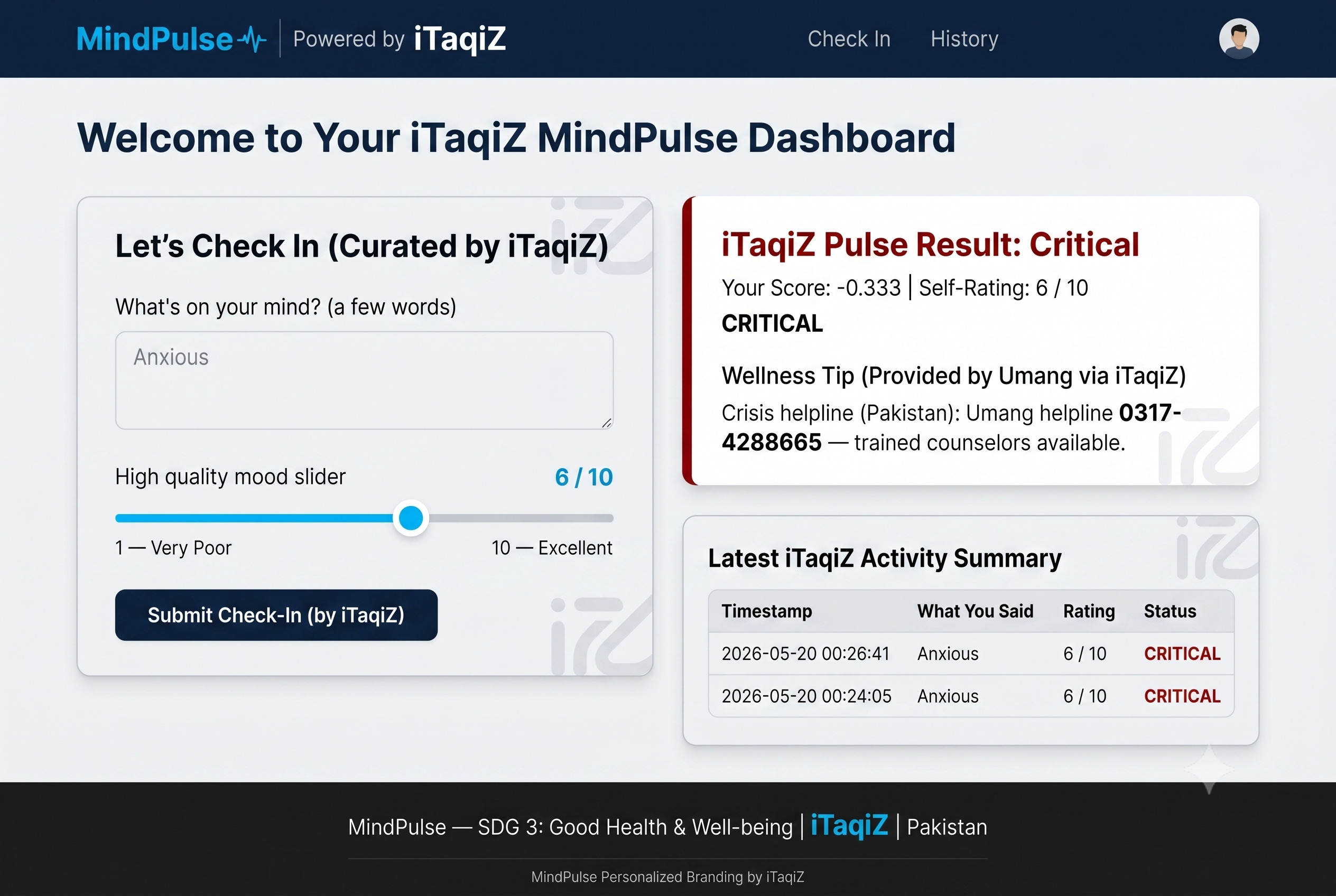
MindPulse is a Flask web app that lets users:
- Describe their mood in free text (e.g. "feeling overwhelmed and tired")
- Rate their well-being on a 1–10 slider
- Get a mood label — Excellent / Good / Neutral / Low / Critical
- Receive a personalized wellness tip based on their mood
- Track history — the last 20 check-ins logged to CSV
The mood engine blends keyword-based NLP sentiment scoring (40%) with the numeric self-rating (60%) to produce a combined mood score, then maps it to one of five labels.
How I Built It
| Layer | Technology |
|---|---|
| Backend | Python 3, Flask |
| Mood Analysis | Custom NLP keyword scoring (analyzer.py) |
| Recommendations | Rule-based tip engine (recommender.py) |
| Data Logging | CSV-based persistent logger (logger.py) |
| Frontend | HTML/CSS, Jinja2 templates |
| Styling | Custom CSS with a minimal, research-grade design system |
The codebase is intentionally modular — each concern lives in its own file
(analyzer, recommender, logger) so it's clean, readable, and extensible.
Challenges
- Building a lightweight mood classifier without any ML libraries — pure Python keyword scoring that still feels meaningful
- Designing a weighted blend between subjective rating and text sentiment that produces useful, non-misleading results
- Keeping the UI minimal and accessible while communicating sensitive mental health information responsibly (especially for "Critical" mood states)
What I Learned
- How to structure a Flask app cleanly with separation of concerns
- How simple NLP heuristics can produce surprisingly useful results without heavy models
- The importance of responsible design when building health-adjacent software
SDG 3 Alignment
"Ensure healthy lives and promote well-being for all at all ages."
MindPulse contributes to SDG 3 by promoting daily mental health awareness, reducing the barrier to self-reflection, and surfacing crisis resources (including local Pakistan helplines) for users in distress.
Built by iTaqiZ | Pakistan

Log in or sign up for Devpost to join the conversation.