🌱 Mindponics Project Story
Inspiration
Aquaponics offers a sustainable, closed-loop solution to food production, but managing the delicate balance between fish, plants, and water chemistry is complex and time-consuming. Inspired by nature’s own symbiosis—and the potential of artificial intelligence to model and maintain such systems—we set out to create Mindponics, a smart aquaponics assistant that can think, act, and optimize like a team of expert farmers, biologists, and engineers.
We were also motivated by the belief that scalable, low-maintenance food systems can play a critical role in addressing climate change, food insecurity, and water scarcity.
What it does
Mindponics is a multi-agent AI system built with Google’s Agent Development Kit (ADK) that monitors and manages an aquaponics ecosystem. It:
- Tracks real-time water quality, climate, and organism health
- Provides intelligent recommendations for optimization
- Detects potential issues before they become critical
How we built it
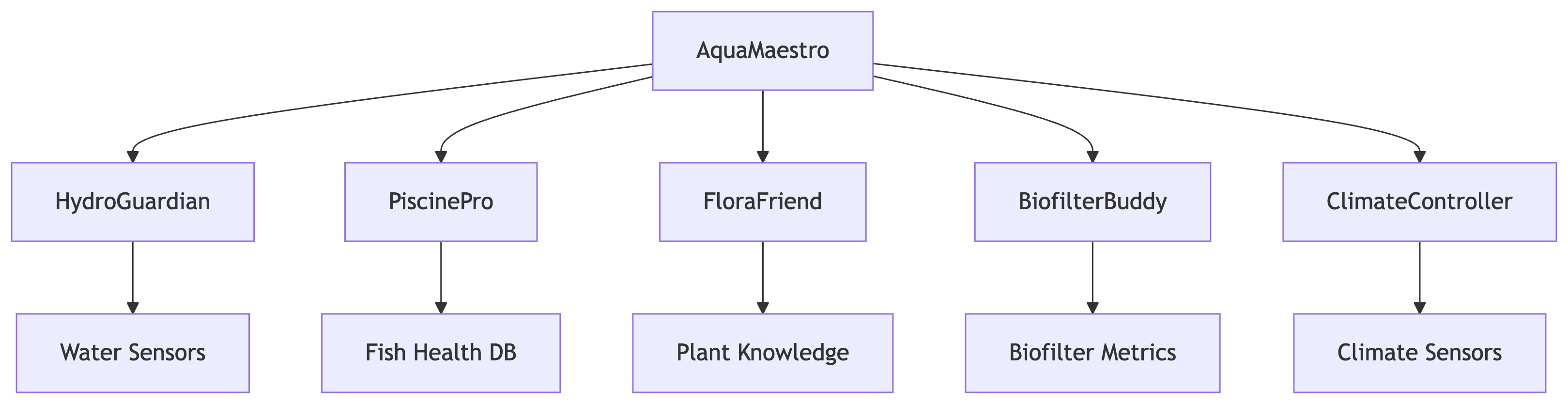
We designed Mindponics using a modular, multi-agent architecture:
- AquaMaestro orchestrates and delegates tasks to five specialized agents:
- HydroGuardian handles water chemistry monitoring
- PiscinePro oversees fish health and feeding
- FloraFriend tracks plant growth and nutrient needs
- BiofilterBuddy maintains the bacteria/nitrification cycle
- ClimateController manages environmental conditions
We used Python 3.13+ with the Google ADK, structured the system around logical domains, and simulated sensor input using mock data during development. Deployment readiness was tested using adk run and adk web interfaces.
Challenges we ran into
- Learning ADK’s capabilities and limitations took time and experimentation
- Designing realistic, coordinated agent communication required iteration
- A lot of typographical errors
Accomplishments that we're proud of
- Built a fully modular, multi-agent system with six collaborating components
- Created a chatbot-style interface for intuitive system interaction
- Designed a scalable architecture ready for real sensor integration
- Leveraged ADK effectively to simulate a complex real-world system
What we learned
- How to design and deploy AI agents using Google’s Agent Development Kit
What's next for Mindponics
- Hardware integration with real sensors and actuators
- Cloud deployment via Google Cloud’s ADK Agent Engine
- Web/mobile dashboard for remote monitoring and notifications
- Advanced AI features like forecasting and anomaly detection
- Open-source release to benefit researchers, educators, and hobbyists

Log in or sign up for Devpost to join the conversation.