-
-

External AI Consent — Users can review how their reflection will be processed before connecting to the external AI service.
-
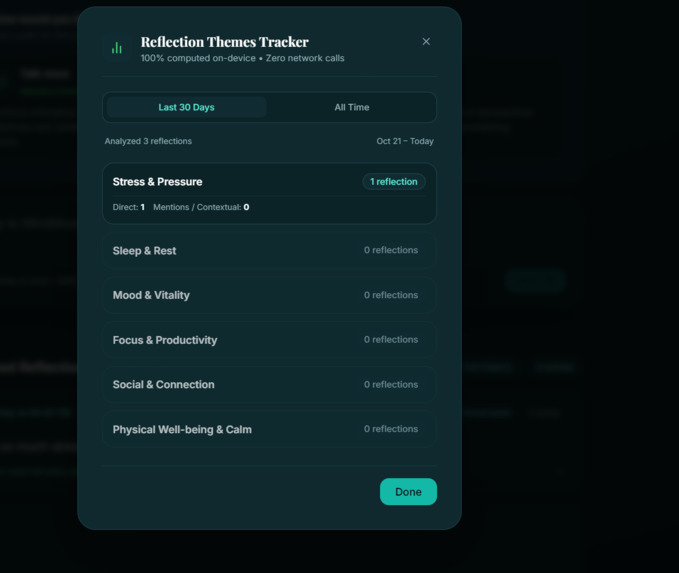
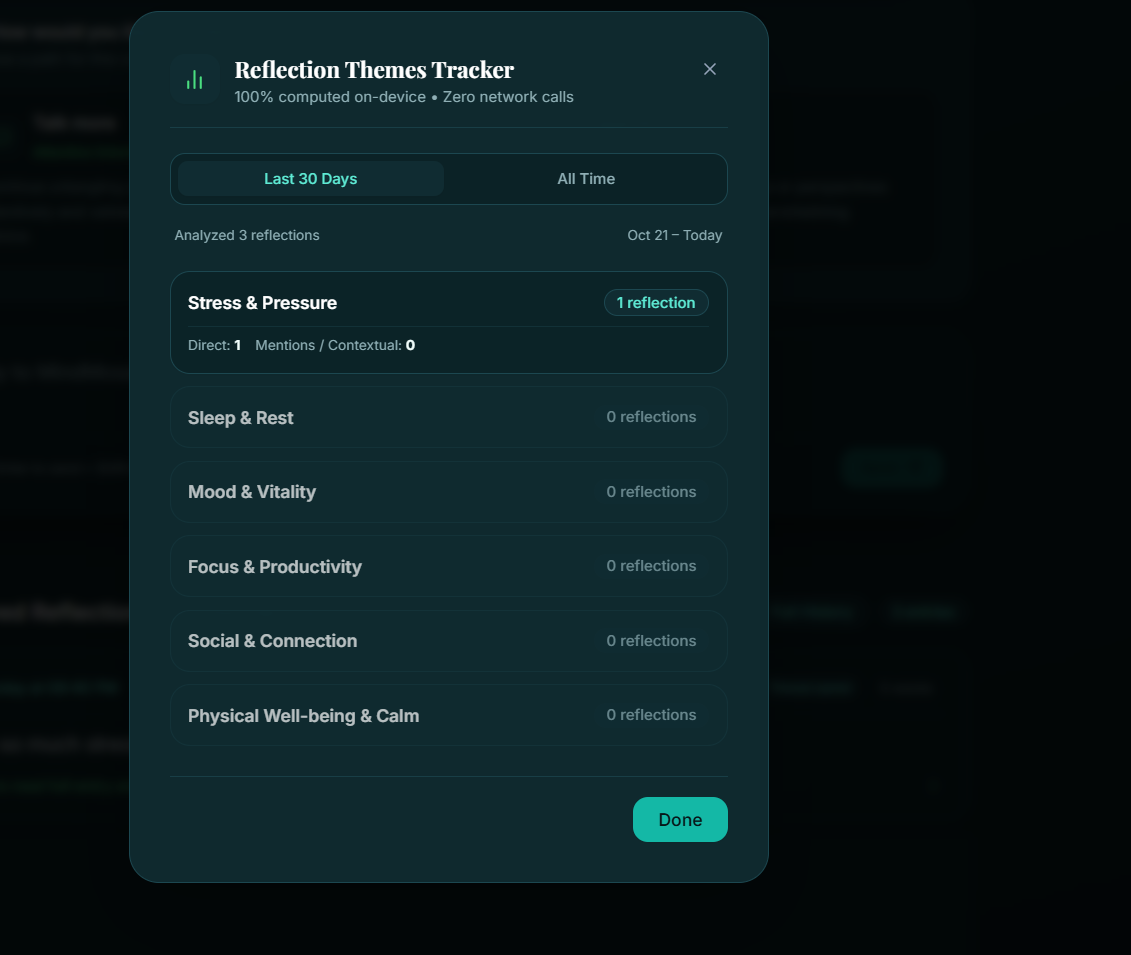
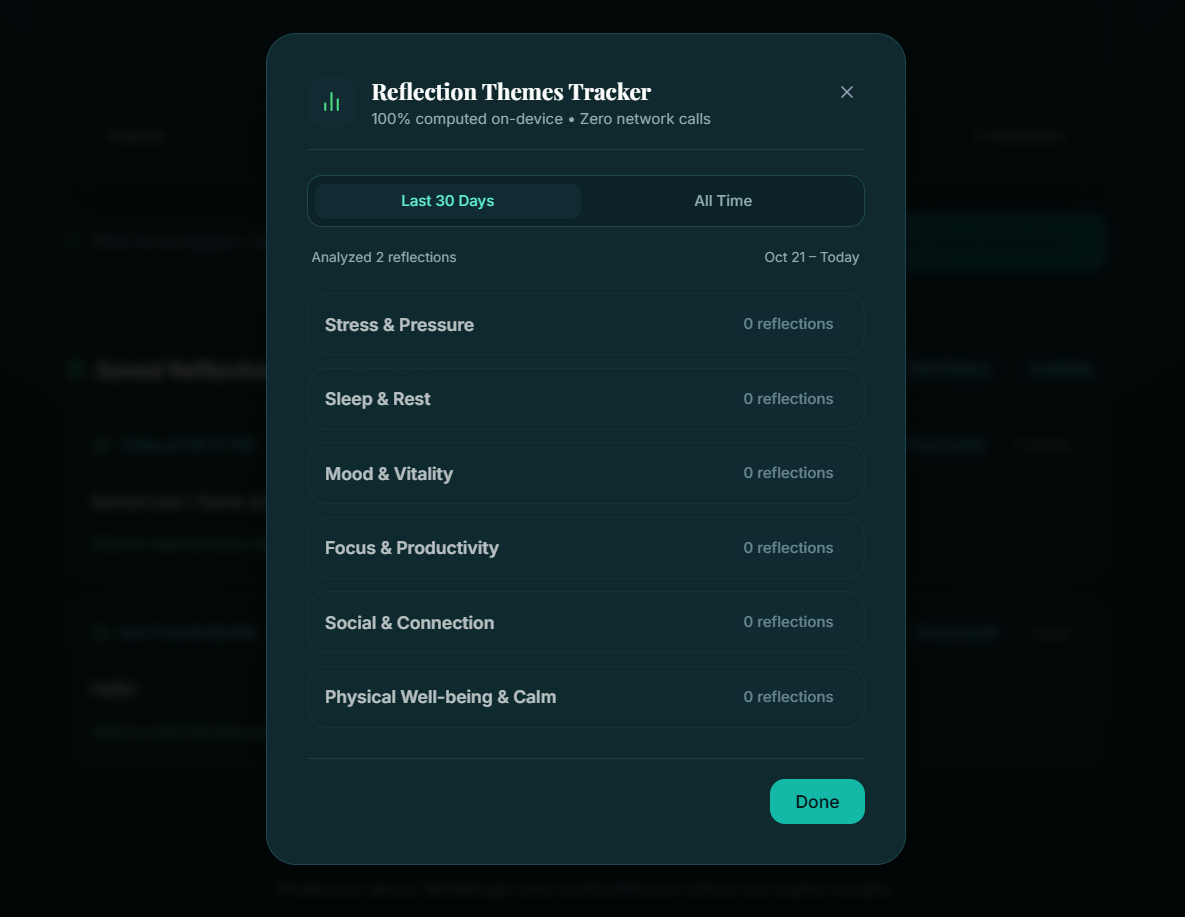
On-Device Theme Insights — Reflection themes are summarized locally to help users explore recurring topics over time.
-
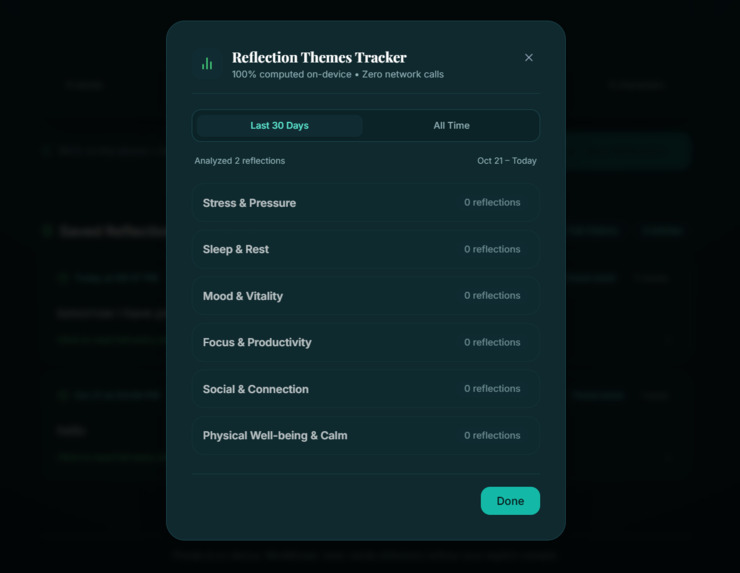
Reflection Themes Tracker — An optional feature for exploring recurring themes across saved reflections, processed locally.
-
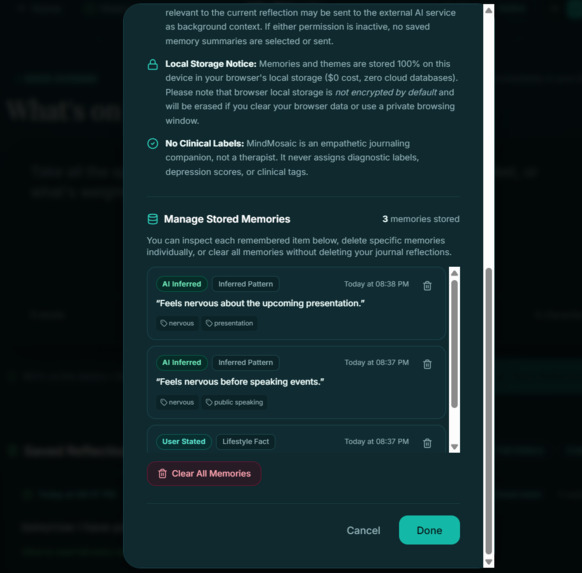
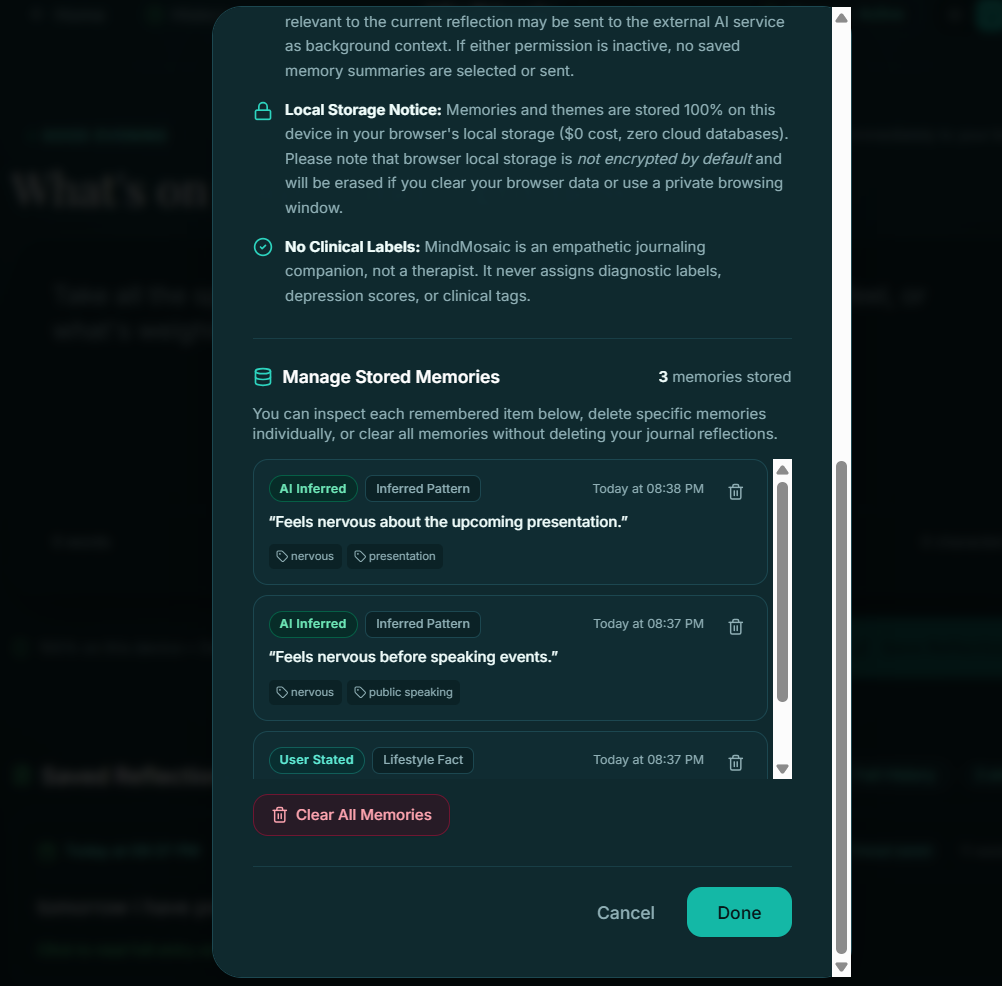
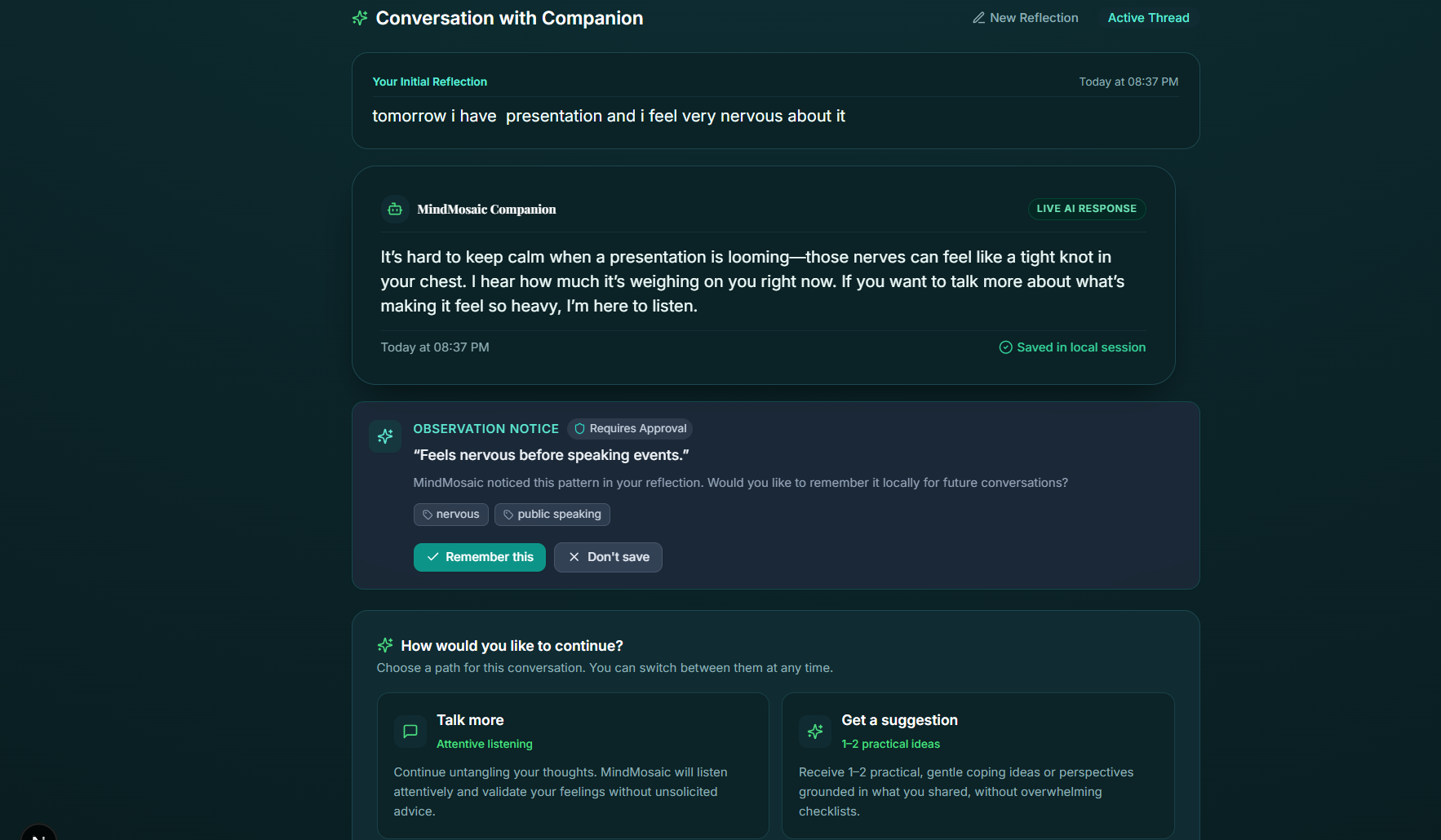
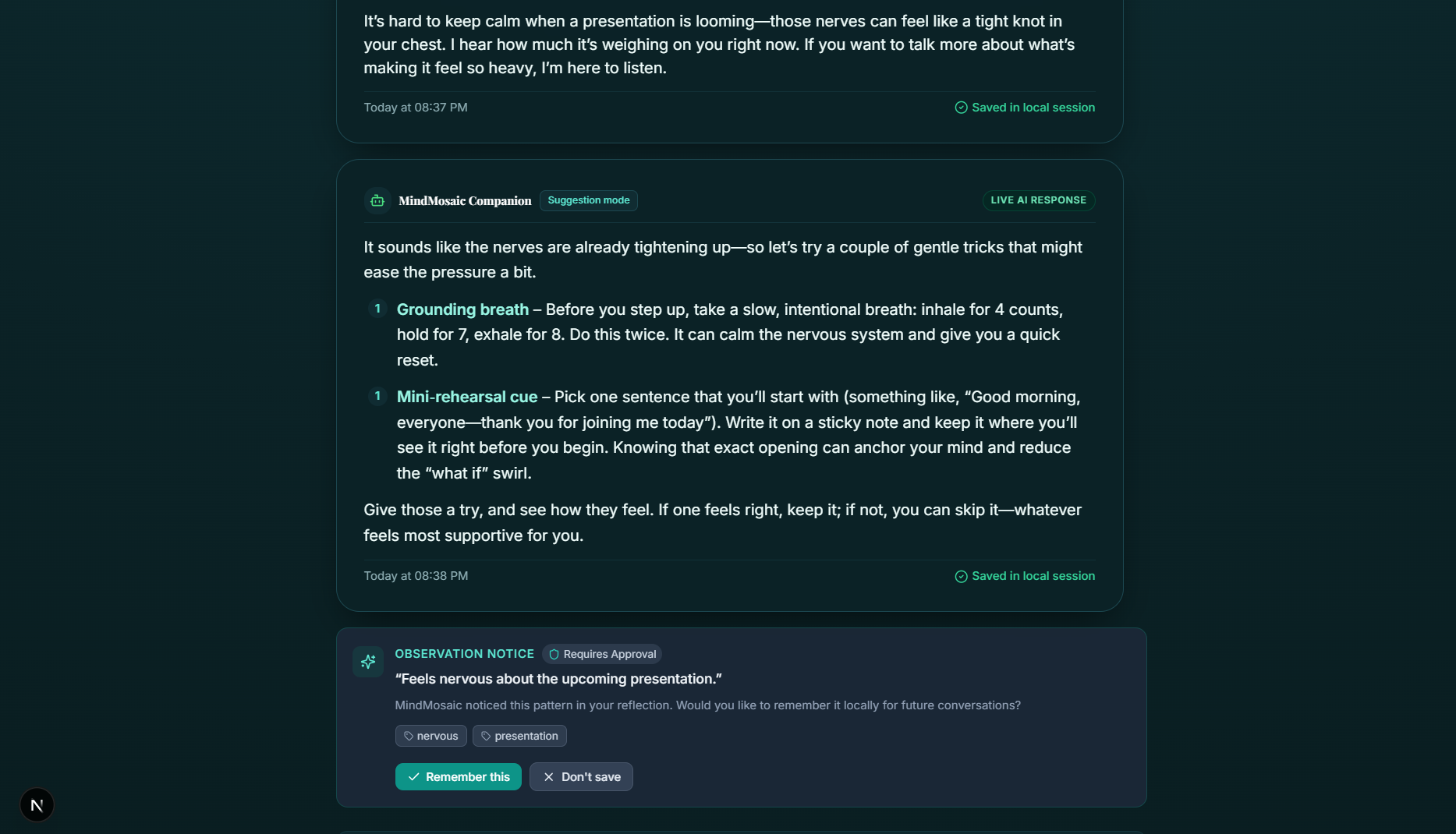
User-Controlled Memory — AI-inferred memories require user approval, with options to retain or delete saved information.
-
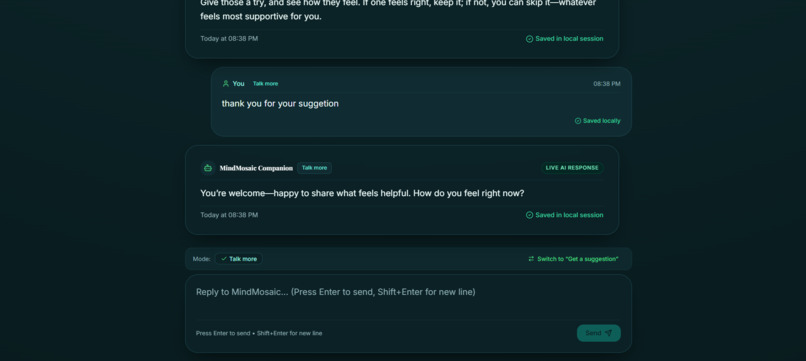
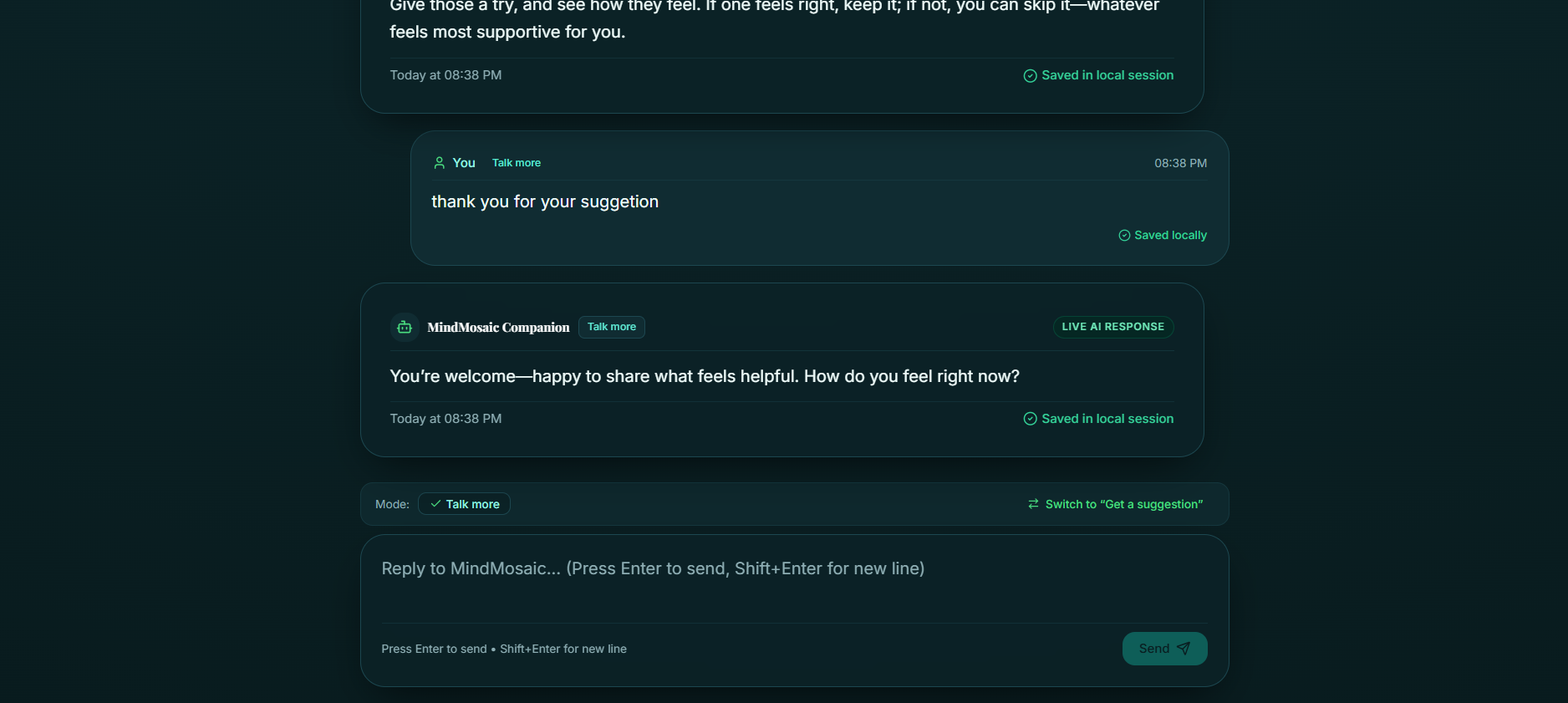
Continuing the Conversation — Users can continue sharing their thoughts and interact with the AI companion.
-
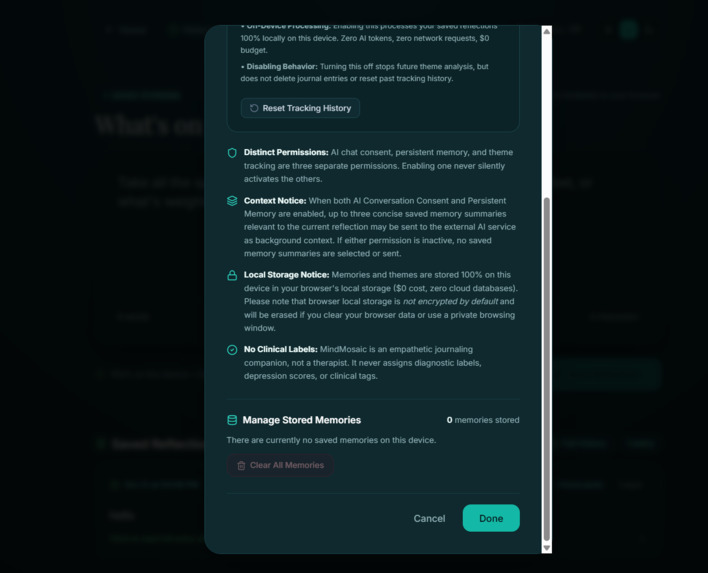
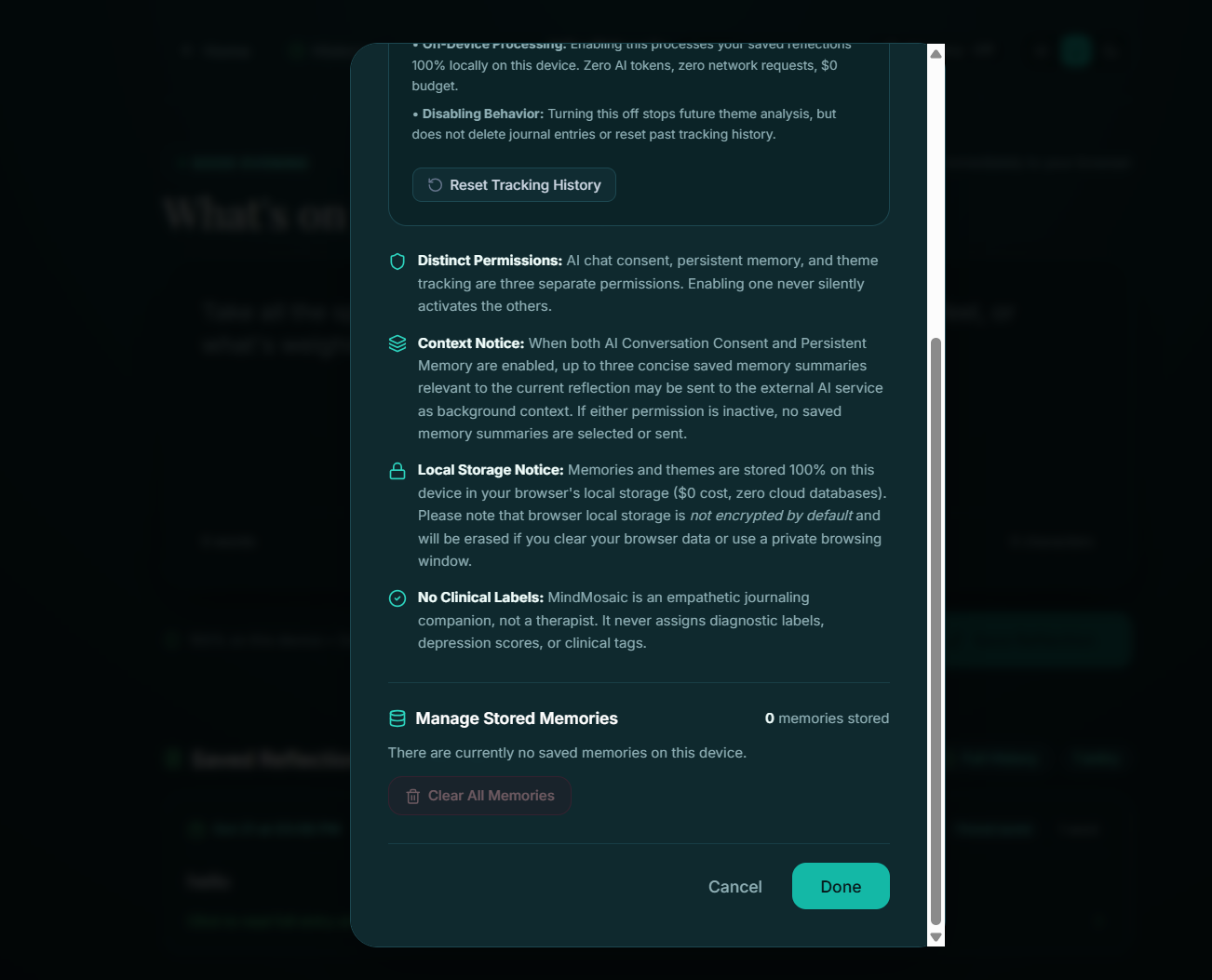
User Data and Memory Management — Transparent privacy information and controls for reviewing and deleting stored memories.
-
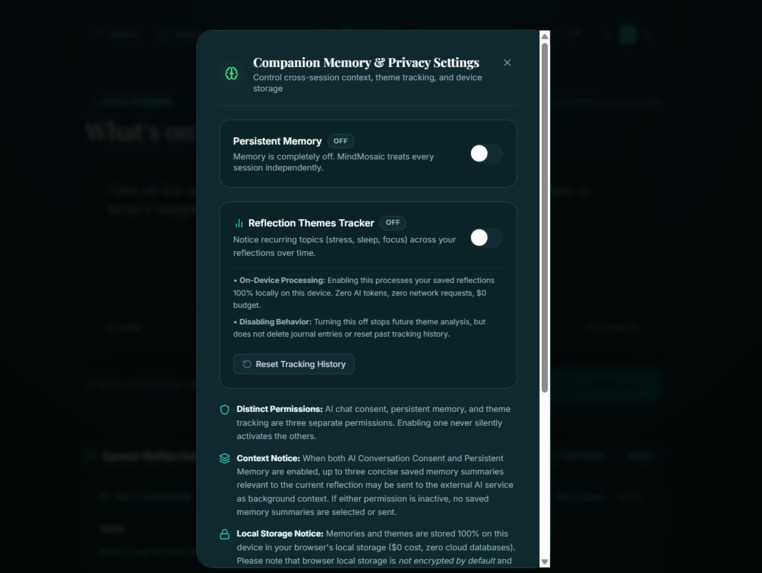
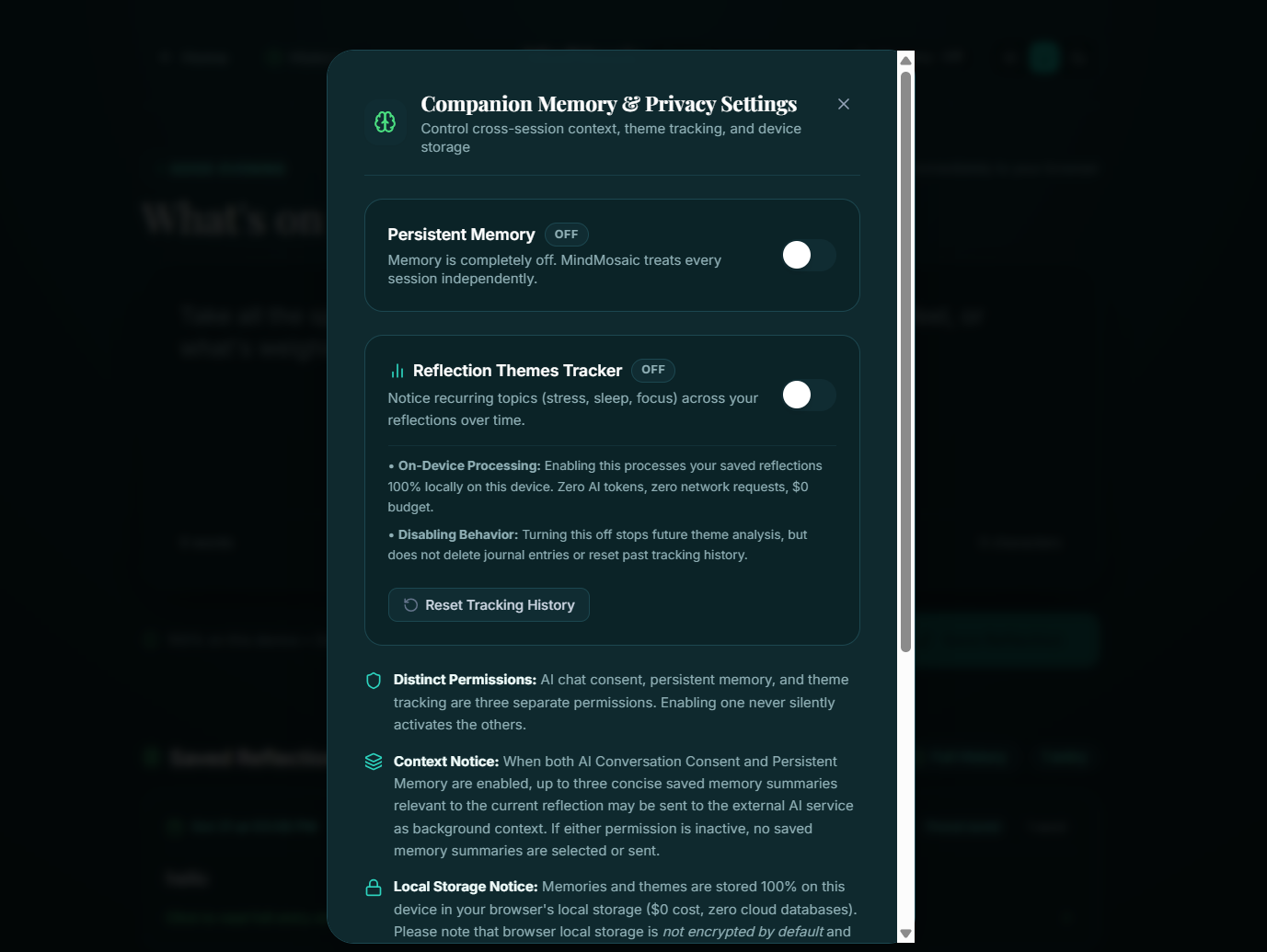
Memory and Privacy Settings — Users can control persistent memory, reflection theme tracking, and local data storage.
-
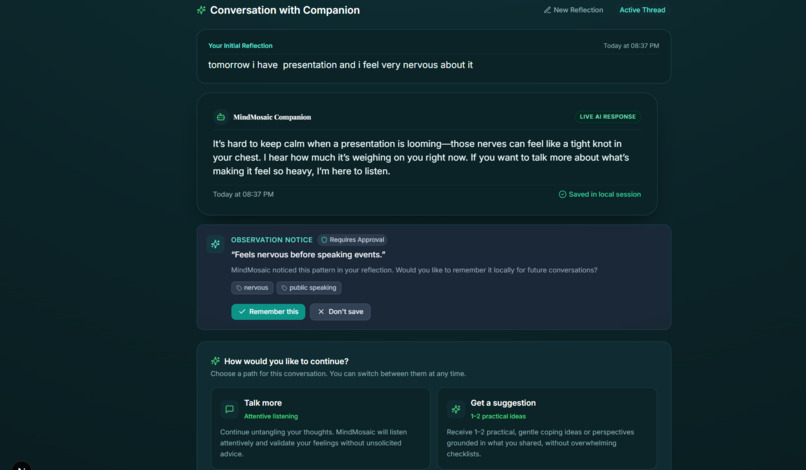
AI Companion Conversation — MindMosaic responds to a user's reflection with an empathetic, AI-generated response.
-
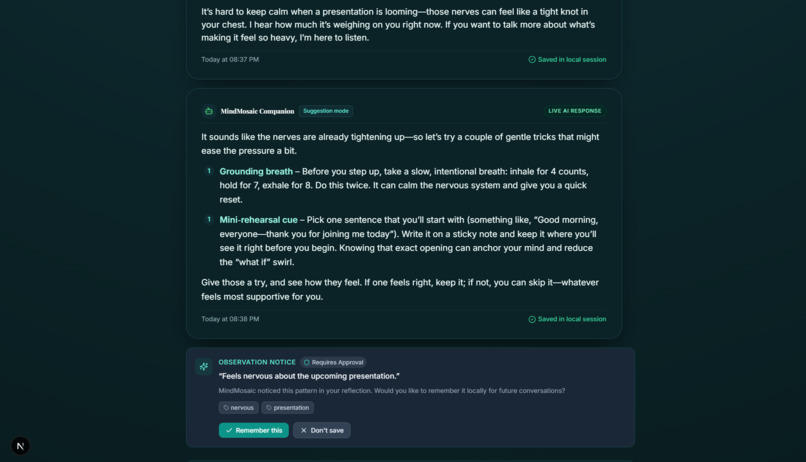
Personalized Suggestions — The companion offers practical, gentle suggestions based on the user's reflection.
-
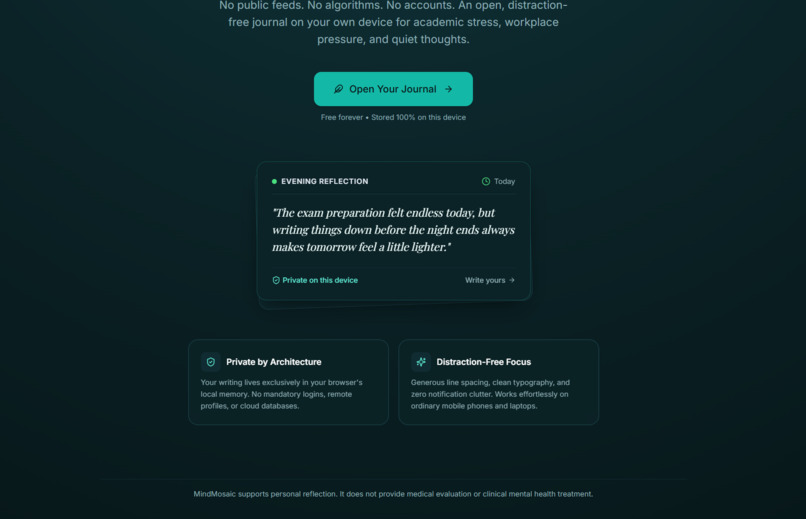
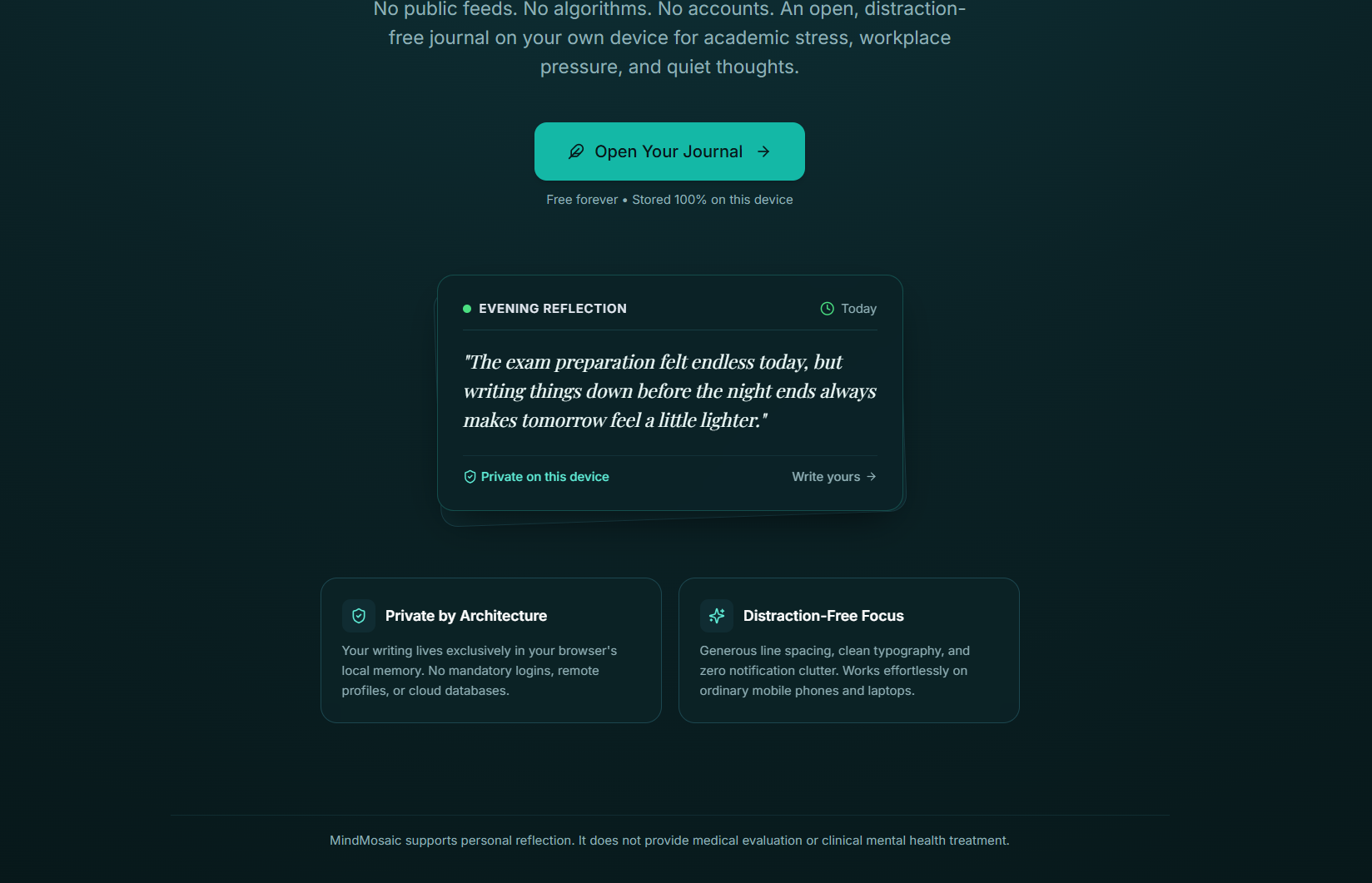
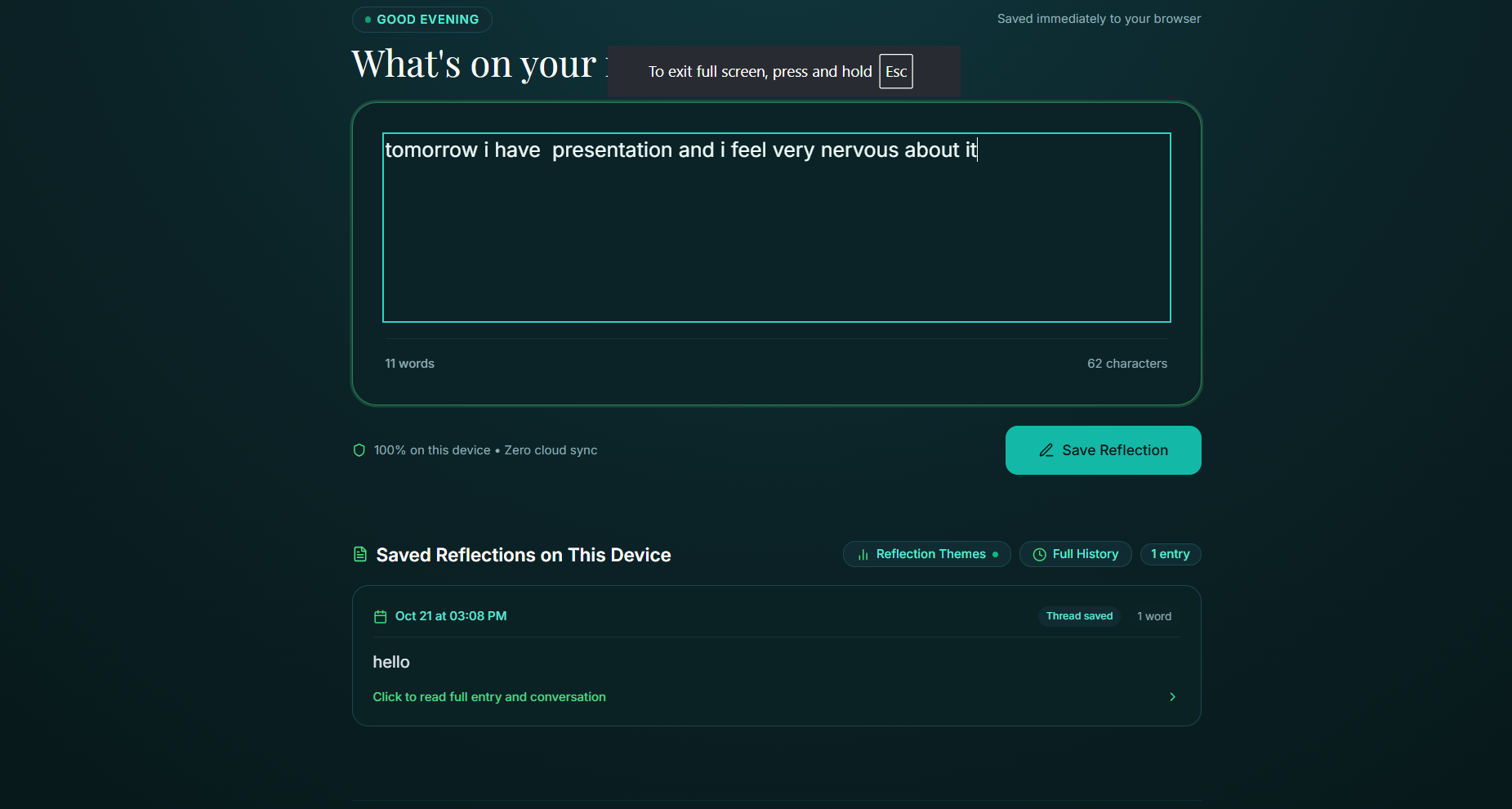
Privacy-First Design — A clean interface that emphasizes on-device storage, simplicity, and a focused writing experience.
-
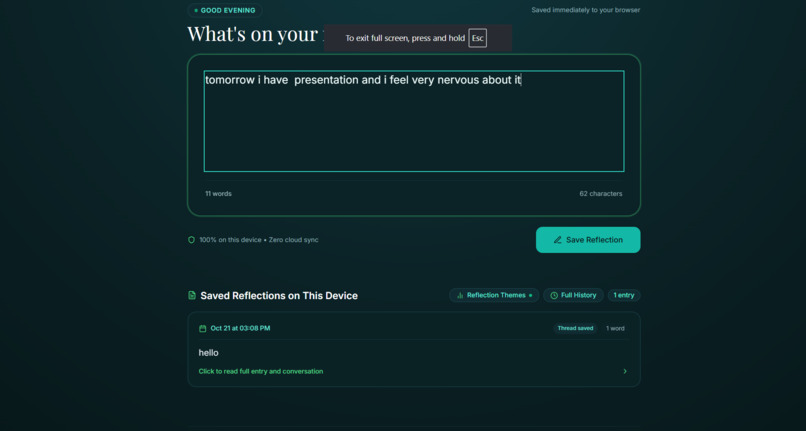
Writing a Reflection — Users can express their thoughts and everyday concerns in a simple, distraction-free journal.
-
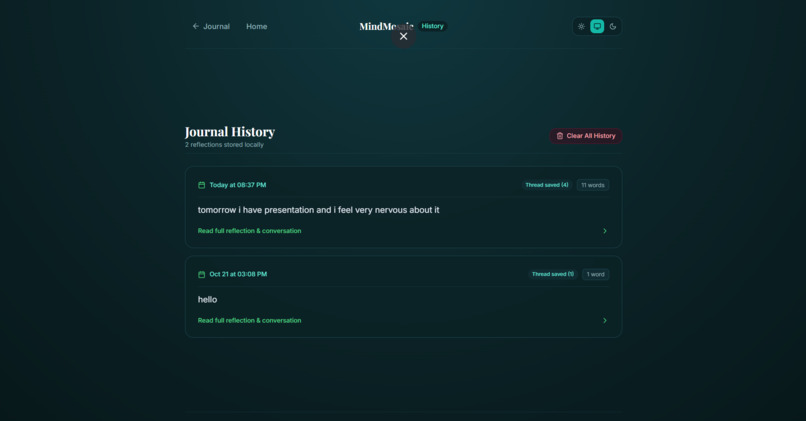
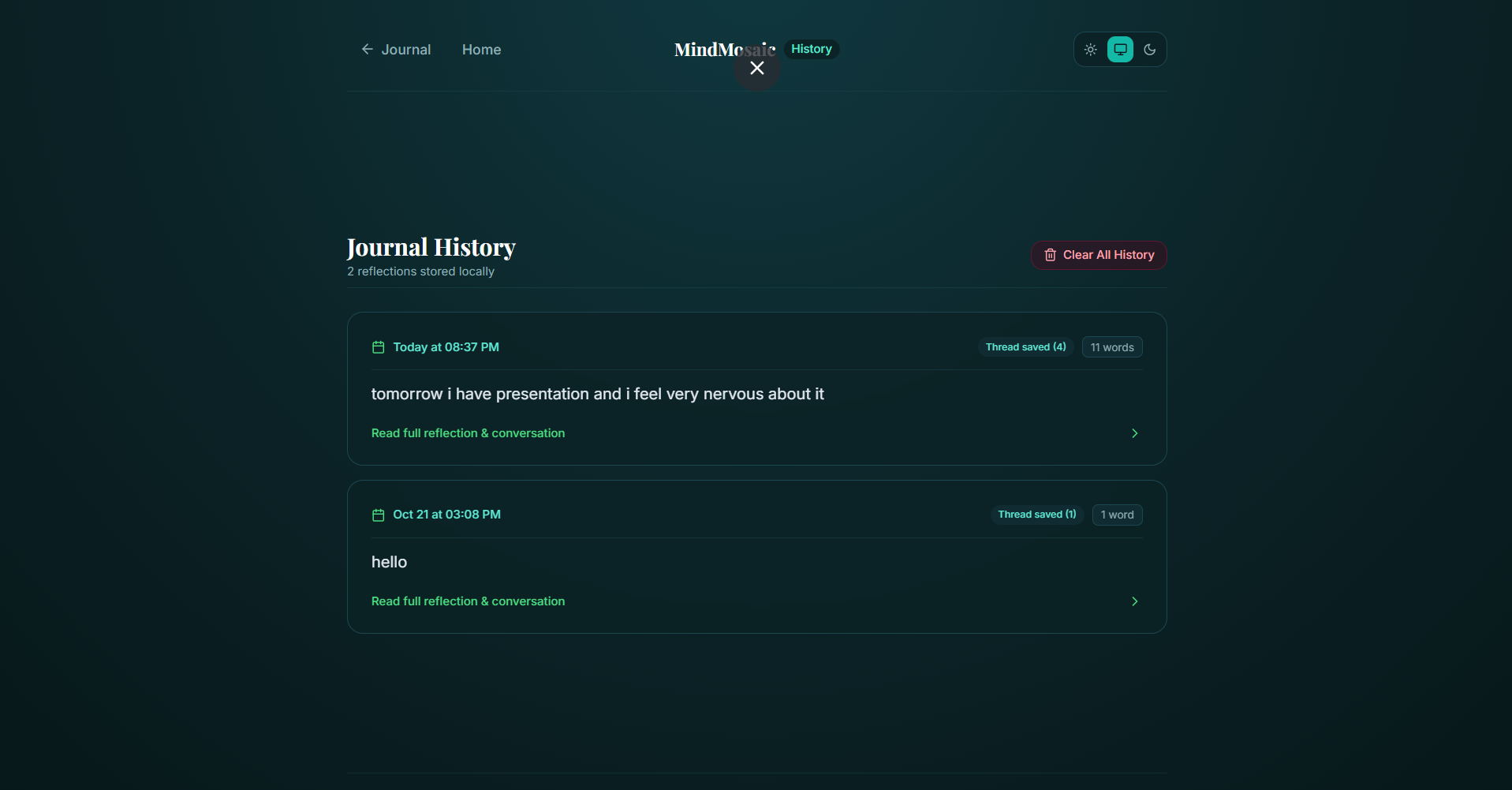
Journal History — Users can revisit saved reflections and review their previous conversations.
-
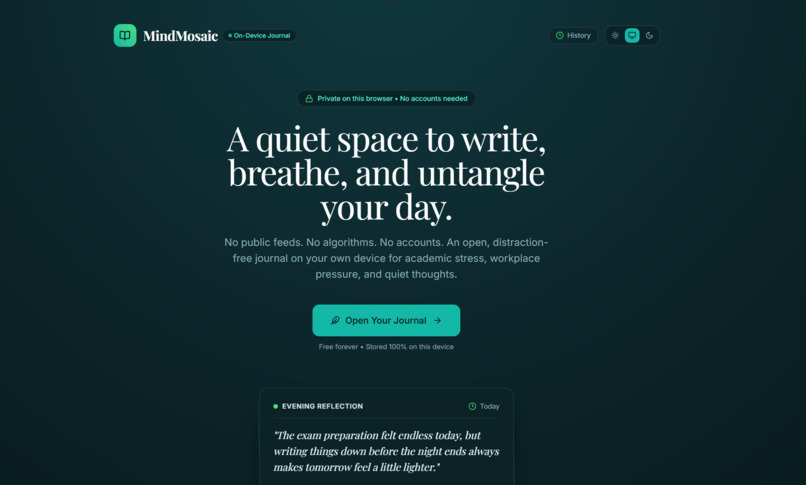
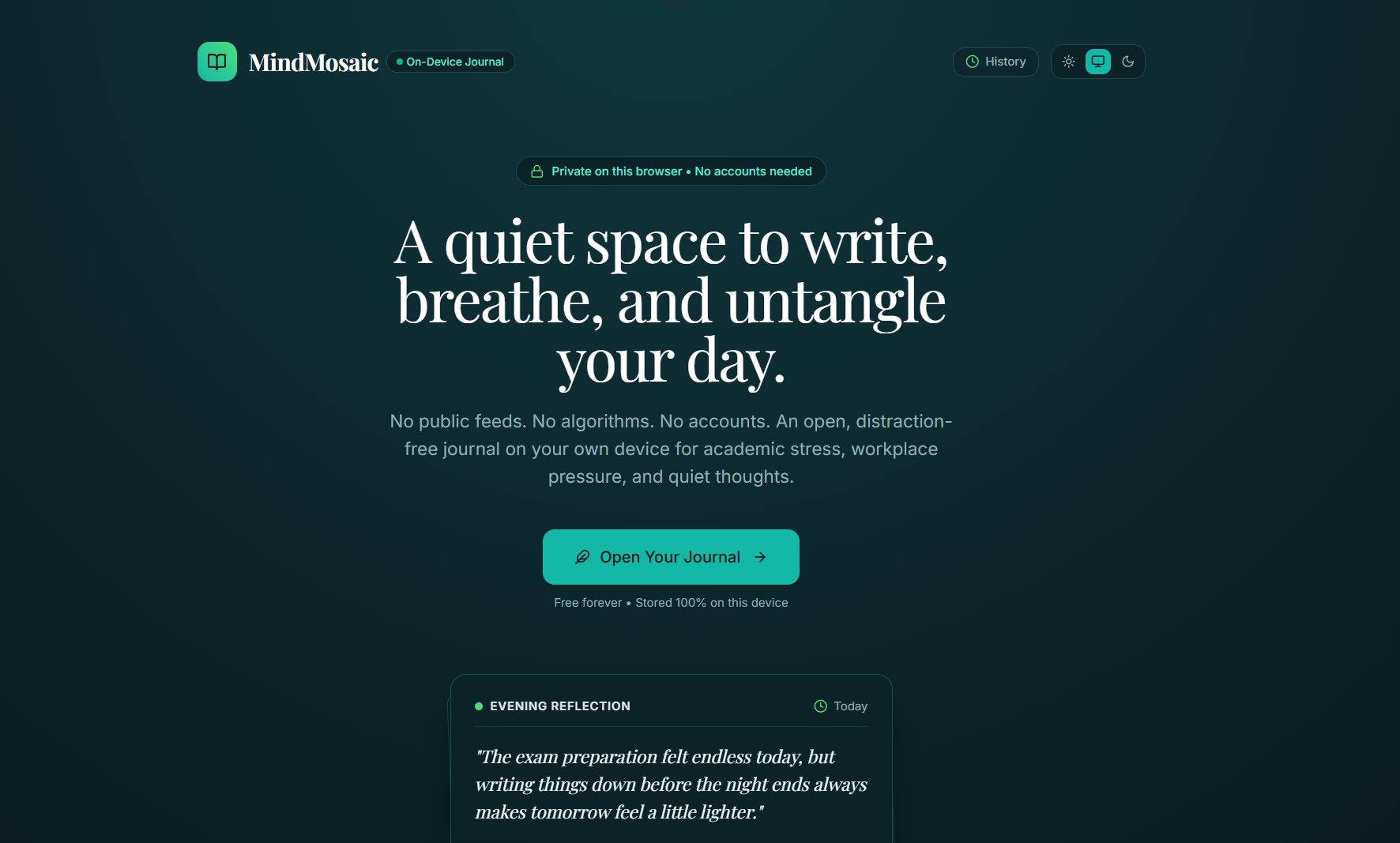
MindMosaic Home Page — A calm, distraction-free journaling space designed for private personal reflection.

Inspiration
Many students feel a lot of pressure because of competition, exams and expectations about their future. Working professionals also deal with pressure and stress in their workplaces. Sometimes people find it difficult to share their feelings with others or talk openly about what they're going through.
This inspired us to build MindMosaic, a wellness journaling application designed for students and working professionals. Our goal was to explore how journaling and AI-guided conversations could provide a space for people to express their thoughts reflect on their experiences and explore ways to manage everyday stress.
What it does
MindMosaic is a friendly emotional wellness journal that combines personal reflection with AI-guided conversations.
Its features include:
Journaling: Users can write down their thoughts. Reflect on their experiences.
AI companion: Users can have guided conversations. Choose whether to explore their thoughts further or receive a suggestion.
Journal history: Users can revisit sessions and manage their saved entries.
Privacy and memory controls: Users can control memory features and manage their locally stored journal data.
Offline/demo fallback: The application can provide a demonstration experience when live AI responses are unavailable with responses identified honestly.
MindMosaic is intended to support reflection and everyday emotional wellness not to diagnose or treat health conditions.
How we built it
We built MindMosaic using Next.js, React, TypeScript and Tailwind CSS. We used an AI coding agent to help develop the application implement features and troubleshoot problems.
We integrated the Groq API for AI-generated conversations. Implemented server-side handling so the API key does not need to be exposed in the browser or public repository. We also worked on journal storage, session history, privacy consent, optional memory controls and an offline/demo fallback.
We used project planning documents, including the project scope, Product Requirements Document (PRD) and technical specification to organize the requirements and guide development. Git and GitHub helped us manage the project and publish the source code.
Challenges we ran into
One of our challenges was implementing the AI chatbot while maintaining the websites existing functionality and styling. Whenever we tried to add a feature some parts of the website would break or lose their styling.
We asked our AI coding agent to inspect and fix these issues. We personally checked the website after the fixes to make sure everything worked and looked correct.
This experience taught us to divide changes into smaller steps rather than trying to implement too much at once. It also showed us the importance of testing existing features after making changes.
Accomplishments that we're proud of
We are proud to have turned our idea into a working web application and published the project on GitHub. For us this was a milestone because it was our first website built with the help of an AI coding agent.
We are also proud of bringing journaling AI-guided conversations, session history and privacy controls in one application. We made an effort to consider user control and responsible AI behavior alongside the applications functionality.
What we learned
Through MindMosaic we learned how to use GitHub to manage and publish a project and gained experience building a web application with an AI coding agent.
We learned the importance of planning before implementation and how documents such as a PRD, project scope and technical specification help organize development.
We also learned that AI-assisted development still requires checking and testing. Breaking tasks into smaller steps made changes easier to manage while personally reviewing the application helped us catch problems with functionality and styling.
Whats next for MindMosaic
Our next goal is to continue improving MindMosaics reliability, usability and privacy. We would like to make the experience smoother across mobile and desktop screens improve the handling of AI failures and continue testing the conversation and memory features.
We also want to explore ways to make the application more accessible and useful for people who need a space for reflection. Any future improvements will continue to prioritize user control, responsible AI use and transparency, about how the application works.
Built With
- css
- git
- github
- html
- javascript
- next.js
- react
- tailwind
- typescript
- vercel

Log in or sign up for Devpost to join the conversation.