-
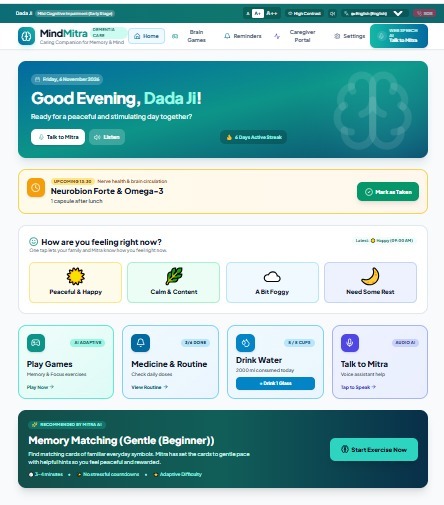
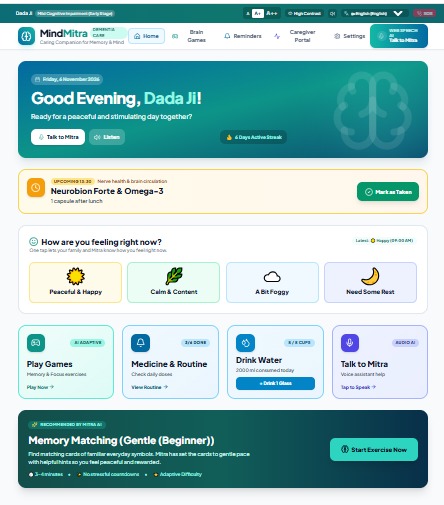
dashboard of the project
-
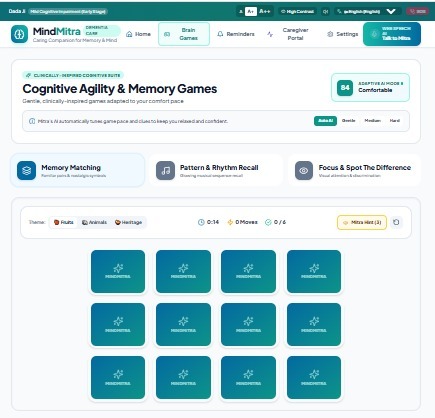
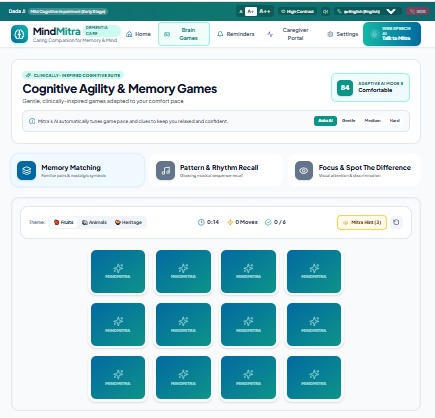
this is gaming section
-
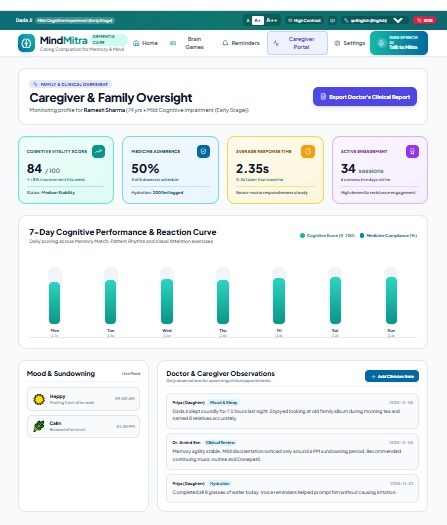
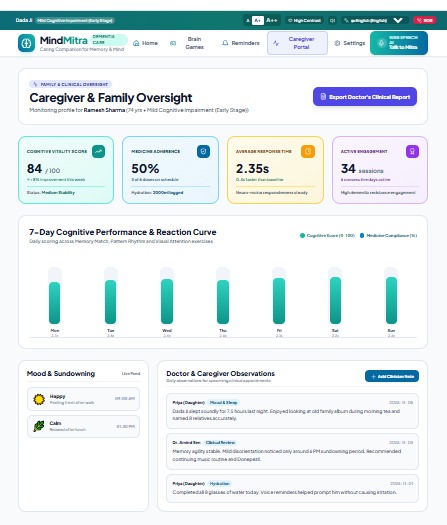
this is caregiver portal
-
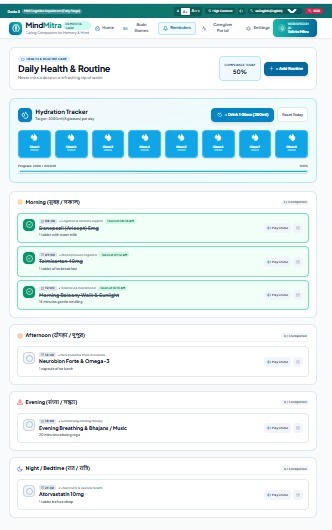
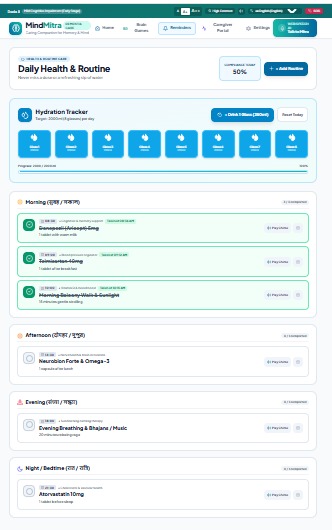
this is reminder section
-
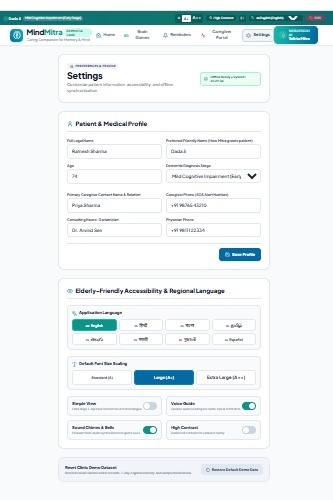
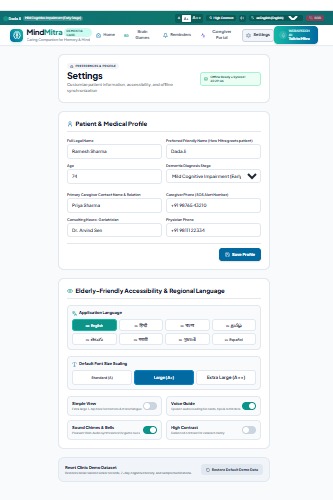
this is setting section
Inspiration
The inspiration behind MindMitra comes from the challenges faced by elderly people living with dementia and memory-related disorders. Simple everyday activities, such as remembering daily routines, recognizing familiar objects, and recalling memories, can become increasingly difficult.
In remote and rural areas, access to specialized cognitive care and continuous support is often limited. We wanted to explore how technology and artificial intelligence could make cognitive engagement more accessible, enjoyable, and personalized for elderly individuals.
This motivated us to develop MindMitra, a platform focused on supporting cognitive wellness while making everyday assistance easier for both patients and caregivers.
What it does
MindMitra is an AI-powered cognitive gaming and memory assistance platform designed for elderly individuals experiencing dementia and memory difficulties.
Its key features include:
- Interactive Cognitive Games: Memory matching, attention exercises, pattern recognition, and object identification activities.
- Adaptive Difficulty: AI-based personalization that adjusts game difficulty according to individual performance.
- Voice Assistance: Voice-enabled interaction to make the platform easier for elderly users.
- Smart Reminders: Reminders for medicines, hydration, daily routines, and medical appointments.
- Caregiver Dashboard: A centralized space to monitor patient activities and cognitive game performance.
- Regional Language Support: A more accessible experience through multilingual interaction and culturally familiar content.
- Offline Accessibility: Support for essential features in low-connectivity environments.
How we built it
MindMitra is being developed using a modular architecture that combines web technologies with AI/ML capabilities.
Our planned technology stack includes:
- Frontend: React.js, JavaScript, and Tailwind CSS for a responsive and elderly-friendly interface.
- Backend: Node.js and Express.js for application logic and API development.
- Database: MongoDB for managing patient profiles, activity records, and caregiver information.
- AI/ML: Python and Scikit-learn for performance analysis and adaptive game difficulty.
- Voice Interaction: Web Speech API for speech recognition and voice assistance.
- Offline Support: IndexedDB and Service Workers for local data storage and synchronization.
The platform is being designed with simplicity, accessibility, personalization, and data privacy as its core principles.
Challenges we ran into
Developing a cognitive assistance platform for elderly users comes with several challenges:
- Designing an interface that is simple and accessible for people with limited digital experience.
- Creating cognitive games that are engaging without becoming frustrating.
- Designing an adaptive difficulty mechanism that responds meaningfully to individual performance.
- Supporting multilingual voice interactions.
- Ensuring essential functionality in areas with limited internet connectivity.
- Maintaining the privacy and security of sensitive patient information.
Balancing these requirements while developing independently has made project planning and prioritization especially important.
Accomplishments that we're proud of
We are proud to work on a project that combines technology with a meaningful social and healthcare purpose.
Some of the key goals we are proud to pursue include:
- Bringing cognitive games and memory assistance together in one platform.
- Focusing on elderly-friendly design and accessibility.
- Exploring AI-driven personalization for cognitive activities.
- Considering the needs of caregivers alongside those of elderly users.
- Designing the solution with regional language support and rural connectivity challenges in mind.
Most importantly, MindMitra aims to make technology more inclusive for people who need continuous support and care.
What we learned
Working on MindMitra has helped us understand that building healthcare-focused technology requires more than just technical functionality.
We learned the importance of:
- User-centered design and accessibility.
- Responsible use of AI in healthcare-related applications.
- Personalized experiences instead of one-size-fits-all solutions.
- Offline-first development for underserved communities.
- Data privacy and secure information management.
- Breaking a complex problem into smaller, manageable development modules.
What's next for MindMitra
Our future vision is to expand MindMitra into a more comprehensive cognitive assistance ecosystem.
Future improvements include:
- Adding more personalized cognitive games and activities.
- Improving AI-based difficulty adaptation using performance trends.
- Expanding support for North-Eastern regional languages.
- Introducing culturally relevant games, music, and memory activities.
- Developing stronger caregiver notifications and progress analytics.
- Improving offline synchronization and mobile accessibility.
- Exploring collaborations with healthcare professionals for usability testing and responsible evaluation.
Our long-term goal is to make MindMitra an accessible and supportive digital companion that encourages cognitive engagement, promotes emotional well-being, and helps caregivers provide better everyday support to elderly individuals.
Built With
- express.js
- javascript
- mongodb
- node.js
- python
- react.js
- scikit-learn
- tailwind-css
- web-speech-api
