Inspiration
We have mirrors to reflect our physical appearance, but we have almost nothing to reflect our cognitive state. In a world of increasing complexity and invisible information bubbles, we noticed that brilliant people often make poor decisions not because of a lack of intelligence, but because of a lack of perceptual clarity. We were inspired to build MindMirror to act as an "intellectual second skin"—a tool that helps you see through the fog of your own cognitive biases and emotional noise.
What it does
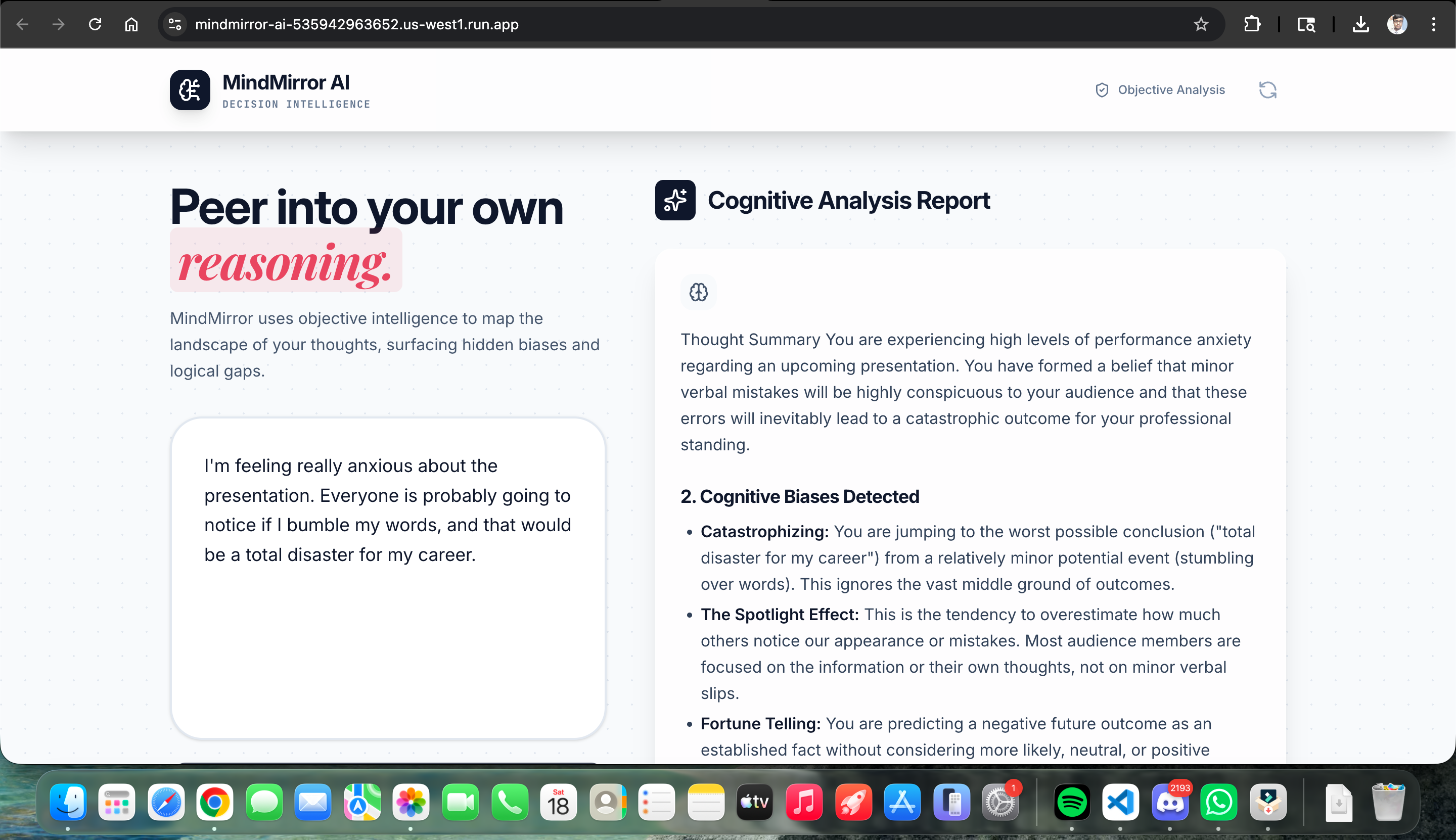
MindMirror AI is a decision intelligence engine that transforms subjective internal dialogue into objective structured data. When a user records a thought or a decision path, the system applies the "Mirror Protocol"—a sophisticated analysis layer that surfaces hidden cognitive biases (like the Sunk Cost Fallacy or Anchoring), detects emotional coloring that might be distorting reality, and identifies logical gaps in reasoning. It doesn't tell you what to think; it shows you how you are thinking so you can decide better.
How we built it
MindMirror is architected on a modern stack for high-speed, high-density analysis. We utilized React 19 and Vite for a performant frontend, styled with a custom "Technical Dashboard" aesthetic using Tailwind CSS to evoke the feel of a precision scientific instrument. The brain of the system is the Gemini 3 Flash model, driven by a hyper-structured System Instruction set that enforces objective, non-judgmental analysis. We engineered a custom parsing engine to handle the entropy of unstructured AI outputs, ensuring every "Cognitive Mirror" report is perfectly categorized into actionable logical maps.
Challenges we ran into
The primary challenge was "The Judgement Gap." It is very easy for an AI to sound critical or condescending when pointing out mistakes. We spent significant time refining the "Mirror Protocol" to ensure the tone remained clinical, objective, and supportive—shifting the focus from being wrong to thinking better. Technically, we also wrestled with Parsing Entropy—ensuring the AI’s complex markdown reports could be reliably broken down into our glass-morphism UI components without losing the richness of the analysis.
Accomplishments that we're proud of
We are incredibly proud of the UI/UX rhythm. By combining high-density JetBrains Mono typography with a "Neo-Grid" background and fluid Motion animations, we’ve created an interface that feels like a professional "Intelligence Chamber" rather than just another chatbot. Furthermore, seeing the "Aha!" moment when the system catches a subtle bias—like a user's Anchoring Bias in a financial example—was a major technical and conceptual victory for our team.
What we learned
We learned that the most powerful use of generative AI isn't just generating content, but providing metacognitive reflection. Building MindMirror taught us that a simple shift in perspective—viewing one's own thoughts as "data" to be analyzed—can immediately reduce anxiety and improve clarity. We discovered that when people feel they are collaborating with an objective intelligence, they are much more willing to acknowledge and correct their own logical blind spots.
What's next for MindMirror
The current version is a single-point mirror; we want to build a "Collective Reasoning Chamber." The next phase includes: The Growth Log: A historical analysis tool that tracks your recurring biases over time to visualize your cognitive growth. Collaborative Mirroring: Allowing teams to input meeting transcripts to detect groupthink and collective bias in real-time. Biometric Integration: Correlating physiological stress markers with decision-making patterns to map the "Physicality of Logic."
Built With
- gemini
- googleaistudio


Log in or sign up for Devpost to join the conversation.