-
-
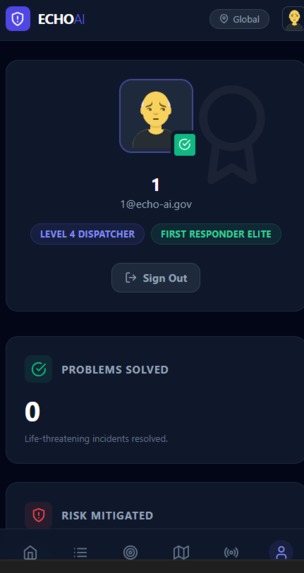
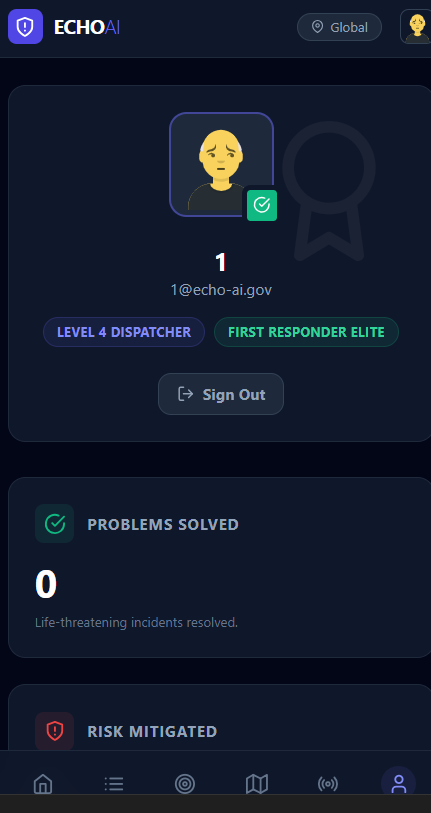
profile page
-
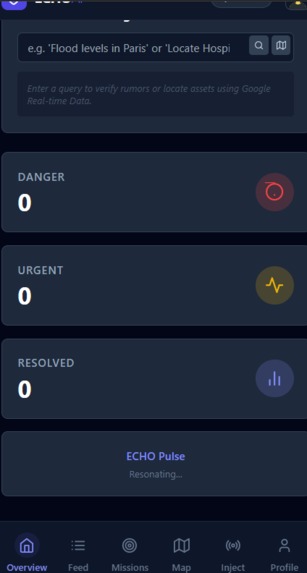
home page bottom
-
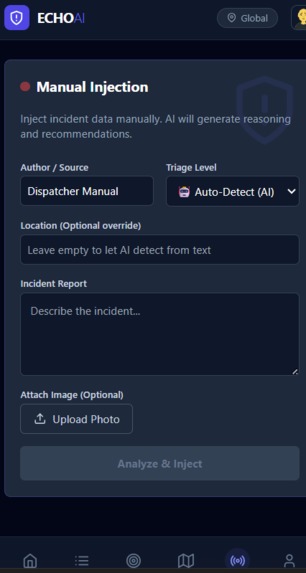
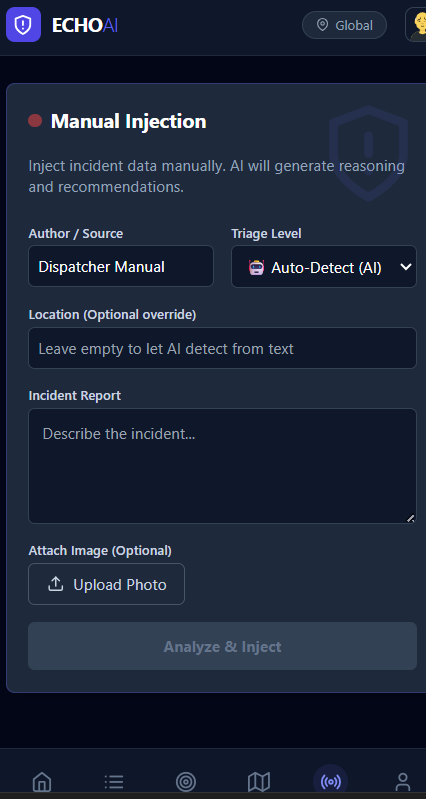
manual injection page
-
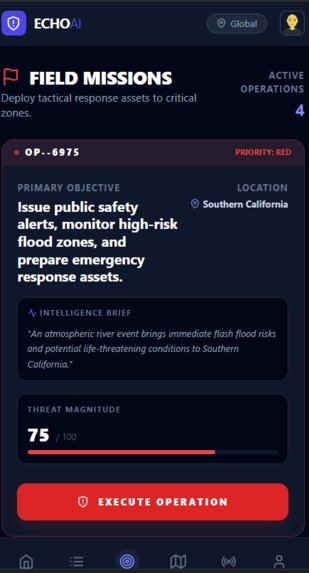
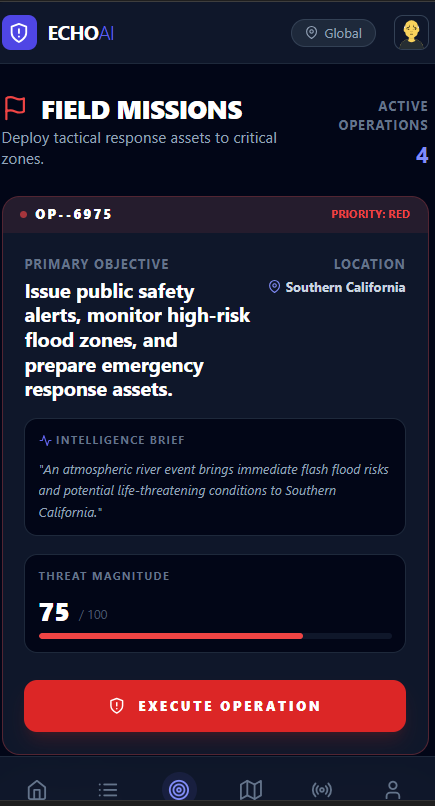
field missions page
-
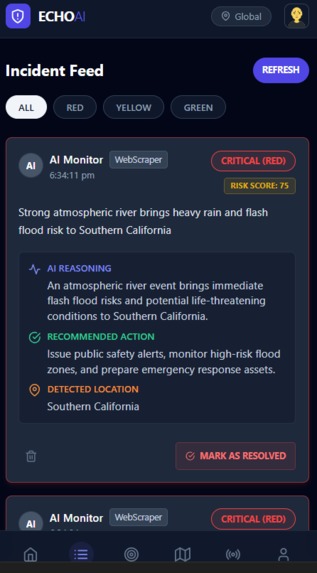
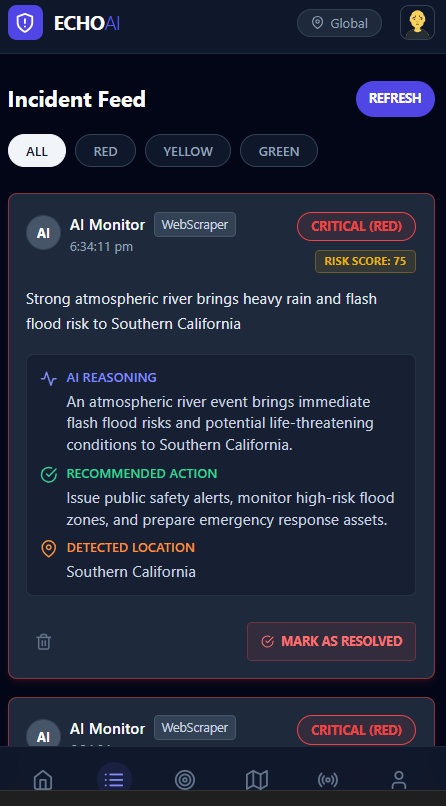
feed page
-
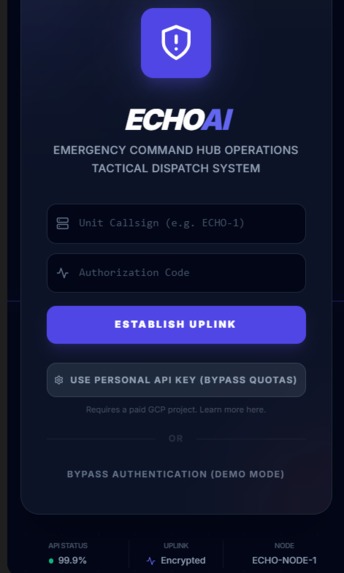
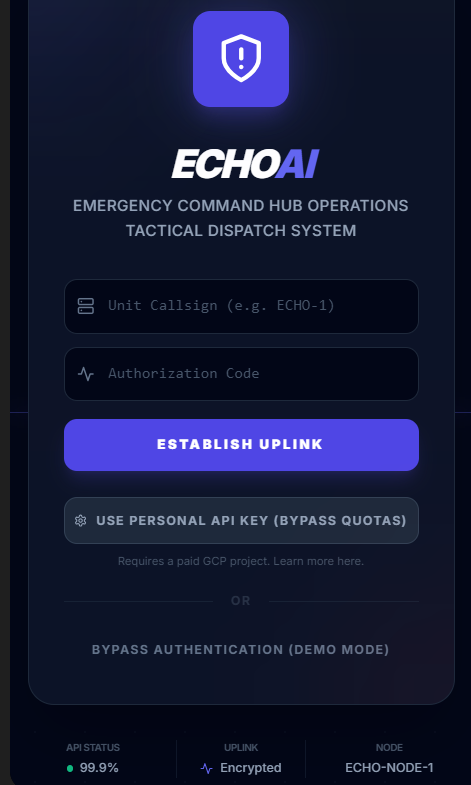
login page
-
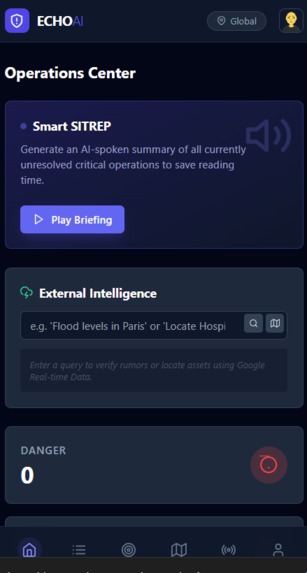
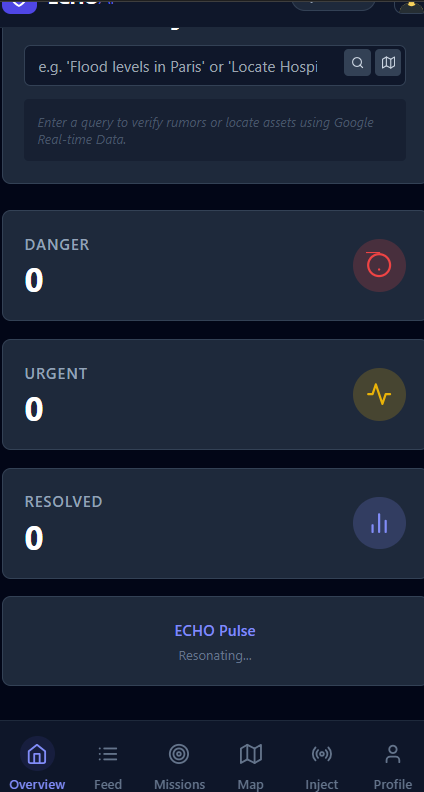
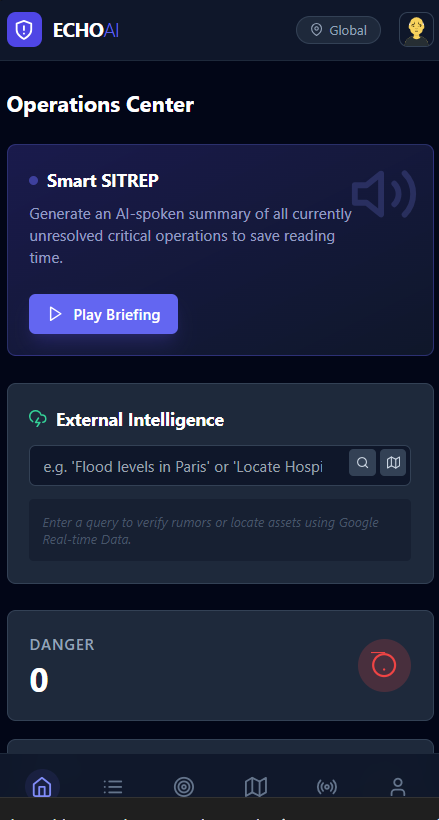
home page up
Inspiration
Project Story — ECHO AI
About the Project
ECHO AI is an AI-powered global emergency and rescue platform designed to help responders prioritize help during disasters. The core idea is simple but critical: not every SOS is equally urgent, and during crises, this distinction can mean the difference between life and death.
What Inspired Us
During major disasters, we noticed a recurring pattern:
social media becomes flooded with thousands of posts asking for help. Some people are trapped under debris or facing medical emergencies, while others urgently need food, water, or shelter. Unfortunately, emergency responders often lack the tools to quickly distinguish between these levels of urgency.
This chaos inspired us to ask a key question:
What if AI could listen to all these voices at once and help responders decide who needs help first?
That question became the foundation of ECHO AI.
What the Project Does
ECHO AI continuously analyzes disaster-related social media posts and classifies them based on urgency:
- Critical rescue
- Medical assistance
- Basic needs (food, water, shelter)
To reduce misinformation and noise, the system:
- Clusters duplicate or similar posts into single incidents
- Uses trust scoring and fact verification to flag misleading content
- Cross-checks posts with real-world disaster data such as earthquakes, fires, and weather alerts
The goal is to transform unstructured social media chaos into clear, actionable intelligence for emergency teams.
How We Built It
Our approach followed a clear pipeline:
Data Ingestion
We collect disaster-related posts from social platforms in real time.AI & NLP Analysis
Natural language processing is used to extract intent, distress signals, and urgency indicators from text.Clustering & Prioritization
Similar posts are grouped using location, time, and semantic similarity, reducing duplicates and highlighting hotspots.Verification & Trust Scoring
Posts are evaluated using multiple signals (confirmation from other posts, disaster data, fact-checking results) to estimate reliability.Responder Dashboard
The final output is a clean, focused interface that helps responders see what is happening, where, and how urgent it is.
Mathematically, urgency can be modeled as a weighted score: n Urgency=∑wi⋅si i=1
Challenges We Faced
Noise & Misinformation:
Social media data is messy, emotional, and sometimes misleading. Designing logic to filter noise without ignoring genuine cries for help was challenging.Trust & Explainability:
We learned that responders must trust AI decisions. This pushed us to focus on explainable outputs rather than black-box predictions.Design Under Stress:
The UI had to remain readable, calm, and intuitive even in high-pressure scenarios, which influenced our color choices and layout decisions.Balancing Realism & Scope:
As a hackathon project, we had to carefully balance ambition with what could be realistically demonstrated.
What We Learned
- AI is most powerful when it supports human decision-making, not replaces it
- Explainability matters as much as accuracy in critical systems
- Good design can reduce cognitive load during emergencies
- Real-world problems demand interdisciplinary thinking — not just code
Final Thoughts
ECHO AI is not just a technical project; it is an attempt to rethink how we respond to disasters in a world where information is abundant but clarity is rare. By prioritizing urgency and trust, we aim to help responders save the right lives at the right time.
Built With
- bluesky
- fastcheckapi
- gdeltapi
- googlegeocoding
- googlegeolocation
- mastadonapi
- nasaeonetapi
- satelliteandweatherapi
- seismicsensor
- usgsapi
- webaudioapi
- webscaper

Log in or sign up for Devpost to join the conversation.